



Niacinamide for Pores: Can It Really Minimise Enlarged Pores?
Niacinamide cannot shrink pores, but it can visibly minimise their appearance by helping regulate oil.
Author
askINKEY skincare advisor
Published
20 August, 2026
Time to read
13 minutes
Niacinamide does not shrink pores, but it can visibly refine them by helping regulate oil so pores appear less stretched.
This article covers what a pore actually is, what makes some pores look larger than others, what niacinamide can realistically do about their appearance, and exactly how to use it. We will be straight with you from the start: pore size is largely set by genetics, oil production, skin elasticity and sun exposure. No ingredient physically shrinks or closes a pore, and any product promising otherwise is selling you something skin cannot do.
What niacinamide can do is meaningful. It is a form of vitamin B3 with solid clinical evidence behind its ability to moderate how much oil your skin produces, and less oil moving through a pore means that pore looks smaller and smoother. That is the honest, achievable goal.
Below you will find the research on niacinamide for pores, the percentages worth using, realistic timelines, where our 10% Niacinamide Serum (£12.00) fits into a routine, and the habits that quietly make pore appearance worse. If oily skin is part of your picture, this is written for you.
What Are Pores and Why Do Some Look Bigger Than Others?
A pore is simply the visible opening of a hair follicle at the surface of your skin. Each one is connected to a sebaceous gland, the small gland that produces sebum, which is your skin’s natural oil. That pore is the channel oil travels through on its way to the surface. It is not a flaw, a blemish or a sign that something has gone wrong. It is functional plumbing, and without it your skin would have no way to keep itself lubricated and protected.
Here is the part most people are never told: the number of pores you have is fixed. You cannot gain new pores and you cannot lose the ones you have. What changes over time is not how many pores you have but how noticeable each one is. That distinction sounds small. It is actually the whole ballgame, because it moves the goal from something impossible to something you can genuinely influence.
Three reasons a pore looks larger
- Oil volume. A steady, high flow of sebum through the duct keeps that duct distended, meaning held open and stretched. More oil moving through, more visible opening.
- Loss of firmness. The collagen and elastin surrounding each pore act like scaffolding. When that support softens, the pore loses its crisp edge and can appear wider or take on a slight teardrop shape.
- Debris at the opening. When dead skin cells and oil gather at the mouth of the pore, the contents oxidise and darken, which outlines the pore and makes it read as bigger than it is.
That third point deserves a clarification, because visibility and congestion are not the same problem. A pore can be perfectly clear and still look large if a lot of oil passes through it. Equally, a pore can be congested without being especially wide. If your main concern is blockage rather than size, our guide to what causes clogged pores covers that process properly and this article will not repeat it.
Pore visibility is also not evenly distributed across your face. Pores are most noticeable on the nose, the inner cheeks either side of the nose, and across the forehead, which together make up what people commonly call the T-zone. On the cheeks near the jaw or around the outer face, the same pores are often almost invisible.
Why pores look bigger on your nose
Your nose has a considerably higher density of sebaceous glands than the rest of your face. More glands packed into a smaller area means more oil moving through more ducts, and the result is that large pores on the nose are the single most common pore complaint we hear. This is normal anatomy, not a sign you have done something wrong.
There is a second thing happening on the nose that causes a lot of unnecessary panic. Many of the small grey or tan dots you can see there are not blackheads at all. They are sebaceous filaments, which are naturally occurring, thread-like structures that line the pore and help channel oil to the surface. Everybody has them and they always come back, because they are meant to be there. Our breakdown of sebaceous filaments versus blackheads explains how to tell the difference, and it is worth reading before you attack your nose with anything. If you genuinely are dealing with blackheads, we have a separate guide on how to get rid of blackheads on your nose.
Dermatology resources are consistent on the underlying determinants here. DermNet’s overview of enlarged pores lists genetics, sebum production, loss of skin elasticity and sun damage as the main factors behind pore size. Notice what is absent from that list: cleansing frequency, water temperature, and whether you exfoliated last Tuesday.
Now that you know what makes a pore look bigger, it is worth separating the causes you were born with from the ones you can actually do something about.
What Causes Large Pores?
Pore size is not random and it is not a punishment for poor skincare habits. It is the product of a handful of specific, well-documented factors, and being clear-eyed about which ones are fixed makes it much easier to spend your money and effort in the right place.
Genetics is the single biggest factor. Pore size runs in families in the same way skin tone and hair texture do. If your parents have visible pores, there is a strong chance you will too, and there is no product on any shelf anywhere that changes your inherited baseline. We would rather tell you that plainly than let you spend three years chasing it.
Sebum output is the most important factor you can actually influence, and the evidence for its importance is striking. A study by Roh and colleagues published in the British Journal of Dermatology in 2006 measured 60 volunteers and ran a statistical analysis to work out which variables best predicted facial pore size. Sebum output came out strongest, ahead of male sex, which came second, and age, which came third. The relationship held in both men and women.
Sebum output was the strongest single predictor of facial pore size in the Roh et al. 2006 analysis, ahead of both sex and age.
That finding is the intellectual backbone of everything that follows in this article. If oil flow is the leading modifiable driver of how large a pore looks, then an ingredient that credibly moderates oil flow is the logical place to start. That same research also found something useful about timing: in the women studied, pore size was significantly larger during the ovulation phase of the menstrual cycle. If your pores seem to fluctuate across the month, you are not imagining it.
Age and loss of elasticity form the third driver. Collagen and elastin are the structural proteins that keep skin firm and hold the tissue around each pore taut. As their production slows with age, that scaffolding softens and pores lose their defined edge. This is why pore appearance can change in your thirties and forties even if your oil production has actually decreased.
Sun exposure accelerates exactly that process. Ultraviolet light degrades collagen over time, which is why sun protection belongs in a pore conversation rather than being filed away as a separate concern.
Hormonal fluctuation ties back to oil. Hormones are a primary regulator of sebaceous gland activity, which is why pore appearance shifts across the menstrual cycle, through puberty, during pregnancy and across other life stages.
The factors you can actually influence
- Cannot change: your genetics, your age, your sex, and the natural density of sebaceous glands across different areas of your face.
- Can influence: how much oil sits in and travels through the pore, how clear the pore opening stays, how well your skin barrier is functioning, and how much further UV damage your collagen sustains from today onward.
That second list is short, and that is good news rather than bad. A short list means a focused routine, not a bathroom cabinet full of hopeful purchases. Managing oil sensibly is well established as the practical lever here, and a clinical review of oily skin management options reinforces that regulating sebum, rather than eliminating it, is the realistic aim.
If you recognised yourself in the sebum discussion, our article on why your skin is so oily goes deeper into causes, and our oily skin hub collects the full picture. If you are not certain where your skin sits, the skin type guide is a sensible five minutes before you buy anything at all.
With the causes clear, let us deal with the question that brought most people here.
Can You Shrink Pores? The Honest Answer
No. You cannot physically shrink, close or remove a pore. Pores have no muscle around them, so they do not open and close, and nothing you apply topically will permanently reduce their size.
We know that is not the answer the internet usually gives. It is the accurate one, and the rest of this article is more useful to you because we said it first.
Pores are structural openings in the skin. There is no mechanism, no drawstring, no valve. This is why so much conventional pore advice quietly does nothing.
Myth versus reality
- Myth: Cold water closes your pores. Reality: Temperature does not change pore size. Cold can cause a brief tightening sensation in the surrounding skin, which is not the same as a pore changing dimension.
- Myth: Steaming opens your pores. Reality: Warmth softens the oil and debris sitting inside a pore, which can make that material easier to shift. Useful, but a different mechanism entirely from an opening.
- Myth: Scrubbing harder makes pores smaller. Reality: Aggressive physical scrubbing irritates skin and can compromise your barrier, and compromised skin frequently responds by producing more oil.
- Myth: Stripping every trace of oil is the goal. Reality: Skin that has been stripped often overcompensates, leaving you oilier a few hours later than when you started.
That last point deserves emphasis because it is where most people go wrong. The harsh route feels productive. Squeaky-clean skin feels like progress. But your barrier, the outermost layer that holds moisture in and irritants out, does not respond well to being repeatedly stripped, and a struggling barrier tends to produce more oil rather than less. You end up further from the goal while working harder for it.
Pore strips fall into a similar category. They can remove some surface material and provide a satisfying visual, but they do not affect pore size and can be rough on the skin around them. We looked at this properly in are pore strips bad for your skin rather than repeating the argument here.
So what is achievable? Reducing the appearance of pores. Less oil sitting in and moving through a duct means less distension, and a less distended pore genuinely reads as smaller to the eye. Keeping the opening clear means the edge is less defined and less shadowed. Protecting the collagen around the pore means the surrounding skin holds its structure for longer. None of that changes anatomy. All of it changes how your skin looks in the mirror.
The goal is not smaller pores. The goal is smoother-looking skin that you actually recognise as yours.
Why “pore minimising” is the honest phrase
When you see a product described as pore minimising, that phrasing is deliberate and it matters. It means minimising the appearance of pores. A well-formulated pore minimising serum is not claiming to alter your anatomy, and any brand telling you otherwise is either careless with language or hoping you will not read closely.
We would rather name that openly. Understanding what a product can and cannot do is the difference between being satisfied with a genuinely good result and being disappointed by an imaginary one. This is why we point people to what niacinamide actually is before recommending our 10% Niacinamide Serum: informed expectations are the foundation of a routine you will actually stick with.
Having established what is realistic, here is the ingredient that delivers on it, and the evidence behind it.
How Niacinamide Helps Minimise the Appearance of Pores
Niacinamide is a form of vitamin B3 that works on several skin functions simultaneously, which is a large part of why it appears in so many routines. For pore appearance specifically, one of its actions matters more than the rest: it helps regulate how much oil the skin produces. Our niacinamide pillar page covers the full ingredient profile, so we will stay focused on the pore mechanism.
The logic runs in three steps, and it is worth walking through slowly because this is where the whole argument lives.
- Oil output is moderated. Niacinamide helps regulate sebaceous gland activity, so less oil is produced and pushed through the duct.
- The duct becomes less distended. With a lower volume of oil travelling through it, the pore opening is not being held stretched to the same degree.
- The pore appears smaller. A less distended duct with a clearer opening catches less shadow and reads as a smaller, smoother pore.
In one sentence: niacinamide does not resize your pores, it reduces what is filling and stretching them, and that visibly changes how they look.
Does niacinamide help with pores? What the research shows
Yes. Clinical research supports niacinamide’s ability to lower sebum production and to reduce measurable pore count over a period of weeks, though the improvements are moderate rather than dramatic.
Three pieces of evidence are worth knowing about, and we will translate each one into plain English.
- The oil mechanism. Draelos and colleagues, 2006, tested 2% niacinamide on facial sebum production. In a Japanese cohort of 100 participants, the sebum excretion rate, meaning the measured rate at which oil reaches the skin surface, was significantly lowered at both 2 and 4 weeks compared with placebo. A separate, smaller cohort in the same paper showed a significant reduction in casual sebum level, the amount of oil sitting on the skin at a given moment, though not in excretion rate. Results varied between the groups, which is honest science rather than a marketing headline, and the overall finding that niacinamide influences sebum is well supported.
- The pore count outcome. Chiu et al., 2007, ran a split-face trial in which each participant used the active on one side of the face and a control on the other, which is a rigorous way to remove individual variation. The 4% niacinamide side showed a reduction in pore count of roughly 14.7% at week 8, improving to around 15.9% by week 12.
- The independent review. A 2023 review in the Journal of Cosmetic Dermatology by Parvar and colleaguesassessed the range of available options for facial pores and carried that niacinamide figure forward, placing it alongside the other approaches available. Worth being precise here: this is the same underlying trial data, independently evaluated, rather than a second separate result.
Sit with those numbers for a moment, because they set the correct expectation. A reduction of roughly 15% in pore count is a real, measurable, visible improvement. It is not a transformation, and anyone promising you a transformation is not being straight with you. What it looks like in practice is skin that reads as smoother and more even in daylight, with less shine building through the day.
There is a second benefit that compounds over time. Niacinamide also supports the skin barrier, and that matters enormously for pore care. A well-supported barrier is far less likely to overproduce oil in response to being stripped or irritated, which means you are less likely to fall into the cycle of harsh cleansing and rebound oiliness described earlier.
Did you know: most oil-control ingredients work by removing oil after it arrives. Niacinamide works further upstream by helping moderate how much is produced in the first place, while simultaneously supporting the barrier. It works with your skin rather than against it, which is exactly why it suits long-term daily use in a way that harsher approaches do not.
Niacinamide also has a calming effect on the look of redness and contributes to smoother overall texture, both of which quietly improve how refined skin appears. If you want to explore the ingredient more broadly, our niacinamide rangeand our guide on how and when to use niacinamide are the natural next stops.
Now that you know it works, here is exactly which strength to reach for and how to use it.
Which Niacinamide Percentage Is Best for Pores and How to Use It
More is not automatically better. This is the single most common mistake in niacinamide shopping, and it is worth understanding before you spend anything.
Look again at the research above. The sebum evidence came from a 2% formula. The pore count evidence came from a 4% formula. Those are modest concentrations by current market standards, and they were sufficient to produce statistically significant results in controlled conditions. Percentage is not a score, and a higher number on the bottle is not a guarantee of a better outcome.
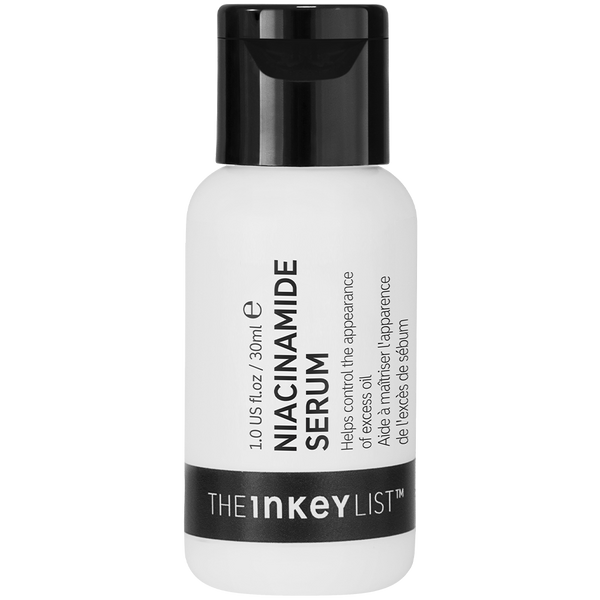
For most people, our 10% Niacinamide Serum (£12.00) is the sensible everyday choice. It sits comfortably above the concentrations used in the clinical work, it is formulated for daily use morning and evening, and it layers easily without pilling or interfering with the rest of a routine. This is where we would tell almost anyone to start.
If your skin runs persistently oily with visible shine by the middle of the day, our 20% Niacinamide Serum (£16.00) is the step up. To be clear about what that means: it is not a better product, it is a stronger one, and it suits skin that produces a lot of oil rather than skin that produces some. If you are unsure which describes you, start at 10% and give it the full eight weeks before deciding you need more.
How to use it
- Cleanse first. Start with clean skin so the serum is not sitting on top of the day’s oil and residue.
- Apply to slightly damp skin. A few drops, pressed gently across the face with particular attention to the T-zone, where oil output and pore visibility are usually highest.
- Let it absorb for a moment. It sinks in quickly. There is no need to wait long.
- Follow with moisturiser. Serum goes before moisturiser, always. This applies whatever else is in your routine.
- Repeat morning and evening. Niacinamide is well tolerated at twice-daily use for most people, and consistency is what produces the result.
How long does niacinamide take to work on pores?
Expect changes in oil and shine from around 2 to 4 weeks, and visible changes in pore appearance from around 8 to 12 weeks.
Those two timelines are different and conflating them causes a lot of unnecessary disappointment. The Draelos work found measurable sebum changes at 2 and 4 weeks, so reduced shine through the day is the earliest signal that something is working. Pore appearance is a structural change in how skin looks, and it takes longer. The pore count evidence landed at weeks 8 and 12, with results continuing to improve between those two points.
Give it a full 8 weeks before you judge the results, and keep going to 12 before you make a final call.
This is where consistency beats intensity, and we mean that practically rather than as a slogan. One serum used twice daily for three months will outperform five different products used sporadically for a fortnight each. Most people who conclude that niacinamide did nothing for them stopped somewhere around week three, which is roughly the point where the oil benefit has appeared but the pore benefit has not yet had time to.
For deeper application guidance, our post on how and when to use niacinamide covers the details, and the skincare routine guide will help you place it correctly among your other steps. Our excess oil range gathers the products that work alongside it.
A serum performs best inside a routine that supports it, so here is what that looks like.
Building a Pore-Friendly Routine Around Niacinamide
Four steps. That is genuinely all this needs to be, and each one earns its place.
Cleanse
You want a cleanser that manages oil without stripping. That balance is the entire point, because over-cleansing compromises the barrier and a compromised barrier tends to produce more oil, which is the opposite of what you came for. Our Salicylic Acid Cleanser works well here, using a beta hydroxy acid that is oil-soluble, meaning it can travel into the oil inside a pore rather than only working on the surface. Twice a day is plenty.
Treat
This is the niacinamide step, and it is the core of the strategy for pore appearance. Apply your serum to clean, slightly damp skin before anything heavier.
Worth knowing: salicylic acid and niacinamide are a genuinely complementary pairing rather than a competing one. Salicylic acid clears the inside of the pore, niacinamide moderates how much oil arrives there in the first place, so they address different points in the same process. We covered this properly in salicylic acid and niacinamide, the best duo for oily, blemish prone skin, and the salicylic acid pillar has the full ingredient detail.
Moisturise
This is the step oily skin skips most often, and skipping it is counterproductive. Dehydrated skin can respond by producing more oil, so leaving moisturiser out to reduce shine frequently achieves the reverse. Our Omega Water Cream (£14.00) is oil-free, water-based and contains 5% niacinamide, which means it compounds the benefit of your serum rather than simply sitting on top of it.
If your skin also feels dry in places or you are starting to notice early lines alongside pore concerns, our Bio-Active Ceramide Moisturiser (£20.00) is the richer option. The full moisturiser collection has the range, and if you want a direct steer, the best moisturiser for oily skin makes the comparison for you. Our explainer on why oily skin gets dehydrated too makes the case for this step better than we can in three sentences.
Protect
Daily sun protection is a legitimate part of pore care, not an unrelated add-on. UV exposure degrades the collagen that holds the tissue around each pore taut, and once that support weakens, pores lose definition and appear larger. Every day you protect your skin is a day you are not adding to that damage. Our Dewy Sunscreen SPF 30 sits comfortably over a niacinamide serum as the final morning step.
Your routine at a glance
AM
- Cleanse
- 10% Niacinamide Serum
- Omega Water Cream
- Dewy Sunscreen SPF 30
PM
- Cleanse
- 10% Niacinamide Serum
- Omega Water Cream
One of niacinamide’s practical advantages is how well it plays with other actives, which means you rarely need to restructure a routine to fit it in. Rather than covering every combination here, we have dedicated answers for using niacinamide with retinol, using niacinamide and vitamin C together and niacinamide and glycolic acid. If you are choosing new products with pores in mind, what non-comedogenic actually means is a genuinely useful read. To assemble everything into one plan, use our routine builder.
With the routine settled, here are the supporting habits worth adopting and the mistakes that quietly undo good work.
What Else Helps, and What to Avoid
A good routine does most of the work. These are the marginal gains and the genuine pitfalls.
What helps
- Gentle chemical exfoliation. Keeping the pore opening clear affects how sharply defined that pore looks. Our Glycolic Acid Toner works across the surface, while our Beta Hydroxy Acid (BHA) Serum is oil-soluble and works inside the pore itself. Once or twice a week is enough for most people.
- Retinol, over the long term. Our Retinol Serum supports skin firmness as it is used consistently over months, and firmer surrounding skin holds pore structure better. This is a slow, cumulative benefit rather than a quick fix, and it works alongside niacinamide rather than replacing it.
- Proper hydration. Dehydrated skin can overproduce oil, so keeping skin well hydrated supports the entire oil-management strategy.
- Consistent daily sun protection. The most underrated long-term pore habit there is, because it protects the collagen scaffolding that keeps pores looking tight-edged.
- Patience measured in months. Every piece of clinical evidence in this article was measured in weeks, not days.
What to avoid
- Aggressive physical scrubbing. Harsh scrubs cause micro-irritation, compromise the barrier and frequently trigger more oil.
- Over-cleansing. More than twice daily is rarely helpful and often actively counterproductive.
- Squeezing and at-home extraction. More on this below, because it matters most.
- Skipping moisturiser. Covered above, and worth repeating because it is the most common self-sabotage in oily skin routines.
- Chasing an overnight result. The products that promise instant pore transformation are generally the harshest ones, and harsh is the direction that makes pores look worse over time.
A genuine caution on squeezing: forcing material out of a pore stretches the pore wall and can cause lasting damage to the surrounding tissue. Unlike most skincare mistakes, this one can permanently change pore appearance in the wrong direction. If something needs extracting, it is worth having it done professionally rather than at your bathroom mirror at midnight.
It is also worth being clear about makeup and primers. Pore-blurring primers work, in the sense that they physically fill and diffuse light across the pore opening so it is less visible. That is a real and perfectly legitimate cosmetic effect. It is not a skincare result, it does not accumulate, and it washes off at night. Use them if you enjoy them, but do not expect them to change anything underneath.
Finally, some context. Pore appearance is one component of overall skin texture, and it rarely travels alone. If you are also dealing with roughness or unevenness, how to improve skin texture broadens the picture, and our improve texture range is built for exactly that. If blackheads are part of your concern, see how to prevent blackheads long termalongside our blackheads hub and blackheads range. Bumpy texture on the legs or arms is a related but distinct concern we cover in strawberry skin, and if shine spikes in warm weather, keeping oily skin under control in summer is the seasonal version of this advice.
If blemishes overlap with your pore concerns, our blemishes and breakouts collection is the right starting point, and our 360 Skin Clearing Serum is built for skin dealing with both at once. For anyone juggling several concerns, the complete skincare concerns guide maps them all. Persistent concerns that are not responding to a consistent routine are always worth raising with a dermatologist or qualified skincare professional.
Here are the remaining questions people ask most often.
The Honest Takeaway on Niacinamide for Pores
You cannot shrink a pore. You can absolutely change how visible one looks, and that distinction is the difference between chasing something impossible and pursuing something achievable.
The mechanism is simple enough to hold in your head: niacinamide helps manage oil, less oil means a less distended duct, and a less distended duct reads as a smaller, smoother pore. The clinical evidence supports a meaningful improvement of roughly 15% in measured pore count over 8 to 12 weeks, which is real, visible and worth having, but is not a transformation. Consistency will always beat intensity here.
And it is worth remembering that pores are supposed to be there. They are functional, they are universal, and every single person reading this has exactly as many as they will ever have. This is about refining how skin looks, not about eliminating something that was never a flaw.
The takeaway
- Pore size is largely genetic, but oil output is the biggest factor you can influence.
- Niacinamide visibly refines pores by moderating oil, with results measured at 8 to 12 weeks.
- Consistency with one well-chosen serum beats rotating through five.
If you are ready to start, our 10% Niacinamide Serum (£12.00) is the straightforward place to begin, and the wider niacinamide range has the rest of the family. Not sure where you fit? Take two minutes with our skin type guide, or use the routine builder to put a full routine together around it.
Your needs, our knowledge. Start with the science, then give it eight weeks.
Frequently Asked Questions
Got a question?
Our askINKEY team are a friendly bunch of skincare experts with deep product knowledge and zero judgement. Whether you're an ingredient obsessive or just starting out, we'll make it make sense. No question too big. No question too small. We Give A Care, Every Day.


