



Glycolic Acid for Hyperpigmentation: What It Actually Does to Dark Spots
Glycolic acid works on pigment two ways at once, and only one of them is exfoliation. Here is what 10% can realistically do for dark spots.
Author
askINKEY skincare advisor
Published
05 August, 2026
Time to read
13 minutes
Glycolic acid for hyperpigmentation is one of the most consistently recommended pairings in skincare, and also one of the most poorly explained. This article covers exactly how glycolic acid acts on pigment, what a 10% formula at home realistically achieves compared with a professional peel, how long fading actually takes, how it stacks up against the other pigmentation actives, and who should approach it slowly or skip it altogether.
Here is the short answer before anything else. Yes, glycolic acid helps with hyperpigmentation, and it does so through two separate mechanisms working at the same time. Most articles mention only one of them, which is why so much glycolic advice feels vague. It exfoliates, certainly. It also directly interferes with the enzyme that produces melanin in the first place. Those are two different jobs, and understanding both is what turns glycolic acid from a hopeful purchase into a deliberate part of a pigmentation routine.
We will be straight with you throughout. Glycolic acid is a strong supporting active for pigment. It is not a standalone eraser, and results arrive gradually rather than dramatically. That is not a caveat buried at the bottom of the page, it is the frame for everything below.
If you already know you want to start, our Glycolic Acid Toner is the product this article is built around, and you can browse other formats in our glycolic acid collection or shop the concern directly through our hyperpigmentation collection. If you need the definitional groundwork this article deliberately skips, start with What is Hyperpigmentation? and come back.
The short version: glycolic acid works on pigment two ways at once, and only one of them is exfoliation.
Since we have promised a two-part mechanism, let us explain it properly.
How Glycolic Acid Works on Pigment: The Dual Mechanism
Glycolic acid is the smallest molecule in the alpha hydroxy acid family. It is derived from sugar cane, and its size is the entire reason it behaves the way it does. Smaller molecules move through the upper layers of skin more efficiently than larger ones, which is why glycolic acts faster and more noticeably than gentler acids at comparable strengths. If you want the full ingredient primer, What is Glycolic Acid? covers the fundamentals, and 5 Benefits of Glycolic Acidcovers what it does beyond pigment. This section is about pigment only.
To understand how glycolic acid affects dark spots, you need a rough picture of how pigment gets made. Something triggers your skin: UV exposure, inflammation from a healing blemish, friction, hormonal shifts. That trigger sends a signal to specialised cells called melanocytes, which sit at the base of the epidermis. Melanocytes respond by producing melanin, the pigment that gives skin its colour. The melanin is then packaged up and passed to surrounding skin cells, where it travels upwards as those cells move toward the surface. When that process runs in a concentrated patch, you get a dark spot. Pigment has many different triggers and What is Hyperpigmentation? breaks those down properly.
The rate-limiting step in melanin production is an enzyme called tyrosinase. Rate-limiting means exactly what it sounds like: tyrosinase sets the pace. However enthusiastically a melanocyte has been told to make pigment, it can only work as fast as tyrosinase allows. Slow the enzyme, slow the pigment.
1. Glycolic acid directly inhibits tyrosinase
This is the mechanism almost nobody talks about, and it is the more interesting of the two.
Research on glycolic acid and tyrosinase activity found that glycolic acid reduced melanin production in a dose-dependent way, and did so without affecting cell growth. That last detail matters: the pigment reduction was not the result of damaging or killing cells, it was a specific effect on the pigment pathway itself.
The researchers then went looking for how. They measured the mRNA levels for tyrosinase and its related proteins, which tells you whether the cell is being instructed to build the enzyme. Unchanged. They measured the protein levels themselves, which tells you whether the enzyme is actually present. Also unchanged. What did change was the enzyme’s catalytic activity, meaning its ability to do its job. They confirmed this by isolating purified human tyrosinase and exposing it to glycolic acid directly, outside of any cell, where it was still inhibited.
In plain English: glycolic acid does not stop your skin from making the enzyme. It stops the enzyme from working properly. The factory is still staffed and the machinery is still installed, the machinery is just jammed.
There is one more detail worth knowing, because it pre-empts the obvious objection. Glycolic acid is an acid, so you might reasonably assume the enzyme is simply being disabled by a drop in pH. The researchers tested precisely that, adjusting the pH to match what the acids produced but without the acids present. Tyrosinase was not inhibited by acidity alone. The effect belongs to the molecule, not merely to its sourness.
2. Glycolic acid accelerates the shedding of pigmented cells
The second mechanism is the familiar one, and it is still important.
Your surface skin cells, called corneocytes, are held together by what is effectively a biological glue. Glycolic acid reduces corneocyte cohesion, loosening those bonds so that the uppermost cells release and shed sooner than they otherwise would. Skin cells that are already loaded with excess melanin do not sit at the surface for as long. Instead of lingering and keeping a spot visible, they move on.
This is why glycolic tends to deliver a general brightening effect well before individual spots fade. You are clearing pigmented cells that were already on their way out, just slowly.
Glycolic acid slows the pigment being made and clears the pigment already there. Most actives only do one.
That combination is genuinely unusual. Plenty of ingredients inhibit melanin formation. Plenty of ingredients accelerate turnover. Glycolic acid does both at once, from a single step in your routine, which is a large part of why it has such staying power in pigmentation advice.
The honest limitation
Here is what glycolic acid does not do. It does not interrupt the original signal, the communication between keratinocytes and melanocytes that instructs pigment production to begin. It acts on the enzyme and it acts at the surface. It does not act on the instruction.
That distinction has real consequences. If your pigment keeps returning because the underlying trigger is still firing, glycolic acid will keep clearing the evidence while the cause carries on unchallenged. Interrupting that signal is a different active’s job, and we will name it directly in the comparison section further down. For now, hold onto the idea that glycolic is a complement, never a replacement.
Does glycolic acid lighten skin?
This question comes up constantly and it deserves a precise answer, because the wording causes real confusion.
Glycolic acid does not bleach your skin and it does not alter your natural skin tone. It has no mechanism for making you lighter than you are. What it does is reduce areas of excess pigment, so that the darker patches move closer to your baseline tone and the overall effect reads as more even, clearer and brighter.
The goal is evenness, not lightness. Those are different outcomes and only one of them is achievable, or desirable.
Now that you know how it works, the next question is which of your own marks it will actually work on.
Which Dark Spots and Pigmentation Glycolic Acid Helps
Glycolic acid is not equally effective on everything, and the reason is refreshingly simple.
The governing principle is depth. Glycolic acid works on pigment sitting closer to the surface. Where that pigment sits predicts how well it responds far better than the label attached to it does. Two people can both have “dark spots” and get completely different results, because one has pigment sitting in the epidermis and the other has pigment sitting deeper in the dermis. If you are not sure what you are looking at, Types of Hyperpigmentation: Melasma, PIH, Sunspots and Freckles will help you work it out.
Sun-induced pigmentation and sunspots
This is glycolic acid’s strongest territory, and it is worth spending time on because it is where the dual mechanism genuinely earns its keep.
Sunspots, sometimes called age spots or solar lentigines, are the cumulative record of UV exposure. Every time skin is exposed to ultraviolet light, melanocytes respond by producing melanin as a protective measure. Over years, that response becomes localised and persistent. Clusters of melanocytes in particular areas become more active than their neighbours and stay that way, depositing excess pigment into the surrounding cells continuously rather than in response to a single event.
Crucially, this type of pigment tends to concentrate in the upper layers of the skin. That places it squarely within glycolic acid’s reach.
Both mechanisms contribute here. The tyrosinase inhibition dampens the ongoing overproduction from those overactive melanocytes, so less new pigment enters the queue. The accelerated turnover clears the pigmented cells already sitting near the surface. You are reducing supply and increasing clearance at the same time, which is exactly the combination this kind of pigment responds to.
Expect the change to be progressive rather than sudden. Sunspots typically soften at the edges first, losing their hard definition, then gradually reduce in intensity. A spot that has taken fifteen years to establish itself will not surrender in three weeks, but it will respond to sustained, consistent work. The causes behind different marks are covered properly in How to Get Rid of Dark Spots if you want to understand the origins of yours.
The obvious caveat, which we will return to repeatedly: treating sun-induced pigment without daily sun protection is close to pointless. You are removing pigment on one hand while commissioning more of it on the other.
General uneven tone and dullness
This is the result people notice first, and it is often the one they were actually hoping for.
Uneven tone is not always a matter of discrete spots. Often it is a diffuse lack of clarity, a slight greyness, patches that do not quite match, skin that looks tired regardless of how much sleep you got. A significant contributor is the surface itself. When the outermost layer is dense with cells that should have shed already, light scatters unevenly across it rather than reflecting cleanly. The visual result is dullness.
Glycolic acid’s turnover effect addresses this directly and relatively quickly. A smoother, more uniform surface reflects light more evenly, which the eye reads as brightness and radiance. This is why people frequently report their skin “looking better” within a few weeks even though no individual dark spot has meaningfully changed. Both observations are accurate. The surface has improved before the pigment has.
Understanding this prevents a common disappointment. Early brightness is real and it is worth having, but it is not the same as pigment correction, and mistaking one for the other leads people to expect the spot fading on the same schedule. For the wider causes of unevenness, Uneven Skin Tone: What Causes It and How to Even It Out covers the ground thoroughly.
Post-blemish marks
Glycolic acid does help fade the flat brown or reddish marks left behind after a breakout has healed, working through the same two mechanisms: less new pigment produced in the affected area, and faster clearance of what is already there. Timing and technique matter a great deal with these marks, and this is territory another article owns properly, so read Post-Inflammatory Hyperpigmentation (PIH): How to Treat It for the full picture.
Melasma
Melasma requires caution rather than enthusiasm.
It is hormonally driven, frequently symmetrical across the cheeks, forehead or upper lip, and it often sits deeper than other forms of pigmentation. The glycolic acid peel therapy review documents the split clearly: epidermal melasma responds reasonably well to glycolic peels, mixed melasma responds partially, and dermal melasma showed no significant improvement. Glycolic also carries a rebound risk with melasma, meaning pigment can return, sometimes more assertively, after treatment stops.
If melasma is your concern, read What is Melasma and How to Treat It before you introduce any acid, and consider speaking to a professional first.
What glycolic acid will not fix
Two things sit outside its remit entirely.
Pigment sitting deep in the dermis is beyond the reach of any topical exfoliant. Glycolic acid works on the upper layers. Melanin that has settled below them is not going to be shed, because the cells carrying it are not shedding.
Textural scarring is a different problem altogether. Indented or raised scars are a collagen and tissue architecture issue, not a pigment issue. No amount of exfoliation will rebuild or flatten them, because there is no excess melanin to clear. If discolouration is mixed with texture, our blemish scars collection is a more appropriate starting point.
The closer the pigment sits to the surface, the more glycolic acid can do.
Knowing it can help raises the obvious next question: is the 10% on your bathroom shelf actually strong enough to matter?
Glycolic Acid Percentages: 10% at Home vs a Professional Peel
Here is a gap that almost no skincare content mentions, and it is worth being blunt about.
Over-the-counter glycolic formulas generally sit between 5% and 10%. Professional in-clinic peels typically run from 30% up to 70%, with formulations available from around 20%. The glycolic acid peel therapy review sets out the depth classification: roughly 30% to 50% for very superficial peels applied for one to two minutes, 50% to 70% for superficial peels applied for two to five minutes, and 70% for medium-depth work.
That is a substantial distance between what you can buy and what a clinic administers, and pretending otherwise does nobody any favours. If you want to understand what an in-clinic treatment actually involves, the American Academy of Dermatology’s chemical peel FAQs is a reliable, non-commercial explainer.
Where our formula sits, and why pH matters
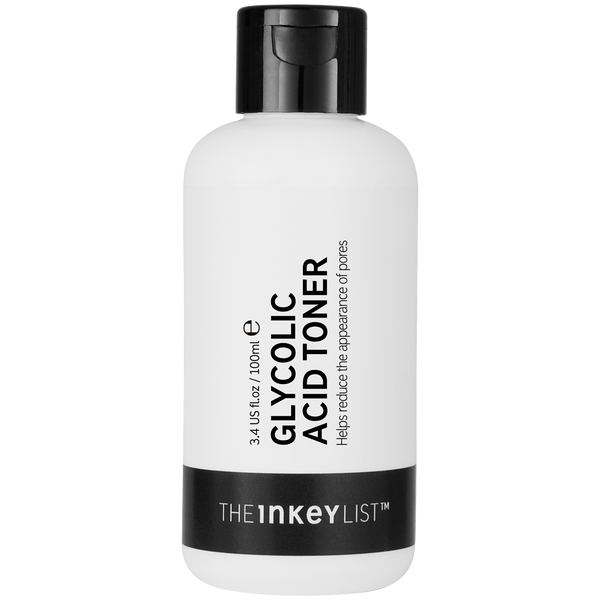
Our Glycolic Acid Toner (£14) is 10% glycolic acid at a pH of 3.6 to 4.0, with 5% witch hazel. That places it at the upper end of the standard over-the-counter band.
Percentage alone is a poor measure of a glycolic product, which is why we quote the pH alongside it. Glycolic acid needs an acidic environment to remain in its active, free form. Formulated too high on the pH scale, more of the acid is neutralised and less is available to do anything useful, so a high percentage can underdeliver. Formulated too low, the product becomes needlessly aggressive, and aggression is specifically what you want to avoid when treating pigment.
The window between roughly 3.5 and 4.0 is where efficacy and tolerability meet. A 12% formula at a badly chosen pH can easily be both less effective and more irritating than a well-formulated 10%. Percentage on the front of the bottle is the headline. pH is the fine print that determines whether the headline means anything.
What each option realistically delivers
At home, 10%:
- Consistent, cumulative surface exfoliation that keeps pigmented cells moving rather than lingering
- Ongoing tyrosinase inhibition every time you apply it, which is the part that reduces new pigment
- A gradual, sustainable improvement in tone and clarity that you can maintain indefinitely without downtime
In clinic, 30% to 70%:
- Deeper, faster and more visible change, particularly across a series of treatments
- Professional assessment of your skin type and pigment depth before anything is applied
- Meaningful downtime, considerable expense, and a materially higher risk of irritation and post-treatment pigment
The clinical evidence is real and we are not going to downplay it. A clinical study on glycolic peels and pigment reduction found that 50% peels administered every two weeks across six weeks produced greater than 75% reduction in post-inflammatory pigmentation in around 45% of participants. That is a strong result.
It is also a supervised clinical protocol at five times the concentration of a home product, delivered by a professional who controls contact time to the minute and neutralises the acid deliberately. A toner does not replicate it, and any brand implying otherwise is selling you something. Different tools, different jobs.
More is not better, and this is the part that matters most
There is a persistent assumption that if 10% produces gradual results, 20% would produce faster ones. For pigmentation specifically, this reasoning fails.
Higher concentrations bring diminishing returns. The melasma treatment update notes reduced additional benefit above 50%, meaning the curve flattens even within professional ranges. Efficacy does not scale indefinitely with strength.
Irritation risk, however, keeps climbing. And with pigmentation, irritation is not merely an unpleasant side effect. Inflammation is one of the primary triggers for melanin production. Irritate your skin in pursuit of fading a dark spot and you can prompt the exact response you are trying to reverse. The mechanism you are fighting is the mechanism you risk activating.
So, to answer the question directly: the best glycolic acid percentage for hyperpigmentation at home is 5% to 10%, used consistently. Not because stronger products do not exist, but because pigment correction requires two to three months of sustained use, and the only routine that lasts two to three months is one your skin tolerates comfortably. A 20% formula that forces you to stop after a fortnight has achieved nothing except lost time.
There is a quiet accessibility argument here too. Effective pigmentation care should not require a clinic budget or a course of appointments. A £14 toner used properly for twelve weeks is available to almost anyone, and consistency is genuinely the variable that determines results.
A stronger acid is not a shortcut. In pigmentation, irritation is the thing you are trying to avoid.
With realistic expectations on strength established, the next honest question is how long any of this takes.
How Long Glycolic Acid Takes to Fade Dark Spots
Pigment is slower than texture, and understanding why makes the wait considerably easier to tolerate.
Surface exfoliation produces visible change quickly because you are working with cells already near the end of their journey. Nudging them off a little sooner shows up within weeks. Reducing an established deposit of melanin is a different order of task. It requires repeated cycles of turnover to clear pigmented cells layer by layer, combined with sustained enzyme inhibition to slow the replacements. That is cumulative work, and cumulative work takes time.
Here is an honest staged timeline. Broader context on how different actives perform over time is covered in How Long Does Skincare Actually Take to Work?.
Weeks 1 to 2: acclimatisation
You may notice mild tingling on application, particularly in the first few uses. That is normal and should settle. Skin often feels smoother to the touch fairly quickly.
There will be no pigment change in this window. None. Expecting some is the single most common reason people abandon glycolic acid before it has had any opportunity to work.
Weeks 4 to 6: texture and brightness
This is where visible improvement begins, and it is worth being precise about what improves.
Skin looks clearer and reflects light better. Overall tone appears fresher. Individual dark spots may start to look slightly softer at the edges, less sharply defined against the surrounding skin.
Our product page describes results in up to six weeks, and this is the window it refers to. We want to be transparent about that, because the pigment research points to a longer horizon. Both figures are accurate, they simply describe different outcomes. Six weeks is when texture and brightness arrive. Pigment is still in progress.
Weeks 8 to 12: genuine pigment change
This is the realistic window for visible fading of individual dark spots, and it is consistent with the pigment literature.
By this stage you have accumulated enough turnover cycles to have cleared meaningful quantities of pigmented cells, while the tyrosinase inhibition has been steadily reducing what replaces them. Spots look lighter rather than merely blurrier. Overall evenness improves in a way that photographs, not just something you notice in flattering light.
Worth knowing: different pigmentation actives run on different clocks entirely, so do not assume a shared schedule. How Long Does Tranexamic Acid Take to Work? sets out a useful comparison.
Beyond 12 weeks: maintenance
Pigmentation is a routine, not a course of treatment. The melanocytes that produced your dark spots are still present and still capable. Remove the trigger control and pigment returns, usually to the same locations.
Sun protection is the entire foundation of maintenance, which is why Does Sunscreen Really Help with Hyperpigmentation? is essential reading alongside this article.
What changes your personal timeline
Four variables account for most of the variation between people:
- Depth of pigment. Surface-level marks respond considerably faster than deeper ones.
- Whether the trigger is still active. Unprotected sun exposure or ongoing inflammation means you are working against continuous new deposition.
- Consistency. Two applications a week for twelve weeks beats five applications a week for three weeks followed by a break.
- Daily SPF, honestly assessed. Not “most days”. Not “when it is sunny”.
If you are at week three and nothing has changed, that is expected. Pigment is the last thing to shift.
Timelines raise a natural comparison: would a different active get there faster?
Glycolic Acid vs Other Pigmentation Ingredients
Pigmentation actives are not competing to do the same job. They intervene at different points in the same process, which means the useful question is not “which is best” but “which stage is my problem at”.
Some ingredients block the signal that starts pigment production. Some inhibit the enzyme that carries it out. Some limit the transfer of finished pigment to surface cells. Some clear what is already visible. Glycolic acid, as established, does two of those. It does not do all of them.
Glycolic acid vs tranexamic acid
This is the most important comparison in this article, because these two actives are close to perfectly complementary.
Tranexamic acid works upstream. It interrupts the communication between keratinocytes and melanocytes, the signal that triggers pigment production in the first place. That is precisely the step glycolic acid cannot touch. What is Tranexamic Acid? explains the mechanism in detail.
Glycolic acid works downstream, inhibiting the enzyme and clearing pigment that already exists.
Choose tranexamic acid when your pigment keeps returning, when it is hormonally driven, or when you fade marks successfully only to watch new ones arrive in the same places. Our Tranexamic Acid Serum (£17) is the relevant product. Choose glycolic acid when existing marks are the problem and texture or dullness are also on your list.
Verdict: tranexamic acid stops the signal, glycolic acid clears the evidence. Pigment that keeps coming back needs both.
Glycolic acid vs vitamin C
Vitamin C is primarily an antioxidant. It neutralises the free radical damage that triggers melanocytes into action, and it also interferes with melanin formation directly. Its greatest strength is preventative: reducing the amount of new pigment that gets commissioned.
Glycolic acid is corrective. It works on pigment that has already been made and deposited.
Framed simply, vitamin C is protective and glycolic is clearing. For most people with existing dark spots and ongoing sun exposure, the honest answer to “which is better” is that they address different halves of the same problem. Our 15% Vitamin C + EGF Serum (£16) sits naturally in a morning routine, where its antioxidant protection is most useful, while glycolic belongs in the evening. The mechanics of combining them are covered in Glycolic Acid and Vitamin C: How to Layer Them the Right Way, and if you are building a fuller brightening routine, Vitamin C and Tranexamic Acid for Dark Spots is a useful companion.
Verdict: vitamin C protects against tomorrow’s pigment, glycolic acid clears yesterday’s. Morning and evening, not either or.
Glycolic acid vs niacinamide
Niacinamide intervenes at yet another point: it limits the transfer of melanin from melanocytes to surrounding skin cells, so less pigment reaches the surface where you can see it.
Its real advantage is tolerability. Niacinamide is significantly gentler than glycolic acid, can be used daily by most people including those with reactive or sensitive skin, and supports the skin barrier rather than challenging it. Our 10% Niacinamide Serum (£12) is a sensible everyday choice for anyone whose skin does not enjoy acids. For the full picture see Niacinamide for Hyperpigmentation, Dark Spots and Brightening, and for combining the two, Niacinamide and Glycolic Acid: Can You Use Them Together?.
Verdict: niacinamide is the gentler daily option, glycolic acid is the harder-working occasional one.
Glycolic acid vs azelaic acid
Azelaic acid is the specialist choice when pigment arrives alongside redness or blemish-prone skin. It inhibits tyrosinase, calms inflammation, and is generally well tolerated by sensitive skin, which makes it particularly suited to marks left behind by breakouts on skin that is still reactive. Our 10% Azelaic Acid Serum for Redness Relief (£16) covers that combination of concerns.
Glycolic acid is the stronger option for straightforward sun-related pigment on skin that tolerates exfoliation comfortably.
Verdict: azelaic acid when pigment comes with redness or breakouts, glycolic acid when it comes with dullness and texture.
How to combine them sensibly
Forget rigid schedules and hold onto three principles instead.
- Use glycolic acid on alternate evenings at most, never as a nightly habit for pigment purposes.
- Keep gentler actives such as vitamin C and niacinamide for the morning, where they also provide daytime protection.
- Never stack multiple exfoliants in a single routine. One acid at a time, always.
If retinol is already in your routine, the timing question is genuinely important and Can You Use Glycolic Acid With Retinol? answers it properly. For general principles on acid use, Guide to Using Acids in Your Skincare Routine is worth reading before you begin.
Before anyone starts layering acids, though, there is a more fundamental question: is glycolic right for your skin at all?
Who Should Be Cautious With Glycolic Acid
The thing that fades pigment can also cause it. Over-exfoliation is the most common reason dark spots get worse, not better.
That sentence is the most important one in this article. Irritation triggers inflammation. Inflammation triggers pigment production. Pursuing dark spots too aggressively can generate new ones, and people frequently misread the result as evidence that they need to exfoliate harder. It is a genuinely vicious loop, and it is entirely avoidable.
Deeper skin tones
This deserves specific, evidence-based attention rather than a vague disclaimer.
Melanocytes in richly pigmented skin, broadly Fitzpatrick types IV to VI, are more reactive. The same degree of irritation that produces temporary redness in lighter skin can produce lasting pigment in deeper skin, because the melanocyte response to inflammation is more pronounced.
The clinical evidence bears this out. The glycolic acid peel therapy review documents a study of Fitzpatrick type IV patients treated with 35% and 50% glycolic peels every three weeks, in which around 5.6% experienced side effects including post-inflammatory hyperpigmentation and irritation. The same body of literature shows those rates climbing considerably with higher concentrations and greater peel depth. The American Academy of Dermatology similarly advises specific consideration for skin of colour when peels are involved.
This is not a reason to avoid glycolic acid. It is a reason to ramp up more slowly. Start at once weekly rather than twice. Patch test properly, on a discreet area, over several applications rather than a single one. Increase frequency only when your skin has clearly settled. Stop at the first sign of persistent irritation rather than pushing through it. The goal is the same, the approach is more patient. For the wider context on pigmentation across different skin tones, What is Hyperpigmentation? is the place to start.
Melasma and dermal pigment
We covered the response rates earlier. The additional consideration is irritancy. A comparison study of glycolic and amino fruit acid peels in melasma found glycolic to be the more irritating of the two, which is a meaningful drawback for a condition where irritation can prompt rebound pigmentation. If you have melasma, gentler routes are worth exploring first.
Compromised or sensitive skin
A damaged barrier plus an exfoliating acid is a reliable route to more pigment, not less.
If your skin currently stings when you apply basic products, feels tight after cleansing, looks flushed without obvious cause, or is flaking, it is not ready for glycolic acid. Repair first. Our Bio-Active Ceramide Moisturiser (£20) supports barrier recovery, and acids can wait until things have calmed.
Start slower, or choose something else, if:
- You have Fitzpatrick skin type IV to VI and have not used acids before
- Your barrier is currently compromised, flaking, tight or stinging
- You have melasma, particularly if it has rebounded after treatment previously
- You are already using retinol, another exfoliant, or a prescription topical
- You are pregnant or breastfeeding, in which case check with a healthcare professional first
- Your skin reacts visibly to most new products
If you are already over-exfoliating
The signs are recognisable: tightness, shine that looks more like taut plastic than healthy glow, stinging from products that never used to sting, unexpected flaking, new redness, and paradoxically, increased breakouts. What To Do If You Have Over-Exfoliated covers recovery in full.
The genuinely gentler alternative
If any of the above applies to you, our PHA Toner (£14) is a real alternative rather than a consolation prize. Polyhydroxy acids have larger molecules than glycolic, so they penetrate less deeply and work more superficially, delivering exfoliation with markedly less irritation potential. They are also humectant, drawing moisture into skin as they work. PHA Toner vs Glycolic Acid Toner: Which One Is Right for Your Skin? compares them directly.
With the cautions clear, here is a routine you can actually follow.
How to Use Glycolic Acid for Pigmentation on Face and Body
Frequency and placement
Evening only, one to three times per week. Not nightly.
Evening matters because glycolic acid increases sun sensitivity, and applying it before a day of UV exposure works directly against your objective. Overnight use also gives skin an uninterrupted recovery window.
The weekly limit exists because pigment correction depends on cumulative consistency rather than intensity. Three well-tolerated applications a week for twelve weeks will outperform nightly use that forces you to stop in week four.
The routine, step by step
- Cleanse thoroughly with something non-stripping. Glycolic works best on genuinely clean skin, but a harsh cleanser beforehand compounds irritation. Our Oat Cleansing Balm (£15) removes makeup, SPF and the day without disrupting the barrier.
- Dry your skin properly. Applying acid to damp skin increases penetration unpredictably. Pat dry and wait a moment.
- Apply the toner. Sweep our Glycolic Acid Toner (£14) across the face on a cotton pad or clean fingertips, avoiding the eye area and any broken skin.
- Wait a minute or two. Let it absorb before the next step.
- Add hydration. Our Hyaluronic Acid Serum (£12) works well here as a buffer, restoring water content and easing any tightness.
- Seal with moisturiser. A barrier-supporting moisturiser is not optional on acid nights. Our Bio-Active Ceramide Moisturiser (£20) does the job.
- SPF the following morning, without exception.
For help fitting this into a complete regimen, The Complete Skincare Routine Guide covers step order in full.
The four-week build-up
- Week one: once only. Observe how your skin responds over the following days.
- Weeks two and three: twice weekly, if week one was comfortable.
- Week four onwards: up to three times weekly, if tolerance is clearly good.
- Never daily. For pigmentation purposes, daily use raises irritation risk without improving results.
SPF is not negotiable
Using glycolic acid for pigmentation without daily sun protection is actively counterproductive.
UV exposure is the primary trigger for the pigment you are trying to fade. Glycolic acid also increases photosensitivity, making your skin more vulnerable while you use it. Skipping SPF means removing pigment on one side of the ledger and commissioning more on the other, and the sun will generally win that exchange.
Our Dewy Sunscreen SPF 30 (£15) is designed for daily wear, and What is SPF? explains what the numbers actually mean.
Body pigmentation
Pigment is not confined to the face, and body pigmentation gets far less attention than it deserves.
Dark marks on shoulders, chest, back, upper arms and legs come from the same sources: accumulated sun exposure, friction from clothing or bag straps, and healed blemishes. The mechanism is identical, so glycolic acid works the same way there. Our Glycolic Acid Exfoliating Body Stick (£15) applies the format to larger areas without the mess of decanting a facial toner across your back.
Body skin is generally thicker and more tolerant than facial skin, so you may find you can use it more frequently. The same build-up principle still applies. Start once weekly, increase gradually, and apply SPF to any exposed area you are treating. Shoulders and chest are among the most sun-exposed parts of the body and among the most commonly forgotten.
If irritation appears
Stop. Do not push through, and do not assume it will settle with continued use.
Return to a simple routine of cleanser, hydration and moisturiser for at least a week, or until skin feels normal again. Then resume at a lower frequency than before. Persistent stinging, redness that does not fade within a few hours, or new flaking are all signals to pause rather than persevere.
No SPF, no results. With pigmentation, sun protection is not the optional final step, it is the whole foundation.
Here are the questions that tend to remain.
The Bottom Line on Glycolic Acid for Hyperpigmentation
Glycolic acid earns its reputation for pigment because it works two ways at once: inhibiting the enzyme that produces melanin, and accelerating the removal of cells already carrying it. Very few single ingredients address both supply and clearance from one step in a routine.
Two things are simultaneously true, and we would rather say both. Glycolic acid is a genuinely effective pigmentation active with real evidence behind it. It also works gradually, over months rather than weeks, and it works best alongside other actives rather than alone.
Three practical anchors are worth carrying away. Ten percent is enough, and chasing higher concentrations raises irritation faster than results. Consistency beats intensity, because the routine that works is the one you can sustain for twelve weeks. And SPF is not the optional last step, it is the foundation the entire effort rests on. If you want the wider view of how pigment forms and behaves, What is Hyperpigmentation? is the guide to read next.
Effective pigmentation care should not require a clinic budget or a shelf of products you do not understand. Clear guidance, proven ingredients, realistic expectations.
Glycolic acid will not erase your dark spots overnight. Used properly for three months, it will genuinely change them.
Ready to start? Our Glycolic Acid Toner is £14 and the simplest entry point for face pigmentation. If you would rather build a fuller routine, explore our hyperpigmentation collection or browse all glycolic acid products to find the format that suits you. And if you are genuinely unsure where to begin, take our skincare quiz for a personalised recommendation built around your skin and your concerns.
Frequently Asked Questions
Got a question?
Our askINKEY team are a friendly bunch of skincare experts with deep product knowledge and zero judgement. Whether you're an ingredient obsessive or just starting out, we'll make it make sense. No question too big. No question too small. We Give A Care, Every Day.


