



Glycolic Acid Body Wash: What to Look For Before You Buy
What to look for in a glycolic acid body wash, from stated acid percentages and acid pairings to pH, coverage and how often you should actually use one.
Author
askINKEY skincare advisor
Published
12 September, 2026
Time to read
12 minutes
Exfoliating body washes all look broadly the same on a shelf. The bottles are a similar size, the language on the front is similar, and most of them promise smoother skin. Behind that front label, the formulas differ enormously: which acid is used, whether the strength is actually stated, how long the product stays on your skin before it goes down the drain, and how often it is designed to be used. Those four variables decide whether a glycolic acid body wash does anything useful for you or simply cleans your skin with a marketing claim attached.
This article is a selection guide. It covers what to check before you buy an exfoliating body wash:
- The acid used and its stated concentration
- Acid pairings and whether the blend has a logic behind it
- How the product is applied, and whether it reaches the areas you want to treat
- The base formula, surfactants, fragrance and pH
- How often the product is designed to be used
- How to match a wash to your specific concern
- Who should be cautious, and when an acid wash is the wrong answer
To be clear about scope: this is about which body wash to choose, not how to exfoliate. If you want technique, body area detail and the difference between scrubs and acids in full, read how to exfoliate body skin instead.
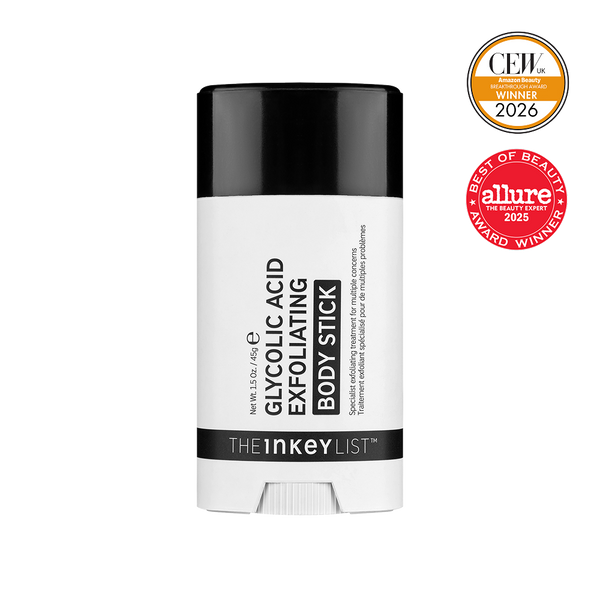
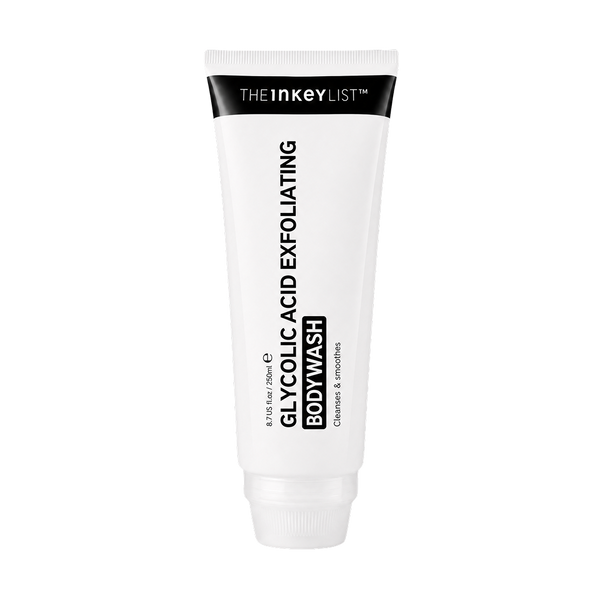
For context as you read, INKEY’s own answer to this format is our Glycolic Acid Exfoliating Body Wash (£12), a rinse-off wash with 5% glycolic acid and 5% lactic acid and a built-in brush head, and its leave-on counterpart the Glycolic Acid Exfoliating Body Stick (£15), which this article returns to later.
What an Exfoliating Body Wash Actually Does
An exfoliating body wash is a cleanser for the body that also contains exfoliating acids. It does two jobs in one step: it removes dirt, sweat, oil and product buildup the way any body cleanser does, and it loosens the bonds holding dead cells to the surface of your skin so they shed more readily.
The single most important structural fact about the format is that it rinses off. It is on your skin for seconds, not hours. That one fact drives almost every criterion in this article, so hold onto it.
Briefly, on the two routes to exfoliation: physical exfoliants such as scrubs work by friction, physically buffing away surface cells. Chemical exfoliants such as AHAs work by dissolving the bonds between those cells so they lift away without scrubbing. Physical and chemical body exfoliation is covered properly on its own page, and glycolic acid has an ingredient page that explains the molecule in full, so we will not repeat either here.
What should you realistically expect? Smoother-feeling skin, less rough surface texture, and better preparation for whatever you apply afterwards. Peer-reviewed work has shown that alpha hydroxy acids act on the stratum corneum, the outermost layer of skin, modulating how it functions and sheds. That is a meaningful effect, but it is a surface effect. Body skin is also thicker than facial skin, which is precisely why body formulas are built differently from face formulas, usually at higher concentrations and in more robust bases.
Because a wash rinses away in seconds, that short contact window changes what you should be looking for.
Rinse-Off vs Leave-On: Why the Format Changes What You Should Look For
Contact time is the central trade-off in body exfoliation, and it is the reason a body wash should be judged by different standards than a leave-on treatment.
Rinse-off, in practice:
- On skin for seconds before it is washed away
- Needs a meaningful, clearly stated acid concentration to achieve anything in that window
- Treats large areas in one step: back, chest, legs, arms
- Generally more forgiving for anyone new to body acids, because exposure is short and controlled
- Fits into a routine you already have, which makes consistency easier
Leave-on, in practice:
- Stays on the skin and keeps working after application
- Suited to higher strengths applied to smaller, targeted areas
- Slower and less even to apply across a whole body
- Requires more care with frequency, because exposure is sustained
The practical consequence for buying is straightforward. A low or unstated acid percentage in a rinse-off wash has very little time to earn its place. The same percentage in a leave-on product has hours. That is why an unquantified “exfoliating complex” in a wash is a weaker proposition than it sounds.
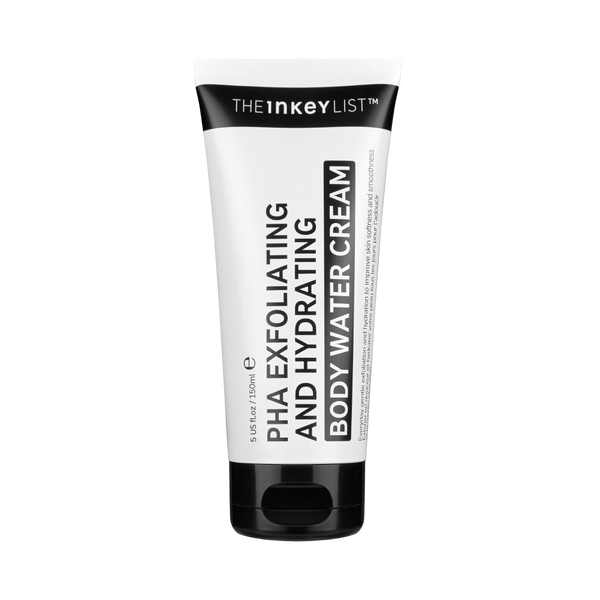
The honest conclusion is that these formats are complementary rather than competing, and any brand telling you one product does everything is overselling. A wash is your broad base layer across large areas. A leave-on is for the specific patches that need more than a base layer can give. The Glycolic Acid Exfoliating Body Stick (£15) illustrates the leave-on end of that range with 7% glycolic acid and 0.5% salicylic acid, a strength that only makes sense because it is applied to targeted areas rather than everywhere. The PHA Body Water Cream (£15) shows a third route again, a leave-on 2-in-1 with 3% PHA that moisturises while exfoliating gently, and the science behind PHA Body Water Creamexplains why PHAs behave differently from AHAs.
With contact time established as the constraint, the first thing to check on any label is what acid is in there and how much of it.
What to Look For 1: The Acid and the Concentration
Glycolic acid is the benchmark for body exfoliation, and there is a structural reason for that. It is the smallest molecule in the AHA family, it is among the most studied cosmetic acids in use, and it performs well on the thicker skin of the body, where rough texture and bumps are most common. Where a gentler acid may struggle on body skin, glycolic tends to deliver.
The most useful thing you can learn from this article is what to look for on a label:
- A stated percentage. “AHA blend”, “fruit acid complex” or “exfoliating actives” with no number attached tells you nothing about strength.
- The acid named individually. A number attached to a named acid is a real specification. A number attached to a blend is not.
- A format that matches the strength. A high percentage in a rinse-off wash and a high percentage in a leave-on product are doing very different things.
- Where the acid sits in the ingredient list. Useful corroboration when a percentage is given, and the only signal you have when it is not.
If a product will not tell you how much acid is in it, you cannot evaluate it. Treat a stated percentage as the minimum standard, not a bonus.
It is also worth correcting a common assumption: more acids listed does not mean a stronger or better product. A blend of four or five unquantified acids can easily be weaker in practice than one well-dosed acid at a known percentage. Long acid lists photograph well on a label. They do not necessarily do more for your skin.
As a worked example of the principle, our 5% glycolic acid and 5% lactic acid body wash states both percentages plainly. You know exactly what you are buying, and you can judge whether that strength suits you before it reaches your bathroom.
One note on salicylic acid for comparison only. Salicylic is oil-soluble, which means it can get into pores, making it better suited to congestion and blocked pores. Glycolic works on surface texture and tone. Neither is universally better, they simply solve different problems, and glycolic acid vs salicylic acid handles that comparison properly. If you want the full picture on the molecule itself, what glycolic acid does is the place to go.
Concentration is not merely a marketing detail, either. AHA concentration and pH are treated as meaningful safety parameters in UK and EU cosmetic regulation, as set out in the SCCNFP position paper on consumer safety of alpha hydroxy acids. If regulators consider the number worth specifying, so should you.
Once you know which acid and how much, the next question is what it has been paired with, and why.
What to Look For 2: Acid Pairings and Why Glycolic Plus Lactic Works
Pairing acids is a deliberate formulation decision, not a decorative one. The useful skill is being able to tell the difference.
Lactic acid is the humectant AHA, meaning it both exfoliates and draws water into the skin and helps hold it there. That dual action matters in an exfoliating product, because it offsets the drying potential of a stronger exfoliating acid working alongside it. This is not a marketing characterisation. Research into lactic and lactobionic acids as moisturising compounds supports the humectant behaviour directly.
So the logic of glycolic plus lactic reads clearly. Glycolic does the heavy lifting on surface texture, because its small molecule size lets it work efficiently on thicker body skin. Lactic contributes exfoliation of its own while supporting hydration and comfort, so the overall experience is less stripping than glycolic alone at the same total acid load. Each acid has a job. That is what a logical pairing looks like, and it is why our body wash uses 5% of each, both stated.
When you are assessing any blend, ask:
- What is each acid in this formula contributing?
- Is there a percentage attached to each one, or only to the blend as a whole?
- Does the combination address one coherent concern, or does it read like a list?
- If one acid is potentially drying, is anything in the formula offsetting that?
If you cannot answer those questions from the label or the product page, the blend may be there for the ingredient list rather than for your skin. That is not an accusation against any particular product, it is simply the limit of what you can reasonably conclude from incomplete information.
For reactive or easily irritated skin, there is a gentler pathway worth knowing about. PHA molecules are larger than AHAs, so they penetrate more slowly and tend to be better tolerated, which is why they appear so often in products for sensitive skin. Our best exfoliator for sensitive skin guide covers that decision in full rather than in passing.
Formula matters. So does something most people never think about until the product is already in their bathroom: how it actually gets onto your skin.
What to Look For 3: How It Is Applied, Coverage and Hard-to-Reach Areas
Body exfoliation only works where the product actually reaches. This sounds obvious. It is also the criterion buyers consider least, and the one that most often decides whether a product delivers.
Consider which areas people most want to treat: the back, the shoulders, the backs of the upper arms. Now consider which areas are hardest to reach evenly with your bare hands. They are the same areas. A perfectly formulated wash that never makes it to the middle of your back is not going to smooth the middle of your back.
How the main application options compare:
- Bare hands. Always available, costs nothing, but gives the least even coverage and cannot comfortably reach the middle of the back or the backs of the shoulders.
- A cloth or mitt. Extends reach and helps spread product, but adds friction on top of acids, which is not always what you want. Cloths also need washing regularly.
- A built-in brush head. Spreads product evenly, extends reach, and removes the need to buy, store and clean a separate tool. It is a coverage and consistency benefit rather than an additional scrubbing step.
Our built-in exfoliating brush head sits in that third category, and we would rather describe it accurately than flatter it. It genuinely helps with even coverage and reach, and it means one fewer thing in your shower. It is not effortless. Some people find the applicator harder to control for dosage, and it can be slippery when wet. If that is you, dispense the product into your hands or onto a cloth instead. The formula performs exactly the same either way, and how you apply it should be whatever you will actually keep doing.
That last point is the real criterion here. Whichever format you choose, check that you can realistically apply it to the areas you actually want to treat, several times a week, without it becoming a chore. Consistency matters more than intensity with body exfoliation, and the most common reason people stop is friction in the routine rather than dissatisfaction with results.
Shower order is simple. Cleanse first. Apply the exfoliating wash to damp skin. Allow a short moment of contact time rather than rinsing immediately. Then rinse thoroughly. For full technique and body area detail, body exfoliation technique is the page that owns it, and awkward spots such as glycolic acid for armpits have their own guidance.
Coverage decides where the acid lands. The base it is carried in decides how your skin feels afterwards.
What to Look For 4: The Base Formula, Surfactants, Fragrance and pH
The non-active part of an exfoliating body wash matters just as much as the acid, and arguably more, because it is applied across a very large surface area several times a week.
Surfactants. These are the cleansing agents that create lather and lift away oil and dirt. They exist on a spectrum from mild to harsh. Harsh surfactants strip the skin of the lipids that keep it comfortable, and combining a stripping cleanser base with an exfoliating acid is the most common route to ending up tight, dry and irritated. The acid usually takes the blame. The base is often the culprit.
Fragrance. A body wash covers far more skin than a face product, which means far greater exposure to whatever is in it. Fragrance is not a problem for everyone, but fragrance-free is the safer default if your skin is reactive, or if you are treating areas that are already irritated or freshly shaved. Our body wash is fragrance-free and vegan, both of which are straightforward things to verify on any product page before you buy.
pH. This is the quiet technical criterion. AHAs need an acidic environment to work properly, so an exfoliating wash has to sit in a lower pH range than a plain cleanser. At the same time, a cleanser that sits too far from skin’s natural pH can compromise the barrier, a relationship examined in peer-reviewed work on the relation of pH and skin cleansing. A well-made exfoliating wash balances both requirements. For the fuller explanation, see pH in your skincare routine.
Pregnancy and breastfeeding. Wash-off AHA formulas at these concentrations are generally considered lower-risk than leave-on treatments, because contact time is short and the product is rinsed away. Guidance varies, though, so check with your doctor before using acids during pregnancy or breastfeeding. For the wider picture, read our guide to pregnancy safe skincare and the specific question of can you use glycolic acid when pregnant.
The principle underneath all four points is barrier respect. The goal of exfoliation is smoother skin, not stripped skin. If a product leaves you tight and squeaky, that is a signal, not a success.
The last formula question is not printed on the front of the bottle at all. It is how often the product is actually designed to be used.
What to Look For 5: How Often It Is Designed to Be Used
“Use daily” on a packet is a usage instruction. It is not proof of gentleness, and it is not a quality signal. What actually matters is whether the recommended frequency suits the strength of the formula and the sensitivity of your skin.
We will be straightforward about our own product here. Our Glycolic Acid Exfoliating Body Wash is designed for use two to three times per week, not every day. That is a deliberate recommendation rather than a limitation. At 5% glycolic and 5% lactic, spacing uses gives skin time to recover between sessions, and that recovery time is what keeps results steady instead of tipping into irritation. Start at twice weekly and build to three times as your skin adjusts.
A sensible build-up protocol:
- Start with once or twice a week for the first two weeks.
- Assess honestly over two to three weeks. Is your skin comfortable, or slightly tight?
- Increase to three times weekly only if there are no signs of sensitivity.
- Hold at whatever frequency your skin is comfortable with, even if that is lower than the maximum.
Signs you are overdoing it:
- Tightness after showering that does not settle
- Stinging on application
- Persistent redness rather than brief flushing
- Unusual dryness or flaking
- New sensitivity to products that never bothered you before
If any of those appear, scale back rather than pushing through. What to do if you have over exfoliated covers recovery properly, and how often to use glycolic acid goes deeper into frequency across different products.
It is also worth remembering that body skin varies by area. Legs and arms generally tolerate more than the chest, neck or inner arms, where skin is thinner and more reactive. You do not have to treat every area on the same schedule.
More frequent is not the same as more effective. Consistency at a sensible frequency beats intensity every time.
With the criteria established, it is worth applying them to the specific reason you are shopping in the first place.
Matching an Exfoliating Body Wash to Your Concern
Different concerns weight the criteria differently. Here is which criterion matters most for each, with the detail living on the pages that cover it properly.
Rough, bumpy skin on the arms and thighs. AHAs including glycolic and lactic are commonly used to soften the look of these bumps and smooth surface texture, with clinical literature supporting AHAs in keratosis pilaris management and longer-term outcomes for glycolic acid specifically. Consistency matters more than strength here. Our full guide to keratosis pilaris covers it end to end.
Strawberry skin. The criteria that matter most are even coverage across the legs and a gentle base formula, given how often the area is shaved. We have covered this concern in detail already, so start with strawberry skin and how to manage strawberry skin.
Blemish-prone areas on the back and chest. Coverage is the deciding factor here, because these are the hardest areas to reach evenly and the ones most often missed. A wash that reaches the whole back beats a stronger product that only reaches the top third. See back breakouts for concern-specific guidance.
Rough texture and dullness. A stated glycolic percentage is the priority criterion. This is the concern glycolic is most directly suited to, so buy on the number and use it consistently.
Ingrown hairs. Regular gentle exfoliation helps keep the skin surface clear so hairs are less likely to become trapped. Coverage and frequency are the deciding factors rather than raw strength. More detail on ingrown hairs.
Feet and other thicker-skinned areas. These tolerate more frequent exfoliation than the rest of the body, and often need it. See glycolic acid for feet.
Before choosing, be clear about the situations where an acid body wash is not the right answer.
Who Should Be Careful and What to Avoid
- Sensitive or reactive skin. Start at the lowest frequency, or consider a gentler PHA route instead. Our guide to gentler exfoliating options sets out the alternatives.
- Broken, cracked, sunburnt or freshly shaved skin. Wait until skin has recovered. Acids on compromised skin cause stinging and further irritation without improving results.
- Do not layer multiple strong exfoliants on the same area on the same day. If you use an exfoliating wash, you generally do not also need a scrub on the same body part.
- Sun sensitivity. AHAs can increase skin’s sensitivity to the sun, a point addressed directly in the SCCNFP position paper on alpha hydroxy acids. Cover exposed areas or apply sun protection such as Dewy Sunscreen SPF 30 to skin that will be exposed, particularly legs, arms, chest and shoulders.
- Pregnancy and breastfeeding. Wash-off AHA formulas at these concentrations are generally considered lower-risk than leave-on products, but guidance varies, so check with your doctor before using acids. See pregnancy safe skincare and using glycolic acid when pregnant.
- Face use: no. Our body wash is formulated for body skin and is not suitable for use on the face. This is a deliberate formulation decision based on the difference in skin thickness, not a caution you can work around. For facial exfoliation, use our Glycolic Acid Toner (£14) or the gentler PHA Toner instead. If you arrived here looking for a face product, our further reading on glycolic acid for your face covers that category.
- Patch test before first full use. Apply to a small area, wait, and check how skin responds. Here is why you need to do a patch test.
- Avoid contact with eyes, and discontinue use if irritation occurs.
Having covered what to look for and what to avoid, here is how these criteria come together in a complete routine.
Our Pick and How to Build a Complete Body Routine
Carry this checklist with you, whatever you end up buying:
- A stated acid percentage, attached to a named acid
- A pairing with a logic you can actually explain
- Coverage that reaches the areas you care about
- A non-stripping, fragrance-free base if your skin is reactive
- Honest frequency guidance rather than a default “use daily”
- A formula designed for body skin, not a face product resized
Measured against that checklist, our Glycolic Acid Exfoliating Body Wash (£12, 250ml) states 5% glycolic acid and 5% lactic acid, pairs them for texture and hydration respectively, includes a built-in exfoliating brush head for coverage, is fragrance-free and certified vegan, is designed for use two to three times weekly, and is formulated specifically for body skin.
The three-step routine:
- Exfoliate in the shower, two to three times a week, with the Glycolic Acid Exfoliating Body Wash (£12).
- Treat targeted areas between washes with the Glycolic Acid Exfoliating Body Stick (£15), 7% glycolic and 0.5% salicylic, on stubborn patches such as the backs of the arms.
- Moisturise afterwards while skin is still slightly damp. The PHA Body Water Cream (£15) works well here as a 2-in-1, hydrating while offering gentle continued exfoliation with 3% PHA.
Moisturising after exfoliating is not optional. You have just accelerated the shedding of surface cells, and replacing water and lipids afterwards is what keeps the result comfortable rather than tight.
If you would rather buy the routine in one step, the Glycolic Acid Exfoliating Body Wash Duo (£22.80), The Bump Smoothing Body Duo (£25.65) and the Exfoliating Body Duo (£28.50) each pair products that work together.
On timing, be realistic. Body skin is thicker than facial skin and turns over more slowly, so measure progress in consistent weeks rather than days. A 250ml tube lasts roughly 10 to 14 weeks at twice weekly use, which gives you a sensible window to judge results properly.
The Short Version: What Actually Matters When Choosing
Choosing an exfoliating body wash comes down to five checks: a stated acid percentage rather than a vague blend, a pairing with a logic you can explain, coverage that reaches the areas you actually care about, a base formula that cleans without stripping, and a frequency that suits your skin rather than a default instruction on the back of a bottle.
It is also worth holding onto the honest framing. A glycolic acid body wash is one strong step in a body routine, not a complete routine on its own. Pair it with a targeted leave-on where you need more, moisturise afterwards, and measure progress in weeks rather than days. That is what clear guidance, proven ingredients and real results look like in practice.
If you want to see how our own formula measures up against those criteria, our Glycolic Acid Exfoliating Body Washis £12, and you can browse the full body range alongside it. For technique rather than selection, how to exfoliate body skin is the guide to read next.
Frequently Asked Questions
Got a question?
Our askINKEY team are a friendly bunch of skincare experts with deep product knowledge and zero judgement. Whether you're an ingredient obsessive or just starting out, we'll make it make sense. No question too big. No question too small. We Give A Care, Every Day.


