



How to Get Rid of Jowls Without Surgery: An Honest Guide to What Actually Works
Jowls are structural, so no cream reverses them. Here is what non-surgical options, face yoga and skincare can honestly do for your jawline.
Author
askINKEY skincare advisor
Published
11 September, 2026
Time to read
20 minutes
If you are searching for how to get rid of jowls, this guide will give you a straight answer before it gives you anything else. Jowls are a structural change in the face, driven by bone, fat, ligaments and skin all shifting at once, and no cream reverses a structural change. What good skincare can genuinely do is improve the quality, firmness and appearance of the skin along your jaw and neck.
We would rather tell you what skincare cannot do than sell you a promise it cannot keep.
That is the contract for the next few thousand words. Most articles about how to get rid of jowls without surgery are published by clinics that sell procedures. We sell skincare, and we are going to place skincare exactly where the evidence puts it, which is partway down the list.
Here is what this guide covers:
- What jowls actually are, and how to tell them apart from crepey skin or neck lines
- What causes jowls, from bone density to fat pad descent
- Whether any non-surgical option genuinely removes them
- An honest ranking of every option you are researching, including the ones we do not sell
- What skincare realistically contributes, ingredient by ingredient
- A daily routine for the jaw and neck you can actually keep up
If you would rather browse than read on, our Bio-Active Ceramide Neck Stick is the product in our range formulated specifically for this area, and the wider anti-ageing collection sits alongside it. Not sure where to begin? The skin quiztakes a couple of minutes, and our 10 Most Common Skincare Concerns guide covers the wider picture.
Let us start with what we are actually looking at.
What Are Jowls, Exactly?
Jowls are the soft tissue that gathers along and just below the jawline as the face loses structural support. Skin, fat and connective tissue that once sat higher in the cheek settle downwards, softening the clean line between the jaw and the neck. They are a normal feature of facial ageing, not a medical condition.
That definition matters because it separates jowls from two things people frequently confuse them with. Getting the diagnosis right in the mirror determines whether the advice you follow will do anything at all.
- Jowls are about volume and support. Tissue has moved and the underlying scaffolding has changed. The problem sits partly beneath the skin.
- Crepey skin is a skin quality issue. The surface looks thin, finely lined and papery, a bit like tissue paper that has been crumpled and smoothed out. We cover this properly in What Causes Crepey Skin?
- Neck lines are horizontal creases across the front of the neck, driven by repeated folding and movement rather than descent. That is its own topic, covered in How to Get Rid of Neck Lines
You can have all three at once. Most people over fifty do. But they respond to different things, and treating jowls as though they were a texture problem is why so many people feel let down by products that were never designed to help.
When Do Jowls Usually Start?
Most people notice the first softening along the jaw somewhere in their forties, though the range is wide and genuinely individual. Bone structure plays a large part. A strong, well-defined mandible provides more scaffolding and tends to hold its line for longer. Genetics influence both the timing and the degree. Lifestyle, particularly sun exposure over decades, shifts the timeline in either direction.
Some people see it in their late thirties. Plenty of people in their sixties have a jawline they are perfectly happy with. There is no schedule you are failing to meet.
It is also worth saying plainly that jowls are not a flaw. They are what a face does over time, in the same way that hair greys and skin thins. Whether you want to soften their appearance is entirely your call, and this guide takes no position on that. It simply tells you what is possible.
How to Tell If What You Are Seeing Is Jowls
There is a simple mirror test. Stand in front of a mirror in natural light and look at your jawline straight on. Then tilt your head back slightly and look again.
If the softening along the jaw visibly reduces when you tilt your head back, the driver is descent. Gravity and loss of support are pulling tissue downward, and lifting your chin temporarily takes the load off. That is the signature of a jowl.
If the texture stays exactly the same in both positions, and what you are seeing is fine lines, thinness or a crinkled surface, you are looking at a skin quality issue rather than a structural one. That is genuinely good news, because skin quality is the thing topical skincare is best at influencing.
The anatomy underneath all this has been mapped in real detail. Surgeons studying the region have shown that the jowl forms in a specific, predictable place, bounded by the mandibular ligament, which is exactly why it appears where it does rather than anywhere else along the jaw. The Surgical Anatomy of the Jowl and the Mandibular Ligament Reassessed sets this out in full.
Once you understand that a jowl has a specific anatomical address, the next question follows naturally. What is actually changing down there?
What Actually Causes Jowls
Jowls are caused by four changes happening together: the jawbone loses density and volume, the fat compartments of the face descend and deflate, the fibrous ligaments that tether skin to deeper tissue loosen, and dermal collagen and elastin decline so skin recoils less well. Sun exposure accelerates all of it.
That is the whole answer in one paragraph, but each of those four deserves unpacking, because understanding them is what makes the rest of this article make sense.
Bone: The Scaffolding Changes Shape
This is the cause almost nobody expects, and it is the most persuasive one.
Your facial skeleton is not fixed. It remodels throughout adult life, and with age the bones of the face lose density and change shape. The jaw is particularly affected. The angle of the mandible, meaning the corner where the jawbone turns upward towards the ear, becomes more obtuse, and the height and projection of the bone reduce.
Research measuring facial bone density across age groups has found significant decline in the mandible over time. You can read the study on facial bone density and the effects of aging if you want the detail.
Think of it as a tent. The canvas is your skin and soft tissue, the poles are your facial bones. Shorten the poles by even a small amount and the canvas develops slack, regardless of the condition of the canvas itself. That slack has to go somewhere, and along the jaw it becomes a jowl.
Fat Pads: Volume Moves South
The fat in your face is not a single even layer. It is organised into discrete compartments, separated by connective tissue, each with its own blood supply and its own ageing behaviour.
With time, two things happen to these compartments. Some deflate, losing volume outright. Others descend, sliding downward from their original position. The high, rounded fullness that sits over the cheekbone in youth loses volume and drifts lower, and some of it ends up sitting along the jaw where it was never meant to be. The clinical literature on facial contours and volume correction describes this pattern of descent and deflation in detail.
This is why a face can look simultaneously hollow and heavy. The upper face empties while the lower face gains weight it did not ask for. The same mechanism explains hollowing under the eyes, which we cover in Under-Eye Hollows and Tear Troughs. Both are volume problems wearing a skin problem’s clothing, which is precisely why creams disappoint people in both cases.
Retaining Ligaments: The Anchors Loosen
Running between the facial skeleton and the overlying skin are fibrous bands called retaining ligaments. Their job is simple. They hold soft tissue in position, like guy ropes on that same tent.
Over the years these ligaments stretch and weaken. The mandibular ligament, anchored near the front portion of the jawbone, is directly relevant here. It stays relatively fixed while the tissue around it descends, which creates a visible notch or break in the jawline. The tissue that falls just behind that anchor point is the jowl.
This is the single clearest reason why topical products cannot remove a jowl. A ligament sits well below the reach of anything you apply to the skin surface. No molecule applied to the epidermis reaches it, and none would re-tension it if it did.
Collagen and Elastin: Skin Recoils Less Well
Within the skin itself, the dermis changes too. Collagen provides structural strength, elastin provides the snap-back that lets skin return to position after it moves. Both decline with age, and the remaining collagen becomes more fragmented and disorganised. Skin becomes thinner, less resilient and slower to recover its shape.
This is the layer that topical skincare can genuinely influence, which is why we will spend real time on it later. The research on structural changes in aged skin explains the mechanisms, and our own Collagen for Skin: What It Does and How to Support It is the deeper dive if you want it.
Four of the five things creating a jowl sit beneath the skin, not in it. That is the entire reason honest expectations matter here.
What Speeds It All Up
Some of this is written into your genes and your bone structure. Some of it is not. Ranked roughly by how much difference they make:
- Ultraviolet exposure. By a considerable distance the largest modifiable factor. UV degrades collagen and elastin directly and accelerates every skin-level change described above. Decades of unprotected sun exposure show up along the jaw, neck and chest more visibly than almost anywhere else.
- Smoking. Directly damages collagen and elastin and restricts blood supply to the skin.
- Significant, repeated weight fluctuation. Repeated cycles of stretching and deflation give soft tissue less chance to recover its position. Worth knowing, not worth anxiety.
- Genetics and bone structure. Not modifiable, but useful context. If your parents developed jowls early, you may too, and that is information rather than fate.
- Sleep position. Consistently sleeping pressed into a pillow on one side is often mentioned. The evidence is limited and the effect is likely small.
- Sustained screen posture. Long hours looking down compress and crease the skin of the neck. We cover this properly in Neck Cream for Tech Neck and Crepey Skin.
Which brings us to the question you actually came here to ask.
Can You Actually Get Rid of Jowls Without Surgery? The Honest Answer
No. Nothing non-surgical fully removes jowls. Because they are caused by changes to bone, fat and retaining ligaments as well as skin, only a procedure that physically repositions tissue can reverse the descent itself. Non-surgical options range from subtle to moderate improvement in the appearance of the jawline, which is a real and worthwhile outcome, but it is a different one.
Now let us reframe that, because the honest answer is not the useful answer.
“Can jowls be removed” is the wrong question. It has one answer, it is no, and it leaves you nowhere. The useful question is: how much can the appearance of my jawline be improved, and by what? That question has genuinely encouraging answers, and they vary a great deal depending on which option you choose and what you expect from it.
Here is the honest scale. Surgery repositions tissue and is the only intervention that addresses descent directly. Energy-based devices and injectables can produce modest to moderate improvement in appearance. Skincare improves the quality, firmness and appearance of the skin itself, which softens how the area reads without changing where the tissue sits. Every one of those is a real result. None of them is the same result.
Anyone telling you a cream removes jowls is either mistaken or selling you something.
We think you should trust this assessment for a specific reason. Almost every page competing for these search terms is published by someone who profits from a procedure. We sell skincare, and we have just told you plainly that skincare does not do the thing you searched for. That is not modesty, it is how we would want to be spoken to.
There is one genuinely optimistic note, and it is not a consolation prize. How your skin ages from here is meaningfully influenced by what you do consistently, starting now. Protecting skin from UV and supporting its quality over years shapes how well the area holds up. That is where prevention and daily care earn their keep, and it is the part most people ignore until it is late. We take the same approach to honest answers in Are Acne Scars Permanent? The Honest Answer, if you want a sense of how we handle these questions generally.
So with expectations set properly, let us go through every option you are researching and grade it fairly.
Ranking the Non-Surgical Options for Jowls, Honestly
What follows is ordered by what the evidence supports, not by what we sell. Skincare appears near the bottom of this list. We are telling you that up front because a ranking that conveniently put our own category first would not be worth reading.
For each option: what it is, what it realistically does, what it does not do, and a plain verdict.
Surgery: The Benchmark, For Context
A lower facelift or neck lift repositions soft tissue, tightens underlying muscle and connective tissue layers, and removes excess skin. It is the only intervention that directly addresses tissue descent, which is the defining feature of a jowl.
We include it purely as a reference point, so you can calibrate everything below it. It is a significant medical decision involving surgery, anaesthetic, recovery time, cost and risk, and it is a conversation for a qualified surgeon rather than a skincare brand. We neither recommend it nor discourage it.
Verdict: the only option that addresses the actual cause. Also the only one that is surgery.
Energy-Based Devices: Modest Improvement, Not Removal
Radiofrequency and focused ultrasound treatments deliver controlled heat into the deeper layers of skin and, with some devices, the tissue layer beneath it. The intention is to cause a tightening response in existing tissue that develops gradually over the following months.
Realistically, these can produce a modest to moderate improvement in the appearance of the jawline. Results vary considerably depending on the specific device, the settings used, the skill of the operator, and your individual anatomy and skin. Multiple sessions are usually needed. Effects are not permanent, because ageing continues.
What they do not do is reposition descended fat or re-tension a stretched ligament. They improve appearance, they do not remove jowls. Any clinic telling you otherwise is overselling. If you want help decoding the claims made about device categories generally, our piece on Red Light Therapy for Skin shows how we assess this kind of technology, and What does dermatologically and clinically tested mean? will help you read the studies clinics cite.
Verdict: genuinely useful for appearance, frequently oversold, and highly operator-dependent.
Microneedling for Jowls: A Skin Quality Treatment
Microneedling creates controlled micro-injuries in the skin using fine needles, prompting a wound-healing response. Some versions add radiofrequency energy through the needles, which pushes it closer to the device category above.
Microneedling works on skin quality. Texture, fine lines, firmness and overall skin thickness are where the evidence sits. That can improve how the jaw area looks, particularly if part of what is bothering you is crepiness rather than pure descent.
It does not reposition tissue. If you go in expecting a jaw contour change, you will be disappointed. If you go in expecting better skin quality along the jaw, it is a reasonable option.
Verdict: a skin treatment, not a contour treatment. Judge it on that basis and it performs.
Injectables: A Conversation for a Qualified Practitioner
Two distinct things get discussed here, and they are often confused.
Dermal fillers can be placed along the jawline to restore volume and definition where support has been lost. Used well, this can visibly sharpen the jaw contour. Used poorly, it can add weight to an area that is already heavy and make things look worse. Technique and assessment matter enormously.
Masseter Botox is the nuance that generates most of the questions. The masseter is the chewing muscle at the angle of the jaw. Relaxing it reduces muscle bulk, which slims the lower face width. This is why it appears in jowl conversations, but the relationship is not straightforward, and in some cases reducing bulk in that area can affect how the surrounding tissue sits.
Both are prescription medical treatments requiring proper assessment of your individual anatomy. We are a skincare brand and we are not going to give medical advice about either. Speak to a qualified, registered medical practitioner.
Verdict: potentially effective, entirely dependent on practitioner skill, and firmly a medical conversation.
Face Yoga and Facial Exercises for Jowls: What the Evidence Actually Shows
This is the most searched non-surgical option, so it deserves a proper, honest answer rather than a dismissal.
Facial exercise programmes involve repeated, resisted movements of specific facial muscles, typically performed daily over several weeks or months, on the theory that building muscle volume will improve facial contour.
The most-cited piece of research is a 2018 study on facial exercise and the appearance of ageing, in which middle-aged women followed a structured 30 minute daily programme for twenty weeks. Blinded raters assessed photographs and found a modest improvement in perceived age, with upper and lower cheek fullness the areas that changed. That is a real finding, and it deserves to be reported accurately.
It also deserves its context reported accurately. The study included sixteen participants who completed it, had no control group, and relied on a photographic ageing assessment rather than any structural measurement. A broader systematic review of conservative techniques for mechanical facial rejuvenation characterises this entire evidence base as small, short in duration, methodologically limited and inconsistent.
No published study demonstrates that facial exercise reverses structural descent along the jawline. The honest summary is modest, localised, and largely about fullness rather than lift.
There is also a reasonable theoretical caution. Facial muscles attach differently from skeletal muscles elsewhere in the body, many inserting directly into skin. Aggressive, repetitive movement and forceful pulling of facial skin is not obviously harmless, particularly on the thin skin of the neck.
Here is what we think is genuinely useful, though. Gentle, consistent massage along the jaw and neck is safe, feels good, takes a minute, and gives you a daily ritual that makes you far more likely to actually apply your products to an area most people skip entirely. That consistency effect is real even where the mechanical effect is unproven. The rule is gentleness. Glide, do not drag. Never pull or stretch the skin.
Verdict: safe and pleasant, weakly evidenced, and no substitute for structural intervention. Enjoy it for what it is.
Topical Skincare: Skin Quality, Prevention and Daily Consistency
Which brings us to our own category, placed here rather than at the top because that is where it belongs.
Topical skincare works on the skin itself. It can improve hydration, barrier function, texture, tone and the appearance of firmness along the jaw and neck. Over sustained use, well-evidenced ingredients improve visible signs of collagen decline. What it cannot do is reposition fat, re-tension a ligament or restore bone.
It has three genuine advantages over everything above it on this list. It is the only option you do every single day. It costs the least by a wide margin. And it has by far the strongest role in prevention, which is the one lever with real long-term influence.
Verdict: modest on existing jowls, meaningful for skin quality and appearance, and the strongest option for prevention.
Let us look at exactly what that means in practice.
What Skincare Can Genuinely Do for the Jaw and Neck
To restate the boundary once, clearly: skincare improves the quality, firmness and appearance of the skin along the jaw and neck. It does not reposition tissue.
Within that boundary, there is more to work with than most people realise, largely because the jaw and neck are so widely neglected.
The skin below your jawline is genuinely different from the skin on your face. It is thinner, with fewer oil glands to keep it comfortable and less structural support beneath it. It moves constantly, every time you speak, swallow or turn your head. It gets significant UV exposure and almost no sun protection. And the overwhelming majority of people stop applying their skincare at the jawline, leaving the area that shows ageing most clearly with no support at all.
That last point is worth sitting with. A lot of the improvement available here is not exotic. It is simply extending care to a region that has never received any.
Ceramides: A Stronger Barrier Looks Firmer
Ceramides are lipids that occur naturally in your skin barrier. Think of the barrier as a brick wall, with skin cells as the bricks and ceramides as a substantial part of the mortar holding them together. When that mortar is depleted, water escapes more easily and irritants get in more easily.
Well-hydrated skin with an intact barrier is plumper, smoother and reflects light more evenly, all of which makes it look firmer and more resilient. This is not a structural effect and we are not claiming it is. It is a genuine, visible improvement in how skin looks and behaves.
Our Bio-Active Ceramide Neck Stick uses 0.2% Bio-Active Ceramide NP specifically. If you want the ingredient detail, What are Ceramides? covers the category and What is Ceramide NP? covers this exact form.
Peptides: Short Chains That Signal to Skin
Peptides are short chains of amino acids, the same building blocks that make up proteins including collagen. Applied topically, certain peptides act as signalling molecules, communicating with skin cells in ways that support the appearance of firmness and elasticity over time.
The Neck Stick contains 1% Gatuline In-Tense MB and 2% CO2llageneer, both selected for this area. Rather than repeat ourselves, What are Peptides? is the ingredient pillar and Do Peptides Really Work? What the Evidence Showsis our honest assessment of the category.
Retinoids: The Best-Evidenced Topical Category
If you use one active ingredient for long-term skin quality, the evidence points to a retinoid. The American Academy of Dermatology explains the family clearly, and a recent network meta-analysis of topical interventions for photoagingplaces retinoids consistently among the strongest performers for visible signs of ageing.
This is a choice of strength rather than a single recommendation.
Our Starter Retinol Serum (£13) is the sensible default for most readers of this article. It is formulated for retinol beginners, all skin types, sensitive skin and rosacea-prone skin, using 1% Granactive Pro+, an encapsulated next-generation retinoid, alongside 0.01% Retinal, 0.5% Amisol Trio and 0.2% SymRelief 100. The directions cover face and neck, which matters here.
Clinically proven to smooth fine lines from 7 days, without irritation.
4-week clinical study on 30 participants.
Our Advanced 0.2% Retinal Serum (£18) is the step-up for readers already confident with retinoids. Retinal sits one conversion step closer to retinoic acid than retinol does, which makes it more potent and carries a moderate risk of irritation. It is not the default. If you are weighing the two, Retinol vs Retinal: Which Vitamin A is Right for You?works through the decision properly, and What is Retinol? covers the ingredient itself.
Whichever you choose, the neck deserves extra caution. This skin is thinner and more reactive than facial skin, so start low and slow. PM only. Two to three nights a week to begin with, building frequency as your skin tolerates it. Always follow with moisturiser, and always use SPF the following morning.
Retinoids are not suitable during pregnancy or breastfeeding without first consulting your doctor. This applies to both products above.
Vitamin C: Antioxidant Support and Visible Tone
Vitamin C is an antioxidant, meaning it helps defend skin against damage from environmental aggressors including UV-generated free radicals. In practice, it supports a brighter, more even appearance in tone, which is relevant along the jaw and neck where years of unprotected exposure often show as patchy pigmentation as much as laxity.
Our 15% Vitamin C + EGF Serum (£16) sits in the morning routine, layered under sun protection rather than in place of it.
SPF: The Highest-Value Step in This Entire Article
If you take one thing from this guide, take this. UV exposure is the largest modifiable driver of every skin-level change described in the causes section. Daily broad-spectrum sun protection is the most valuable long-term step available to you, and it costs less than any procedure on this page.
The jaw, neck and chest are the three most commonly missed areas in the entire body. People apply carefully to the face, stop at the jawline, and leave the region that most visibly betrays ageing entirely unprotected for decades. Take your SPF down over the jaw, the whole neck including the sides and back, and the chest.
This matters even more if you are using a retinoid, which increases sun sensitivity. What is SPF? covers how to choose and apply it properly.
The Product Formulated for This Area
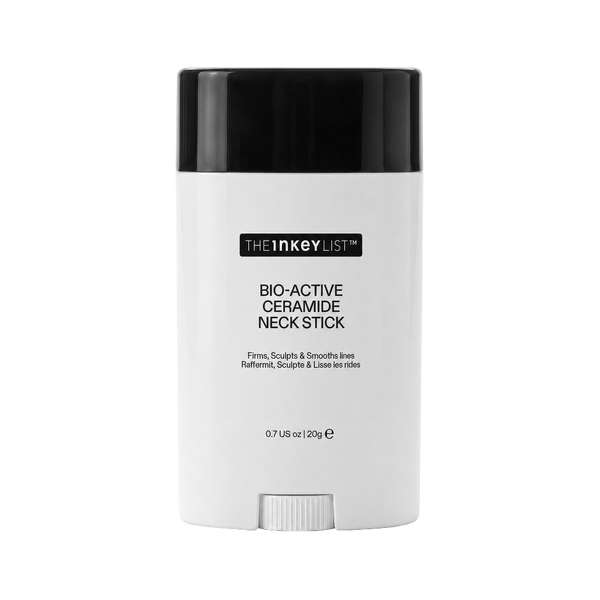
Our Bio-Active Ceramide Neck Stick (£15) is a 20g stick designed specifically for the jaw and neck, combining 0.2% Bio-Active Ceramide NP, 1% Gatuline In-Tense MB and 2% CO2llageneer in a gua sha-inspired shape you glide directly along the skin. It is used morning and evening.
Clinically proven to improve tightness of the jawline (by 32% in 56 days).
Clinically tested on 28 participants over 8 weeks.
Clinically proven to improve the lifted appearance of the neck and jawline (by 26% in 8 weeks).
Clinically tested on 28 participants over 8 weeks.
To be completely clear about what those numbers mean: these are measured improvements in the appearance and tightness of the jawline and neck. They are not structural repositioning, and no topical product lifts a jowl.
Two practical notes. Unlike the retinoids above, the Neck Stick is safe to use during pregnancy and breastfeeding. It is also vegan, fragrance-free and non-comedogenic. If you are building out the wider routine, our Bio-Active Ceramide Moisturiser (£20) is the face counterpart.
Knowing the ingredients is one thing. Using them consistently in the right order is what actually produces a result.
A Realistic Daily Routine for the Jawline and Neck
Before the steps, the honest framing. This routine supports skin quality and the appearance of firmness along the jaw and neck. It is not a jowl removal protocol, and no routine is.
What it is, is achievable. Roughly five minutes in the morning, five at night, using products you may already own with one area added to where you apply them. If you want the complete face routine rather than this jaw and neck focused version, our Best Anti-Ageing Skincare Routine covers it in full.
Morning
- Cleanse gently, taking the cleanser down over the jaw and onto the neck.
- Antioxidant serum. Our 15% Vitamin C + EGF Serum (£16) applied to face and neck.
- Neck Stick along the jaw and neck, using the technique below.
- Moisturise, again continuing past the jawline.
- Broad-spectrum SPF, taken deliberately over the jaw, the full neck and the chest. Do not skip this step on overcast days.
Evening
- Cleanse thoroughly to remove SPF, make-up and the day.
- Retinoid, two to three nights a week to start. Our Starter Retinol Serum (£13) for most readers, or our Advanced 0.2% Retinal Serum (£18) if you are already confident with retinoids. Build frequency slowly, because neck skin is more reactive than facial skin. Neither is suitable during pregnancy or breastfeeding without medical advice. If retinoids are new to you, Retinol for Beginners will save you a fortnight of irritation.
- Neck Stick along the jaw and neck.
- Moisturise to seal everything in and buffer the retinoid.
On the nights you are not using a retinoid, simply cleanse, apply the Neck Stick and moisturise. If you are extending the routine further, our Bio-Active Ceramide Eye Cream (£15) completes the Bio-Active set.
How to Apply the Neck Stick: The Gua Sha Technique
The stick format exists for a reason. Its shape is gua sha-inspired, which means you get the massage and the product application in the same movement. For anyone who arrived here searching face yoga terms, this is the honest, tangible version of that ritual.
- Start at the chin. Glide the stick outward and upward along the jawline, from the centre of the chin towards the ear. Repeat three or four times on each side.
- Move to the neck. Glide downward along the sides and front of the neck, from just below the jaw towards the collarbone. Three or four passes.
- Keep the pressure gentle. You are gliding, not dragging. If the skin is being pulled or stretched, you are pressing too hard. Never tug the skin of the neck.
- Finish in about a minute. Twice daily, morning and evening.
Apply it after your serums and before your moisturiser. One stick lasts roughly two to three months with twice-daily use, and there is a Bio-Active Ceramide Neck Stick Duo (£28.50) if you are committing to the full eight week timeline and beyond.
What to Expect, and When
Managing your own expectations is part of the routine. Here is the honest timeline.
Within days: hydration, comfort and an immediate smoothness to the surface of the skin. This is real but it is a hydration effect, not a firmness effect.
Two to four weeks: improvements in texture and overall skin condition begin to become noticeable, particularly if the area has never had a routine before.
Eight weeks and beyond: this is the window in which firmness and appearance changes are measured, and it is how the clinical testing on the Neck Stick was conducted. Clinically tested on 28 participants over 8 weeks. Retinoid benefits for fine lines and skin quality continue building well past this point, over months rather than weeks.
Our guide to How Long Does Skincare Actually Take to Work? sets realistic timelines across ingredient categories.
The single biggest reason people see no result is that they stop at week six, just before the point at which the measurable changes were recorded. Consistency genuinely outperforms intensity here. A modest routine you follow every day for a year will do more than an ambitious one you abandon in March.
And the earlier that routine starts, the more it has to work with.
Prevention and the Habits That Actually Matter
Let us be clear about the goal. You cannot prevent your face from ageing, and we would not suggest you try. What you can influence is how well your skin holds its quality, firmness and resilience over time, and that influence is genuine.
Ordered by actual impact rather than by ease, because being honest that sun protection matters more than your pillow is the whole point of this section.
- Wear broad-spectrum SPF daily, and take it down over the jaw, neck and chest. This is not close. UV is the largest modifiable driver of collagen and elastin degradation, and the research on structural changes in aged skinis unambiguous about the relationship. If you do nothing else on this list, do this one. What is SPF? covers the practicalities.
- Do not smoke. Smoking damages collagen and elastin directly and restricts the blood supply that keeps skin nourished. Its effect on skin ageing is well established and substantial.
- Extend your skincare routine past your jawline. The cheapest and easiest change available to anyone reading this, and one of the most effective, because it addresses an area that has typically received nothing for decades. It costs you nothing beyond a slightly larger amount of product.
- Avoid repeated significant weight fluctuation where you reasonably can. Framed purely mechanically: repeated cycles of stretching and deflation give soft tissue less opportunity to recover. This is a note about skin behaviour, not about how anyone should look.
- Be aware of screen posture. Long hours with your chin tucked down compress and crease the neck. Raising your screen to eye level is a free adjustment. Neck Cream for Tech Neck and Crepey Skin covers this in proper depth.
- Sleep position, honestly weighted. You will see confident claims that sleeping on your back prevents facial ageing. The evidence is limited and the effect is likely small. Worth knowing about. Not worth losing sleep over, which would be counterproductive in every sense.
The other honest piece of prevention advice is about timing. Starting a considered routine in your late twenties or thirties gives you decades of accumulated benefit that no product can retrospectively provide at fifty. That is not a reason for anyone older to feel they have missed the boat, because improvement in skin quality is available at any age. It is simply a reason for anyone younger reading this to begin now. Our guide to When Should I Start Using Anti-Ageing Products? answers this question directly.
None of this is about anxiety. It is about spending your effort where it actually pays off, and knowing where skincare stops.
When to See a Professional
If the appearance of your jawline is genuinely affecting your confidence, and topical care is not giving you what you are looking for, speaking to a qualified professional is a completely reasonable next step. We would rather say that plainly than pretend a £15 stick is the answer to every question.
Our suggestion is to start with your GP or a registered dermatologist rather than walking directly into a treatment provider. The advantage is straightforward: your first conversation is with someone who has no financial interest in which option you choose. They can assess what is actually driving the change and tell you honestly whether an intervention is likely to help. The British Association of Dermatologists has a clear guide to seeing the right skin specialist, which is the sensible starting point in the UK.
If you do go on to consider a procedure, check the practitioner’s registration and qualifications carefully. This matters particularly for injectables, where the UK regulatory picture is less tightly controlled than most people assume and where the consequences of poor technique are significant.
One clear safety note. Any sudden change in facial appearance, or new asymmetry that develops quickly rather than gradually, should be assessed medically rather than treated cosmetically. Gradual, symmetrical softening over years is ordinary ageing. Rapid or one-sided change is a reason to see a doctor.
When you are in a consultation, these four questions will tell you most of what you need to know:
- What degree of improvement is realistic in my specific case, given my anatomy?
- How long will the result last?
- What are the risks and possible side effects, including the uncommon ones?
- What happens to the area if I stop maintaining it?
A good practitioner will answer all four without hesitation, and will tell you if you are not a suitable candidate. Vagueness on any of them is useful information in itself.
The Honest Summary on How to Get Rid of Jowls
Jowls are structural. They are created by bone that has remodelled, fat that has descended and deflated, ligaments that have loosened and skin that has lost some of its collagen and elastin. No topical product reverses any of that, and anyone promising you otherwise is selling something.
What is genuinely available to you is worth having. Meaningful improvement in the quality, firmness and appearance of the skin along your jaw and neck. Real influence over how that skin ages from this point onward. And clarity about which professional options do what, so that if you ever decide to have a clinical conversation, you walk into it informed rather than hopeful.
Daily consistency will outperform occasional intensity every time. Sun protection will outperform almost everything else on this page. And extending whatever routine you already have past your jawline is the single easiest improvement available to most people reading this.
We could have written a more exciting article than this one. We would rather tell you honestly what skincare cannot do than sell you a promise it cannot keep. Because at INKEY, we give a care.
Where to Start
If you want to begin with the area itself, our Bio-Active Ceramide Neck Stick (£15) is clinically proven to improve tightness of the jawline (by 32% in 56 days). Clinically tested on 28 participants over 8 weeks. Use it morning and evening, give it eight weeks, and judge it on skin quality and appearance rather than on contour.
If you would rather work out your whole routine first, take the skin quiz for a personalised starting point, or browse the anti-ageing collection at your own pace.
Frequently Asked Questions
Got a question?
Our askINKEY team are a friendly bunch of skincare experts with deep product knowledge and zero judgement. Whether you're an ingredient obsessive or just starting out, we'll make it make sense. No question too big. No question too small. We Give A Care, Every Day.


