



Neck Cream for Tech Neck & Crepey Skin: What Actually Firms Below the Jawline
Screens are ageing your neck faster than your face - here’s what actually firms, smooths and lifts crepey skin below the jawline.
Author
askINKEY skincare advisor
Published
06 March, 2026
Time to read
8 minutes
Most people notice it in a photograph taken from slightly below, or in a lift mirror under overhead lighting. Horizontal creases running across the neck. A softening of definition below the jawline. A fine, papery texture across the décolleté that was not there a couple of years ago. The words people actually type into a search bar are “turkey neck” and “crepey neck”, so let’s use them plainly and without judgement, because they describe something real.
Here is the honest premise of this guide. Most people extend their face routine downward, get to the collarbone, and then wonder why the results below the jaw never quite match the results above it. Neck skin is not facial skin. It is structurally different, it behaves differently, and it responds to being treated differently.
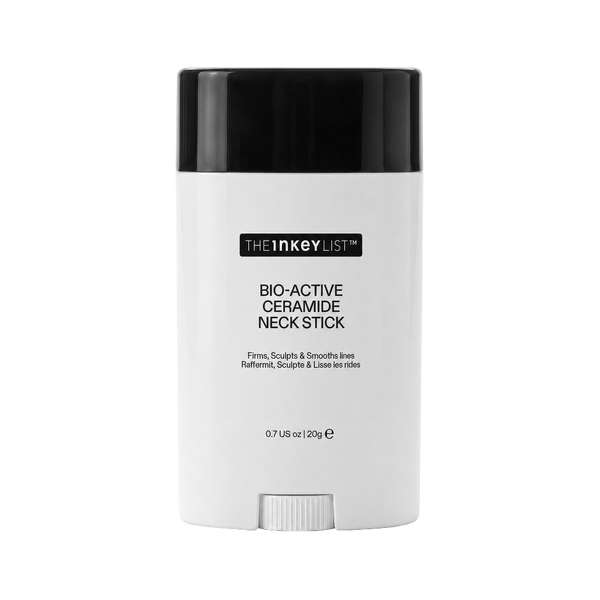
This is a buying guide rather than an explainer. It covers what to look for in a neck cream, whether the format genuinely matters, and what INKEY’s Bio-Active Ceramide Neck Stick actually does. The guidance is ingredient-led, the claims are evidence-backed, and where a cream cannot do something, this guide says so.
Turkey Neck, Crepey Neck or Tech Neck Lines: Which Is It?
Before choosing a product, it helps to correctly identify what you are actually looking at. Three distinct concerns get bundled together under the same shorthand, and they are not the same thing. Naming yours properly makes everything that follows more useful, because it tells you which benefit to prioritise.
- Horizontal tech neck creases. The lines that run across the front of the neck, associated with the repeated downward head position that comes with screen use. These are lines of position and repetition.
- Crepey neck. Fine, papery, slightly loose-looking crepey texture that catches the light. This is far more about surface quality, barrier health and hydration than it is about deep structural lines, which is genuinely good news, because surface quality is the most responsive to topical care.
- Turkey neck. Loss of firmness and definition under the jaw and along the front of the neck. This is the one that requires the most honesty from a skincare brand.
On that last point, we would rather be straight with you. A well-formulated topical product can visibly improve firmness, smoothness and the lifted appearance of the neck. It does not replace clinical procedures, and any brand telling you otherwise is overselling. What it can realistically do is meaningful and visible. It is simply not surgical, and we are not going to pretend it is.
Most people, in practice, have some combination of all three. The reassuring part is that the same care approach supports all of them at once, because firmness, smoothness and hydration are not competing goals. They tend to improve together.
Tech neck is worth understanding briefly, because it explains why this area is under such constant physical demand. Cleveland Clinic’s guidance frames it memorably. In their article on tech neck, chiropractor Andrew Bang, DC, suggests thinking of your head like a 10 to 12 pound bowling ball. Your neck muscles and the natural curve of your spine are built to support that weight when you are in a neutral position. As the head tilts forward, the load on the neck increases.
That is a posture and musculoskeletal point rather than a skin one, and it is worth keeping those two things separate. What it usefully illustrates is that the neck is an area in near-constant mechanical use, folding and extending through every scroll, every email and every glance downward, all day long.
That is as far as this guide goes on causation. For the full picture on why neck lines form and which habits genuinely help, read our full guide to what causes neck lines and what actually helps. From here, we are focused on what to put on your skin.
Having named the concern, the next question is why the neck warrants a dedicated product at all. The answer is in the skin itself.
Why Neck Skin Needs Different Care to Your Face
The neck is not simply a continuation of the face with a slightly awkward angle. It is a genuinely different environment, and understanding why makes the case for a specialised product far better than any marketing copy could.
Neck skin is thinner and more delicate than the skin on your face, with less structural support underneath it. That has a straightforward consequence. Changes in firmness and texture become visible here earlier and more obviously than they do higher up. There is simply less cushioning to disguise what is happening beneath the surface.
The neck also has fewer oil glands than the face. Oil is not just something to be managed and mattified. It plays a real role in helping skin retain water. With fewer glands producing less of it, the neck holds on to moisture less easily, which means it tips into a dehydrated skin state faster and stays there longer. Dehydration is one of the fastest routes to visible crepiness, because when the upper layers of skin lose water, the surface loses its smooth, plumped-out quality and starts to look fine and papery.
Then there is movement. Consider what this area does across a single day:
- It turns, tilts, extends and folds constantly, from the moment you wake up until you go to sleep.
- It carries the mechanical demand described in the previous section, every time your head drops toward a screen.
- It is compressed against pillows and collars, and stretched again the moment you look up.
- It is one of the first areas to show tension when you are stressed or working at a badly set-up desk.
Facial skin gets comparative rest. The neck does not. It never really stops.
Finally, and this is the one most people underestimate, the neck and décolleté receive significant daily sun exposure and are routinely missed at the SPF stage. People apply sunscreen diligently to the face, stop at the jawline, and leave the area most likely to show the consequences entirely unprotected. Over years, that omission compounds. We will come back to this properly later, because it is the single highest-impact habit change available to most readers.
Put those factors together and the picture is clear. Thinner skin, lower oil gland density, near-constant movement, and inconsistent sun protection. That combination is precisely why extending a face routine downward so often underdelivers. Your face cream was formulated for a different set of conditions. It is not doing anything wrong. It is simply solving a different problem.
This is the case for a specialised formulation. Not because the neck is mysterious, but because it has specific, identifiable needs that are worth designing around.
Now that the requirements are clear, the useful question becomes how to judge whether any given product actually meets them.
What Actually Works in a Neck Firming Cream
If you are searching for the best neck firming cream that really works, this section is designed to be useful regardless of what you end up buying. These are the criteria. Take them to any label, ours included, and see how it measures up.
Peptides
Peptides are short chains of amino acids, and the simplest way to understand them is as messengers. Rather than acting as raw material, they signal to skin, supporting its own natural firmness and structural processes. That messenger role is why peptides appear so consistently in products targeting firmness rather than exfoliation or brightening. They are working with the skin’s existing machinery instead of stripping or resurfacing.
The peptide in our formulation is Gatuline® In-Tense MB, a plant-derived peptide. When you are comparing neck products, look for a named peptide at a stated concentration rather than a vague reference to a “peptide complex” somewhere near the bottom of the ingredients list. Specificity is a reasonable proxy for seriousness.
Ceramides
Ceramides are barrier lipids. They occupy the spaces between skin cells and help hold everything together, which in turn helps skin retain moisture and stay resilient against daily stress. The relevance to the neck is direct. A compromised barrier loses water more readily, and skin that is losing water shows crepey texture faster and more visibly.
Given the neck’s lower oil gland density, ceramides are arguably more relevant here than almost anywhere else on the body. Our formulation uses Bio-Active Ceramide NP. If you want the detail on the technology rather than the headline, read how Bio-Active Ceramides differ from conventional ceramides.
Hydration That Plumps
This one deserves precision, because it is frequently oversold. Well-hydrated skin looks smoother and fuller, and fine lines genuinely look softer when the surrounding skin is holding water properly. Ingredients like hyaluronic acidsupport this by helping skin attract and hold moisture.
That is a real, visible and relatively immediate benefit. It is also an appearance benefit rather than a structural one, and those two things should never be conflated. Plumping makes skin look better now. It is not remodelling anything underneath. Both are worth having, but a brand should tell you which is which.
Something You Will Actually Use
Underrated, and possibly the most decisive factor of all. The best formulation in the world delivers nothing sitting unopened in a cupboard. Neck care fails on consistency far more often than it fails on chemistry. Texture, application method and how easily a product slots into a routine you already have are legitimate purchase criteria, not afterthoughts. The next section deals with this properly.
Daily SPF
Non-negotiable, and it belongs on this list even though it is not a firming ingredient. Any effort you make on firmness is substantially undermined without daily sun protection on the neck and décolleté. Full detail comes later, but if you take only one thing from this guide and it is this, the guide has done its job.
Those are the criteria. Which brings us to a question almost every neck cream searcher hits next.
Neck Stick vs Neck Cream: Does Format Matter?
Let’s answer this honestly and immediately, because it would be easy to be self-serving here. The actives do the work, not the packaging. A stick is not automatically better than a cream. Anyone claiming a delivery format is inherently superior is selling you the container.
What a solid stick format genuinely offers is practical rather than magical:
- Controlled, precise application along the contours of the neck and jawline.
- A built-in massage action as you sweep upward, which is pleasant and encourages you to slow down.
- No decanting, no mess, no product lost across your palms.
- Portable enough that consistency becomes realistic rather than aspirational.
What a traditional neck cream offers is equally legitimate:
- A familiar texture that most people already know how to work with.
- Easy layering within an established routine.
- Straightforward for anyone who applies moisturiser by hand and sees no reason to change.
The honest conclusion is unglamorous. Choose the format you will genuinely reach for twice a day, then judge the formula on the criteria in the previous section. A neck tightening cream you use consistently will outperform a superior formulation you use sporadically, every single time.
We made the Bio-Active Ceramide Neck Stick a stick because the precision and the upward sweep suit this area well, and because portability supports the consistency that neck care depends on. Those are good practical reasons. They are not a claim that solid formats are inherently superior, and we are not going to make one.
With the criteria set and the format question answered, here is how our formulation measures up against both.
Inside the Bio-Active Ceramide Neck Stick
The Bio-Active Ceramide Neck Stick is a targeted formula for the neck, jawline and décolleté in a solid stick format. It was built against the same criteria set out above, which is the fairest way to assess it.
The formulation contains 1% Gatuline® In-Tense MB, the plant-derived peptide discussed earlier, working in that messenger role to support skin’s own firmness processes. It contains 0.2% Bio-Active Ceramide NP, providing barrier support for an area that loses moisture more readily than the face. And it contains 2% CO₂llageneer®, a marine-derived ingredient included to support the skin’s collagen-related pathways.
Those are formulation facts. We are stating them as concentrations rather than attaching a percentage improvement to any individual ingredient, because a finished formula is tested as a whole and that is the only level at which results can be honestly reported.
Here is what the clinical testing on the finished product showed:
- Clinically proven to lift, tighten and firm neck and chest in 14 days
- Clinically proven to reduce tech neck by 30% in 8 weeks
- 32% improvement in jawline tightness in 56 days
- 26% improvement in lifted appearance in 8 weeks
\Clinically tested on 28 participants over 8 weeks*
We have put the qualifier directly beneath the claims deliberately. Sample size and duration are part of the result, not a footnote to be buried, and you deserve to see the context alongside the numbers.
On price, it is £15 for 20g. That reflects a principle we hold to across the board. A clinically tested formulation with named actives at stated concentrations should not require a luxury price tag. Effective skincare should be something you can commit to for the months that consistency actually requires, not something rationed because of what it cost.
Which brings us to the part that determines whether any of it works: using it properly.
How to Use a Neck and Décolleté Cream Properly
Application technique matters more here than on the face, because direction, coverage and consistency all influence what you see. This is genuinely instructional, so here it is step by step.
- Start at the collarbone. Not the jaw. Beginning low means the décolleté actually gets covered rather than forgotten.
- Sweep upward toward the jawline in firm, even strokes. Upward is the direction that works with the area rather than dragging against it.
- Cover the whole area, including the sides of the neck and across the décolleté. The sides are the most commonly missed zone.
- Let it absorb before layering anything else on top.
On frequency, twice daily is best, morning and evening. If your skin is on the sensitive side, start with evenings only and build up as it settles. Consistency beats intensity every time, and this is not an area that rewards enthusiasm followed by abandonment.
In terms of routine order, it goes after cleansing and serums, before moisturiser. Our Oat Cleansing Balm is the pairing we recommend for the cleansing step, and the Milk Cleanser - 180ml works well as a gentler alternative if your skin prefers something lighter.
Already using retinol on your face and wondering whether to extend it downward? You can, with care. The neck is more reactive than the face, so introduce retinol here slowly, at a lower frequency than you use above the jaw, and build gradually. The critical rule is not to layer multiple strong actives on the neck simultaneously. Vitamin C in the morning, retinol at night keeps things simple and avoids the most common irritation traps. If you want the fuller picture, here is what products you should not layer together.
Heads Up: Always patch test a new product before applying it across the full neck and décolleté. It takes a fraction of the time that recovering from a reaction does, and here is why you should always patch test.
In the morning, always finish with SPF. The neck and décolleté remain among the most consistently under-protected areas on the body, and every bit of firming work you do is undermined without it. Our Dewy Sunscreen SPF 30 is £15 and layers comfortably over the neck without a heavy finish. If you are weighing up protection levels, SPF 30 vs SPF 50 breaks down what the difference genuinely means in daily use. Whichever you choose, the habit that matters most is simply not stopping at the jawline.
If screen fatigue is showing around your eyes as well as your neck, our Caffeine Eye Cream addresses the same long-day, close-to-the-screen pattern. And for anyone wanting a fuller moisturising step built on the same technology, the Bio-Active Ceramide Moisturiser shares the same Bio-Active Ceramide approach.
That covers the practical guidance. Here are the direct answers to what people ask most.
The Takeaway on Firming Below the Jawline
The neck responds to targeted care. The ingredients that genuinely matter are peptides for firmness signalling, ceramides for barrier support, and consistent hydration to keep the surface smooth, all protected daily with SPF. Those four things, applied properly from the collarbone upward, are the whole of it.
Be realistic and you will be pleasantly surprised. Visible improvement in firmness, smoothness and crepey texture is achievable. Structural reversal of significant laxity is not, and no cream should claim otherwise. What delivers the difference is consistency, which is precisely why we think a clinically tested formulation should cost £15 rather than a luxury price. Skincare only works if you can afford to keep using it.
If you are ready to start, you can shop the Bio-Active Ceramide Neck Stick now. If you would rather build the full picture first, take our personalised skincare quiz for a routine matched to your skin, or join INKEY Insiders for early access to new launches and expert guidance.
Because at The INKEY List, We Give A Care.
Frequently Asked Questions
Got a question?
Our askINKEY team are a friendly bunch of skincare experts with deep product knowledge and zero judgement. Whether you're an ingredient obsessive or just starting out, we'll make it make sense. No question too big. No question too small. We Give A Care, Every Day.


