



How to Get Rid of Neck Lines: Tech Neck, Causes and What Actually Helps
Neck lines explained simply: what causes them, what tech neck really is, and the ingredients and daily habits that make a visible difference.
Author
askINKEY skincare advisor
Published
06 March, 2026
Time to read
14 minutes
Neck lines are the horizontal creases and vertical cords that appear across the front of the neck, and they are one of the most common skin concerns people search for without ever getting a straight answer. If you have been looking into how to get rid of neck lines, the honest starting point is understanding that there are two distinct types, and they behave differently.
Horizontal neck lines are the rings that run across the front of the neck, sometimes called necklace lines. They come from repeated folding combined with a gradual loss of structural support. Vertical platysma bands are the two cord-like lines running down the front of the neck. These come from the platysma, a broad sheet of muscle sitting just under the skin, becoming more visible over time.
The neck often shows change before the face does, for reasons that are quite practical. The dermis across much of the neck is thinner than at many facial sites. It has less sebaceous support than the oiliest zones of the face. It moves constantly, every time you swallow, turn or look down. And most people’s skincare routine stops dead at the jawline.
This article covers what causes neck lines, what tech neck actually is, the ingredients with real evidence behind them, a simple routine, realistic timelines, and when in-clinic options are worth considering.
What Causes Neck Lines
Neck lines are not caused by one thing. They are the result of several factors stacking up over years, and understanding each one is what makes the rest of this article useful rather than just a list of products.
Collagen and elastin gradually decline
Collagen and elastin are the proteins that keep skin firm, springy and able to bounce back from a fold. Collagen provides structure. Elastin provides recoil. Together they are the reason young skin creases and then immediately smooths out again.
Collagen production gradually slows from your twenties onward. It is worth being precise here, because a lot of articles are not. You will frequently see the claim that you lose exactly one percent of your collagen every year from your mid-twenties. That is a rule-of-thumb simplification rather than a measured constant. The real picture is messier and more individual: the rate varies from person to person and from one body site to another, influenced by genetics, hormones, sun exposure and general health. What is reliable is the direction of travel. Production slows, existing fibres degrade, and skin becomes less able to recover from repeated folding.
The skin on your neck is thinner and drier
This is a genuine anatomical difference rather than a marketing line. Studies using high-frequency ultrasound to compare skin thickness across facial and neck sites have found that the dermis at the neck tends to be thinner than at many facial regions, including areas like the forehead and cheek.
Thinner dermis means less structural cushioning. Less cushioning means lines show sooner and read as deeper once they arrive.
Alongside that, the neck does not have the sebaceous density of the oiliest areas of the face. Less oil means less natural occlusion holding water in the skin, which is why the neck can feel drier and look crepier than the face on the same person, on the same day, in the same weather. This matters more than people expect, because dehydrated skinexaggerates the appearance of every fine line sitting on it. Some of what reads as a permanent crease is simply a line being made more visible by skin that is short on water.
UV exposure is the most preventable cause
If you only change one thing after reading this article, make it this one. Sun exposure is the single largest modifiable contributor to how quickly neck lines form and how deep they get.
The mechanism is well characterised. UV exposure generates reactive oxygen species in the skin, which trigger signalling cascades that increase production of enzymes called matrix metalloproteinases. Those enzymes break down collagen and elastin. At the same time, UV suppresses new collagen synthesis. So you get accelerated breakdown and slowed rebuilding at once. Over years, UV exposure also disorganises the elastic fibre network in the upper dermis, a change described in the research literature on structural changes in aged skin and in reviews of matrix-degrading enzymes in photoageing.
The neck and decolletage are the perfect storm for this. They are chronically exposed, sitting uncovered through commutes, car journeys, garden afternoons and dog walks. And they are chronically under-protected, because SPF application habitually stops at the jaw. You can see the result on almost anyone who has spent decades driving: the sun-facing side of the neck often shows more textural change than the other.
Repeated folding, every single day
Every time you look down, swallow, turn your head or laugh, the skin on your neck creases. In skin with plenty of elastin, that crease vanishes the moment the movement ends. In skin that has lost elasticity, the return is slower, and eventually incomplete. The fold keeps landing in the same place, and the skin becomes progressively less willing to spring back from it.
This is why neck lines tend to sit in consistent, roughly parallel positions rather than scattering randomly.
Sleep position
If you sleep on your side or your front, your neck and decolletage spend several hours a night compressed and folded. That is a meaningful proportion of your life spent holding skin in a crease. It is a contributing factor worth knowing about, not something to lose sleep over, which would rather defeat the purpose.
Neglect, the most fixable cause of all
Here is the uncomfortable one. For most people, the biggest single reason the neck ages differently from the face is that it receives a fraction of the care. The face gets cleansed, treated, hydrated, moisturised and protected. The neck gets whatever runs down it in the shower.
Decades of that differential add up. The fix costs nothing extra: extend what you already do. If your routine needs structure in the first place, our guide on how to build your skincare routine is a sensible place to start, and then simply carry every step below the jaw.
One cause on this list has changed dramatically in the last fifteen years, and it now affects people far younger than neck lines traditionally did.
What Is Tech Neck, and Is It Really Causing Your Neck Lines
Tech neck, sometimes called text neck, is the sustained forward head and neck flexion that happens when you look down at a phone, tablet or laptop for long stretches. It has become one of the most searched skincare terms of the last decade, and also one of the most exaggerated.
Let us separate what the evidence actually supports from what has been layered on top of it.
What the evidence does show
The musculoskeletal side is well documented. Bending the head forward increases the mechanical load carried by the neck, because moving the head away from a neutral position lengthens the lever arm that the neck muscles have to work against. Looking down at a handheld device produces markedly greater neck flexion than working at a screen set at eye level.
A systematic review and meta-analysis on forward head posture and neck pain found that adults with neck pain show greater forward head posture than those without, and that the relationship holds across the literature. Prolonged screen-based sedentary behaviour is associated with increased neck pain risk. None of that is controversial.
So the posture is real, it is measurable, and it has consequences worth taking seriously.
The honest caveat
The posture is real and well documented. The claim that your phone is permanently wrinkling your neck is not established by long-term clinical study. Anyone telling you otherwise is selling certainty they do not have.
This is where most articles on tech neck quietly overstep. There is a substantial gap between “forward head posture increases mechanical load on the cervical spine and is associated with neck pain” and “your phone is carving permanent creases into your skin.” The first is supported. The second has not been demonstrated in long-term clinical study.
What is reasonable to say is this: repeatedly folding skin in the same place, in an area where the dermis is thinner and elasticity declines over time, is a plausible contributor to how visible those lines eventually become. Plausible contributor. Not proven cause of permanent damage.
We would rather tell you that than sell you a panic. The practical advice below is worth following regardless, because it improves your comfort and your posture even if the skin question stays open.
Practical fixes for tech neck
These are behaviours, not purchases. None of them cost anything.
- Raise the screen. Bring the phone up toward eye level rather than dropping your head down to meet it. It feels self-conscious for about a week and then becomes automatic.
- Raise the laptop. Put it on a stand and use a separate keyboard. A laptop used flat on a desk forces your head down for the entire working day, which is a far longer exposure than your phone gives you.
- Do chin tucks. Gently draw your chin straight back toward your throat, as though making a double chin deliberately. Hold briefly, then release. A few repetitions spread through the day.
- Take movement breaks. Change position regularly rather than holding one flexed posture for hours. The duration of the hold matters as much as the angle.
- Reconsider your pillow. Side and front sleeping hold the neck and decolletage folded for hours. A supportive pillow that keeps the neck in a neutral line helps, and costs you nothing in effort once it is in place.
Tech neck lines are best addressed the way most skin concerns are: by changing the input, not just treating the output. Behaviour and ingredients work together rather than in competition, which brings us to what you can actually apply.
Ingredients That Actually Help Neck Lines
Every ingredient below is here for a specific reason tied to the neck. Not to general anti-ageing, not to facial skin, but to the particular combination of thinner skin, less oil, constant movement and chronic sun exposure that defines this area.
Ceramides
If you take one ingredient from this list, take this one. Ceramides are lipids that occur naturally in your skin barrier, where they sit between skin cells and hold everything together. A barrier with sufficient ceramides holds water far more effectively than one without.
That matters enormously on the neck specifically. Because the area has less sebaceous support than the oiliest parts of the face, it loses moisture more readily and shows the consequences faster. Better-hydrated skin looks smoother, plumper and considerably less crepey. Support the barrier and you address the water-loss problem at its source rather than topping up hydration that keeps escaping.
For readers who want to understand the formulation detail, we have covered bio-active ceramides versus regular ceramides separately.
Retinol and retinal
Both are vitamin A derivatives, and both work through the same biological pathway. The difference is conversion. Your skin has to convert these ingredients into retinoic acid, the active form, and retinal reaches that active form in fewer steps than retinol does.
Fewer steps does not automatically mean better for you. It is a difference in conversion pathway, not a ranking. Some people do better with retinol, some with retinal, and tolerance is the deciding factor rather than potency on paper.
For the neck specifically, one rule overrides everything: start low and go slow. Neck skin is thinner and irritates more readily than facial skin. Two to three nights a week is a sensible beginning, applied lightly. People who charge in at nightly application on the neck tend to end up with irritation that sets them back weeks.
Peptides
Peptides are short chains of amino acids that act as signalling molecules, essentially communicating with skin cells. They are gentle, well tolerated and useful as a supportive step.
Their real value on the neck is as an option for people who cannot tolerate retinoids in this area at all. That is a genuinely common situation, and peptides give those readers something constructive to use on their non-retinoid nights, or every night if retinoids are off the table entirely.
Hyaluronic acid
Hyaluronic acid draws water into the upper layers of skin, which plumps the surface and softens the look of fine lines almost immediately.
Being straight with you: this is an appearance and hydration benefit, not structural remodelling. It makes lines look better by filling the skin around them with water. It is not rebuilding collagen. That said, on an area as prone to dehydration as the neck, an appearance benefit you can see within days is genuinely worth having. Apply it to damp skin so it has water available to hold, and always seal it with a moisturiser afterwards.
Glycolic acid
Glycolic acid exfoliates the surface, improving texture and reducing the crepey look that comes from a build-up of dead cells sitting on dry skin.
Restraint is the entire skill here. Use it less frequently on the neck than you would on your face, and never on the same night as a retinoid. That combination is a reliable route to irritation on skin this delicate, and we have set out the full picture in our guide on what not to mix with retinol.
Sun protection
This is the most important preventative step in the entire article, and the one most people skip below the jawline.
Daily broad-spectrum SPF applied down the neck and across the decolletage does more to determine how this area looks in twenty years than any serum will. Our Dewy Sunscreen SPF 30 works comfortably under makeup and takes seconds to carry down past the jaw.
Prevention is unglamorous and it is not what most people come to an article like this looking for. It is still the answer.
Knowing the ingredients is only half of it. Order and consistency are what actually produce a result.
A Simple Neck Routine You Will Actually Stick To
Here is the single most useful instruction in this article: extend whatever you already do for your face down over your neck and decolletage, and apply upward.
Most people do not need to buy a separate routine for their neck. They need to stop stopping at the jawline. If your existing routine needs shape before you extend it, start with how to build your skincare routine and then simply carry each step lower.
Your morning routine
- Cleanse. Take your cleanser down the neck rather than stopping at the jaw.
- Hydrate on damp skin. Hyaluronic Acid Serum, applied to the face and continued down the neck while skin is still damp. A few spritzes of Hydro-Surge Dewy Face Mist beforehand gives it something to work with.
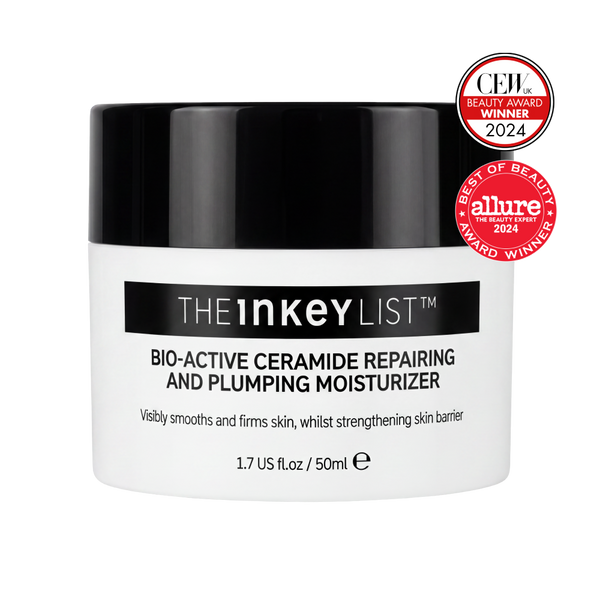
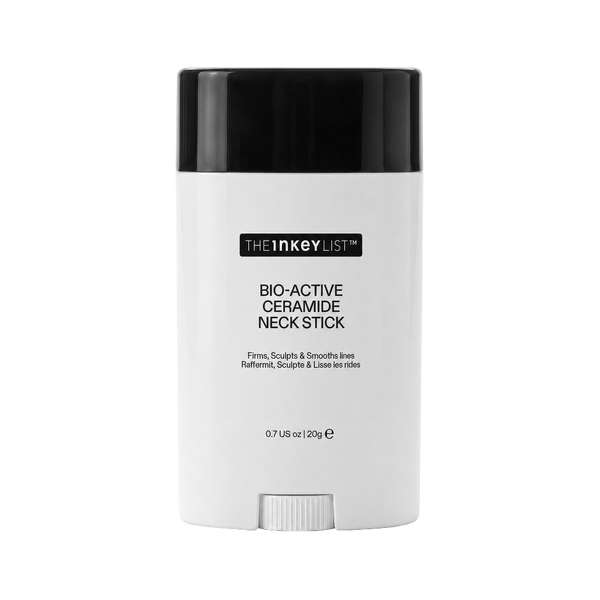
- Moisturise. Bio-Active Ceramide Moisturiser, £20.00, applied upward from the decolletage toward the jawline. If you want something dedicated to the area specifically, the Bio-Active Ceramide Neck Stick, £15.00 is designed for exactly this.
- Protect. Dewy Sunscreen SPF 30, taken down the neck and across the decolletage. Every day, not just sunny ones.
Your evening routine
- Cleanse. Oat Cleansing Balm 150ml, £15.00 to remove SPF, makeup and the day. Massage it down the neck too.
- Treat. A retinoid two to three nights a week to begin with, taken lightly down the neck. If you are new to vitamin A, Starter Retinol Serum, £13.00 is the gentler entry point. If you are experienced and well tolerant, Advanced 0.2% Retinal Serum, £18.00. On alternate nights, use a hydrating or peptide step instead.
- Exfoliate, optionally. Glycolic Acid Toner on a non-retinoid night only, and less often on the neck than on the face.
- Moisturise. Ceramide moisturiser as your final step, applied upward.
The upward direction is the detail most people get wrong. You are working with the natural line of the area rather than dragging skin down, and it takes no extra time once it becomes habit.
How long until you see a difference
Honest timelines, because unrealistic expectations are why most people abandon a routine at week three.
- Around two weeks. Hydration and barrier improvements. Skin feels more comfortable, looks smoother and reads as less crepey. This is a surface and water-content change rather than a structural one, and it is largely about correcting dehydrated skin. Real, visible, but not the same as remodelling.
- Around four to six weeks. Texture refinement from consistent retinoid use and gentle exfoliation. Fine lines start to look softer and the overall surface looks more even.
- Around eight to twelve weeks. The point at which most people notice a genuine difference in the look of established lines. Deeper horizontal lines and platysma bands will soften in appearance rather than disappear.
Skincare improves how neck lines look and helps prevent them worsening. It does not remove structural creasing entirely. We would rather you knew that at week one than discovered it at week twelve.
If you want to place this within a broader approach, our guides on the best anti-ageing skincare routine and when to start using anti-ageing products cover the wider picture.
Consistent care genuinely changes how lines look. Some readers will still want to know what exists beyond skincare.
When to Consider Professional Neck Treatments
We do not sell any of the following. We think you should know about them anyway.
These are options a qualified practitioner can discuss with you, and they work alongside daily care rather than replacing it. Good in-clinic results still require daily sun protection and consistent skincare to hold. Nobody gets a procedure and then stops looking after the area.
Microneedling and radiofrequency microneedling. These create controlled micro-injury to prompt the skin’s own repair response, encouraging new collagen formation. Both have been studied for neck rejuvenation, with reported improvement in the severity of horizontal neck wrinkles. Different devices and depths suit different concerns, which is a conversation for a practitioner rather than a website.
Radiofrequency and combination approaches. Fractional radiofrequency microneedling has been studied both on its own and in combination with other modalities, with reported improvements in skin quality and line appearance. Combination protocols are increasingly common in clinical practice.
Neurotoxin for platysma bands. Botulinum toxin relaxes the platysma muscle, which softens the vertical cord-like bands running down the front of the neck. This is the one treatment on this list that addresses a cause topical skincare fundamentally cannot reach, because the bands originate in muscle rather than skin. Different injection techniques suit different goals.
The honest limitations. Much of the published research in this area involves small participant groups, follow-up periods are often short, and results generally require repeat treatments to maintain. That does not mean these treatments do not work. It means the evidence base is less mature than the marketing around it suggests, and you should go in with calibrated expectations.
Anything in-clinic should be discussed with a qualified medical practitioner who can assess your skin in person. No article, including this one, can tell you what is appropriate for you.
Most of the questions people ask about neck lines come up again and again, so here they are.
The Takeaway
Three things matter more than everything else in this article. Extend the routine you already have down over your neck and decolletage, applying upward. Protect the area from UV every single day, because sun exposure is the most preventable cause by a wide margin. And give it at least eight to twelve weeks of consistency before you judge whether it is working.
Being clear about what is achievable: neck lines can be softened, prevented from worsening and genuinely improved in appearance. They are not erased by a cream, and any brand telling you otherwise is overpromising. The same honesty applies to tech neck. Raising your screen and taking movement breaks are worth doing, but nobody has proven your phone is permanently creasing your skin, and we are not going to pretend they have.
Start with the Bio-Active Ceramide Moisturiser, £20.00, worked upward from the decolletage to the jawline. If you want something dedicated to the area, the Bio-Active Ceramide Neck Stick, £15.00 is built specifically for it. And if you would rather understand the ingredient before you buy anything, read up on ceramides first. Your needs, our knowledge, and no BS about what skincare can and cannot do.
Frequently Asked Questions
Got a question?
Our askINKEY team are a friendly bunch of skincare experts with deep product knowledge and zero judgement. Whether you're an ingredient obsessive or just starting out, we'll make it make sense. No question too big. No question too small. We Give A Care, Every Day.


