



What is Ceramide NP? The Ingredient on Your Label, Explained
Ceramide NP is the ceramide you'll spot on almost every ingredients label - here's what it actually is, what it does for your skin barrier, and how much of it you really need.
Author
askINKEY skincare advisor
Published
22 August, 2026
Time to read
10 minutes
What is Ceramide NP?
Ceramide NP is a specific type of ceramide used in skincare, and it is the same ingredient that was previously listed as Ceramide 3. If you have turned a moisturiser over and found “Ceramide NP” in the small print, that is what you are looking at: one clearly defined lipid, not a category or a marketing phrase.
It appears on your ingredients list under its INCI name. INCI stands for the International Nomenclature of Cosmetic Ingredients, the naming system that cosmetic brands are legally required to use on packaging. Its purpose is consistency. The same ingredient is called the same thing on every product, whatever the front of the bottle chooses to say.
That system is where our name comes from. INKEY is named after the INCI list, because the brand was built on a straightforward idea: you should be able to read what is in your skincare and understand what it does. Decoding ingredient names is the point of us.
Ceramides as a group are the lipids that help hold the skin barrier together, and if you want the broader picture we have a full guide to what ceramides are and what they do. This article is narrower. It decodes Ceramide NP specifically: what the letters mean, what the ingredient is made from, why it used to be called Ceramide 3, where it sits on a label and whether that matters, how much you actually need, who it suits, and how to use it across face, eyes and neck.
Ceramide NP at a glance
What it is: A ceramide, a type of lipid found naturally in your skin barrier.
Also known as: Ceramide 3, its former INCI name.
What it does: Helps strengthen the look of the skin barrier, supports barrier function and helps skin retain moisture.
Best for: Dry, sensitive, mature and barrier-compromised skin. Suitable for oily and combination skin as well.
How much you need: 0.2%, the concentration used and clinically studied across our Bio-Active range.
Where to find it in our range: Bio-Active Ceramide Moisturiser, £20 for 50ml. Bio-Active Ceramide Eye Cream, £15 for 18ml. Bio-Active Ceramide Neck Stick, £15 for 20g.
With the definition settled, the sensible place to begin is the name itself.
What Does NP Stand For in Ceramide NP?
NP stands for N-acylated Phytosphingosine. That is the answer, and the rest of this section is about making those words useful.
Split it in two. The P is phytosphingosine, the backbone of the molecule, the structural spine that everything else attaches to. The N describes how the fatty acid is joined to that spine, through an N-acyl bond formed at the nitrogen atom on the backbone. A fatty acid attached to a phytosphingosine base. That is a ceramide.
N = N-acylated
P = Phytosphingosine
These letters are structural codes rather than branding. In the ceramide naming convention, the first letter describes the type of fatty acid and the second describes the type of sphingoid base it attaches to. The system scales neatly: change the base and the second letter changes, change the fatty acid and the first letter changes. The name is a compressed description of the chemistry.
There is a practical consequence worth holding onto. Because INCI naming is a legal requirement, every brand using this ingredient must list it identically. There is no premium spelling and no proprietary alternative that quietly means something better. If two products contain it, both labels will read Ceramide NP. What differs is the concentration, the formulation around it and whether the finished product has been tested.
That is the broader value of the INCI list, and the reason we took our name from it. The front of a pack is marketing. The ingredients list is regulated. Learning to read the second one is the most reliable skincare skill there is.
Worth knowing too: Ceramide NP is one of the ceramide types your own skin produces. Your stratum corneum is built from a lipid mixture that includes several ceramide species, and NP is among them. Applying it topically is not introducing something unfamiliar. You are supplementing a lipid your skin already recognises and already uses structurally.
You will see other ceramides on labels as well, including Ceramide AP and Ceramide EOP, which follow the same letter logic with different components. We have covered that comparison in full elsewhere, along with what makes a ceramide bio-active, in how bio-active ceramides compare to regular ceramides.
There is one further naming question that causes regular confusion, and it comes from the older name still in circulation.
Ceramide NP and Ceramide 3 Are the Same Ingredient
To be direct, because this causes more label confusion than anything else in the category:
Ceramide 3 is the former INCI name. It was replaced by Ceramide NP. It is the same ingredient. The molecule did not change. The naming system did.
If you see Ceramide 3 on a label, you are looking at Ceramide NP under its old name.
The reasoning behind the change is simple once you see both systems side by side. The original convention numbered ceramides sequentially, producing names such as Ceramide 1, Ceramide 2 and Ceramide 3. Those numbers described nothing about the molecules themselves, and as more ceramide species were characterised, a numbered list became steadily less useful. The industry moved to the structural letter-code system, where the name carries actual information about what the molecule is. Ceramide 3 became Ceramide NP.
This is documented in the Safety Assessment of Ceramides as Used in Cosmetics from the Cosmetic Ingredient Review, the independent panel that assesses cosmetic ingredient safety. The assessment states that Ceramide 3 will be replaced by Ceramide NP, and defines the NP designation in terms of N-acylated phytosphingosine.
The same can be verified through official ingredient identity records. The FDA UNII database entry for Ceramide NPlists Ceramide 3 as a recognised synonym. UNII records exist to give each substance one unambiguous identifier, so a synonym listing there is about as settled as ingredient identity gets.
In practical terms, when you are comparing two products:
- Older packaging may still say Ceramide 3. Packaging artwork is updated on long cycles, so anything produced before the transition may carry the older name.
- Older articles will say Ceramide 3. A good deal of the skincare writing online predates the change and is describing the ingredient you now know as Ceramide NP.
- One product listing Ceramide 3 and another listing Ceramide NP are offering the same ingredient. Judge them on concentration, formulation and evidence rather than on which name is printed.
- Neither name is better. Ceramide NP is simply the current correct INCI name.
If you already know you want the ingredient rather than the explanation, our ceramide range is built around it.
Knowing what something is called leads naturally to what it is made from.
What is Ceramide NP Made Of and Where Does It Come From?
Ceramide NP is a lipid. Structurally it is a phytosphingosine backbone with a fatty acid attached, which is precisely what the name indicated. That is the whole molecule. It is not a complex, a blend or an extract, but a single defined compound.
Your skin produces ceramides continuously as part of building and maintaining the stratum corneum. They sit alongside cholesterol and free fatty acids in the lipid matrix filling the space between skin cells, and Ceramide NP is among the types your skin makes. The molecule your skin produces and the molecule in a well-made product are the same molecule.
Where it comes from is a reasonable question, because ceramides can be obtained in more than one way. The Ceramide NP used across our Bio-Active range is plant-derived rather than animal-derived, produced through a controlled process.
There are practical advantages to that beyond the ethical one:
- Consistency. Every batch is the same, with no seasonal or biological variation in the raw source.
- Purity. A controlled process means a defined, well-characterised ingredient.
- No animal-derived inputs. Which is what makes the certifications below possible.
Our Bio-Active Ceramide Moisturiser holds the certifications to support this:
- Certified by The Vegan Society
- Leaping Bunny approved
- Fragrance-free
- Alcohol-free
- Non-comedogenic
- Dermatologically tested
Plant-derived is not a performance compromise, and there is published work on exactly this point. A 2022 study on plant-derived Ceramide NPs examined ceramide NPs built from plant seed oils and found they accelerated barrier recovery and improved stratum corneum cohesion in human testing, with the researchers noting that plant-oil-derived versions can more closely reflect the fatty acid diversity of human skin ceramides. For wider grounding on ceramide function, the review Ceramides in Skin Health and Disease: An Update is a useful overview.
None of which means the presence of the ingredient on a label is sufficient on its own. Which brings us to the question people ask as soon as they spot how far down the list it sits.
Where Ceramide NP Sits on an Ingredients List and How Much You Need
This is the most common misreading of an ingredients list, and correcting it is worthwhile, because it leads people to dismiss good formulas and overrate weak ones.
INCI lists are ordered by concentration in descending order, but only down to 1%. Below 1%, ingredients may be listed in any order. That is the rule. The top of an ingredients list is genuinely informative. The bottom half is considerably less so than most people assume.
So finding an ingredient near the end of a list, after the preservative, tells you it is used at under 1%. Whether that is a concern depends entirely on how much of that particular ingredient is needed.
Take our own product as the worked example. On the Bio-Active Ceramide Moisturiser, Ceramide NP appears in the second half of the ingredients list, after the preservative. That is expected and correct for an ingredient used at 0.2%.
With ceramides, more is not automatically better. This is the part that tends to get lost. There is a persistent assumption that a higher percentage means a stronger product, carried over from how people think about acids and vitamin C. Ceramides do not behave that way. They are structural lipids that integrate into an existing matrix. What matters is not how much you can load in, but whether the concentration in the bottle is the one that was tested and shown to do something.
Ours is 0.2%. That figure is the level tested in a 12-week independent clinical study of 30 people comparing Ceramide NP at 0.2% against a placebo formulation, which supports up to 4x visible fine line and wrinkle reduction versus standard ceramide formulations*.
At finished formula level, the Bio-Active Ceramide Moisturiser is clinically proven to strengthen the skin barrier from first use** and clinically proven to deliver 24-hour hydration**.
Barrier lipids matter for hydration because of water loss. A barrier well supplied with lipids retains water more effectively than a depleted one, and we have set out the mechanism in our guide to how skin loses moisture.
Independent research points the same way for this specific ceramide. A human study by Lim et al on a lipid mixture enriched by Ceramide NP found skin treated with the Ceramide NP-enriched mixture showed significantly better barrier recovery, better stratum corneum integrity and greater hydration than skin treated with the vehicle alone. The researchers concluded that both the ceramide subtype and the diversity of fatty acid chain lengths contributed to the result, which is another way of saying formulation is not a detail.
The takeaway on label position: do not read the lower half of an ingredients list as a ranking of importance. Read the top to understand the base of the formula, then look for whether the brand has published the concentration of its actives and whether that concentration has been tested. A brand that will not tell you the percentage is asking you to treat list position as evidence. It is not evidence, in either direction.
Study footnotes
*12-week independent clinical study of 30 people, comparing the performance of the ingredient Ceramide NP at 0.2% vs a placebo formulation.
**4-week clinical study of 20 people.
*4-week consumer trial of 70 people.
With concentration settled, the next question is whether the ingredient suits your skin in particular.
Is Ceramide NP Good for Your Skin Type?
Ceramide NP is one of the more broadly suitable ingredients in skincare, largely because it is not an active in the conventional sense. It does not exfoliate or resurface, and it does not require an adjustment period. It replenishes a lipid your barrier is built from. The question is therefore less about tolerance and more about how much difference you are likely to see.
Here is how it breaks down. If you are unsure which category you fall into, you can work out your skin type first.
Dry skin
The most direct fit. Dryness is, at its simplest, a shortage of lipids and the resulting difficulty holding water. Ceramide NP addresses that structurally rather than only sitting on the surface as an occlusive layer, replacing something the barrier is short of with a lipid the skin already produces.
Sensitive and reactive skin
A great deal of what presents as sensitivity is a barrier that is not holding up. When the lipid matrix is compromised, irritants penetrate more easily and skin reacts to things it would otherwise tolerate. Supporting barrier function often reduces that reactivity over time. Our Bio-Active Ceramide Moisturiser is fragrance-free, alcohol-free and clinically tested for sensitive skin.
Eczema-prone skin
There is well-established research here. The foundational work by Imokawa et al found markedly reduced ceramide levels in the stratum corneum of atopic skin, including in areas that appeared unaffected, and proposed ceramide deficiency as a factor in atopic dry skin. That is much of why ceramide-containing formulas are so often suggested for eczema-prone skin. To be clear on scope, skincare is cosmetic rather than medical. If you have a diagnosed condition, speak to your doctor about managing it.
Oily and combination skin
Yes, and this is the objection we hear most often, so it deserves a proper answer. The assumption is that skin already producing plenty of oil does not need more lipids. But oil and hydration are different things. Sebum is not the same as the ceramide-cholesterol-fatty acid matrix that holds water in the barrier, and it is entirely possible to be oily and dehydrated simultaneously. Our Bio-Active Ceramide Moisturiser is clinically tested non-comedogenic. If you would still prefer something lighter, Omega Water Cream is an oil-free, water-based option containing 0.2% Ceramide Complex.
Mature skin
Natural ceramide production slows with age. According to the Cleveland Clinic, ceramides make up roughly half of the lipids in the epidermis, and ageing skin replenishes them more slowly. The Imokawa research observed the same age-related decline in total ceramide content. Replenishing them becomes more relevant over time rather than less.
Stressed or easily irritated skin
If your skin is reacting to environmental stress, weather or an overloaded routine, Ectoin Hydro-Barrier Serum at £16 contains a 1% Barrier Blend of three ceramides and is designed for skin being pushed around by its environment.
If you use retinol or acids
Ceramides support the barrier, which makes stronger actives more comfortable to continue using. Our pillar guide covers layering and pairing in full.
Once suitability is established, the remaining question is which format belongs where.
Ceramide NP on Face, Eyes and Neck
Skin is not uniform. Thickness, oil gland density and how much an area moves all vary considerably between the cheeks, the eyelids and the neck. The same ingredient can be right for all three while needing a different texture, delivery format and supporting ingredients in each. That is why Ceramide NP appears three times across our range.
Face
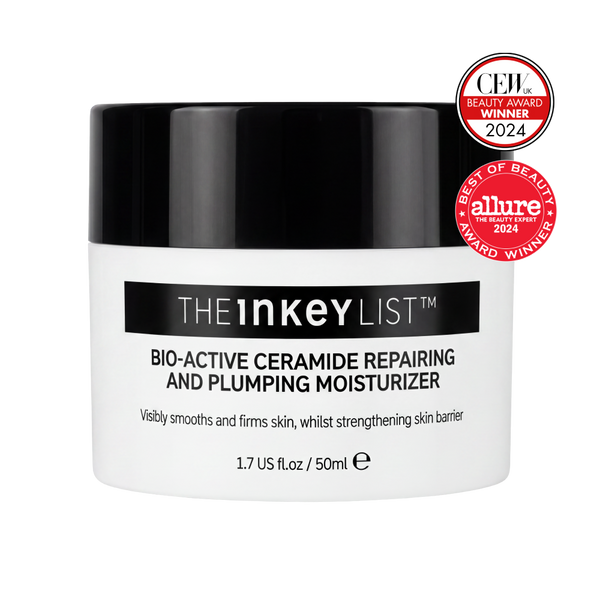
The Bio-Active Ceramide Moisturiser is the core of the range at £20 for 50ml. It combines Bio-Active Ceramide NP with 5% Gransil Blur X-11, Glycerin and Shea Butter, pairing barrier support with immediate smoothing and a soft-focus finish.
The results: 100% saw a clinical improvement in 6 signs of ageing in 28 days**. On texture and wearability, 91% agree it did not pill and 88% agree it created a smooth base for makeup*, which addresses the two most common complaints about barrier creams. A moisturiser that balls up under foundation does not get used, however good the ingredients list.
Eyes
The skin around the eyes is the thinnest on the face and has the fewest oil glands, so it shows lipid loss earlier and more visibly than elsewhere. It is also in near-constant movement.
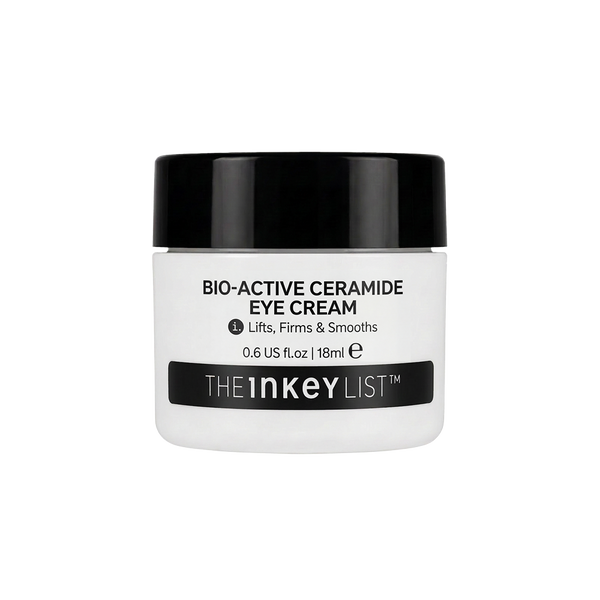
The Bio-Active Ceramide Eye Cream, £15 for 18ml, pairs Ceramide NP with a Tetrapeptide Complex. It lifts the appearance of eyelids by 29% in 4 weeks, and 89% saw fine lines instantly smoothed, from a study of 32 participants over 28 days. It is dermatologist and ophthalmologist approved, which is worth noting for anything used near the eye area and particularly if you wear contact lenses.
Neck
The neck is thinner than the face, more mobile and frequently skipped when a routine stops at the jawline. It is also the area most affected by how we hold our heads over screens.
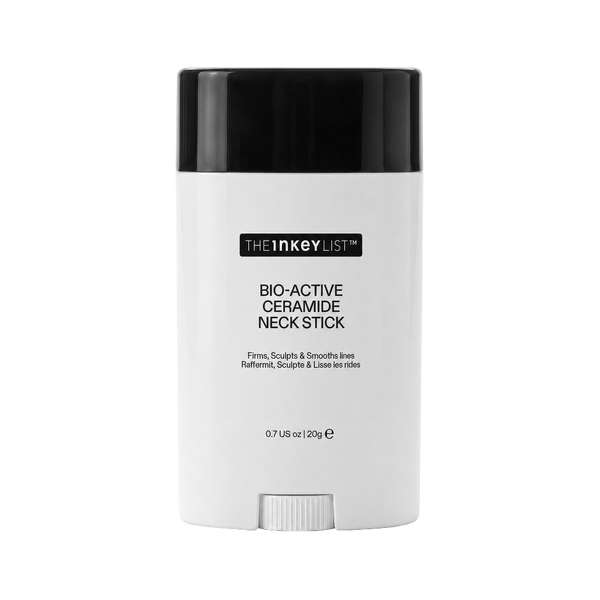
The Bio-Active Ceramide Neck Stick, £15 for 20g, delivers 0.2% Bio-Active Ceramide NP with 1% Gatuline In-Tense MB and 2% CO2llageneer, in a stick format that makes the neck genuinely easy to include. It is clinically proven to lift, tighten and firm in 14 days, reduces the appearance of tech neck by 30% in 8 weeks and improves jawline tightness by 32% in 56 days, from a study of 28 participants over 8 weeks.
On the two neck concerns people ask about most, tech neck refers to the lines that develop from looking down at devices, and crepey skin describes the thin, finely lined texture that develops as skin loses support. Both have their own guides.
To browse the wider category, our full Moisturisers collection is the place to start.
Study footnotes
*12-week independent clinical study of 30 people, comparing the performance of the ingredient Ceramide NP at 0.2% vs a placebo formulation.
**4-week clinical study of 20 people.
*4-week consumer trial of 70 people.
Conclusion
Ceramide NP is not a complicated ingredient once the name is decoded. It is a ceramide your skin already makes, formerly listed as Ceramide 3, plant-derived in our formulas and clinically studied at 0.2%. The letters describe its chemistry rather than its marketing, and a position near the bottom of an ingredients list is not a weakness when the concentration in the bottle is the one that was tested. That is the real lesson of reading an INCI list properly: the label tells you what is in a product, but only the evidence tells you whether it works. Clear guidance, proven ingredients, real results.
If you would like to put that into practice, our ceramide range is built around Ceramide NP, starting with the Bio-Active Ceramide Moisturiser at £20. If you are still deciding what your skin needs, take our skincare quiz.
Frequently Asked Questions
Got a question?
Our askINKEY team are a friendly bunch of skincare experts with deep product knowledge and zero judgement. Whether you're an ingredient obsessive or just starting out, we'll make it make sense. No question too big. No question too small. We Give A Care, Every Day.


