



Ascorbyl Glucoside vs L-Ascorbic Acid: Which Form of Vitamin C Is Right for Your Skin?
Ascorbyl glucoside or L-ascorbic acid? We break down how each form of vitamin C works, why pH and stability matter, and how to pick the one your skin will actually tolerate.
Author
askINKEY skincare advisor
Published
15 August, 2026
Time to read
13 minutes
Two serums can both say vitamin C on the front and behave completely differently on your skin, because the form of vitamin C inside the bottle matters more than the percentage printed on it.
Vitamin C is not one single ingredient. It is a family of molecules, and the one a formula uses determines how stable the product is, what pH it has to sit at, whether it stings, and how the active actually gets into your skin. This is why two people can have opposite experiences with what looks, on the label, like the same thing. The comparison that comes up most often is ascorbyl glucoside vs L-ascorbic acid, and that is the decision this article is written to settle.
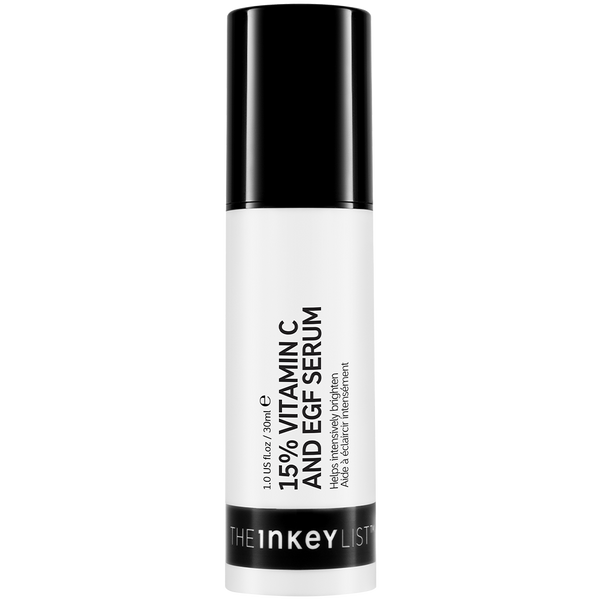
Our own formula uses ascorbyl glucoside. Our 15% Vitamin C + EGF Serum (£16) combines 15% ascorbyl glucoside with 1% Epitensive EGF, a plant-derived vegan peptide, at a verified pH of 6.8 to 7.2. We reference it throughout as a worked example of what a derivative formula looks like in practice, not as the only correct answer. For the wider overview of the ingredient, our pillar guide What is Vitamin C? covers the fundamentals, and you can see the full vitamin C collection if you want to compare formats.
What this blog covers:
- What vitamin C actually is, and why the form changes everything
- How L-ascorbic acid works, and where it falls short
- How ascorbyl glucoside works, and what it trades away
- An honest side-by-side on potency, tolerance, stability and pH
- How to choose based on your skin and your goal
- Realistic results timelines
- Myths and frequently asked questions
Neither form is universally better. L-ascorbic acid is the potency benchmark with the deepest research record. Ascorbyl glucoside is the stable, near-neutral option that most skin tolerates without complaint. The right answer depends on your skin and what you want it to do.
The short answer comes first, for anyone who does not want the full breakdown.
The Short Answer: Which Form of Vitamin C Should You Use?
L-ascorbic acid is the most potent and most researched form of vitamin C, and it suits resilient skin that tolerates a low-pH formula. Ascorbyl glucoside is a stable, near-neutral pH derivative that converts to vitamin C once it is in the skin, and it suits sensitive skin, first-time users, and anyone who has reacted to a vitamin C serum before.
That is the whole decision in two sentences. If you want the quick version of how to place yourself, here it is.
Choose L-ascorbic acid if:
- Your skin is resilient and does not react easily to low-pH products
- You have used a vitamin C serum before without stinging or redness
- You want the form with the longest and deepest clinical research record
- You are willing to manage freshness and replace the product before it degrades
Choose ascorbyl glucoside if:
- Your skin is sensitive, reactive, or you are not sure how it will respond
- You are using vitamin C for the first time
- You have tried a vitamin C serum before and found it stung or turned your skin red
- You want the last pump of the bottle to be as effective as the first
Both stacks are the same length on purpose. This is a genuine trade-off, not a case of one molecule quietly winning.
Here is the most useful honest line in this entire article. The difference people feel between these two forms is almost always tolerance. The difference people see over months is almost always consistency, not raw potency. A powerful serum that irritates your skin into abandoning it after three weeks loses to a gentler one you actually finish.
Ascorbyl glucoside is what we chose for our own formula, at 15% and a verified pH of 6.8 to 7.2, for two straightforward reasons. It stays stable in the bottle rather than degrading over the months you are using it, and it converts to active vitamin C once it has been absorbed. That combination means the product you finish is close to the product you opened. You can read the ingredient overview on our vitamin C pillar page, or look at the 15% Vitamin C + EGF Serum directly.
One question worth answering immediately, because it is the single most searched thing about this ingredient. Is ascorbyl glucoside the same as vitamin C? Yes, it is a form of vitamin C. Specifically, it is a stabilised derivative that your skin converts into active ascorbic acid.
The best vitamin C is the one you can use consistently without your skin objecting.
To understand why these two molecules behave so differently, you need to know what vitamin C is actually doing once it gets into skin.
What Vitamin C Actually Is, and Why the Form Changes Everything
Vitamin C is ascorbic acid. Your skin cannot manufacture it and cannot store large amounts of it, which is why topical application is the route that matters for skincare. Our full vitamin C guide goes deeper into the fundamentals if you want the complete picture.
In skin, it does two well-documented jobs. It works as an antioxidant, neutralising the free radicals generated by UV exposure and environmental pollution. It also interferes with melanin production by inhibiting tyrosinase, the enzyme that drives pigment formation, which is why vitamin C is such a familiar name in conversations about dullness, uneven tone and hyperpigmentation. The broader benefits of the ingredient family are well summarised in The Roles of Vitamin C in Skin Health, which remains one of the most useful overviews available.
Here is the core concept that the rest of this article rests on. L-ascorbic acid is the active molecule. It arrives on your face already in the form your skin can use. Vitamin C derivatives are that same active molecule with something else chemically attached to it, acting as a protective cap. That cap keeps the molecule stable while it sits in the bottle, and your skin removes it after absorption.
That difference sounds small. It is not. It changes everything about how the product behaves.
Think of it as a two-part hurdle. A vitamin C product has to survive intact from the factory to your face, and then it has to cross the skin barrier and reach the layers where it can do something useful. Pure ascorbic acid is genuinely excellent at the second half of that job when it is formulated correctly, and genuinely poor at the first. Derivatives flip the equation. They are built to survive the bottle, and they hand the delivery problem over to your skin’s own enzymes.
A vitamin C serum has two jobs. Survive the bottle, then get into your skin. Very few molecules are brilliant at both.
There are more forms on the market than most people realise, and it helps to know roughly what you are looking at on an ingredients list.
- L-ascorbic acid - the pure, unmodified active. No conversion required.
- Ascorbyl glucoside - a glucose molecule is bonded to the ascorbic acid, and skin enzymes cleave it off to release the active.
- 3-O-ethyl ascorbic acid - an ether derivative with an ethyl group attached, which also needs converting in skin.
- Sodium ascorbyl phosphate and magnesium ascorbyl phosphate - phosphate esters that require dephosphorylating before the vitamin C becomes available.
That is the orientation, not the full map. This article is about the two forms people are genuinely torn between, and the rest of the family is a topic for another day.
The important takeaway is that percentage on a label is close to meaningless without knowing the form and the pH it sits at. Fifteen percent of one molecule is not chemically comparable to fifteen percent of another, because part of a derivative’s molecular weight is the protective cap rather than the vitamin C itself. Any comparison that ignores this is comparing numbers rather than ingredients.
We will start with the form that has the longest research history behind it.
L-Ascorbic Acid Explained: The Potent Original and Its Trade-Offs
L-ascorbic acid is pure vitamin C. It is the biologically active form, the version your skin can use the moment it arrives, with no conversion step in between. There is no ambiguity about whether it works. It is the reference point against which every other form is measured.
The “L” is not a grade or a marketing letter. It refers to the molecule’s three-dimensional orientation, its chirality. Ascorbic acid can exist in two mirror-image configurations, and the L form is the one the body recognises and uses. When you see L-ascorbic acid on an ingredients list, you are looking at the correct-handed, biologically relevant version of the molecule.
The pH rule that explains everything about an l ascorbic acid serum
This is the most important and most misunderstood fact in the entire category. The foundational work here is Pinnell and colleagues’ 2001 percutaneous absorption research, which established that topical L-ascorbic acid must be formulated below pH 3.5 in order to enter the skin at all. Above that threshold, the molecule carries a charge that prevents meaningful penetration.
Below pH 3.5 or it does not get in. That is the whole reason L-ascorbic acid serums sting.
The plain English consequence is unavoidable. An effective l ascorbic acid serum has to be genuinely acidic. Skin’s own surface sits at roughly pH 4.7 to 5.75, so a formula at pH 3.0 is meaningfully more acidic than the environment it is being applied to. That acidity is not a formulation flaw, it is a functional requirement, and it is the source of most of the stinging, tingling and transient redness people associate with vitamin C. If someone tells you a low-pH vitamin C serum stings because it is “working”, they have the causation backwards. It stings because of the pH, and the pH exists because of the chemistry.
The concentration ceiling, and why higher is not automatically better
The same body of research dismantles the assumption that drives a great deal of vitamin C marketing. Pinnell’s work found that percutaneous absorption of L-ascorbic acid increased with concentration up to around 20%, and then plateaued. Beyond that point, adding more vitamin C to the formula did not put more vitamin C into the skin.
That single finding should change how you read a label. A 30% L-ascorbic acid serum is not delivering fifty percent more active than a 20% one. It is delivering roughly the same amount, at a lower pH, with more potential for discomfort. The number on the front of the bottle stopped being a proxy for efficacy somewhere around the 20% mark.
The dosing insight almost nobody talks about
Buried in the same research is a genuinely practical finding that rarely makes it into skincare content. Tissue levels of vitamin C saturated after three daily applications, and the half-life of tissue disappearance was around four days.
Translated into a routine, this means something useful. Once your skin is topped up, it stays topped up for several days. You do not need to double up in the morning and evening to accelerate results, because there is a ceiling on how much your skin will hold. What matters is repeated, regular application over time. Consistency beats intensity, and this is measurable rather than aspirational advice.
The instability problem
L-ascorbic acid’s chemical reactivity is exactly what makes it useful and exactly what makes it fragile. It degrades on exposure to oxygen, light, heat and metal ions, a well-documented set of vulnerabilities covered thoroughly in this review of vitamin C stability in cosmetic formulations. As it degrades it loses potency, which means the real-world strength of a pure acid serum can drift below its label strength over the life of the bottle.
Formulators have developed genuine countermeasures, including airless packaging, anhydrous bases and antioxidant partners such as ferulic acid and vitamin E. These help considerably. They do not eliminate the underlying chemistry. If you want the practical detail on packaging, colour change and where to keep your bottle, our guide on how to store your vitamin C serum covers it properly, and that is the right place for it.
On the sensitivity question, the short version is that low-pH formulas are more likely to cause stinging and redness on reactive skin. That is a tolerance consideration rather than a safety one, and our dedicated piece on whether you can use vitamin C on sensitive skin goes into it in full.
Who L-ascorbic acid genuinely suits
It suits resilient, non-reactive skin. It suits people who have used an l ascorbic acid serum before and know from experience that they tolerate it. It suits anyone who specifically wants the most-studied option available and is prepared to manage freshness, buy smaller bottles, and replace them before they degrade. For a broader look at how vitamin C works mechanistically and clinically, the review on mechanisms and clinical applications of topical vitamin C is a solid authority.
What it does well:
- Delivers the active molecule with no conversion step required
- Has the deepest and longest clinical research record of any form
- Absorption is well characterised, with a known optimal range
- Widely available across a huge range of formulations and price points
What you take on:
- A genuinely acidic formula, with the tolerance implications that carry
- Degradation on exposure to oxygen, light, heat and metal ions
- A shorter usable window, meaning freshness management becomes your job
- A concentration ceiling that makes very high percentages largely pointless
That pH problem is precisely what derivative forms were engineered to solve, and ascorbyl glucoside is the most widely used answer to it.
Ascorbyl Glucoside Explained: The Stable Derivative That Converts in Your Skin
Ascorbyl glucoside, also written as ascorbic acid 2-glucoside or AA-2G, is vitamin C with a glucose molecule bonded to it. That glucose acts as a protective cap. While the molecule sits in the bottle it is shielded from the oxidation that degrades pure ascorbic acid. Once it is absorbed into the skin, alpha-glucosidase enzymes cleave the glucose away and release ascorbic acid.
In pharmacological terms, that makes it a prodrug. A prodrug is an inactive delivery version of a molecule that becomes active once it is inside the body. The compound you apply is not the compound that does the work. It is the vehicle that gets the work to where it needs to be.
The glucose is a lid. Your skin takes it off.
The conversion runs in three steps:
- The serum is applied and ascorbyl glucoside penetrates the skin, protected and intact.
- Alpha-glucosidase enzymes in the skin cleave the glucose bond.
- Free ascorbic acid is released gradually into the tissue, where it goes to work.
What the research actually shows about whether ascorbyl glucoside works
The most compelling evidence in this whole comparison comes from Jacques and colleagues’ 2021 study of ascorbic acid 2-glucoside as an ascorbic acid prodrug, which used human skin explants rather than synthetic membranes. That distinction matters, because enzymatic conversion requires living tissue with functioning enzymes.
The findings were striking. Human skin explants completely metabolised ascorbic acid 2-glucoside into ascorbic acid before any of it reached the receptor compartment. Not partially. Completely. The conversion mechanism is not theoretical, it is observable.
The study also found both the parent glucoside and free ascorbic acid present within the skin layers themselves. That is the reservoir effect: a store of the protected molecule sitting in the skin, converting steadily over time rather than releasing everything at once. Absorption flux peaked at around 12 hours and continued across the full 24-hour measurement period. A pure acid serum delivers its payload and is done. A glucoside serum keeps trickling.
Then comes the finding that reframes the entire potency debate. The same study tested a 15% pure ascorbic acid formula against a 1.8% ascorbyl glucoside formula. As you would expect, the pure acid delivered more total vitamin C by weight. But when the researchers measured oxidative stress markers, the 1.8% glucoside produced very similar protective effects.
Less absolute vitamin C delivered. Comparable antioxidant outcome. Sustained over a longer window.
That is not a claim that derivatives are secretly stronger. It is evidence that delivered dose and biological outcome are not the same axis, and that sustained release can compensate for a great deal of raw concentration.
The pH advantage
Because ascorbyl glucoside does not depend on an acidic environment to be absorbed, it can be formulated close to skin’s own pH. Our 15% Vitamin C + EGF Serum sits at a verified pH of 6.8 to 7.2. That is the entire reason it does not sting the way a sub-3.5 formula can. There is no acid load on the skin barrier, because the delivery mechanism never required one.
The stability at that pH is documented too. Stability studies of ascorbic acid 2-glucoside in cosmetic lotion support its resilience in near-neutral formulations, which is precisely where pure ascorbic acid would be both inactive and rapidly degrading.
Evidence at higher strengths
Explant work establishes mechanism. Clinical work establishes outcome. A 24-week trial of a 28% ascorbyl glucoside-arginine complex formulated at a near-neutral pH of around 6.5 examined solar lentigines, the flat pigmented patches associated with cumulative sun exposure.
The complex significantly reduced pigmentation against both baseline and placebo at 12 weeks and again at 24 weeks, confirmed with colorimeter and Mexameter measurement rather than subjective assessment alone. There was no hypopigmentation and no persistent irritation reported. A high-strength derivative at near-neutral pH produced measurable pigmentation change, given enough time.
On tolerability, the CIR Safety Assessment of Ascorbyl Glucoside and Sodium Ascorbyl Glucoside found no significant dermal irritation or sensitisation up to 10% in human patch testing.
Stability in the bottle is the quieter advantage. Ascorbyl glucoside does not oxidise and brown the way pure ascorbic acid does, so the product you finish is close to the product you started.
Who ascorbyl glucoside suits
It suits sensitive or reactive skin. It suits first-time vitamin C users who want to introduce the ingredient without the low-pH variable confusing the picture. It suits anyone who has stung, tingled or gone red on a previous serum. And it suits anyone who wants the last pump to be doing the same job as the first. Our formula is also suitable during pregnancy and breastfeeding, and our guide on whether you can use vitamin C when pregnant has the detail.
The honest trade-offs:
- It delivers less absolute ascorbic acid than a well-formulated pure acid serum
- Conversion depends on your skin’s enzyme activity, which is less precisely quantified in living skin than in explant models
- Results tend to be steadier rather than faster
With both mechanisms on the table, the two forms can now be compared properly, including the places where the evidence does not give a clean answer.
Ascorbyl Glucoside vs L-Ascorbic Acid: The Honest Head-to-Head
Here is the criterion-by-criterion comparison, with the caveats intact.
Potency. L-ascorbic acid wins on raw delivered dose. It is the active molecule arriving as the active molecule, and no conversion step means no conversion losses. Ascorbyl glucoside delivers less absolute ascorbic acid, but benefits from the reservoir effect, releasing what it does deliver across a longer window.
Tolerance. Ascorbyl glucoside wins clearly. Near-neutral pH removes the single biggest driver of stinging and redness in this category. This is the practical difference most people actually notice, and it is the difference that determines whether a bottle gets finished.
Stability. Ascorbyl glucoside wins. Pure ascorbic acid degrades with oxygen, light, heat and metal ions, which means real-world potency frequently drops below label potency over the life of a bottle. A stable vitamin c serum built on a derivative avoids that decay curve almost entirely, and the glucose bond is doing that protective work.
pH. L-ascorbic acid needs to sit below 3.5 to be absorbed at all. Ascorbyl glucoside works close to skin’s own pH, and our serum’s verified 6.8 to 7.2 is a real-world example of what that looks like on shelf. This is not a minor formulation detail, it is the root cause of most of the differences above.
Speed of visible results. This one deserves care. A fresh, well-formulated l ascorbic acid serum may show changes sooner on tolerant skin, because there is no conversion step and no ramp-up. But a stable derivative used consistently for several months may end up further ahead, for two unglamorous reasons. The bottle is still active in week ten, and the user has not abandoned it because of irritation. Efficacy on paper and efficacy in a bathroom cabinet are different measurements.
Who each suits best. L-ascorbic acid suits resilient skin that tolerates acidity and users prepared to manage freshness. Ascorbyl glucoside suits sensitive skin, first-timers, and anyone who values consistency over peak intensity. The next section turns that into a proper decision.
The caveat that most comparisons leave out
There is no clean head-to-head trial that settles this.
That deserves to be stated plainly rather than buried. There are very few direct head-to-head randomised controlled trials comparing ascorbyl glucoside vs ascorbic acid in the same study population, under the same conditions, measuring the same endpoints. Almost everything we know comes from separate absorption studies, in-vitro work, explant models and individual clinical trials with different designs and different participants.
Anyone claiming a definitive winner between these two forms is going beyond what the published evidence supports. There is a further complication worth knowing. Most clinical trials of topical vitamin C use concentrations under 10%, which sits well below the strengths at which these two forms are typically sold. So even the clinical record we do have is not testing the products people actually buy.
For context on vitamin C’s clinical track record generally, a systematic review of topical vitamin C in melasma and photoaging is a useful starting point, and a frequently cited randomised trial comparing 5% L-ascorbic acid with 4% hydroquinone in melasma found meaningful results with fewer side effects on the vitamin C side. That is a real data point about the ingredient. It is explicitly not a data point about which molecular form is superior, because only one form was tested. The broader mechanisms and clinical applications review is worth reading if you want the full clinical context.
If you are weighing vitamin C against entirely different brightening actives rather than comparing forms within the category, our vitamin C vs niacinamide vs exosomes comparison covers that ground.
The practical synthesis is this. The form that gets used consistently, in a product that is still active when you reach the end of it, is the form that delivers. You can see how we have applied that thinking across our vitamin C range.
Since the evidence does not crown a universal winner, the decision comes down to your skin and your goal.
How to Choose: Matching the Right Vitamin C Form to Your Skin and Your Goal
Find yourself below.
If your skin is sensitive or reactive. Ascorbyl glucoside at near-neutral pH is the sensible starting point. You remove the acidity variable entirely, which means if something does not agree with you, you can identify it rather than guessing. Our full guidance on using vitamin C on sensitive skin covers this properly.
If you have never used vitamin C before. Start with a stable derivative. You will learn how your skin responds to the ingredient itself, without a low pH clouding the picture. Introduce it slowly, ideally every other morning for the first fortnight, and build from there. Our vitamin C routine guide for beginners walks through the sequencing.
If your main concern is dark spots and uneven tone. Both forms act on melanin production through tyrosinase inhibition, so neither is disqualified. The 24-week glucoside-arginine trial on solar lentigines is good evidence that the derivative route delivers on pigmentation when given a proper run at it. It is worth knowing that tranexamic acid targets a different point in the same pigmentation pathway, which is why the two are often used together. Our Tranexamic Acid Serum (£17) is built for that, and our guide on vitamin C and tranexamic acid for dark spots explains the pairing. For the wider picture, see how to get rid of dark spots and what hyperpigmentation actually is.
If you have oily or blemish-prone skin. Lightweight, water-based vitamin C serums layer well under other products without adding weight, and fragrance-free formulas are the sensible default when your skin is already dealing with congestion or post-blemish marks. Browse blemishes and breakouts for products formulated with that in mind, and if you are worried about purging, our piece on whether vitamin C can cause breakouts answers it directly.
If your skin is dry or your barrier feels compromised. The low pH of an L-ascorbic acid formula is more likely to feel uncomfortable on a barrier that is already struggling. A near-neutral derivative paired with a barrier-supporting moisturiser is the steadier route. Our Bio-Active Ceramide Moisturiser (£20) is designed to support the barrier while you introduce an active.
If you are pregnant or breastfeeding. Our 15% Vitamin C + EGF Serum is formulated to be pregnancy and breastfeeding safe. As always, check with your healthcare provider before starting anything new during pregnancy or while breastfeeding. Our guide on using vitamin C when pregnant has more.
If your skin is resilient and you have used vitamin C happily before. L-ascorbic acid is a legitimate choice, and that is worth saying without hedging. If your skin tolerates a low pH and you are prepared to manage freshness, buy sensible sizes and replace bottles before they degrade, you are getting the most-studied form of the ingredient with no conversion step in between. That is a real advantage and there is no reason to talk you out of it.
If you genuinely cannot tell which camp you are in. That is common, particularly if you have never used an active before or your skin behaves inconsistently across seasons. Our skincare quiz builds a personalised routine in about two minutes.
A note on how the choice plays out in practice for anyone shopping for a vitamin c serum uk-side. Availability is not the constraint it once was, and both forms are easy to find at reasonable prices. The constraint is self-knowledge. People buy the highest percentage they can find, react to it, conclude that vitamin C does not suit them, and abandon an ingredient that would have worked perfectly well in a different form. That is a form-selection failure being misread as an ingredient failure.
Pick the form your skin will tolerate every single day, then give it twelve weeks before you judge it.
Whichever form you choose, expectations need setting correctly, because most disappointment with vitamin C is a timing problem rather than a product problem.
What Results to Expect, and How Long They Realistically Take
Vitamin C is not an overnight ingredient. Here is the honest timeline.
- Weeks 1 to 2: Skin feels more hydrated, with a subtle initial glow. Nothing dramatic, and nothing that should be.
- Weeks 3 to 4: Visible brightness, with tone beginning to even out.
- Weeks 6 to 8: Meaningful change in dark spots and overall clarity.
- Week 12 and beyond: Continued improvement in firmness and general skin health.
Our own consumer data sits in that first window.
In a 4-week independent consumer trial of 64 people using our 15% Vitamin C + EGF Serum: 87% agreed skin looks brighter, 88% saw visible improvement in tone and texture, and 84% agreed skin looks healthier and less dull.
Those figures come from an independent consumer trial of 64 participants over four weeks. They reflect what people reported seeing, and they are consistent with what the timeline above would predict at the four-week mark.
The Pinnell dosing insight reinforces the same point from a different direction. Because skin levels saturate after roughly three daily applications and take around four days to fall, there is no benefit in applying more than once a day. Consistency matters far more than intensity, and that is a measured finding rather than a slogan.
A reality check on pigmentation specifically. The 24-week glucoside trial recorded its strongest results at 24 weeks, not at four. Dark spots are a months-long project regardless of which form you choose, and any product promising otherwise is overpromising. If you are using a vitamin c serum for dark spots, plan in seasons rather than weeks.
How to use it
- Apply to clean, slightly damp skin.
- A pea-sized amount is enough for the whole face.
- Morning is the usual choice, because antioxidant protection is most useful during daylight hours.
- Follow with moisturiser, then sunscreen.
- Our serum should not be layered with retinol, AHAs, BHAs or PHAs in the same routine.
For the full timing breakdown, see our guide on when to use vitamin C.
What it pairs with
Vitamin C sits comfortably alongside hyaluronic acid and niacinamide, and our Hyaluronic Acid Serum (£12) layers underneath it without any conflict. Keep vitamin C and retinol or exfoliating acids in separate routines rather than stacking them. The detail is covered in our guides on niacinamide and vitamin C together, hyaluronic acid with vitamin C and vitamin C and retinol together.
Sunscreen is not optional here. Vitamin C works on pigmentation and photodamage, and unprotected UV exposure works against you faster than any serum works for you. Our Dewy Sunscreen SPF 30 (£15) finishes the routine, and our piece on vitamin C and SPF explains why the pairing is non-negotiable.
A few persistent myths are behind most poor vitamin C decisions, so they are worth clearing up.
Vitamin C Myths, Cleared Up
Myth: a higher percentage always means better results.
Reality: absorption of L-ascorbic acid peaks at around 20%, and most clinical trials demonstrating benefit used concentrations under 10%. A percentage without the form and pH alongside it tells you very little. It is an easy number to print and a difficult one to interpret.
Myth: derivatives are just watered-down vitamin C.
Reality: Jacques 2021 found ascorbyl glucoside completely metabolised to ascorbic acid in human skin explants, and at 1.8% it matched a 15% pure acid formula on antioxidant markers within the same study. That is a different delivery strategy, not a diluted version of the same one.
Myth: if it does not tingle, it is not working.
Reality: tingling is a pH effect, not an efficacy signal. A near-neutral formula at pH 6.8 to 7.2 is doing its job silently, because it never needed acidity to get in. Stinging is a pH reading, not a progress report.
Myth: L-ascorbic acid is the only real vitamin C.
Reality: it is the only form that is active on arrival, which is a meaningful distinction but a narrower one than it sounds. Derivatives become the same molecule once your skin’s enzymes have done their work. The destination is identical, the route differs.
Myth: you need to apply it twice a day for faster results.
Reality: Pinnell’s research found tissue levels saturate after around three daily applications and take roughly four days to fall. Once your skin is topped up, more does not add more. You are using product without gaining benefit.
Myth: ethyl ascorbic acid is the same as L-ascorbic acid.
Reality: 3-O-ethyl ascorbic acid is a separate ether derivative with an ethyl group attached, and it also has to be converted in skin. Similar family, genuinely different molecule, different behaviour.
None of these are silly things to have believed. Most of them are repeated confidently by people who should know better, and several were reasonable interpretations of older information. The systematic review of topical vitamin C and our full vitamin C guide are both good places to keep reading.
Now to the direct questions people search most.
The Verdict on Ascorbyl Glucoside vs L-Ascorbic Acid
The form of vitamin C in your serum matters more than the number on the front of the bottle.
The trade-off is clean once you see it properly. L-ascorbic acid offers the highest potency and the longest research record, and asks you to accept a low pH and a short usable life in return. Ascorbyl glucoside offers stability, near-neutral pH and a reservoir effect that keeps releasing over time, and asks you to accept a lower absolute dose delivered more gradually.
Without direct head-to-head trials, the sensible decision is based on your own skin’s tolerance and your own consistency, not on a claimed winner. That caveat is worth carrying with you the next time you read a confident comparison somewhere else.
The short version:
- L-ascorbic acid is the potency benchmark, and it needs a low pH to work, which is what makes it sting.
- Ascorbyl glucoside is stable at near-neutral pH and converts in your skin, which is what makes it gentle.
- The one you use every day, in a bottle still active in week ten, is the one that produces results.
Results from any form of vitamin C take weeks rather than days, and daily sunscreen protects the progress you make along the way. Our Dewy Sunscreen SPF 30 is a straightforward way to finish the routine. Choose the molecule your skin will accept, then give it long enough to prove itself.
Where to Go From Here
Our 15% Vitamin C + EGF Serum (£16, 30ml) is 15% ascorbyl glucoside with 1% Epitensive EGF, formulated at a verified pH of 6.8 to 7.2. Fragrance-free, suitable for all skin types including sensitive, pregnancy and breastfeeding safe, and Vegan Society certified.
Still weighing it up? Our skincare quiz builds a personalised routine in about two minutes.
Want to compare formats first? Browse our full vitamin C range.
Or read the complete vitamin C guide for the broader overview of the ingredient.
Frequently Asked Questions
Got a question?
Our askINKEY team are a friendly bunch of skincare experts with deep product knowledge and zero judgement. Whether you're an ingredient obsessive or just starting out, we'll make it make sense. No question too big. No question too small. We Give A Care, Every Day.


