



When to Use Vitamin C Serum: Morning or Night, Routine Order & How Often
Morning or night, before or after moisturiser, every day or not — here's exactly when to use your Vitamin C serum, and why timing changes your results.
Author
askINKEY skincare advisor
Published
17 May, 2026
Time to read
16 minutes
Knowing when to apply Vitamin C serum is one of the most common skincare questions we get asked, and the answer is refreshingly simple. Apply your Vitamin C serum in the morning, after cleansing, on slightly damp skin, before moisturiser and SPF.
That is the short version. The rest of this article explains the reasoning, because understanding why the timing works makes it far easier to stick to. We will cover the best time of day to use Vitamin C, exactly where it sits in your routine order, how to apply it properly, how often to use it, which ingredients to keep in a separate part of the day, and how long results realistically take to show up.
If you are looking for what is Vitamin C serum and how the ingredient actually works on skin, our What is Vitamin C? guide covers the fundamentals in full. This article is about timing.
Here is why timing is worth getting right. Vitamin C is an antioxidant, and antioxidants earn their value when there is something to defend against. Put simply, an antioxidant applied at the wrong end of the day is still doing a job, just not the most useful one available to it.
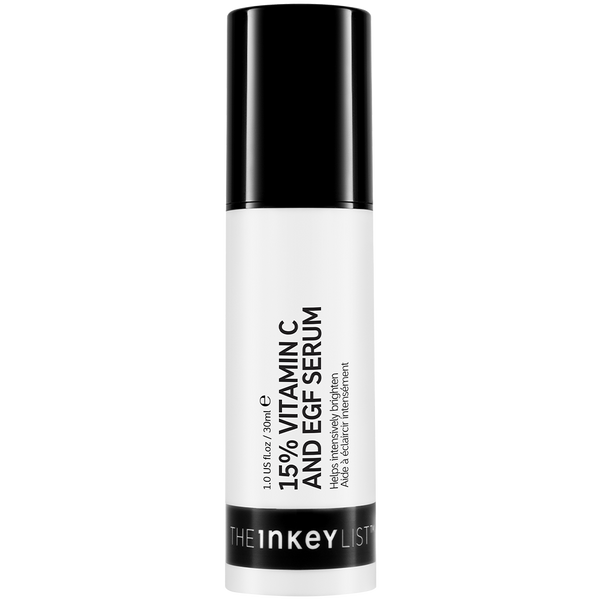
One quick note before we begin. INKEY’s 15% Vitamin C + EGF Serum (£16) is formulated with Ascorbyl Glucoside, a stable Vitamin C derivative. Stability is not the deciding factor in this article. Strategy is.
When to Apply Vitamin C Serum: Morning or Night?
The best time to apply Vitamin C serum is the morning. If you take one thing from this article, take that.
The question of when to use Vitamin C serum day or night comes up constantly, and the reason it generates so much confusion is that both answers appear defensible on the surface. Vitamin C serum morning or night is one of the most searched skincare debates going, and the internet is full of people arguing both sides with total confidence. The morning case, though, is stronger, and it comes down to what the ingredient is actually built to do.
Why Morning Is the Better Slot for Vitamin C
Vitamin C is an antioxidant. Antioxidants work by neutralising free radicals, which are unstable molecules generated by UV light, pollution, and general environmental stress. Free radicals are missing an electron, so they go looking for one, and they take it from whatever cell is nearest. That process is what contributes to dullness, uneven tone and visible signs of premature ageing over time. An antioxidant steps in and donates an electron before your skin cells have to.
Now think about when free radicals are generated. UV exposure happens during daylight hours. Pollution exposure happens on your commute, on the walk to the shops, sitting near an open window in traffic. Environmental stress is a daytime event, overwhelmingly. So applying your antioxidant in the morning means it is already in place and working when the exposure actually happens.
Harvard Health Publishing sets out the same underlying principle, explaining that topical Vitamin C acts as an antioxidant defence against the free radical damage generated by sun exposure and environmental aggressors. This is well-established territory rather than a marketing position.
Here is the way we find most useful to think about it. Applying Vitamin C at night is a bit like arriving after the event has finished. Everyone has gone home. The protection is technically present, but there is nothing left for it to protect against.
The one-line answer: Morning, after cleansing, on slightly damp skin, before moisturiser and SPF.
Should I Use Vitamin C Serum at Night?
Let us be fair here, because a lot of skincare advice online overstates its case and this is one of those areas.
Using Vitamin C at night is not wrong. It is not harmful. It will still deliver brightening benefits, still support a more even-looking tone, and still contribute to the cumulative results we describe later in this article. Vitamin C does not stop working at sunset.
What night application does is leave value on the table. You get the brightening, but you miss the daytime antioxidant defence, which is arguably the most compelling reason to use the ingredient in the first place. So it is a missed opportunity rather than a mistake.
And there is an important caveat to that. If your life genuinely works better with an evening skincare routine, if mornings are chaotic and the serum will simply go unused, then use it at night. Some use always beats no use. Consistency delivers results. A perfectly timed routine you abandon after nine days delivers nothing at all. We would rather you used Vitamin C at 10pm every night than intended to use it at 7am and never did.
The Second Argument: Your Evening Slot Is More Valuable Elsewhere
There is a whole other reason to keep Vitamin C in the morning, and it has nothing to do with Vitamin C itself. It has to do with everything else in your bathroom cabinet.
Some ingredients genuinely need to be used at night. Retinoids are photosensitive, which means they can degrade in sunlight and can leave skin more reactive to UV exposure, so they are firmly a PM ingredient. Exfoliating acids are also best used away from direct sun exposure. These are not preferences, they are functional requirements.
Vitamin C has no such requirement. It is perfectly happy in daylight, and in the case of a stable derivative, particularly so. That makes it the obvious candidate for the morning slot, which frees your evening entirely for the ingredients that have no alternative.
Splitting your routine across the day this way means neither slot is wasted. Antioxidant defence in the morning. Renewal and resurfacing at night. Two distinct jobs, two distinct windows, no competition between them. It is the single most efficient structure for a routine containing multiple actives, and it happens to solve the “can I use these together” problem at the same time. Readers who want the broader picture on antioxidants and where they fit will find more in your guide to antioxidant skincare.
A Note on Stability, Since Someone Always Asks
You may have read that Vitamin C is unstable, that it oxidises rapidly, and that this is somehow an argument for night use. It is worth addressing directly.
The instability reputation attaches primarily to pure L-Ascorbic Acid, which is the most potent form of Vitamin C and also the most temperamental. DermNet, the dermatology reference resource, makes the broader point clearly: the behaviour of topical Vitamin C depends significantly on which form of the ingredient a product uses. Different derivatives behave differently in terms of stability, penetration and tolerance.
INKEY’s 15% Vitamin C + EGF Serum uses Ascorbyl Glucoside, a stable derivative. It is not fighting to stay intact in the bottle, and it is not going to fall apart on your face because the sun is up.
Which matters for this article specifically, because it means our morning recommendation is not a workaround for a formulation weakness. It is a strategic recommendation based on when the ingredient does the most good. If you want the full explanation of how the different forms of the ingredient work, the What is Vitamin C? guide breaks it down properly.
Once you accept that morning is the right slot, the next question follows immediately: where exactly in that morning routine does the serum go?
How to Apply Vitamin C Serum: Your Morning Routine Order
The governing principle of layering skincare is straightforward. Thinnest to thickest, lightest to heaviest. Vitamin C serum is lightweight and water-based, so it goes on early.
Knowing how to apply Vitamin C serum correctly is mostly about sequence. Get the order right and every product in your routine performs closer to its potential. Get it wrong and you are applying an excellent serum on top of a barrier it cannot easily get through.
Here is the full morning routine, in order.
-
Cleanse. Start on clean skin so nothing sits between the serum and your face. Overnight your skin produces oil, and there may be residue from last night’s products still sitting on the surface. A quick morning cleanse clears the way.
-
Tone, if you use one. Reach for the Nourishing Rice Milk Hydrating Toner. It hydrates and preps the skin without introducing an exfoliating acid alongside your Vitamin C, which keeps your morning routine simple and comfortable. If you own the PHA Toner (£14), keep it for your evening routine instead. The rule is easy to remember: Vitamin C in the AM, PHA in the PM.
-
Apply your 15% Vitamin C + EGF Serum. Onto slightly damp skin. Not soaking wet, not bone dry. Damp skin helps with spreadability and absorption, so you get more from a smaller amount.
-
Any additional serums. Hyaluronic Acid layers well underneath or after, and we cover that pairing in full in our guide to Hyaluronic Acid, with the specific combining question answered in Can you use Hyaluronic Acid with Vitamin C?.
-
Eye cream. If it is part of your routine, pat it gently around the orbital bone rather than dragging product across the delicate skin directly under the eye.
-
Moisturiser. The Vitamin B, C & E Moisturiser (£12) works neatly here, adding hydration while contributing a further antioxidant layer to the morning.
-
SPF. Always last. Non-negotiable, and covered properly in the next section.
That is the whole thing. Seven steps at most, and steps two, four and five are optional depending on your routine. A minimal version is cleanse, Vitamin C, moisturiser, SPF, which takes about ninety seconds.
Vitamin C Serum Before or After Moisturiser?
Before. Every time.
The logic is about texture and delivery. Serums are lightweight, water-based, and formulated with small molecules designed to be delivered directly onto skin. Moisturisers are heavier, richer, and often contain occlusive ingredients whose entire purpose is to form a layer that slows water loss.
Apply moisturiser first and you have asked your serum to travel through a barrier specifically engineered to reduce what passes through it. Some will get there. But you have made the job harder for no reason.
Applied in the correct order, moisturiser also does something useful for your serum. Once the Vitamin C has absorbed, moisturiser goes over the top and helps seal everything in, supporting the skin barrier while the active gets on with its work. Serum delivers, moisturiser seals. That is the relationship.
How to Apply It Properly: Small Details That Change the Result
Application technique is the part almost everyone skips, and it makes a genuine difference to both how the product performs and how long the bottle lasts.
- Use your fingertips, not your palms. Dispense onto a fingertip rather than into your hand. Your palm is large, absorbent, and will happily soak up a meaningful percentage of the product before it reaches your face.
- Press and pat, do not rub. Rubbing drags the skin and pushes product around the surface. Pressing helps it settle where you put it. Work outwards from the centre of the face.
- A pea-sized amount is enough. This is the most common mistake we see. More serum does not mean more results, it means more pilling, longer absorption times and a bottle that empties in six weeks. Three to four drops covers the whole face comfortably.
- Do not forget your neck. Extend whatever is left on your fingertips downwards. The neck shows uneven tone readily and is very often left out.
- Wait around sixty seconds before the next layer. Not because of any chemical reaction, purely because layering onto a wet surface causes pilling. Brush your teeth. Come back. It will have absorbed.
Where Vitamin C Sits If You Are Skin Cycling
Skin cycling has become a popular way to structure a routine, rotating between exfoliation nights, retinoid nights and recovery nights. It is worth clarifying how Vitamin C fits, because it sits slightly outside the system.
Vitamin C stays constant in the morning regardless of where you are in a PM cycling rotation. It does not need a rest night and it does not need to be scheduled around anything. Your evenings rotate. Your morning Vitamin C does not. If you are structuring a routine this way, our guide to skin cycling explains the evening rotation in detail.
The routine ends on SPF, and that final step deserves considerably more than one line, because it is what makes the entire Vitamin C routine worth doing.
Vitamin C and SPF: Why the Pairing Matters
Vitamin C and SPF are not competing options. They are two halves of the same strategy, and using one without the other is how people end up disappointed with results that should have arrived.
The two work on completely different mechanisms. SPF blocks and absorbs UV radiation before it reaches your skin, acting as a physical and chemical shield at the surface. Vitamin C works behind that shield, neutralising the free radicals generated by whatever UV inevitably gets through. Different jobs, same problem.
No sunscreen filters one hundred percent of UV, and in real-world conditions almost nobody applies the quantity used in laboratory testing. There is always a percentage getting through. That percentage is precisely what your antioxidant is there for.
Dermatologist Melissa Piliang, MD, describes the relationship neatly in Cleveland Clinic’s guidance on Vitamin C serum, noting that combining the two produces better protection because they work together:
If any of the sun gets through that sunscreen, the vitamin C is there to take care of it.
That is also, incidentally, why she recommends applying Vitamin C in the morning rather than overnight. Her phrasing is that the two work “in synergy.” It is a useful independent confirmation of this article’s central argument.
The Reason This Matters More Than It Sounds
Here is the practical consequence, framed positively rather than as a warning.
Vitamin C is frequently used to support a brighter, more even-looking complexion, and to help address existing areas of uneven tone. UV exposure is one of the primary triggers for the pigment production that creates uneven tone in the first place. So if you are using Vitamin C daily without daily SPF, you are working on tone at one end while the sun keeps adding to the workload at the other.
It is a bit like filling a bucket with a hole in the bottom. You can absolutely keep pouring, and the level will rise eventually, but you will get there far faster if you deal with the hole.
Think of SPF as protecting your investment. You have chosen the serum, built the habit, and committed to the routine. SPF is what allows that effort to compound rather than reset. Understanding how SPF works and what the numbers actually mean makes this considerably easier to get right.
Vitamin C and SPF are partners, not alternatives.
Can You Apply Sunscreen Straight After Vitamin C Serum?
Yes, you can. There is no chemical reason to wait, no incompatibility, and nothing about Vitamin C that interferes with the performance of sunscreen filters.
The only reason to pause is textural. Give your serum around sixty seconds to absorb before applying SPF, and the sunscreen will spread evenly and sit properly on the skin. Apply SPF onto a surface that is still wet with serum and you will get pilling, rolling, patchy coverage, and the distinctly irritating experience of a product balling up under your fingers.
That minute is the difference between an even, comfortable finish and having to start again.
For the final step, the Dewy Sunscreen SPF 30 (£15) sits comfortably over serum and moisturiser without disrupting the layers underneath. It is a lightweight finish rather than a heavy one, which matters enormously for daily compliance, because the honest truth is that people skip sunscreens they find unpleasant to wear.
One Line on Reapplication
If you are indoors most of the day, your morning application is doing the bulk of the work. If you are outside for extended periods, commuting in strong sun, or sitting by a window for hours, reapplication through the day is what maintains protection. It does not need to be complicated, and it does not affect the Vitamin C you applied at 7am, which has long since absorbed.
We will not turn this into a sunscreen guide, since that is a subject in its own right. Our essential guide to suncare & SPF covers choosing and using SPF properly.
With the morning pairing settled, the next practical question is frequency. Is this a daily habit, and are there ever times to pause it?
How Often to Use Vitamin C Serum, and What to Keep Separate
Once daily, every morning. That is the answer to how often to use Vitamin C serum, and it holds for most people, most of the time.
Vitamin C is not an ingredient that works in bursts. Results are cumulative, built through repeated daily exposure over weeks. The serum you apply on a Tuesday is not producing a visible change by Wednesday. It is contributing to a change you will notice somewhere around week four. Consistency is not a nice-to-have with this ingredient, it is the entire mechanism.
Starting Out: Easing In Without Overthinking It
If you are new to active ingredients, or your skin tends to react to new products, use it every other morning for the first week or two, then build up to daily.
This is standard practice with any new active, not a warning about this particular formula. Introducing anything new gradually gives you a clear read on how your skin responds, and if something does not agree with you, you know exactly what caused it. Adding three products at once and then trying to work out which one is responsible is a familiar and entirely avoidable frustration.
For complete beginners, there is a gentler entry point. The Vitamin B, C & E Moisturiser (£12) delivers a lower dose of Vitamin C as part of a daily moisturiser, which means you get antioxidant benefit without adding a separate active step. It is a sensible first move if the idea of a dedicated serum feels like a lot, and plenty of people stay there happily.
Can You Use Vitamin C Twice a Day?
You can. It will not harm your skin.
But it is not meaningfully better, and we would gently steer you away from it. Your skin has a finite capacity to absorb and use the ingredient, and doubling application does not double results. What it does do is consume a PM slot that other ingredients need far more than Vitamin C does.
Your evening is the only window available to retinoids and exfoliating acids. Vitamin C has an entire other half of the day where it performs at its best. Using it twice means giving up something valuable in exchange for a marginal gain. Once daily, in the morning, is the efficient answer.
It is also worth stating clearly: Vitamin C does not need cycling, tapering or rest days. Unlike retinoids, which are often introduced gradually and used a few nights a week, and exfoliating acids, which need spacing to avoid over-exfoliation, Vitamin C is a steady daily ingredient. Once your skin is comfortable with it, you simply keep going.
Vitamin C and Retinol: The Simplest Protocol There Is
This is the pairing that causes the most anxiety, and the solution is almost disappointingly easy.
Vitamin C in the morning. Retinol at night.
That is the whole protocol. You do not have to choose between them, you do not have to alternate days, and you do not need to build an elaborate schedule. You just put them at opposite ends of the day, which is where each one wants to be anyway.
Retinol is a PM ingredient by nature. It is photosensitive, and it can leave skin temporarily more sensitive to sun exposure, which is exactly why INKEY’s own product guidance specifies evening use with SPF the following morning. Vitamin C, as established, performs best in daylight hours. The two ingredients have opposite preferences, which resolves the conflict for you. Our What is Retinol? guide explains how retinoids work and what to expect when introducing one.
For your evening step, the Starter Retinol Serum (£13) is the sensible starting point for anyone new to retinoids, designed for gradual introduction. If you are an experienced retinoid user and ready for a step up, the Advanced 0.2% Retinal Serum (£18) is the stronger option.
Two things worth adding. First, the morning after a retinol night, SPF is not optional. This is the clearest case there is for daily sunscreen, and it is another reason the morning Vitamin C and SPF pairing works so well as a structure. Second, if you are restructuring a full routine around a retinoid, our guide to what not to mix with Retinol covers the wider picture, and Can you use Vitamin C and Retinol together? goes deeper on this specific pairing.
Vitamin C and AHAs or BHAs
Same principle, same solution. This is a timing question, not a prohibition.
Keep your exfoliating acids in the evening. Glycolic, lactic, salicylic, PHA, all of them belong to the PM routine, both because exfoliated skin benefits from being kept away from direct sun exposure and because stacking multiple actives in a single sitting is the most reliable way to irritate your skin.
This is also why the morning toner recommendation earlier in this article matters. If you use an acid toner, it belongs in your evening routine, not alongside your Vitamin C. A hydrating toner in the morning gives you the prep step without the clash. The PHA Toner is a genuinely gentle exfoliant, but gentle is not the same as simultaneous. Give it its own slot at night and both products perform better.
Vitamin C and Niacinamide: A Myth Worth Retiring
You have probably read somewhere that Vitamin C and niacinamide cancel each other out, or combine to form something irritating. It is one of the most persistent pieces of skincare misinformation online, and it deserves to be put to rest.
The concern originates from older laboratory research involving high concentrations of pure L-Ascorbic Acid and niacinamide under conditions, including heat, that bear little resemblance to a normal skincare routine on a normal face. As DermNet notes, how topical Vitamin C behaves depends heavily on the form used. Findings from high-concentration L-Ascorbic Acid do not automatically transfer to stable derivatives such as Ascorbyl Glucoside.
The clearest possible proof sits on our own shelf. The Vitamin B, C & E Moisturiser contains both niacinamide and Vitamin C in a single stable formula. We would not have formulated it that way, or sold it for years, if the two ingredients were incompatible.
So use them together, in the same routine, in the same product if you like. Our What is Niacinamide? guide has the full picture on how it works.
Can You Use Vitamin C After a Chemical Peel?
Not straight away, no.
After a professional chemical peel, laser treatment or microneedling session, your skin barrier is temporarily compromised by design. That is the point of the treatment. During that recovery window, active ingredients that skin normally tolerates without issue can sting, irritate, or slow the process down.
The general guidance is to pause actives, including Vitamin C, for around five to seven days after treatment, or to follow whatever timeline your practitioner gives you. Their instructions always override general advice, because they know the depth and intensity of the specific treatment you had. Once you are cleared to resume, reintroduce gradually rather than jumping straight back to daily use. Every other morning for a week is a sensible re-entry.
The same principle applies during a significant sensitivity flare, whatever the cause. If your skin is visibly irritated or the barrier feels compromised, pause the actives, focus on hydration and barrier support, and reintroduce once things have calmed.
A PM Partner for Uneven Tone
If uneven tone is your primary concern, there is a neat way to work on it around the clock. Vitamin C in the morning, and the Tranexamic Acid Serum (£17) in the evening, targets tone from two directions without stacking two actives into one sitting.
Two final housekeeping notes. Pregnancy and breastfeeding change which actives are appropriate, so speak to your GP or midwife about your specific routine. And if you have questions about Vitamin C and breakouts, that is covered properly on our dedicated page rather than squeezed in here.
With frequency and pairings sorted, the honest question everyone asks next is how long before any of this actually shows up on your face.
How Long Until You See Results from Vitamin C
Vitamin C is not an overnight ingredient. Anyone promising you a transformed complexion by Friday is selling something.
What it is, is a reliable one. Results build steadily and predictably, and knowing roughly what to expect and when is the single best defence against giving up at week three, which is precisely when most people abandon a product that was about to start working.
Here is a realistic timeline.
Weeks 2 to 4. The first thing that shifts is radiance. Skin looks less flat, more awake, a bit more lit from within. Surface dullness lifts before anything else does, which is why brightness is the earliest visible change. It is subtle, and you may notice it in photographs before you notice it in the mirror.
Weeks 4 to 8. Overall tone becomes more even. Texture starts to feel smoother under your fingers. Clarity becomes more consistent rather than something you get on a good day. This is the phase where other people start to comment, usually vaguely, along the lines of you looking well.
Weeks 8 to 12. This is where targeted concerns respond. Visible improvement in dark spots, post-blemish marks and areas of uneven pigment. Pigmentation is the slowest-responding concern with almost any ingredient, because you are working on melanin that has already been produced and deposited. It takes time, and it takes patience.
The Evidence Behind the Early Weeks
We would rather show you data than adjectives. In an independent four-week consumer trial of the 15% Vitamin C + EGF Serum:
87% agreed skin looked brighter
88% saw visible improvement in tone and texture
84% agreed skin looked healthier and less dull
Independent 4-week consumer trial, 64 participants.
Those figures cover the near-term window, and they align with the radiance-first pattern described above. For the longer view, Cleveland Clinic is more conservative. Dr Melissa Piliang’s guidance there is direct: “It takes about three months to really see the effects, so be patient.”
Both things are true, and the apparent gap between them is not a contradiction. Early radiance changes show up within weeks. The fuller picture, including meaningful change to established hyperpigmentation, takes closer to three months. Set your expectations across a four to twelve week window and you will not be disappointed at either end.
Piliang also offers a genuinely practical suggestion for tracking progress: photograph yourself without makeup at the start, then once a month. Gradual change is almost impossible to perceive day to day, which is exactly why so many people conclude a product is not working when it is.
What Changes the Timeline
Four variables move the dates around.
- How pronounced the concern is. Faint post-blemish marks fade considerably faster than long-established sun-related pigmentation.
- Skin type and individual variation. Cell turnover rates differ. Some people simply respond more quickly.
- Consistency. By some distance the biggest factor, and the one entirely within your control.
- SPF use. Daily sunscreen is what allows progress to accumulate rather than partially reset. The Dewy Sunscreen SPF 30 is the step that protects everything the serum is building.
The Habit Is the Treatment
If there is one behavioural point worth carrying away from this article, it is this. Four consecutive weeks of daily use beats eight scattered weeks of occasional use, comfortably.
The reason is that Vitamin C works cumulatively. Skipping three days does not pause your progress neatly, it interrupts the accumulation. Most people who conclude Vitamin C did not work for them did not use it consistently for long enough to find out. That is not a criticism, it is just how routines go when life gets busy.
So make it easy on yourself. Put the bottle where you will see it. Attach it to something you already do without thinking, like brushing your teeth. Do not aim for a twelve-step routine you will resent by Wednesday. Cleanse, Vitamin C, moisturiser, SPF is a complete and effective morning routine, and it is short enough to survive a bad week. Our guide to how long skincare takes to work sets expectations across other ingredients too.
For readers who want more than brightness alone, there is a next step worth knowing about.
Want More Than Brightness? Adding Exosomes to Your Morning Routine
Vitamin C handles brightness, tone and antioxidant defence, and for a great many people that is exactly the right scope. Some readers, though, are looking for broader rejuvenation alongside it.
That is where the Exosome Glow Serum (£20) comes in. Exosomes are unfamiliar to most people, so if you want to get properly to grips with what exosomes are before adding one to your routine, our pillar guide is the place to start.
On placement, it is simple. It layers comfortably in the morning, applied to damp skin after cleansing, and works alongside Vitamin C rather than competing with it.
What the serum is proven to do:
- “100% saw more glowing skin, clinically proven*”
- “Clinic worthy rejuvenated skin in 14 days*”
- “55% reduction in visible signs of skin stress (redness, puffiness, visible irritation)*“
- “63% increase in skin renewal activity in 8 hours*“
- “6-in-1 skin rejuvenation: clinically proven to visibly improve radiance, hydration, tone, firmness, elasticity, and texture*”
- “Proven to deliver up to 12-hours of hydration**”
- “Helps support natural collagen production”
\4-week clinical study of 26 people*
\*Clinical study of 31 people*
\**In-vitro testing of Cica Exosomes showed a 55% reduction in pro-inflammatory markers and a 63% increase in markers associated with skin renewal after 8 hours.*
If you are weighing up which glow ingredient suits your goals, our comparison of Vitamin C vs Niacinamide vs Exosomes sets them side by side.
That covers the main routine decisions. Below are the specific questions readers most often arrive with.
Conclusion: The Short Answer on When to Use Vitamin C Serum
Morning, after cleansing, on slightly damp skin, before moisturiser and SPF. Everything else in this article is the reasoning behind that one sentence.
The essentials, in brief:
- Morning beats night, because that is when antioxidant protection is actually needed.
- SPF is the partner that protects the results you are working towards.
- Routine order is cleanse, hydrating toner if you use one, Vitamin C serum, other serums, eye cream, moisturiser, SPF.
- Use it daily, easing in every other morning if you are new to actives.
- Keep retinoids and exfoliating acids for the evening, which solves the compatibility question entirely.
- Expect first glow around weeks two to four, and pigment change from around week eight.
The last point is the one that matters most, and it is not about the product at all. The biggest barrier to results is rarely the formula, it is inconsistency. The habit is the treatment. A simple routine you actually complete will always outperform an elaborate one you abandon.
For the full picture of how the ingredient works, visit our What is Vitamin C? guide.
Start Your Morning Vitamin C Routine
If you are ready to begin, the 15% Vitamin C + EGF Serum is where to start, at £16 for 30ml, with 87% of participants agreeing skin looked brighter in four weeks.
To complete the pairing, add the Dewy Sunscreen SPF 30 (£15). It is the step that protects everything your serum is building, and the reason the morning routine works as a whole rather than as two separate products.
Prefer to think it through first? Build Your Own Routine lets you bundle and save up to 20%, or take the Skincare Quizfor a personalised routine in about two minutes.
Whatever you choose, start tomorrow morning and give it four weeks before you judge it. Because at The INKEY List, we give a care.
Frequently Asked Questions
Got a question?
Our askINKEY team are a friendly bunch of skincare experts with deep product knowledge and zero judgement. Whether you're an ingredient obsessive or just starting out, we'll make it make sense. No question too big. No question too small. We Give A Care, Every Day.


