



Can Vitamin C Cause Breakouts? What the Science Says
Vitamin C doesn’t cause breakouts - but the form, the pH and how fresh your serum is can all make a difference.
Author
askINKEY skincare advisor
Published
18 May, 2026
Time to read
11 minutes
Vitamin C does not cause breakouts. It is an antioxidant, not an exfoliant, and it has no mechanism for blocking follicles or driving oil production. That is the direct answer to the question, and it is worth stating plainly before anything else.
The nuance sits in the bottle rather than the ingredient. The wrong form of vitamin C at the wrong pH, a serum that has oxidised on a warm bathroom shelf, added fragrance, or a heavy oil-rich base can all cause irritation or congestion that looks exactly like a vitamin C reaction. So when people ask whether vitamin C can cause breakouts, the honest answer is that the category does not, but a specific formula might.
This article covers how to tell the difference between purging, a genuine blemish and an irritant reaction, which parts of a formula actually cause problems, why the form of vitamin C on the ingredients list changes your experience, how vitamin C works on oily and blemish-prone skin, and a simple method for introducing it without triggering congestion. There is a full FAQ section at the end for quick answers.
Does Vitamin C Cause Breakouts? The Short Answer
The strongest version of the answer starts with a mechanism rather than a reassurance, because a mechanism is something you can check for yourself.
Purging happens when an ingredient speeds up skin cell turnover. Underneath the surface of most skin there are microcomedones, which are follicles in the very early stages of becoming clogged. They are already forming. You cannot see them yet. When an ingredient accelerates the rate at which skin cells shed and renew, those microcomedones are pushed to the surface faster than they would have arrived on their own. The result is a cluster of spots in the first few weeks that feels like the product has made everything worse, when what has actually happened is that a few weeks of future congestion has been compressed into a shorter window.
That means purging is only possible with ingredients that genuinely accelerate turnover. In practice that is a short list: retinoids, alpha hydroxy acids such as glycolic and lactic acid, and beta hydroxy acids such as salicylic acid. If you want the full picture on how those ingredients interact with the rest of a routine, our guide on what not to mix with retinol breaks it down.
Vitamin C is not on that list. Vitamin C works primarily as an antioxidant, neutralising free radicals generated by UV exposure and pollution, and supporting collagen production and the look of even tone. It does not significantly accelerate cell turnover. Because it does not accelerate turnover, it cannot cause a true purge. This is the part most articles skip, and it matters, because it changes what you should be looking for when your skin reacts.
So if your skin becomes congested after starting a vitamin C serum, the cause is far more likely to be something else in the formula, or an irritant reaction, than the vitamin C itself.
Purging Is a Consumer Term, Not a Clinical One
Worth being honest here, because INKEY would rather give you an accurate picture than a tidy one. “Purging” is a word the internet invented. It is not a formal dermatological diagnosis. Clinical literature tends to refer to an “initial flare” instead, and even there the evidence is less settled than social media suggests. A study by Yentzer and colleagues asking whether topical retinoids actually cause acne to flare found the expected early worsening was not consistently observed. If the evidence for flare is shaky even with retinoids, which are the strongest turnover accelerators available over the counter, then the case for a vitamin C purge is weaker still.
None of that means your skin is imagining things. It means the label you have been given for what is happening may not be the right one.
How to Work Out What Is Actually Happening to Your Skin
Four things separate an adjustment period from a reaction. Read them together rather than in isolation, because any one on its own can mislead.
- Where the spots appear. Congestion surfacing in your usual zones, so the chin, the nose, the forehead, wherever you normally break out, points towards existing microcomedones coming up. Spots in areas that never break out, or a diffuse spread across the cheeks and jaw, points towards a reaction to something in the formula.
- What they look like. Familiar whiteheads and blackheads that behave like your normal blemishes suggest congestion clearing. Burning, stinging, tightness, a flat diffuse redness or any swelling suggests irritation. These are genuinely different things. The British Association of Dermatologists’ guidelines on contact dermatitisdescribe irritant reactions as a distinct inflammatory response to a substance in contact with skin, not a follicular one. An irritant reaction and a blemish are different events with different causes.
- Timing. A gradual increase over one to two weeks is consistent with congestion working its way up. A rapid onset, within hours or a couple of days of first use, is far more consistent with irritation or sensitivity to an ingredient in the base.
- Duration. Skin that is settling should be visibly improving by around four to eight weeks. Skin that is still worsening at eight weeks is telling you something.
Treat the eight-week mark as a useful guide rather than a diagnosis. Skin is not a stopwatch. Cycles vary, hormones interfere, seasons change and life gets in the way of consistency. But if you have used a product properly for two months and things are still heading in the wrong direction, that is a reasonable point to change something rather than persevere.
Having established that vitamin C itself cannot purge skin, the obvious next question is what in the bottle is actually causing the problem.
What Actually Causes Congestion In a Vitamin C Serum
This is where the real answers live. When someone breaks out after starting a vitamin C serum, one of a handful of things is usually responsible, and none of them are the vitamin C molecule doing what vitamin C does.
Low pH In Pure L-Ascorbic Acid Formulas
Pure L-ascorbic acid is the most studied form of vitamin C, and it comes with a formulation constraint. It only penetrates skin properly when the formula around it is acidic, typically below pH 4. That is not a marketing choice, it is chemistry. At higher pH the molecule carries a charge that stops it crossing the skin barrier effectively, so brands that want a pure L-ascorbic acid serum to work have to build it acidic. The peer-reviewed review The Roles of Vitamin C in Skin Health by Pullar, Carr and Vissers sets out this sub-pH-4 requirement clearly.
Here is the trade-off. Healthy skin sits at a mildly acidic pH of roughly 4.5 to 5.5. A formula well below pH 4 is significantly more acidic than the surface it is being applied to. On robust, well-functioning skin that is usually fine. On sensitive skin, or skin with a compromised barrier, that acidity can leave you stinging, flushed and reactive. It is not that the vitamin C is harmful. It is that the acidity required to deliver that particular form is demanding, and not every skin type is in a position to meet it.
Oxidation, and the Colour Test You Can Do In Five Seconds
Vitamin C in its pure form is genuinely unstable. In water-based formulas it degrades on exposure to light, air, heat and metal ions. As it oxidises it converts to dehydroascorbic acid and loses activity, which means the serum you are applying is progressively less of what you paid for.
The practical tell is colour. A fresh formula should be clear or very pale. A serum that has turned yellow, orange or brown has oxidised. That is the single most useful thing to know about vitamin C, and it takes five seconds to check. Look at the bottle before you use it. If the colour has shifted noticeably from where it started, it is not going to deliver what it promised, and a degraded formula is more likely to sit poorly on skin.
Storage is the other half of this. Keep vitamin C away from direct sunlight and out of heat, so not on a sunny windowsill and not next to a radiator. Close the cap fully every time. A bathroom shelf that gets steamy twice a day is not the ideal home for an unstable active.
Fragrance
Fragrance is one of the most common and least discussed triggers for irritation in skincare, and it frequently presents as exactly the thing people blame on an active: small bumps, patchy redness, a general sense that skin is unhappy. Because fragrance sits low on an ingredients list, it rarely gets the blame. If a vitamin C serum smells pleasant and your skin has reacted, the fragrance is worth ruling out before the vitamin C.
INKEY formulates its actives without unnecessary fragrance. There is no benefit to skin in adding it to a serum, so it does not go in.
Heavy Silicones and Rich Carrier Oils
An active never arrives alone. It sits in a base, and the base has its own behaviour. Some vitamin C products are suspended in rich emollients, heavy silicones or oils chosen for slip and texture. Those can sit on the surface and contribute to clogged follicles, particularly on oily or blemish-prone skin.
The vitamin C is not the issue in that scenario. The base is. Two serums can contain the same active at the same percentage and behave completely differently on your face depending on what surrounds it.
Over-Layering Actives
Adding a vitamin C to a routine that already contains an exfoliating acid, a retinol and a strongly foaming cleanser puts a lot of pressure on the skin barrier at once. A compromised barrier is more reactive, looks redder, loses water faster and is more prone to congestion. Very often what looks like a vitamin C problem is a routine problem. There is more on building a routine that does not fight itself further down.
The Reframe
Work through those five one at a time. Check the colour of the bottle. Check the ingredients list for fragrance and heavy oils. Check the form of vitamin C and whether the formula needs to be strongly acidic to work. Check what else you introduced in the same fortnight. Check whether redness and stinging are part of the picture, because that points to irritation rather than congestion.
When you rule those out one by one, the vitamin C almost never turns out to be the culprit.
If low pH and instability are the problem with one form of vitamin C, the natural question is whether a different form solves it.
Why the Form of Vitamin C Matters: Ascorbyl Glucoside Explained
“Vitamin C” on a label is a category, not a single ingredient. That is the detail that explains why two serums both advertising vitamin C can feel entirely different on the same face.
Behind that one phrase sits a family of molecules. L-ascorbic acid is the pure form. Then there are derivatives: ascorbyl glucoside, sodium ascorbyl phosphate, ascorbyl tetraisopalmitate and others. They share a common purpose, but they differ in stability, in the pH they need, and in how comfortable they are to wear.
Pure L-Ascorbic Acid: Powerful, and Demanding
L-ascorbic acid is the most researched form and the benchmark most studies use. It is also the most difficult to live with. It is unstable in water, oxidises readily, and as covered above, needs a formula below pH 4 to penetrate at all. Get all of that right and it performs. Get any of it wrong, or apply it to skin that is not in a robust state, and you get stinging, flushing and a serum that browns faster than you can finish it.
Ascorbyl Glucoside: What It Is and Why It Behaves Differently
Ascorbyl glucoside is vitamin C bound to glucose, which is a simple sugar. That bond is the whole point. It protects the vulnerable part of the vitamin C molecule, which makes ascorbyl glucoside markedly more stable than pure L-ascorbic acid and considerably more resistant to oxidation.
Two practical consequences follow from that stability.
First, ascorbyl glucoside works at a higher, gentler pH. It does not need a strongly acidic formula to be viable, so it can be built at a pH much closer to skin’s own. That removes the acidity issue entirely for people whose skin reacts to traditional vitamin C serums.
Second, it converts to active vitamin C on the skin. Enzymes naturally present in skin cleave the glucose bond, releasing vitamin C where it is needed rather than requiring it to survive the journey in the bottle and through the barrier in its most fragile state.
The Honest Framing
Ascorbyl glucoside is not a magic upgrade, and it would be easy to overclaim here. L-ascorbic acid remains the most extensively studied form of vitamin C, and nothing above changes that.
The accurate framing is this: ascorbyl glucoside is more stable and gentler. That makes it a better everyday choice for people whose skin reacts to traditional vitamin C formulas, and a more reliable one over the life of the bottle, because a serum that has not oxidised is still doing what it says it does. Stability is not a consolation prize. A gentle formula you use consistently for three months will do more for your skin than a potent one you abandoned in week two or left to turn amber in a cupboard.
Where This Lands In Practice
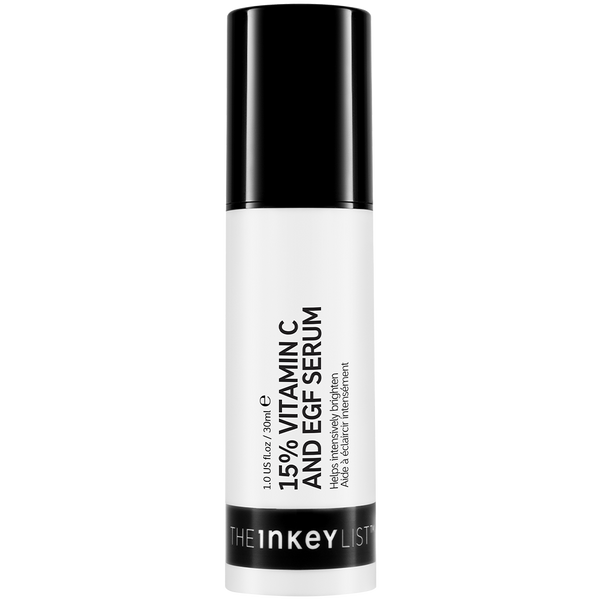
The 15% Vitamin C + EGF Serum is built on exactly this logic. It uses ascorbyl glucoside, a stable form of vitamin C that converts on skin, to help brighten and target the look of uneven tone and dark marks. It is paired with 1% Epitensive EGF, a plant-based peptide that supports skin renewal. It is fragrance-free and lightweight, which addresses two of the congestion triggers covered in the previous section.
If you want the fuller ingredient breakdown, including how vitamin C supports collagen and why it pairs well with sun protection, our vitamin C ingredient guide goes deeper than an article on breakouts reasonably can.
Now to the group most likely to have asked this question in the first place.
Vitamin C for Oily Skin and Congested Skin
There is a widespread assumption that vitamin C is for dry, dull or mature skin, and that anyone with oil or congestion should stay away. It is one of the more persistent pieces of bad advice in skincare, and it means a lot of people are missing out on an ingredient that would genuinely help them.
A vitamin C serum for oily skin is not a contradiction. Texture and formula base matter far more than the active itself. A lightweight, water-based, fragrance-free vitamin C serum behaves very differently on oily skin from a rich oil-suspended one, even at identical active percentages.
What Vitamin C Actually Offers Oily and Blemish-Prone Skin
Two things, both relevant.
Antioxidant support against daily environmental stress. Oil on the skin’s surface oxidises through the day, and UV and pollution generate free radicals that contribute to an inflammatory environment. An antioxidant helps counter that oxidative load.
Help with the look of post-blemish marks and uneven tone. This is often the real ongoing concern. The spot itself resolves in a week or so. The flat dark or reddish mark it leaves can hang around for months, and for many people that is the more persistent frustration. Vitamin C supports the look of a more even tone over time. If post-blemish marks are your main concern, our page on blemish scars and marks covers that specifically.
Choosing the Right Formula
Practical guidance, kept simple:
- Look for lightweight, water-based or fast-absorbing textures rather than rich creams and oils.
- Avoid heavy occlusive bases if congestion is your concern.
- Avoid added fragrance.
- Pair with an oil-free moisturiser rather than a rich cream, so the serum is not undone by the step that follows it.
On that last point, Omega Water Cream is a genuinely appropriate match rather than a bolt-on recommendation. It is oil-free and water-based, with 5% niacinamide to help control oil and support the look of even tone, plus a 0.2% ceramide complex for barrier support. It gives skin the hydration and barrier support it needs without the weight.
If you want niacinamide as a separate step at a higher concentration, the Niacinamide Serum sits comfortably alongside vitamin C in a morning routine.
For a broader look at managing oily skin across a full routine, and at what actually causes blemishes in the first place, those guides go into far more detail than belongs here.
Now that vitamin C is on the table for your skin type, here is the method for introducing it safely.
How to Use Vitamin C Without Triggering Congestion
Everything above turns into six practical habits. This is the part worth screenshotting.
Patch Test Properly
Apply a small amount to the inner forearm or along the jawline for three consecutive days before using it across your whole face. Three days matters. A single application catches immediate stinging, but irritant reactions can build with repeat exposure, so one test tells you less than three consecutive ones. If nothing happens after three days, you are clear to move to the face.
Start Low and Build
Begin two to three times a week, ideally in the morning, and increase towards daily as your skin adjusts. Introduce one new active at a time and give it a fortnight before adding anything else. If you add three products in the same week and your skin reacts, you have no way of knowing which one is responsible and you will probably abandon all three.
Get the Layering Order Right
Cleanse first, then apply thinnest to thickest. Water-based serum, then any targeted serum, then moisturiser. Vitamin C goes onto clean skin before heavier textures, so nothing is sitting between it and your face.
Less Is More
A few drops covers the whole face. Using more will not speed anything up. It increases the chance of irritation, makes pilling under moisturiser or makeup more likely, and empties the bottle faster for no benefit.
Ingredients That Pair Well
- Niacinamide. Helps control oil and calm the look of redness, and sits happily alongside vitamin C. The long-standing claim that you must never mix niacinamide and vitamin C is outdated. It traces back to decades-old research using raw, unformulated ingredients under high heat, conditions that bear no resemblance to a modern stabilised serum on a bathroom shelf. Modern formulas are designed with compatibility in mind. Our niacinamide guide covers this in more detail, and the Niacinamide Serum layers cleanly after a vitamin C.
- Hyaluronic acid. Hydration without weight, which is exactly what you want if you are avoiding rich textures. Apply Hyaluronic Acid Serum to slightly damp skin.
- Daily sun protection. Vitamin C’s antioxidant benefits are best supported by protecting skin from UV, and if you are targeting the look of dark marks, unprotected sun exposure works directly against you. More on this in the routine below and on our SPF guide.
Ingredients to Layer With Care
Not forbidden, just better separated.
- Salicylic acid and other BHAs. Use vitamin C in the morning and your exfoliating acid in the evening rather than stacking them in one session. Our salicylic acid guide explains how it works and where it fits.
- Retinol. Same principle. Vitamin C in the morning, retinol at night. When first introducing a retinol alongside an established vitamin C, alternate nights rather than going straight to daily. For the full layering breakdown, read what not to mix with retinol.
- A targeted blemish step. If you want something focused on active blemishes while vitamin C handles the morning, the 360 Skin Clearing Serum works as an evening counterpart.
Store It Properly
Out of direct sunlight, away from heat, cap closed fully every time. This is the same oxidation point from earlier, applied as a habit rather than a fact. A well-stored serum stays effective for its full shelf life.
With the method established, here is how it fits into a full day.
A Simple Morning and Evening Routine With Vitamin C
Skincare has become unnecessarily complicated. Four steps done daily beat eight steps done occasionally, every time. Here is a realistic structure.
Morning
- Cleanse. For oily and congested skin, the Salicylic Acid Cleanser clears overnight oil and helps keep follicles clear without stripping. For a gentler daily option, the Glycerin Gentle Purifying Cleanser cleanses without disrupting the barrier.
- Vitamin C serum. A few drops of 15% Vitamin C + EGF Serum onto clean skin. Give it a minute to absorb.
- Hydrating serum, if you need it. Hyaluronic Acid Serum on damp skin.
- Moisturise. Omega Water Cream for oily and combination skin, or Bio-Active Ceramide Moisturiser for dry, sensitive or mature skin.
- Sun protection. Dewy Sunscreen SPF 30 as the final morning step.
Vitamin C sits best in the morning, where its antioxidant activity lines up with the day’s environmental exposure. Pairing it with daily sun protection is the single most effective thing you can do for tone and the look of dark marks. Skipping SPF while using a brightening serum is working against yourself.
Evening
- Cleanse. Double cleanse if you have worn makeup or SPF. Oat Cleansing Balm as a first cleanse to break everything down, followed by your usual cleanser.
- Targeted serum. A BHA or a retinol, on alternate nights rather than both together. The 360 Skin Clearing Serum is an option here if blemishes are your focus.
- Moisturise. Same choice as the morning.
For individual surface spots, Hydrocolloid Invisible Pimple Patches are a useful optional step overnight. They protect the area and stop you picking, which is half the battle.
Consistency beats complexity. If a routine is too long to do on a tired Tuesday, it is the wrong routine.
If you are trying to work out why breakouts are happening at all, adult acne and why it happens after 25 and does stress cause acne are both worth reading.
That covers what a routine can do. Here is where it stops being the right answer.
When to See a Professional
Skincare supports skin. It does not replace medical care, and there are situations where the right move is to speak to someone rather than adjust another serum.
Consider seeing a GP, dermatologist or pharmacist if:
- A reaction involves significant swelling, blistering, or a rash spreading beyond where you applied the product.
- Breakouts are painful, deep or cystic, the kind that sit under the skin rather than coming to a head.
- There has been no improvement after around eight to twelve weeks of a consistent routine.
- Breakouts are causing you real distress. That is a legitimate reason on its own and does not require anything else on this list to also be true.
Persistent deeper breakouts often need clinical input, and that is not a failure of your skincare routine or a sign you chose wrong. Some things sit outside what topical products are designed to do. If you want a deeper clinical explanation of what is happening in the skin, what is acne vulgaris covers the underlying condition properly.
The Bottom Line on Vitamin C and Breakouts
Vitamin C does not cause breakouts. It is an antioxidant rather than a cell-turnover accelerator, which means it cannot purge skin, and it has no mechanism for blocking follicles.
Four variables do the work that gets blamed on the ingredient. The form of vitamin C determines how gentle and how stable it is. The pH determines whether a formula stings. Oxidation determines whether the serum in your hand is still active, and colour will tell you. And the base, particularly added fragrance or heavy oils, determines how it sits on skin that is already prone to congestion.
Choose a stable form such as ascorbyl glucoside, introduce it slowly with a proper patch test, keep the rest of the routine simple, and store it out of the light. That removes most of the risk before you have applied a single drop.
Clear guidance, proven ingredients, real results. That is what this comes down to.
If you are building a routine around congestion and blemishes, our blemishes and breakouts collection brings together the cleansers, serums and moisturisers formulated for exactly that. Start with one product, give it a fair run, and add from there. If you would rather have a steer before you buy anything, our skincare quiz builds a personalised routine in a couple of minutes.
Frequently Asked Questions
Got a question?
Our askINKEY team are a friendly bunch of skincare experts with deep product knowledge and zero judgement. Whether you're an ingredient obsessive or just starting out, we'll make it make sense. No question too big. No question too small. We Give A Care, Every Day.


