



PDRN vs Exosomes: What’s the Difference and Which Does Your Skin Need?
Two of skincare's most talked-about ingredients, compared honestly, so you know which one your skin actually needs.
Author
askINKEY skincare advisor
Published
13 May, 2026
Time to read
17 minutes
PDRN and exosomes are the two ingredients most people are currently trying to choose between. PDRN is a DNA fragment that communicates with your skin cells in a language they already understand. Exosomes are nanoscale messengers that carry signals between cells. If you want the full explainers, we have written them properly elsewhere: here is what PDRN is and here is what exosomes are. This page is not a definition. It is a decision.
Here is what the two have in common. Both are clinically backed. Both are 100% vegan in INKEY’s formulations. Both are suitable for sensitive skin. That is a lot of overlap, which is exactly why the choice feels difficult.
Here is the one thing that separates them. They work through different routes, so they suit different priorities.
By the end of this page you will know how PDRN Serum and Exosome Hydro-Glow Complex compare, which one suits which concern, whether you should be using both, and the exact order to layer them in. Let’s start with the short version, for anyone who wants the answer before the detail.
The Short Answer: PDRN vs Exosomes at a Glance
The simplest way to frame PDRN vs exosomes is this. PDRN works through one targeted, well-mapped route in the skin. Exosomes work by delivering a broader set of signals that support several visible improvements at once.
That single distinction drives almost every decision below.
Choose PDRN if:
- You want instant glass-skin glow on day one, plus firmness and hydration that build gradually
- Fine lines and loss of bounce are your main concerns
- You are thinking in terms of long-term renewal rather than a quick fix
- Your route in is PDRN Serum
Choose Exosome Hydro-Glow Complex if:
- Your skin looks tired, dull or stressed
- You want visible improvement across several things at once rather than one
- You are dealing with dehydrated skin, visible redness or that flat, depleted look after a bad week
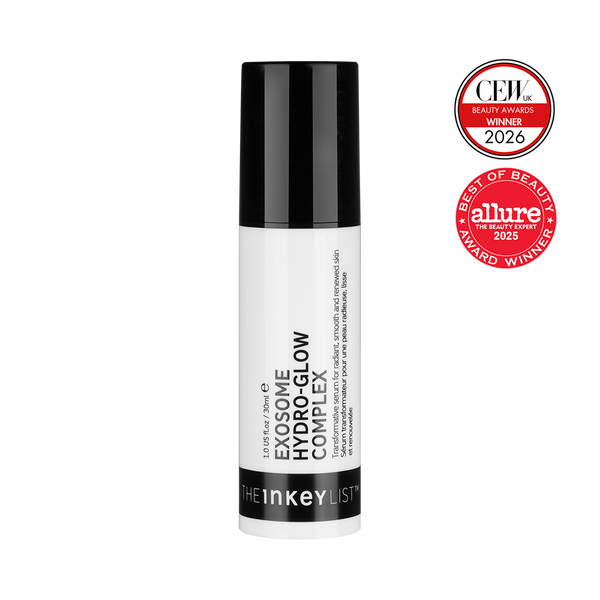
- Your route in is Exosome Hydro-Glow Complex, which delivers 6-in-1 skin rejuvenation: clinically proven to visibly improve radiance, hydration, tone, firmness, elasticity, and texture*
Choose both if:
- Anti-ageing and all-round rejuvenation are the goal
- You want the two working in parallel through different routes rather than duplicating each other
- You are happy to add one extra step to your routine
Before you decide, here are the facts that apply to both. Both are 100% vegan. Both are fragrance-free. Both are suitable for sensitive skin. Both are fine to use during pregnancy. Neither needs an introduction period, so you do not have to build up slowly. Neither causes purging.
For a lot of readers, that is genuinely enough information to buy with confidence. But understanding why the two differ makes the choice easier to trust, and it makes the results easier to interpret when you are three weeks in and wondering whether it is working.
What PDRN and Exosomes Actually Are (The Short Version)
PDRN in one paragraph
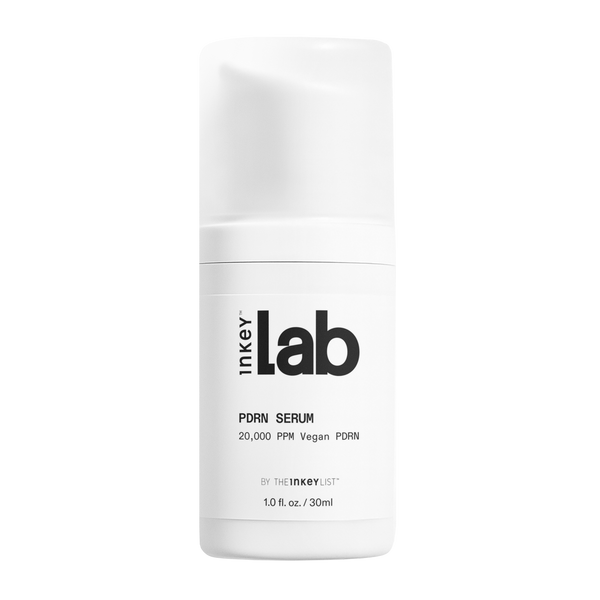
PDRN stands for polydeoxyribonucleotide. It is a DNA fragment, and its usefulness comes from the fact that skin cells already recognise this kind of molecule. It is not a foreign instruction being forced on your skin. It is a familiar one. Traditionally, PDRN has been salmon-derived, which is where the whole salmon sperm serum conversation comes from. INKEY’s is not. PDRN Serum uses 2% INJIN Vegan PDRN, plant-derived from Artemisia capillaris, with no salmon and no animal-derived ingredients anywhere in the formula. It also contains an 18% emollient blend, which is the part responsible for the instant glass-skin glow you see on day one, before the longer-term work has even begun. That is the summary. If you want the mechanism, the sourcing and the research in full, read the full PDRN guide.
Exosomes in one paragraph
Exosomes are nanoscale messengers. Cells release them naturally to carry signals to other cells, which is why they are so often described as a communication system rather than an active in the traditional sense. INKEY’s Exosome Hydro-Glow Complex uses 1% Cica Exosomes derived from Centella Asiatica, the plant better known as cica. Around that sits a supporting cast chosen to do the practical work of a daily serum: 1% Hyaluronic Acid for water-binding hydration, 1% Ectoin for barrier support, Kollaren peptide, Prickly Pear Extract and Q10. Like our PDRN, it is entirely plant-derived and 100% vegan. That is the short version, and it is deliberately short. For the science, the sourcing and what the research actually says, read the full exosomes guide.
Knowing what each one is matters less than knowing how differently they behave once they are on your skin. That is where the real decision lives.
How PDRN and Exosomes Work Differently
This is the section that actually answers the question, so it is worth reading slowly. The difference between PDRN and exosomes is not a difference in quality. It is a difference in approach.
PDRN takes one targeted route
PDRN binds to adenosine A2A receptors on fibroblasts. Two pieces of translation there. Fibroblasts are the cells responsible for producing your skin’s structural support, the scaffolding that keeps it firm and bouncy. Adenosine A2A receptors are a specific docking point on the surface of those cells, a bit like a keyhole that only accepts one shape of key.
What makes this interesting is how specific it is. PDRN is not scattering activity across the skin and hoping something lands. It has one well-mapped point of entry. The pharmacology of PDRN and its A2A receptor activity has been reviewed in peer-reviewed literature, including Squadrito et al., Frontiers in Pharmacology, 2017. Worth noting honestly: that body of research concerns pharmaceutical-grade PDRN in a clinical context, not a topical cosmetic serum. It tells you the receptor route is real and well characterised. It does not tell you a serum will do what an injectable does, and we would rather say that plainly than let you assume otherwise.
The practical translation is that PDRN is precise and cumulative. It does one job, repeatedly, and the results compound. Helps support natural collagen production.
Exosomes deliver a broader set of signals
Exosomes work differently. Rather than one targeted route, they deliver a payload of signals to skin cells, which is why the visible benefits show up across several areas at the same time rather than in one place.
The standard for what qualifies as an extracellular vesicle is set out by the International Society for Extracellular Vesicles in its MISEV2018 position statement, which is the reference point researchers work to. It is a genuinely young field, and the terminology is still being tightened, which is part of why so much marketing around exosomes is vague.
The clearest plain-English description we have seen came from an independent title rather than a brand.
They are best described as tiny communication bubbles that our cells naturally release, akin to emails or text messages. Tony Kaliya, speaking to Marie Claire UK
That analogy does more work than a paragraph of technical copy. Cells send messages. Exosomes are the format those messages travel in.
The analogy that makes it click
If it helps, think of it like this. PDRN is like handing your skin one very detailed instruction for one job. Exosomes are like handing your skin a whole set of messages at once.
Neither is better. They are different tools, and the right one depends entirely on what you are trying to change.
Speed and shape of results
This is where the difference becomes something you can actually see, and the two follow noticeably different curves.
PDRN Serum gives you an instant glass-skin glow on day one, but that immediate effect comes from the 18% emollient blend rather than the PDRN itself. Be clear-eyed about that. The emollients deliver the finish. The PDRN does the slower work underneath, with hydration and firmness building over weeks. If you are the kind of person who gives a product a fortnight and moves on, PDRN needs more patience than that.
Exosome Hydro-Glow Complex moves faster on the visible measures. Clinic worthy rejuvenated skin in 14 days. Testing also showed a 63% increase in skin renewal activity in 8 hours**, and it is proven to deliver up to 12-hours of hydration**.
It also delivered a 55% reduction in visible signs of skin stress (redness, puffiness, visible irritation)*, which is the measure that tends to matter most when your skin looks depleted rather than aged. If that description sounds familiar, we have written more on what skin stress is and why it shows up on your face before you have consciously registered it.
One more difference worth knowing
Both of INKEY’s formulas are 100% vegan and plant-derived. In a category where salmon-derived and bovine-derived sourcing are genuinely common, that is a real point of difference rather than a marketing line. If you have found yourself reading ingredient lists trying to work out what is actually in a regenerative serum, our breakdown of the salmon sperm serum question covers the sourcing landscape honestly.
So that is how they work. The more useful question is what that means for your particular skin.
Which One Does Your Skin Need?
Skip to whichever of these sounds most like you. These are organised by concern rather than by product, because that is how people actually shop.
If your main concern is fine lines and loss of bounce
Go with PDRN Serum.
This is the clearest-cut recommendation on the page. Fine lines and loss of bounce are structural concerns, and PDRN’s targeted route is aimed squarely at the cells involved in that structural work. Helps support natural collagen production.
The bonus is that you are not waiting weeks to see anything at all. The 18% emollient blend gives you glass-skin glow immediately while the gradual work happens underneath. You get something to look at on day one and something to measure at week twelve.
If your skin looks tired, dull or stressed
Go with Exosome Hydro-Glow Complex.
This is a different problem from ageing, and it gets confused with ageing constantly. Skin that looks tired is not necessarily skin that has lost structure. It is often skin that has been through something: a long-haul flight, a fortnight of bad sleep, city pollution, a stressful few weeks, a season change.
Testing showed a 55% reduction in visible signs of skin stress (redness, puffiness, visible irritation)*, which is exactly the cluster of things that makes a face look depleted. If visible redness is part of your picture, that is the concern pillar worth reading.
Travel skin is the clearest use case we hear about. So is the week after a deadline.
If your concern is dullness and uneven tone
Go with Exosome Hydro-Glow Complex.
In a 4-week clinical study, 100% saw more glowing skin, clinically proven. It also delivers 6-in-1 skin rejuvenation: clinically proven to visibly improve radiance, hydration, tone, firmness, elasticity, and texture.
Six things at once is the entire argument for a broader signal set over a targeted one. If you cannot name a single concern because it is more that your skin has lost its overall quality, this is the more logical pick.
If you have been weighing exosomes against the glow ingredients you already know, we have compared them directly in how exosomes compare to Vitamin C and Niacinamide.
If your skin is dehydrated
Either works, and here is the honest version.
PDRN Serum gives you the emollient glow, which makes dehydrated skin look immediately better. Exosome Hydro-Glow Complex is proven to deliver up to 12-hours of hydration**.
But if your real issue is barrier strength rather than water content, neither of these is your best answer. Ectoin Hydro-Barrier Serum is the more targeted pick. Skin that stings when you apply things, feels tight after cleansing and loses water as fast as you put it in has a barrier problem, and a barrier problem wants a barrier product. We would rather point you there than sell you the headline serum.
Worth understanding the difference properly, because it changes what you should buy: dehydrated skin explains it in full.
If your skin is dehydrated and oily or combination, pair whichever serum you choose with Omega Water Cream rather than a richer moisturiser. Oil-free hydration, no heaviness.
If your skin is sensitive or reactive
Both are suitable. Neither requires an introduction period, so there is no building-up phase and no alternate-nights schedule to manage.
That said, always patch test first. Sensitive skin is individual, and a suitable-for-sensitive-skin formulation is a starting point rather than a guarantee.
If you are new to all of this
Either is a reasonable starting point, and you genuinely cannot get this wrong. Neither conflicts with anything else in a normal routine. Neither demands you rebuild what you already use.
If you want a tiebreaker: pick based on whether your concern is structural (lines, bounce, firmness) or situational(dullness, tiredness, stressed-looking skin). Structural points to PDRN. Situational points to exosomes.
If you want the most complete approach
Use both. Because they work through different routes rather than duplicating each other, layering them is additive rather than redundant.
Which raises the obvious question, and it is the one we get asked most.
Can You Use PDRN and Exosomes Together?
Yes. For a lot of people, using both is the more complete approach, precisely because they are not doing the same job twice.
The layering rule
Exosome Hydro-Glow Complex goes on first, on damp skin, straight after cleansing. PDRN Serum goes on second.
The reason is refreshingly boring. Apply the lighter, water-based formula first so it is not trying to absorb through heavier layers sitting on top of it. Thin to thick. That is the whole rule.
Morning routine
- Cleanse
- Exosome Hydro-Glow Complex on damp skin
- PDRN Serum
- Optional: Hyaluronic Acid Serum if you want extra hydration
- Bio-Active Ceramide Moisturiser
- Dewy Sunscreen SPF 30, non-negotiable
On that last step: if you are investing in ingredients aimed at firmness, tone and texture, daily SPF is what protects the investment. Why SPF matters every day makes the case better than we can in one line.
The ceramides in step 5 are what seal the whole thing in. Serums deliver, moisturiser holds.
Evening routine
- Double cleanse
- Exosome Hydro-Glow Complex on damp skin
- PDRN Serum
- Optional: Ectoin Hydro-Barrier Serum if skin feels dry, tight or stressed
- Optional: Starter Retinol Serum, PM only
- Bio-Active Ceramide Moisturiser
Step 4 is genuinely optional and worth using responsively rather than religiously. Some nights your skin wants it. Most nights it will not need it. If you are running Ectoin alongside actives, how to layer Ectoin with other actives covers the combinations.
INKEY Tip: A pea-sized amount of Exosome Hydro-Glow Complex and one pump of PDRN Serum is enough for your whole face. These are concentrated formulas. More product does not mean more results, it just means you get through the bottle faster.
What to expect, and when
Day one, both give you glow. That is the emollient blend in PDRN Serum and the immediate hydration in Exosome Hydro-Glow Complex doing visible surface work.
Two weeks in, the exosome formula reaches its clinically tested milestone: clinic worthy rejuvenated skin in 14 days*.
Eight to twelve weeks in is where PDRN’s firmness and hydration benefits accumulate into something you would describe as a change rather than an effect. That is a long time in skincare attention spans, and we are not going to pretend otherwise. Structural work is slow work.
What you can safely use alongside them
Both are compatible with Vitamin C, Niacinamide, AHAs, BHAs and retinol. There is no ingredient in a standard routine that either of these fights with.
The only rule that matters is order: lightest to heaviest, retinol in the evening only, SPF in the morning without exception.
If you would rather not assemble it yourself, the Exosome + Ceramide Glow Duo pairs the serum with its moisturiser step already matched.
Now for the part that tends to get relegated to the bottom of articles, which is where the practical safety questions actually live.
Safety, Sensitivity and What to Know Before You Start
Both formulas are fragrance-free and suitable for sensitive skin. Neither requires an introduction period or an adjustment phase, which means no alternate-night schedule and no expectation that things get worse before they get better.
Neither causes purging. This is worth stating clearly, because purging has become the default explanation for any breakout that follows a new product. Purging is associated with ingredients that accelerate cell turnover. If you break out after starting either of these, treat it as a reaction rather than a phase, and stop.
Neither causes photosensitivity. Both can be used morning and evening. You still need Dewy Sunscreen SPF 30 every morning, but that is true regardless of what else is in your routine.
Pregnancy and breastfeeding. Both PDRN Serum and Exosome Hydro-Glow Complex are suitable. As with any new product during pregnancy, patch test first and have a quick conversation with your GP or midwife. That is not us hedging, it is that your healthcare team knows your circumstances and we do not. Our pregnancy-safe skincare guidecovers what to swap and what to keep.
Using them with retinol. Entirely compatible. Retinol is PM only. Serums first, retinol after, moisturiser last. We build products in pairs when we expect people to use them together, and the Retinol Boost Duo pairs Starter Retinol Serumwith our exosome formula, which should tell you how intentional that combination is. For everything else in this territory, what not to mix with retinol is the definitive version.
Topical versus clinic treatments. This matters and it gets blurred constantly. Everything on this page refers to topical, plant-derived cosmetic formulas that you apply at home. Injectable exosome and PDRN treatments performed in clinic are a completely separate category with different formulations, different concentrations and different regulatory considerations. Research findings from the clinical world do not automatically transfer to a bottle on your bathroom shelf, and any brand implying otherwise is stretching. PDRN injections vs topical PDRN sets out the distinction properly.
Patch test anything new. Inner forearm, 24 hours, before it goes near your face. Here is how, and why it is worth the day.
That covers the practical ground. Here is everything else people ask us.
Conclusion: Two Routes to the Same Goal
The distinction is simpler than the internet makes it sound. PDRN takes one targeted route through a specific receptor on the cells that support your skin’s structure. Exosomes deliver a broader set of signals that support several visible improvements at once. Both are legitimate ways to change how your skin looks and feels, and neither is the compromise option.
What makes ours worth trusting is what they have in common. Both are plant-derived and 100% vegan, with no salmon and no animal-derived ingredients. Both are clinically tested, with the study sizes disclosed rather than buried. Both are fragrance-free and suitable for sensitive skin. Neither needs an introduction period, so whichever you choose, you can start tomorrow morning.
If you take one thing from this page, make it this: match the ingredient to the concern, not to the hype cycle. Structural concerns point to PDRN Serum. Tired, dull or stressed-looking skin points to Exosome Hydro-Glow Complex. Both, if you want the complete approach.
Clear guidance, proven ingredients, real results. That is the whole job.
Shop PDRN Serum
Shop Exosome Hydro-Glow Complex
Not sure which suits your skin? Take our skincare quiz and get a routine built around your concerns in two minutes.
Keep Reading
- Complete Guide to PDRN
- Complete Guide to Exosomes
- PDRN vs Retinol: Two Approaches to Skin Regeneration
* 4-week clinical study of 26 people.
** Clinical study of 31 people.
*** In-vitro testing of Cica Exosomes showed a 55% reduction in pro-inflammatory markers and a 63% increase in markers associated with skin renewal after 8 hours.
Frequently Asked Questions
Got a question?
Our askINKEY team are a friendly bunch of skincare experts with deep product knowledge and zero judgement. Whether you're an ingredient obsessive or just starting out, we'll make it make sense. No question too big. No question too small. We Give A Care, Every Day.


