



PDRN Injections vs Topical PDRN: Which Is Right for Your Skin?
Injections or serum? We compare PDRN skin boosters with topical PDRN on cost, comfort and results, so you can decide what your skin actually needs.
Author
askINKEY skincare advisor
Published
13 May, 2026
Time to read
17 minutes
PDRN now exists in two very different forms, and the choice between them is the reason you are here. The first is a clinic treatment, injected into the skin by a licensed aesthetic practitioner and usually sold in the UK as a skin booster or a polynucleotide injection. The second is a topical serum you apply at home, twice a day, in front of your own bathroom mirror. Same ingredient family. Very different experience, very different commitment, very different cost. Understanding PDRN injections vs topical PDRN means understanding that difference properly rather than assuming one is simply a watered down version of the other.
This guide lays both options out side by side and honestly. We cover the science of how PDRN works, what a course of skin booster injections actually involves, what topical PDRN can and cannot do, what each costs in the UK, how quickly you see results, how much downtime to expect and how the safety profiles compare. Where the evidence is strong, we say so. Where it comes from an ingredient supplier rather than an independent laboratory, we say that too.
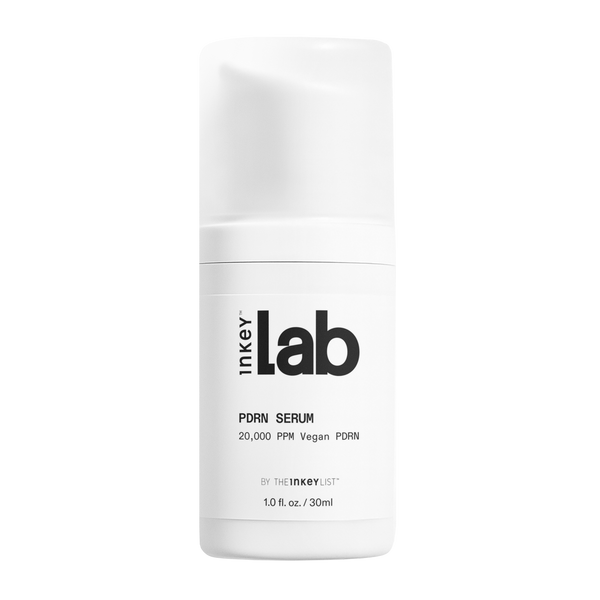
This is not a verdict piece. Injections and topicals are different interventions rather than a like-for-like swap, and pretending otherwise would not help you decide anything. What we can tell you plainly is that the at-home option has become considerably more credible than it used to be. The INKEY PDRN Serum uses 20,000 PPM, which is 2%, of vegan INJIN PDRN at £18 for 30ml. If you want the ingredient science before the comparison, start with our full PDRN ingredient guide and come back. Otherwise, a short primer on the ingredient comes first, then we compare the two delivery methods in detail.
What PDRN Is, and Why It Comes in Two Very Different Forms
PDRN stands for polydeoxyribonucleotide. It is a fragment of DNA that signals skin cells to repair and renew, and on an ingredient list you will usually find it written as Hydrolyzed DNA rather than by its full name. That naming quirk catches a lot of people out, so it is worth knowing before you start reading labels.
The mechanism is simpler than the name suggests. PDRN works largely through activation of adenosine A2A receptors, a signalling route that supports the activity of fibroblasts, the cells responsible for producing collagen and hyaluronic acid in your skin. It also feeds the salvage pathway, meaning the DNA fragments themselves supply raw material that cells can reuse rather than having to build from scratch. That dual action is documented in the peer-reviewed literature, including a review of the pharmacological activity and clinical use of PDRN published in Frontiers in Pharmacology.
There are two sources of PDRN on the market. Animal-derived PDRN is traditionally extracted from salmon, which is where the internet nickname you have probably seen comes from. Vegan plant-derived PDRN is the newer route, and INKEY uses INJIN Vegan PDRN sourced from Artemisia capillaris. If the source question matters to you, and for a lot of people it genuinely does, we have covered it in full in our guide to salmon-derived vs vegan PDRN.
Here is the part that shapes everything else in this article. In the UK, the clinic version of PDRN is almost always marketed as a skin booster or as polynucleotide injections. The at-home version is a serum. Two names, two price brackets, two entirely different Saturday mornings, built on the same underlying ingredient science.
We are keeping this primer short on purpose. If you want the full breakdown of how PDRN behaves in the skin, what the research actually shows and how it compares with other actives, that lives in our dedicated explainer on what PDRN is in skincare and in the complete PDRN ingredient guide. Both go deeper than this section needs to.
Because the real difference between the two options is not the ingredient at all. It is how that ingredient gets into your skin, and that is where the comparison properly begins.
PDRN Skin Boosters and Polynucleotide Injections: What the Treatment Actually Involves
Walk into a UK aesthetic clinic and ask about PDRN and you will most likely be shown a treatment menu listing skin boosters or polynucleotide injections, sometimes abbreviated to PN. The branding varies between clinics. The underlying approach does not. These are injectable treatments that deliver PDRN or closely related polynucleotide chains directly into the skin, and they have become one of the fastest growing categories in British aesthetics.
How the procedure works
A skin booster treatment is administered by a licensed medical professional or a suitably qualified aesthetic practitioner. The product is delivered intradermally, meaning into the dermis rather than into muscle or fat, using a very fine needle. Practitioners typically use a nappage technique, a series of shallow, closely spaced micro-injections that distribute the product evenly across the treatment area rather than depositing it in one place. A full face session usually involves somewhere around 2ml in total.
It is worth being clear about what this is not. Skin boosters are not fillers. They are not designed to add volume or change the shape of your face. The goal is a change in skin quality: density, hydration, smoothness, resilience. Practitioners often describe the aim as making the skin behave younger rather than making the face look different.
It is a course, not a one-off
This is the detail people most often underestimate when they first enquire. Skin booster treatments are structured as a course, typically three to four sessions spaced roughly three weeks apart, followed by maintenance sessions to hold the result. That structure is deliberate. The skin responds cumulatively, with each session building on the fibroblast activity stimulated by the last, which is why a single appointment is rarely presented as a complete treatment.
The results timeline follows the same logic. Most people notice early improvements in skin quality from around six weeks, with fuller results visible at around the twelve week mark once the full course has been completed and the skin has had time to respond.
What practitioners use it for
Skin boosters tend to be recommended for a specific set of concerns:
- Skin laxity and loss of density, particularly where skin has started to feel thinner or less resilient.
- Fine lines and surface roughness, especially in areas like the under-eye and around the mouth.
- Dullness and chronic dehydration that has not responded to topical routines alone.
- Photodamage, meaning the cumulative textural and tonal changes caused by sun exposure over years.
- Post-procedure recovery support, where PDRN is used in clinical settings to support the skin’s own healing response after other treatments.
That last use is a clue to the ingredient’s origins. Polynucleotides were used in tissue repair and wound healing medicine long before they arrived on an aesthetic treatment menu, an application supported by a systematic review of the effects of polydeoxyribonucleotide on wound healing and tissue regeneration published in Regenerative Medicine. The aesthetic use case grew out of the medical one rather than the other way round.
Evidence and safety
The clinical evidence base for injectable PDRN is meaningful and growing. Randomised controlled trial data has reported measurable improvements in skin elasticity, hydration and the appearance of fine lines following a structured course, and you can read a summary of that clinical evidence here. More recent peer-reviewed work has examined the mechanism in detail, including a 2024 Dermatologic Surgery review of polynucleotides in skin regeneration, targeting the adenosine A2A receptor and salvage pathway, which also clarifies the technical distinction between polynucleotides and PDRN that clinic marketing tends to blur.
The safety profile is generally strong. The most commonly reported effects are transient redness and mild swelling at the injection sites, which typically settle within around 48 hours. Some people experience small bumps immediately after treatment where the product has been deposited, which usually disperse within a day.
None of that changes the most important point in this section, so we will state it without hedging: injectable PDRN must always be administered by a qualified, licensed practitioner, and you should always have a consultation before booking a course. A consultation is not a formality. It is where a trained professional assesses whether your skin concerns are actually best addressed by this treatment, or by something else entirely.
Skin boosters are a legitimate, well-evidenced treatment with a strong safety record. But the barriers are real for a lot of people: the cost, the appointments, the needles, the geography of actually having a reputable clinic within reach. That is precisely the context in which topical PDRN became worth taking seriously.
Topical PDRN: How a Serum Delivers PDRN at Home
Let us start with the objection, because if you have read anything sceptical about topical PDRN you have already encountered it.
For years, the fair criticism of PDRN in skincare was that it simply could not work. PDRN molecules are large. The skin barrier is specifically designed to keep large molecules out. Put a big molecule in a serum and it sits on the surface, does very little, and the brand charges you handsomely for the privilege. That criticism was not cynicism. For a lot of early topical PDRN products, it was accurate.
What actually changed
The advance was not marketing. It was formulation science, specifically the development of low molecular weight PDRN. By fragmenting the polynucleotide chains into smaller pieces, formulators produced a version of the ingredient small enough to penetrate meaningfully below the surface of the skin rather than sitting on top of it.
This is why “contains PDRN” on a label tells you almost nothing on its own. Two serums can both legitimately list PDRN and behave completely differently, because molecular weight determines whether the ingredient reaches the layers where fibroblasts actually live.
Concentration is the number that matters
The second variable is concentration, and this is where the industry gets uncomfortable. PDRN concentration is measured in PPM, parts per million. A product can list PDRN prominently on the front of the bottle, place it near the bottom of the ingredient list, and contain a functionally negligible amount. Nothing about that is illegal. It is simply not useful to you.
The concentration studied for topical PDRN is 2%, which equates to 20,000 PPM. If a brand will not tell you its PPM or percentage, that silence is information.
The INKEY PDRN Serum contains 20,000 PPM, 2%, INJIN Vegan PDRN, low molecular weight, plant-derived from Artemisia capillaris, at £18 for 30ml. It is formulated at pH 4.0 to 4.5, fragrance-free, 100% vegan, and confirmed safe to use during pregnancy and breastfeeding. It is designed for both morning and evening use, with one pump covering face and neck, and it currently holds a rating of 4.8 out of 5 from verified reviews.
On the clinical data, we want to be precise about attribution rather than let you assume more than the evidence supports. The performance figures for this concentration are based on clinical studies completed using 2% INJIN PDRN, run by the ingredient supplier. That is supplier data, not independent third-party data, and we are not going to dress it up as something it is not. It is still the most relevant data available for this specific ingredient at this specific concentration, and the shift of PDRN from clinic to shelf has been widely documented, including in Allure’s coverage of the ingredient.
The rest of the formula does real work too
A serum is never just its hero ingredient. Around the PDRN sits an 18% emollient blend of propylheptyl caprylate, shea butter and sunflower seed oil, which is what produces the immediate glass skin finish and supports the skin barrier. Glycerin acts as the humectant, drawing water into the skin for both immediate and ongoing hydration. If you want the detail on why that combination works, our pillar pages on glycerin and hyaluronic acid explain how humectants behave in a formula, and hyaluronic acid is relevant twice over here, since supporting fibroblast activity is partly about supporting the skin’s own production of it.
What the timeline actually looks like
Topical PDRN gives you something injections do not, which is an immediate cosmetic payoff alongside the longer-term work:
- Day one: an instant glass skin glow and visible plumping, largely from the emollient and humectant system.
- Four weeks: measurable improvement in skin hydration.
- Eight to twelve weeks: progressive improvements in texture and bounce as the cumulative effects build.
How to judge any PDRN serum, including ours
Apply this checklist to any PDRN product you are considering:
- Is the concentration disclosed in PPM or as a percentage? If not, assume it is low.
- Is the ingredient itself clinically tested, or only the finished formula? These are not the same claim, and the second is much easier to make.
- Is it low molecular weight? Without this, penetration is questionable regardless of concentration.
- What is the source? Vegan plant-derived options now exist and perform.
- Is it safe for twice daily use? Consistency of delivery matters more than intensity with this ingredient.
We are comfortable publishing that list because our own product answers all five. If a competitor’s does too, good. The category improves when brands are forced to disclose numbers.
With both delivery methods now properly understood, the useful next step is putting them directly side by side.
PDRN Injections vs Topical PDRN: The Honest Head-to-Head
There is no single verdict here, and any article that gives you one is selling you something. What follows is a factor-by-factor comparison. Read the factors that matter most to your situation first, because the right answer for a 29 year old with a limited budget and mild dehydration is not the right answer for a 52 year old with established photoageing and a clinic ten minutes away.
Effectiveness
Both approaches work on the same biological principle: supplying polynucleotides that support fibroblast activity and the skin’s own renewal processes. The meaningful differences are delivery depth and intensity of intervention.
Injections place PDRN directly into the dermis, bypassing the skin barrier entirely. That is a genuine advantage, and it means the intervention is more concentrated, more targeted and faster acting. Topical PDRN works from the surface downwards, relying on low molecular weight formulation to penetrate.
Being straightforward about it: for significant photoageing or visible laxity, injections are the faster and more intensive route. A serum is not going to replicate what a structured course of intradermal treatment delivers into the dermis, and we are not going to pretend it will.
What topical PDRN offers instead is cumulative renewal through consistent daily use, twice a day, every day, indefinitely. Different mechanism of accumulation, different kind of result. For dehydrated skin, surface roughness, early signs of ageing and general maintenance, daily topical delivery is a genuinely effective approach rather than a consolation prize.
Cost
Skin booster injections in the UK typically cost between £200 and £500 per session, which puts a full course of three to four sessions at somewhere between £600 and £2,000, before you factor in maintenance appointments.
The PDRN Serum is £18 for 30ml.
That gap is enormous, and it deserves the fairness caveat immediately rather than three paragraphs later. You are not buying the same thing. The clinic price includes a qualified practitioner, a professional assessment of your skin, sterile technique, dermal delivery and clinical oversight. A serum includes none of that. The price difference reflects a real difference in what is being delivered. We look at this properly in the next section.
Accessibility
Injections require a reputable clinic within travelling distance, a consultation, and then three to four appointments spaced three weeks apart, plus maintenance. For anyone outside a major city, with inflexible working hours, or with caring responsibilities, that logistical load is often the real barrier rather than the money.
Topical PDRN requires a bathroom shelf and about fifteen seconds, twice a day.
Pain and comfort
Skin boosters involve fine needles and multiple injection points across the face. Most people describe the discomfort as mild and manageable, and topical numbing cream is commonly offered, but it is a needle-based treatment and there is no version of it that is entirely comfortable.
Topical application is painless. For people with genuine needle anxiety, this is not a minor consideration, it is decisive.
Downtime
Expect up to around 48 hours of redness and mild swelling after a skin booster session, sometimes with small visible bumps at injection sites for the first day. Most people plan treatments around social and work commitments accordingly. If post-treatment redness is a particular concern for you, discuss it at your consultation.
Topical PDRN has zero downtime. You apply it and get on with your day.
Safety profile
Both options have strong safety records, and neither is the risky option here.
For injectables, the safety record depends entirely on the practitioner. This is the one point in this article we will state without any hedging: injectable PDRN must be administered by a qualified, licensed professional. The UK aesthetics market is inconsistently regulated, and the difference between a good outcome and a bad one is overwhelmingly about who is holding the needle.
Topical PDRN at 2% is well tolerated across skin types, including sensitive skin, and the formula is fragrance-free. As with any new active, patch test before full-face use. If you have never done one properly, our guide on why you should patch test walks through the method in about two minutes.
Pregnancy and breastfeeding suitability
For injectable treatments during pregnancy or breastfeeding, seek medical advice first, always. Most reputable clinics will decline to treat pregnant clients as standard policy.
The PDRN Serum is confirmed safe to use during pregnancy and breastfeeding. That is genuinely uncommon for an active serum, and it is one of the clearer practical advantages of the topical route. Pregnancy tends to remove a lot of options from a routine at exactly the point when skin behaviour changes most.
Vegan and ethical considerations
Injectable PDRN used in UK clinics is typically salmon-derived. If that matters to you, ask your practitioner directly about the source before booking, because it is not always stated on the treatment menu.
INKEY’s PDRN is 100% plant-derived vegan PDRN from Artemisia capillaris. We have covered the salmon-derived vs vegan PDRN question in full detail elsewhere rather than repeating it here.
Results timeline
Injections: early improvements from around six weeks, fuller results at around twelve weeks, following a completed course.
Topical: instant glass skin glow on day one, measurable hydration improvement at four weeks, progressive texture and bounce improvements across eight to twelve weeks.
Interestingly, the twelve week horizon is similar. The difference is what happens in between, and what happens afterwards.
Long-term maintenance
Injectable results diminish over roughly six to twelve months, at which point repeat sessions are needed to maintain the effect. The cost is therefore recurring and substantial.
Topical benefits accumulate with continued use and hold for as long as the routine continues. Stop using it and the benefits gradually fade, in exactly the same way they would with any other active. If you are weighing PDRN against other long-term actives, our PDRN vs Retinol comparison covers that ground.
Neither option is universally better. Which brings us to the factor that decides it for most people.
The Cost Question: What You Get for £200 to £2,000, and What You Get for £18
Cost is the single biggest decision driver for most UK readers considering PDRN, so it deserves its own section rather than a line in a comparison.
The clinic numbers, laid out plainly: £200 to £500 per session. £600 to £2,000 for a full course of three to four sessions. Then ongoing maintenance appointments to hold the result. These figures are consistent with independently published UK clinic pricing across the market, and they are what you should expect a reputable practitioner to quote.
The topical number: £18 for 30ml of PDRN Serum, used twice daily.
Put those side by side and the arithmetic is stark. For the price of one mid-range clinic session, you could run a daily PDRN routine for well over a year.
Now the part that most brand-published cost comparisons conveniently skip.
Injections are a different intervention, and the price difference is not a markup, it is a reflection of what is genuinely being delivered. A skin booster session places product directly into the dermis, under clinical supervision, administered by a trained professional who has assessed your skin, considered your medical history and selected a protocol for you specifically. A serum does none of those things. It cannot. Anyone telling you that £18 buys you the identical outcome to £400 is being dishonest, and you should be sceptical of any brand that tries.
So the honest conclusion is not that one is better value than the other in the abstract. It is this: the right question is which intervention matches what your skin actually needs, and what your circumstances actually allow. If your concerns are significant and structural, and you have the budget and access, a clinic course may well be the appropriate route, and we would rather you got a good outcome than bought a serum that was never going to meet your expectations.
But most people are not dealing with significant structural change. Most people want better texture, better hydration, more bounce and a real preventative step, delivered consistently over years. That is a maintenance job, and maintenance jobs are what daily topicals are built for.
Which brings us to something we believe fairly strongly: effective skincare should not require a clinical budget to access. We have written about that principle more fully in The Glow Revolution, which looks at how results that once required an appointment increasingly arrive in a bottle.
Worth knowing on the pricing: pairing the PDRN Serum with the Exosome Glow Serum at £20 for 30ml brings the total for both to £38. That is still a fraction of a single clinic session, for two actives used daily rather than four appointments spread across three months.
Cost, though, only tells you what each option asks of you. The more useful question is who each one is actually right for.
Who Each Option Suits, and How to Build Your At-Home PDRN Routine
Here is the practical part. First, who each route genuinely suits. Then, exactly what to do with a topical PDRN routine, in order, tonight.
Who should consider skin booster injections
Skin boosters are best suited to people seeking significant, clinician-guided correction. Specifically:
- Established photoageing, where years of cumulative sun exposure have produced visible textural and tonal change.
- Meaningful loss of skin density, where skin feels noticeably thinner or less resilient than it did.
- Visible laxity beyond what daily maintenance realistically addresses.
Alongside the skin criteria, there are practical ones. You need the budget for a full course plus maintenance, access to a reputable clinic, and genuine appetite for a structured programme of appointments rather than a single treatment.
And once more, because it matters more than anything else in this section: always administered by a licensed practitioner, always after a proper consultation.
Who is best suited to topical PDRN
Topical PDRN is likely the better fit if:
- You want a daily step for prevention and maintenance without the clinical commitment.
- You are new to PDRN and want to see how your skin responds before considering anything more intensive.
- You have sensitive skin and need actives that are barrier-supporting and well tolerated rather than aggressive.
- You want clinically studied ingredients at £18 rather than at £400.
- You are vegan and want a plant-derived source.
- You are pregnant or breastfeeding and most of your usual actives are currently off the table.
- You are proactively supporting your skin before visible signs of ageing become established.
- You already use other actives and want something that layers without conflict. PDRN sits comfortably alongside a retinoid, acids and Vitamin C.
Using topical PDRN alongside clinic treatments
These are not mutually exclusive, and treating them as an either/or is a false choice. Topical PDRN works well as a maintenance layer between clinic sessions, keeping delivery consistent in the weeks when you are not in the chair.
One caveat, and it is important. Always consult your practitioner before introducing topical actives around treatment dates, and check their specific aftercare protocol if you are having microneedling or any procedure that compromises the skin barrier temporarily. Your practitioner’s instructions override anything in a blog post, including this one.
Your AM and PM routine
The layering order is Exosome first, then PDRN. Apply the Exosome Glow Serum straight after cleansing, before anything else, then layer PDRN over the top. This follows the product guidance on both pages and it is the order we recommend consistently.
Morning:
- Cleanse.
- Exosome Glow Serum.
- PDRN Serum, one pump for face and neck.
- Moisturiser.
- SPF. We use Dewy Sunscreen SPF 30.
Evening:
- Double cleanse.
- Exosome Glow Serum.
- PDRN Serum, one pump for face and neck.
- Moisturiser.
One pump of PDRN Serum covers face and neck comfortably. Twice daily use is what keeps delivery consistent, and consistency is the whole mechanism with this ingredient.
If you are wondering what exosomes actually are and why they go first, our what are exosomes pillar page explains the ingredient, and Exosomes Explained goes further into the detail.
How to stack for different goals
Maximum glow.
“Maximum glow: Apply Exosome Glow Serum first, then layer the PDRN Serum over it. The Exosome Glow Serum delivers 6-in-1 skin rejuvenation: clinically proven to visibly improve radiance, hydration, tone, firmness, elasticity, and texture.* 100% saw more glowing skin, clinically proven,* with clinic worthy rejuvenated skin in 14 days.* It also helps support natural collagen production and is proven to deliver up to 12-hours of hydration.**”
If you are still deciding between the two ingredients rather than layering both, our PDRN vs Exosomes comparison is the piece to read next, and 5 Exosome Skincare Myths Debunked is worth your time if you are sceptical about the category. For a wider view, Vitamin C vs Niacinamide vs Exosomes vs PDRN puts the main glow actives side by side. The exosomes in our formula are Cica exosomes, and if the sourcing question interests you, plant-derived vs fermentation-derived exosomes covers how the two routes differ.
Ageing concerns. PDRN Serum morning and evening, paired with a retinoid in the evening. PDRN’s barrier-supporting profile makes it a sensible companion to a retinoid, which is a more demanding active. Boost your retinol results with Exosome covers how to build that stack, and what not to mix with retinol is the one to read before you start combining things freely.
Hydration. Apply Hyaluronic Acid Serum to damp skin, then layer PDRN Serum over it. Our hyaluronic acid guide explains why damp skin matters for humectants, and if your skin is dehydrated rather than dry, that distinction changes what you should be reaching for.
Barrier support. Follow your serums with Bio-Active Ceramide Moisturiser, £20, to seal everything in. Ceramides are the lipids that hold your barrier together, and peptides are a natural companion in the same routine. If you are working with a damaged skin barrier, prioritise repair before adding intensity. The Exosome + Ceramide Glow Duo pairs the two steps if you want them together.
The rule of thumb: thinner, water-based products first, thicker ones after. PDRN always goes on before moisturiser, never after.
Optional weekly boost. The Exosome Boosting Dry Sheet Mask gives you a ten minute high performance boost when your skin needs more than the daily routine, which is usually the week before something you care about.
That is the routine. Now for the questions people ask most.
Conclusion: The Bottom Line
PDRN injections and topical PDRN are two expressions of the same science, built for different goals and different circumstances. They are not competitors, and framing them as rivals only makes the decision harder than it needs to be.
Injectable PDRN, sold in UK clinics as skin boosters or polynucleotide injections, suits people wanting significant, clinician-overseen correction. If you are dealing with established photoageing, meaningful loss of density or visible laxity, and you have the budget, the clinic access and the appetite for a structured course of three to four sessions plus maintenance, that is a well-evidenced route with a strong safety record. Administered by a qualified, licensed practitioner, after a proper consultation, every time.
Topical PDRN suits daily renewal, prevention and maintenance. It suits readers who are budget-conscious, vegan, pregnant or breastfeeding, sensitive-skinned, needle-averse, or simply not in a position to book four clinic appointments across three months. It delivers an instant glass skin glow on day one, measurable hydration at four weeks, and cumulative improvements in texture and bounce over eight to twelve weeks.
And they are not mutually exclusive. Topical PDRN works well as a maintenance layer between clinic sessions, keeping the ingredient in your skin during the weeks you are not in the chair.
The genuinely useful question was never which one is better. It is which intervention matches what your skin needs and what your life allows. For most people, most of the time, that answer is a consistent daily routine rather than a course of appointments, and the fact that this is now a credible option rather than a compromise is the real story of PDRN’s move from clinic to shelf.
We believe effective skincare should not require a clinical budget to access. Clear guidance, proven ingredients, real results.
Start Your PDRN Routine
The PDRN Serum is £18 for 30ml. Vegan PDRN at 20,000 PPM, instant glass skin, clinical strength, safe for twice daily use and safe during pregnancy and breastfeeding.
“For the ultimate glow boost: layer Exosome Glow Serum with the PDRN Serum. 100% saw more glowing skin, clinically proven.*”
Still deciding? Three places to go next. The Complete PDRN Guide covers the ingredient science in full if you want to understand the mechanism before you buy. PDRN vs Exosomes is the comparison to read if you are choosing between our two glow actives rather than layering both. And if you would rather someone else did the thinking, the INKEY Skincare Quiz builds a personalised routine around your skin, your concerns and your budget in a couple of minutes.
*4-week clinical study of 26 people
**Clinical study of 31 people
***In-vitro testing of Cica Exosomes showed a 55% reduction in pro-inflammatory markers and a 63% increase in markers associated with skin renewal after 8 hours.
PDRN performance data based on clinical studies completed using 2% INJIN PDRN, run by the ingredient supplier.
Frequently Asked Questions
Got a question?
Our askINKEY team are a friendly bunch of skincare experts with deep product knowledge and zero judgement. Whether you're an ingredient obsessive or just starting out, we'll make it make sense. No question too big. No question too small. We Give A Care, Every Day.


