



Are Exosomes Safe? 5 Exosome Skincare Myths Debunked
The five biggest exosome myths, cleared up - what plant-derived exosomes really do for your skin, and how soon you'll actually see it.
Author
askINKEY skincare advisor
Published
13 March, 2026
Time to read
16 minutes
Exosomes have moved from a clinic-only term to a shelf-level buzzword in a remarkably short space of time. Two years ago most people encountered them, if at all, in an aesthetics context. Now they appear on serum packaging, in ingredient lists, across social feeds and in conversations between people who have never set foot in a treatment room. That speed has created a problem, and the problem is not the ingredient. It is the information around it.
Read three articles about exosomes for skin and you will likely come away with three contradictory conclusions. One will call them the most significant advance in skincare in a decade. Another will tell you they are an expensive gimmick dressed up in scientific vocabulary. A third will hedge so heavily that you finish it knowing less than when you started. Those positions cannot all be correct, and the gap between them is where most people give up and buy nothing.
This article takes the five myths that come up most often about exosomes for skin and addresses them one at a time, with what the evidence actually supports and what it does not. Specifically, it answers the questions people are really asking before they spend money: are exosomes safe, do exosome serums work, do you need needles or an appointment, and is the price tag buying performance or prestige.
If you want the fundamentals first, our pillar page covers what exosomes actually are in full. This piece assumes you have heard of them and want to know whether to believe the noise.
Myth 1: All Exosomes Are the Same, and You Need Human-Derived Ones
The first myth is the most technical, and it is the one that quietly shapes how people judge every exosome product they see. The belief goes something like this: human-derived or stem-cell-derived exosomes are the authentic version, the one the clinics use, the one the science is about. Anything plant-based is therefore a diluted stand-in, chosen because it is cheaper and easier to put in a bottle.
It is an understandable assumption. It is also built on a misunderstanding of what the word “exosome” describes.
Exosomes Are a Category, Not a Single Ingredient
“Exosome” is not the name of one standardised substance the way “niacinamide” or “hyaluronic acid” is. It describes a type of tiny vesicle that a wide range of living organisms produce, and vesicles from different sources are not interchangeable. They differ by origin, by composition, by how they are processed, and by how they are treated under cosmetic regulation.
That last point matters more than most articles admit. A cosmetic product sold on the UK high street operates under a different framework from a treatment administered in a clinical setting. The source of an ingredient is not a marketing detail bolted on afterwards. It shapes what the ingredient is, how it can be formulated, and how it can legitimately be described.
So when someone says exosomes are exosomes, they are collapsing an entire category into a single word. The more useful question is not whether a product contains exosomes, but which exosomes, from where, and at what concentration.
Why INKEY Uses Plant-Derived Exosomes From Centella Asiatica
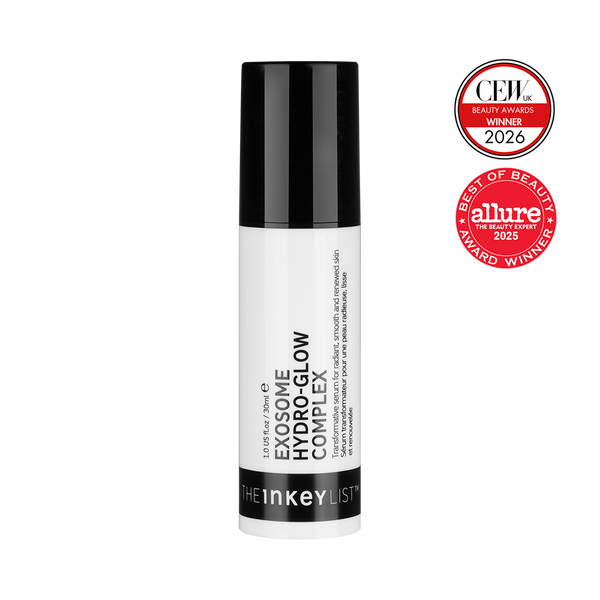
The Exosome Hydro-Glow Complex uses plant-derived exosomes sourced from Centella Asiatica, which you almost certainly know by its shorter name: Cica.
Cica is not a newcomer, and that is precisely the point. It has a long-standing reputation in skincare as a comforting, calming ingredient, particularly for skin that flushes easily, feels tight, or reacts to everything. It has been a staple of Korean skincare for years and a fixture in barrier-focused formulas for longer than exosomes have been a mainstream conversation. Choosing Cica as the botanical source was a deliberate decision rooted in that heritage, not a cost-saving substitution.
What do our Cica-derived exosomes do? They work at the surface of the skin to support its natural renewal processes. That is the accurate description, and we are not going to inflate it. You will find plenty of exosome copy elsewhere that reaches for dramatic mechanistic explanations. We would rather tell you what you can reasonably expect to see than sell you a story about what is supposedly happening somewhere you cannot observe.
There are two numbers worth knowing here, and both are about scale rather than performance.
Exosomes are 300 times smaller than a pore. There are 3 million Cica-derived exosomes in every bottle.
The size point is the one that unlocks the rest of this article, because it is the reason a topical serum is a viable format at all. We will come back to it properly in Myth 3. The volume point speaks to concentration: this is not a trace inclusion added so the word can appear on the front of the box.
If you want to go deeper on how sourcing methods differ from one another, we have a separate breakdown of plant-derived vs fermentation-derived exosomes that covers that comparison properly.
Plant-Derived Exosomes Are a Genuinely Researched Category
Here is where we need to be careful and clear at the same time, because this is exactly the point at which skincare writing tends to overreach.
Plant-derived vesicles are a real and active area of independent scientific study. Researchers have published work characterising vesicles derived specifically from Centella Asiatica, the same botanical source we use, in an in vitro characterisation study available through PubMed Central. There is also a broader dermatology review of plant-derived extracellular vesicles examining the wider category and its relevance to the field.
What those papers establish is that plant sourcing is a legitimate, studied area of research rather than a marketing shortcut invented to make an expensive ingredient affordable. That is the entire claim we are making by referencing them, and we are not going to stretch it further.
What they do not do is test the Exosome Hydro-Glow Complex. Independent research into plant-derived exosomes is background on an ingredient category. It is not evidence about our product, and any brand that blurs those two things is doing something you should be suspicious of. Our formula’s performance is described only through our own clinical testing, which appears throughout this article with its sources footnoted at the bottom of the page.
That distinction is worth internalising as a reader, because it is one of the fastest ways to assess whether an exosome product is being honest with you. If a brand cites a study, ask what the study actually tested. If the answer is “a different material, in a different context”, the citation is decoration.
What This Means When You Are Comparing Products
The practical takeaway from Myth 1 is not that plant-derived exosomes are superior to every other source. It is that “contains exosomes” is not, on its own, useful information. Source matters. Concentration matters. Formulation matters. A product that tells you it contains 1% Cica Exosome from a named botanical source is giving you something you can evaluate. A product that just says “exosome technology” on the front is giving you a word.
If you want the deeper ingredient explanation now that you know source is the variable that matters, our page on plant-derived exosomes goes further into the detail. For a full background read, we also have a complete guide covering exosomes explained.
Having established that our exosomes are a deliberate plant-derived choice rather than a compromise, the obvious next question is whether any of that justifies what you pay for it.
Myth 2: Exosomes Are Just an Expensive Marketing Gimmick
This myth deserves more respect than it usually gets, because the people who hold it are reasoning correctly from the evidence in front of them.
Exosomes entered the consumer market at the top. They arrived through aesthetic clinics and luxury skincare, at prices that positioned them as a treat rather than a routine step. When an ingredient shows up wearing a three-figure price tag, it is entirely rational to wonder whether you are paying for the formula or for the story around it. Scepticism is not cynicism here. It is a reasonable response to how the category was introduced.
So let us deal with the money directly.
£20 Versus the £70-£100 Norm
Exosome serums commonly sit somewhere between £70 and £100. The Exosome Hydro-Glow Complex is £20.
That is the comparison, stated plainly. What matters is the sentence that follows it, because a lower price only means something if the specification holds.
A lower price is not the same as a lower specification. Those two things get conflated constantly, and the conflation benefits everyone except the person buying. Price in skincare is determined by a long list of factors that have nothing to do with what is in the bottle: packaging weight, retail positioning, marketing spend, distribution model, margin expectations. An ingredient does not become more effective because the container it arrives in is heavier.
Our position on this is not a promotional angle, it is the reason the brand exists. We do not believe premium skincare should require a premium price tag. If an ingredient is genuinely worth using, the goal is to get it to as many people as possible at a price they can actually sustain, because skincare that you can only afford occasionally is skincare that cannot deliver on consistency.
What Is Actually in the Formula
Value arguments are worthless without specifics, so here is what the Exosome Hydro-Glow Complex contains.
The headline is 1% Cica Exosome, the plant-derived exosomes from Centella Asiatica covered in Myth 1.
Alongside that sits 1% Kollaren™, which helps visibly improve firmness and skin structure. Kollaren™ belongs to the peptide family, and if you want to understand where peptides fit into a routine more broadly, our guide to peptidescovers the ground properly.
Prickly Pear Enzyme acts as a gentle natural exfoliator. This is a softer approach to surface texture than an acid, which is deliberate given the formula is built for daily use across skin types.
Then there is the supporting cast: CoQ10, Hyaluronic Acid and Ectoin. Hyaluronic acid handles hydration, Ectoin supports comfort, and CoQ10 rounds out the antioxidant side. None of these are exotic, and that is intentional. A well-built formula is not a competition to include the most unfamiliar ingredient names.
On the subject of concentration, it is worth knowing that some exosome products are marketed on particle counts running into the billions. Those are impressive-looking numbers that tell you very little on their own, because a count is not a concentration. We break down why that distinction matters in how much exosome is enough.
So Do Exosome Serums Work?
This is the question underneath the price objection. People asking whether exosomes are a gimmick are usually not asking about margins. They are asking whether the category delivers anything measurable, or whether it is a new word attached to a familiar hydrating serum.
Our answer comes from our own clinical testing rather than from inference.
100% saw more glowing skin, clinically proven*
6-in-1 skin rejuvenation: clinically proven to visibly improve radiance, hydration, tone, firmness, elasticity and texture*
That second claim is the one worth sitting with, because it covers six separate visible attributes rather than a single headline benefit. Radiance and hydration are what most people notice first. Tone, firmness, elasticity and texture are the slower-burning ones that tend to matter more over time.
We have also had external validation. The Exosome Hydro-Glow Complex is a CEW UK Beauty Awards Winner 2026, which is judged by people within the industry rather than voted for by a marketing budget. Third-party recognition is not a substitute for clinical data, but it is a useful additional signal when you are weighing up whether a brand’s own confidence is shared by anyone else.
The Honest Version of the Value Argument
We are not going to tell you that every expensive exosome serum is overpriced, because we do not know how every other formula is built and it would be a cheap thing to claim. Plenty of thoughtful, well-formulated products sit at higher price points for reasons that make sense to the people making them.
What we will say is this. The assumption that a low price signals a compromised formula is one of the most expensive beliefs in skincare. It costs people money continuously, and it is the belief the entire premium positioning strategy depends on. If you are choosing between products, interrogate the formula, the concentration, the source and the testing. Then look at the price. Doing it in that order changes what you buy.
If you are still weighing exosomes against a cheaper, more familiar glow ingredient before committing, our comparison of Vitamin C vs Niacinamide vs Exosomes: the ultimate glow ingredient showdown walks through how they differ in practice.
Price, though, is only half the accessibility question. A lot of readers have got past the cost and are still stuck on something else entirely: the belief that exosomes only really work if a professional is the one applying them.
Myth 3: You Need Injections or an In-Clinic Exosome Facial
Yes, exosomes are safe for cosmetic use in a topical serum, and no, you do not need needles or an appointment to use them.
That is the direct answer, given first, because this is the question that stops more people than any other and it deserves a straight response rather than a build-up.
Now the context.
Where This Myth Comes From
This one has an entirely legitimate origin, which is why it has proved so persistent. Exosomes reached public awareness through aesthetic clinics. They were typically paired with microneedling, or used as a post-procedure step, and they were discussed in the vocabulary of treatments rather than routines. If your first exposure to an ingredient is a clinician applying it after a device, you will quite reasonably conclude that a clinician and a device are part of the deal.
An exosome facial is a real thing. In-clinic protocols exist, professionals administer them, and we are not going to pretend otherwise or wave them away as unnecessary. The category has genuine clinical interest, and reviews such as this PubMed Central overview of exosome use in cosmetic dermatology discuss application across professional and topical contexts as an area of ongoing study.
What we are correcting is the leap from “clinics use exosomes” to “only clinics can use exosomes”. Those are different statements, and the second does not follow from the first.
Why a Topical Serum Is a Legitimate Route
Return to the number from Myth 1: our Cica-derived exosomes are 300 times smaller than a pore.
That scale is the whole reason a leave-on serum is a viable format for this ingredient rather than a marketing exercise. It is also why the Exosome Hydro-Glow Complex is designed as a daily step rather than an occasional intensive treatment. No needles, no appointment, no downtime, no recovery period, no diary management.
The distinction we want to draw carefully is this: a topical serum is a different route to a professional treatment, not a substitute for one. They are not the same proposition and we are not going to claim they are. If you are considering an in-clinic procedure, that is a conversation to have with a qualified practitioner. What we can tell you is that using exosomes topically is a legitimate way to use the ingredient, not a consolation prize for people who cannot get to a clinic.
Are Exosomes Safe? The Practical Answer
Framed for cosmetic use, the answer is straightforward. The Exosome Hydro-Glow Complex is formulated for daily use across skin types, including sensitive skin. The Cica heritage discussed in Myth 1 is directly relevant here, because Centella Asiatica’s reputation in skincare has always been built on comfort rather than intensity.
Our clinical testing supports the tolerability picture:
55% reduction in visible signs of skin stress (redness, puffiness, visible irritation)***
That is a claim about what is visible on the surface, which is exactly how we intend it to be read. If your skin flushes easily, feels reactive, or looks stressed by the end of the day, this is the data point most relevant to you. Our page on redness covers the wider picture if visible reactivity is your main concern, and if the phrase itself is new to you, we explain what skin stress is separately.
Ectoin also earns a mention here rather than only in the ingredients list. It sits in the formula as part of the comfort and barrier story, which is a meaningful part of why the serum is built for daily use rather than intermittent application.
Patch Test Anyway
Here is advice that does not help us sell anything and is worth giving regardless: patch test any new active before you commit it to your face. Not because exosomes are risky, but because you are an individual and any formula can interact unpredictably with your particular skin, your particular routine, and whatever else you are currently using.
Apply a small amount to a discreet area, leave it, and see what happens before you introduce it fully. Our guide on why you should always patch test explains the method properly and takes about two minutes to read.
If sensitivity and barrier comfort are your primary concerns rather than glow, the Ectoin Hydro-Barrier Serum at £16 is built specifically for that, and it pairs comfortably alongside the exosome step for anyone who wants both.
With needles off the table, the next objection tends to be patience. And this is the point where a great deal of exosome content, including an earlier version of this article, has been getting it wrong.
Myth 4: Exosome Results Take Months
Let us answer the search query first, because people arriving at this section want a number, not a preamble.
Glow from first use. Full clinically proven results in 14 days.*
That is the timeline. It is not an overnight miracle, and we would rather say that plainly than let you discover it yourself and feel misled. But you are not signing up for an indefinite waiting period either.
Why the Waiting-Period Myth Took Hold
Skincare has trained everyone to expect delay. The standard advice for most actives is to commit, be patient, and reserve judgement until you have used the product consistently for a long stretch. That advice exists for good reasons with certain ingredient categories, and it has become such a default that it now gets applied indiscriminately to everything.
The result is that people assume any new active requires a long, faith-based trial before it earns its place. That assumption discourages people from starting at all, because nobody wants to commit to something on the promise that it might reveal itself eventually.
We are correcting that here, because our own clinical testing does not support it for this product, and repeating a generic industry expectation over our own data would be dishonest.
What the First Application Actually Does
Set your expectations for day one around hydration and radiance. That is what is realistically available immediately, and it is not a small thing. Skin that is properly hydrated looks different straight away: smoother in appearance, more even in how it catches light, less tight.
Proven to deliver up to 12 hours of hydration**
That is a full-day claim, which is the relevant framing. Hydration that fades by mid-morning does not change how your skin looks when it matters. If your primary complaint is that your skin looks flat, dull or tight, our page on dehydrated skin explains what is actually going on and why the fix is often faster than people assume.
So the first use gives you glow and hydration. That is genuine, and it is visible, and it is also not the full result.
The 14-Day Result
Clinic-worthy rejuvenated skin in 14 days*
Fourteen days is the point at which our clinical testing measured the fuller outcome, and it is the timeframe we stand behind. It is deliberately specific. Vague timelines are a way of never being wrong, and we would rather give you a number you can hold us to.
On the question of why the timeline is what it is, we will stay within what we can actually support. Our exosomes work at the surface of the skin to support its natural renewal processes, and our in-vitro testing recorded a 63% increase in skin renewal activity in 8 hours***. That is a laboratory measurement, footnoted at the bottom of this page, and we are presenting it as exactly that rather than dressing it up as something more.
We are not going to offer you a dramatic explanation of what is supposedly happening beneath the surface. Plenty of exosome marketing does, and the confidence of the storytelling rarely matches the strength of the evidence behind it. What we can tell you is what we measured and when.
If you would rather see how this plays out for real people over time, our exosome serum before and after results timeline sets it out.
Consistency Is the Condition
One important caveat, and it is the one most likely to be skipped.
The 14-day result was measured on daily use. It assumes you actually apply the product every day, not most days, not when you remember. This is not a technicality designed to give us an excuse. It is how the testing was conducted, and reporting a result while omitting the conditions it was achieved under would make the number meaningless.
The practical implication is that ease of use matters as much as formulation. A serum you enjoy applying, that layers without fuss, that does not pill under everything else and does not cost so much that you ration it, is a serum you will actually use daily. That is another reason the £20 price is a performance factor rather than just a value one. Affordable skincare is skincare you use consistently.
You can find the Exosome Hydro-Glow Complex here if this is the section that decided it for you.
Comparing Timelines Across Newer Actives
If you are evaluating exosomes against other next-generation ingredients, timeline is a fair basis for comparison and you are not the only person making it. Our breakdown of PDRN vs exosomes sets the two side by side, and our PDRNpage covers that ingredient in its own right if it is new to you.
Fast, clearly defined results raise one final gatekeeping question, which is whether this ingredient was ever intended for your skin in the first place.
Myth 5: Exosomes Are Only for Mature or Damaged Skin
The last myth is the one that quietly excludes the most people, and it operates almost entirely below the level of conscious thought.
Because exosomes launched through clinics and arrived embedded in anti-ageing conversations, they picked up a positioning that has stuck: corrective rather than everyday, for skin with a problem rather than skin you simply want to look after. Readers in their twenties scroll past assuming the product is not aimed at them. Readers with sensitive skin assume anything described as advanced will be too much for them.
Both assumptions are wrong, and both cost people a product they would actually benefit from.
Exosomes Are for Everyone, and the Formula Is Built That Way
The Exosome Hydro-Glow Complex is designed to be compatible with any routine and suitable for any skin type. There is no minimum age, no prerequisite concern, no threshold of damage you need to reach before it becomes relevant.
The clearest way to demonstrate that is the claim that covers the full range of what it does:
6-in-1 skin rejuvenation: clinically proven to visibly improve radiance, hydration, tone, firmness, elasticity and texture*
Six attributes. Different readers will care about different ones, and that is precisely the point. This is not a single-benefit product that happens to have been marketed to one demographic.
If You Are Younger, the Draw Is Glow and Even Tone
For skin in its twenties and early thirties, the appeal sits at the radiance, hydration and even tone end of that list. These are the concerns that actually come up: skin that looks tired rather than aged, uneven tone from old marks, a dullness that no amount of highlighter genuinely fixes.
None of that requires an anti-ageing framework to be worth addressing. If tone and texture are your main focus, niacinamide is a natural companion ingredient and works comfortably alongside an exosome step. If radiance is the priority, our vitamin C page covers how that ingredient approaches the same goal differently.
If You Are Seeing Early Visible Changes, the Draw Is Firmness and Texture
For skin beginning to show early visible changes, the relevant part of the list shifts towards firmness, elasticity and texture. This is where the 1% Kollaren™ in the formula does its work, helping to visibly improve firmness and skin structure.
The formula also helps support natural collagen production. That is the accurate description, and we are stopping there deliberately. You will see far more forceful phrasing used across this category, and forceful phrasing is not the same as strong evidence.
We would also rather not frame any of this as damage control. Skin changes. That is not a failure requiring correction, and we are not interested in selling anything on the basis of making people anxious about a normal process.
If Your Skin Is Sensitive, the Draw Is Comfort
This is where the Cica heritage from Myth 1 becomes directly relevant rather than merely interesting. Centella Asiatica earned its place in skincare through comforting and calming the look of skin, and choosing it as our botanical source means the sensitivity conversation was built into the formula rather than added as a reassurance afterwards.
55% reduction in visible signs of skin stress (redness, puffiness, visible irritation)***
If your experience of new actives has been a cycle of trying something, reacting, and retreating to the basics, that is the number worth noting. Ceramides are worth understanding too if barrier support is a recurring theme for you, since a compromised barrier is often the reason products that should be tolerable are not.
If You Feel Like Your Skincare Has Stopped Working
There is one more group worth naming explicitly, because they rarely see themselves described.
Some people are not dealing with a specific concern at all. Their routine simply is not doing what it used to. Everything is fine, nothing is wrong, and nothing is visibly improving either. Skin looks flat. Glow has gone somewhere. It is a difficult thing to search for because it does not have a name.
If that is you, the radiance and hydration side of this formula is likely the most relevant entry point, and 14 days is a short enough horizon to find out without a long commitment.
If a Daily Serum Is Not Your Format
Not everyone wants another daily step, and pretending otherwise helps nobody. For readers who want the ingredient in a lighter-touch format, the Exosome Boosting Dry Sheet Mask offers an occasional-use route without committing to a daily serum.
We would genuinely rather you used something occasionally and enjoyed it than bought a daily product out of obligation and abandoned it. Gatekeeping who gets to use an ingredient is a strategy for selling less to fewer people, which has never been what we are for.
Once you accept that exosomes are for your skin, the practical question is simply where the serum sits among everything else you already use.
How to Use Exosomes for Skin in Your Daily Routine
Layering anxiety is real, and it stops more purchases than price does. People buy an active, become uncertain about where it goes or what it clashes with, use it inconsistently, and conclude it did nothing. So here is the placement guidance in full, given properly rather than compressed into a line on the back of the box.
Where the Serum Goes
Apply the Exosome Hydro-Glow Complex immediately after cleansing, before heavier textures.
The detail that matters most: apply it to damp skin. Not dripping, just not fully dried. Cleanse, leave your skin slightly damp, and apply. This is a specified usage note rather than a general suggestion, and it is the single easiest thing to get wrong through habit, because most people instinctively dry their face completely first.
After the serum, continue as normal. Moisturiser goes on top, and any heavier treatment textures come afterwards.
Morning, Evening, or Both
Both. The formula is designed for daily use and is compatible with either end of the day, or both ends if you prefer.
In the morning, the hydration and radiance benefits work in your favour under makeup and through the day. In the evening, it slots in as part of a straightforward routine without needing anything rearranged around it. Given the 14-day result is measured on daily use, the practical advice is to attach it to whichever routine you are most reliable about.
Layering With Vitamin C
Vitamin C and exosomes work comfortably together, and the two are complementary rather than competitive since both sit in the radiance and even-tone space.
The simplest approach is to apply your vitamin C first, then the exosome serum, then moisturiser. If you prefer to separate them, vitamin C in the morning and exosomes in the evening is a perfectly reasonable split. Our vitamin Cpage has the fuller ingredient picture if you want to understand why the two pair well.
Layering With Retinol
Retinol is the ingredient that generates the most “can I mix this” searching, and the answer here is more reassuring than most people expect.
Exosomes and retinol are compatible. The comfort-focused profile of the formula makes it a sensible companion to a retinoid rather than a competing irritant, which is why the Cica sourcing and the Ectoin content matter to this conversation.
The practical order is exosome serum first, then retinol, then moisturiser. If you are new to retinol or your skin is currently adjusting, applying the exosome serum first is the approach we would suggest.
Rather than duplicate an entire retinol guide here, our dedicated piece on what not to mix with retinol covers the full compatibility picture, and our retinol page explains the ingredient itself for anyone still deciding whether to use one.
Finish the Morning With SPF
Every morning routine ends with sun protection, and no glow-focused routine is complete without it. Radiance work without daily SPF is effort spent against a headwind.
Our SPF page covers what to look for and how much to apply, which is almost always more than people think. In the UK, Dewy Sunscreen SPF 30 layers well over the exosome step without disturbing it.
Building Out the Wider Routine
If you want to extend beyond the single serum, three additions make sense depending on what you are after.
-
PDRN Serum, £18. For readers exploring next-generation actives more broadly. It sits comfortably in the same routine and covers different ground.
-
Ectoin Hydro-Barrier Serum, £16. For barrier support and comfort. The natural pick if sensitivity is an ongoing theme rather than an occasional flare.
-
Exosome Boosting Dry Sheet Mask. For a periodic boost, or for anyone who prefers a treatment format to a daily one.
None of these are required. The Exosome Hydro-Glow Complex is a complete step on its own, and a routine of three well-chosen products used consistently will always outperform a routine of nine used sporadically. Skincare has become far more complicated than it needs to be, and adding steps is not the same as improving results.
For anything still unresolved, the questions below cover what readers ask most often.
The Honest Summary on Exosomes for Skin
Five myths, five corrections. Source genuinely matters, and plant-derived exosomes from Centella Asiatica are a deliberate choice rather than a cheaper stand-in for something better. A £20 price is a position on accessibility, not a compromised formula. You do not need needles or an appointment, because a topical serum is a legitimate route to the ingredient. You are looking at glow from first use and full clinically proven results in 14 days, not an open-ended wait. And exosomes are not reserved for mature or damaged skin, they are for anyone who wants radiance, hydration, comfort and visible improvement.
The wider point is one we keep coming back to. Skincare has become far more complicated than it needs to be, and exosomes are a textbook example: a genuinely interesting ingredient buried under vocabulary designed to impress rather than inform. When a category arrives wrapped in language nobody can verify, confusion is not an accident. It is the strategy.
Our alternative is straightforward. Clear guidance, proven ingredients, real results, and a willingness to tell you what something does not do alongside what it does. You should not need a science degree to work out whether a serum is worth £20.
If you want to try it, the Exosome Hydro-Glow Complex is £20 and a CEW UK Beauty Awards Winner 2026. Clinic-worthy rejuvenated skin in 14 days*
And if you would rather keep reading before you buy, that is entirely reasonable too. You can read more about exosomes on our ingredient page and come back when you are ready.
*4-week clinical study of 26 people **Clinical study of 31 people ***In-vitro testing of Cica Exosomes showed a 55% reduction in pro-inflammatory markers and a 63% increase in markers associated with skin renewal after 8 hours.
Frequently Asked Questions
Got a question?
Our askINKEY team are a friendly bunch of skincare experts with deep product knowledge and zero judgement. Whether you're an ingredient obsessive or just starting out, we'll make it make sense. No question too big. No question too small. We Give A Care, Every Day.


