



Where Do Exosomes Come From? Plant-Derived vs Fermentation-Derived Explained
Not all exosomes are the same - here’s where they come from, how plant and fermented sources differ, and what actually matters when you’re choosing a serum.
Author
askINKEY skincare advisor
Published
20 May, 2026
Time to read
15 minutes
Exosomes in skincare are not all sourced the same way, and where do exosomes come from is a more useful question than it first appears, because the answer changes what is actually in the bottle you are holding. There are three routes. Exosomes can be plant-derived, extracted from botanical material. They can be fermentation-derived, produced through a controlled fermentation process. Or they can be human or animal-derived, which is the route associated with clinical settings rather than the cosmetic serums you buy over the counter.
For a sense of scale, exosomes are around 300x smaller than a pore.
By the end of this article you will be able to read an exosome label, work out what is in the bottle, and decide whether it suits your routine. If you want the fundamentals first, start with what exosomes are and come back.
The source matters more than most labels let on.
Why the Source of an Exosome Actually Matters
Here is the thing that trips most people up. An exosome is defined by what it is structurally, not by what it is made from. That means two products can both say “exosome” on the front of the box and contain materially different things inside. The word describes a type of tiny particle. It does not describe the origin of that particle, the botanical or organism it came from, or what else was carried along with it during extraction.
Think of it the way you would think of the word “oil” on a food label. Oil is a category. Olive, sunflower, coconut and palm are specifications. Nobody would accept “contains oil” as sufficient information on a bottle in their kitchen, and yet “contains exosomes” is routinely accepted as sufficient information on a bottle in a bathroom cabinet. That gap between category and specification is the whole reason this article exists.
Source affects three practical things you can actually act on when you are choosing between products.
First, what else comes along for the ride. Exosomes are never isolated in a perfect vacuum. Whatever process is used to obtain them, the resulting material is an extract, and that extract contains more than just the vesicles themselves. A botanical extraction brings botanical compounds with it. A fermentation process brings the by-products of fermentation with it. Neither of those is a problem in itself. But they are different, and if you have skin that reacts to specific inputs, knowing which family you are dealing with is genuinely useful.
Second, whether the product suits a vegan routine. This one is binary and it depends entirely on origin. A plant-derived exosome and a human-derived exosome are not remotely the same proposition ethically, and the word “exosome” on its own will never tell you which you have. We deal with this properly further down.
Third, how consistent the input is from batch to batch. Growing conditions, harvest timing and raw material variability affect botanical inputs in ways that a closed, controlled process handles differently. Neither approach is automatically better. They are simply different manufacturing philosophies, and being aware of the trade-offs makes you a sharper shopper.
Those two philosophies, in one line each, are the spine of everything that follows. Plant extraction takes an existing natural source and isolates the vesicles already present within it. Fermentation uses microorganisms in controlled conditions to transform a raw input and generate material that is then collected. One harvests. One cultivates.
Now, the uncomfortable part. Labels rarely spell any of this out. There is no requirement for a brand to tell you which route it used, and plenty do not. You will find products that lead with enormous particle counts and say nothing at all about origin, which is a bit like advertising the number of pages in a book without mentioning the language it is written in.
This category grew extremely quickly, which is part of the explanation. When demand outpaces consumer understanding, marketing language tends to fill the gap before clear labelling standards catch up. We covered that growth curve in The Glow Revolution, and it is useful background for understanding why “exosome” ended up functioning as a category label rather than a specification.
We are not going to relitigate what exosomes do for skin here, because that belongs in our full guide to exosomes and it deserves proper space. This article has a narrower and more practical job: telling you where the things come from.
So let us answer the question directly.
Where Do Exosomes Come From? The Three Main Sources
Exosomes used in skincare come from three main sources: plants, controlled fermentation, or human and animal cells. The first two are what you will find in cosmetic products sold over the counter. The third sits in a different context entirely.
Here is each one in turn.
Plant-Derived Exosomes
Plant-derived exosomes are extracted from plant material. That includes fruits, roots, leaves, stems and botanical cell cultures grown specifically for the purpose. The raw material is processed and the vesicles are separated out and purified, producing a concentrated botanical fraction rather than a conventional plant extract.
“Plant based exosomes” is the phrase you will most often see printed on packaging, and it is a reasonable shorthand. Where brands vary is in how specific they get afterwards. Some name the exact botanical. Some stop at “plant based exosomes” and leave it there. The named-botanical version gives you more to work with, because it lets you research the source yourself rather than taking a category label on trust.
Common botanicals studied in this space include Centella Asiatica, ginger, ginseng, green tea and grape. If a product names one of these, you can go and read about it independently, which is exactly the position a shopper should be in.
Fermentation-Derived Exosomes
Fermentation-derived exosomes are produced through a controlled fermentation process. Microorganisms are cultivated in a nutrient medium under managed conditions, and vesicles secreted during that process are collected from the medium and incorporated into formulas.
This route belongs to the same broad family of manufacturing that sits behind the wider fermented skincare trend, which is why you will often see the two discussed together. It is a biotechnology approach rather than an agricultural one. The input is defined, the conditions are defined, and the process happens in a tank rather than a field.
Human and Animal-Derived Exosomes
The third route is human and animal-derived. This is the origin most associated with clinical and in-office settings, where it is used in professional contexts under professional supervision. It is not what sits in a cosmetic serum you pick off a shelf.
We are covering it here for completeness rather than because it is a live choice for most shoppers. If your curiosity about non-botanical ingredient origins extends further, salmon sperm serum: what is it? tackles a related question in the same honest spirit.
INKEY’s exosomes are plant and cica-derived. That is the simple version and we will expand on it shortly.
How to Read Your Label
The practical skill here is short enough to learn in a minute.
Look for the source named in one of two places: the product description, or the INCI list. If a brand has gone to the trouble of using a specific botanical, it will almost always say so, because naming your source is a selling point rather than something to hide.
And if the source is not stated anywhere at all, that is information in itself. It does not automatically mean the product is poor. It does mean you are being asked to buy something without knowing what it is made from, and you get to decide how you feel about that.
Anyone weighing exosomes against other headline ingredients will find PDRN vs exosomes a useful companion read, since it is the comparison most people run next.
Let us take the plant route first, since it is the one you are most likely to have already seen on a label.
Plant-Derived Exosomes: What the Research Says
Plant exosomes are obtained by taking plant material or botanical cell cultures, processing that material, and then isolating and purifying the vesicles from everything else present. The result is not the same thing as a standard plant extract. It is a specific fraction, separated out through additional technical steps, which is why producing it is more involved than pressing or steeping a botanical.
There is a genuine and growing body of published research examining this class of material. It is worth reporting accurately, and it is worth being clear about what it does and does not tell you.
An open-access study published in Applied Biological Chemistry via Springer Nature compared plant extracts against plant exosomes on human skin cells in laboratory conditions, and reported that the two produced measurably different profiles of activity. The practical reading of that finding is narrow but interesting: a plant exosome is not simply a more concentrated version of a plant extract. It behaves as a distinct category of material, which is why the two are not interchangeable on an ingredient list.
A review published in Tissue Cell via PubMed provides an overview of plant-derived exosome structure, isolation methodology and potential applications, noting bioavailability and sustainability among the advantages of the category. The same review is explicit about ongoing challenges in standardisation across the field, which is a caveat worth carrying with you.
Further work published via ACS Molecular Pharmaceutics has examined plant exosome activity in skin research models, adding to the laboratory literature on the category.
Coverage in the trade press has followed. Dermatology Times has published commentary from dermatology expert Dr Frank Roesken, MD, PhD, discussing why plant-derived exosomes have attracted growing attention as a skincare ingredient.
Now the honest part, and we would rather say it than let you infer it.
Much of the published work on plant exosomes is early-stage or conducted in-vitro, meaning in controlled laboratory conditions rather than on human volunteers using a finished product. That is completely normal for an emerging ingredient category and it is not a criticism of the science. But it does mean something specific that gets glossed over constantly in beauty marketing: a research finding about a plant exosome in a laboratory is not the same thing as a finding about a finished cosmetic formula.
Those are two different claims. A study examining isolated material under controlled conditions tells you about that material. It does not tell you what happens when a version of that material is formulated at a given concentration, alongside other ingredients, in a preserved and stabilised product, applied to a real face over real weeks. Brands blur that line constantly, borrowing the authority of a paper to imply something about a bottle. We are not going to do that, and you should be sceptical of anyone who does.
Setting the science aside, plant sourcing carries three straightforward practical upsides for a shopper.
- It scales. Botanical material is renewable and cultivable, which supports consistent supply.
- It suits a vegan routine. Plant based exosomes are botanical in origin by definition.
- It is traceable to a named botanical. You can look up Centella Asiatica. You cannot look up “proprietary complex.”
That third point is the one we would underline. Traceability is not a luxury feature, it is the thing that lets you make an informed decision at all.
Fermentation approaches the same destination from a completely different direction, so let us look at that.
Fermentation-Derived Exosomes and the Rise of Fermented Skincare
Fermentation is a controlled process in which microorganisms break down and transform a raw input into new compounds. That is the whole concept, and it is one of the oldest pieces of technology humans have. Bread, yoghurt, wine, soy sauce and kimchi all rely on it. The principle in skincare is identical, just aimed at a different outcome.
Fermented skincare is not a new trend, despite currently being discussed like one. Fermented ingredients have a long history in skincare formulation, particularly within East Asian traditions, and they have been used in commercial products for decades. What is new is the volume of consumer interest and the visibility of the terminology. The search demand around fermented skincare has grown considerably, which is precisely why the word is now printed on so much packaging.
The practical characteristics of the fermentation route are worth understanding on their own terms.
Conditions are highly controlled. Temperature, time, nutrient supply and organism strain are all specified and managed. This is a closed system, not an open one.
Inputs are consistent. Because you are not dependent on a harvest, seasonal variation is largely removed from the equation. That consistency is a genuine manufacturing advantage.
The resulting extract contains fermentation by-products. This is the part most worth knowing. When you collect material from a fermentation process, you are collecting from a medium in which a lot of biological activity has taken place. The finished ingredient contains the by-products of that process alongside the vesicles themselves. That is not a flaw. Many of those by-products are the reason fermented ingredients are valued in the first place. But it does mean the ingredient is a mixture, and it is a different mixture from what a botanical extraction produces.
Now, the question everyone actually wants answered: which route is better?
Neither. Genuinely, neither.
Plant and fermentation-derived exosomes are two different manufacturing philosophies applied to the same broad goal, and anyone telling you one is categorically superior is, in all likelihood, selling you the one they happen to make. Formulation quality, concentration, stability, the rest of the ingredient deck and whether the finished product has actually been tested all matter far more than which of the two families the raw material came from. A well-formulated fermented product will outperform a badly formulated botanical one, and the reverse is equally true.
What you should be comparing is not source against source. It is product against product, with source as one input among several.
Readers who arrive at fermented actives usually do so for barrier and sensitivity reasons, which is a sensible instinct and worth understanding properly. If that is you, what skin stress is unpacks what is actually happening when skin looks reactive, tight or generally fed up. And for a look at another biotech-produced active with a barrier-support role, ectoin is a useful cross-reference, since it is made through a comparable fermentation-family approach.
On the vegan question, fermentation-derived material is generally botanical or microbial in origin rather than animal-derived, but the honest answer is more nuanced than a single sentence, and it depends on the specific product. We have given it a dedicated section further down rather than compressing it here.
With both routes explained, the obvious question is which one we use.
What Are Cica Exosomes, and Which Route Does INKEY Use?
We use cica-derived exosomes. That places us firmly on the plant-derived side of the split.
Cica, also known as Centella Asiatica, is a botanical with a long history in skincare, most commonly associated with soothing and calming formulations. It is a plant people already trust, and it is the source of the exosomes in our formula. Cica exosomes are simply exosomes isolated from that specific botanical rather than from a generic or undisclosed plant source.
Two compositional facts, both straightforwardly measurable. There are 3 million cica-derived exosomes per bottle. And as mentioned at the top, exosomes are around 300x smaller than a pore.
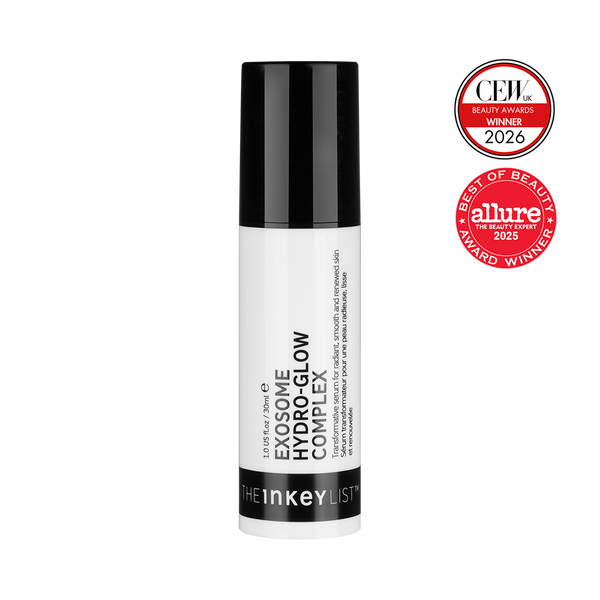
The Exosome Glow Serum is built around 1% Cica Exosome as the delivery route within the formula, supported by a deliberately chosen cast of other ingredients.
1% Kollaren - helps visibly improve firmness and skin structure. Kollaren is a peptide, and peptides are among the most established ingredient families in skincare for this kind of work.
Prickly Pear Enzyme acts as a gentle natural exfoliator, keeping the skin’s surface smooth without the abrasiveness of a physical scrub.
Supporting hydrators round the formula out, including CoQ10, hyaluronic acid and ectoin. Hydration is not a garnish here. A well-hydrated surface looks brighter and smoother immediately, and it makes everything else in the formula more pleasant to wear.
The results we can talk about are the ones we have tested. The serum delivers 6-in-1 skin rejuvenation: clinically proven to visibly improve radiance, hydration, tone, firmness, elasticity, and texture*. In our clinical testing it produced clinic worthy rejuvenated skin in 14 days*. It helps support natural collagen production.
Beyond those specifics, what the formula is designed to do is support skin’s natural processes rather than force anything. It revitalises dull-looking skin, renews the look of tired skin, and helps skin look like it has had a decent night’s sleep even when it has not. If your face currently looks flat, grey and a bit fed up by 4pm, that is the brief this formula was written against.
Anyone who wants the full formulation story rather than the summary will find it in Meet the Exosome Hydro-Glow Complex, which goes deeper into how the ingredient deck was built.
One thing worth saying plainly, because it connects back to everything above. We tell you the botanical. We tell you the percentage. We tell you the count. That is not us being unusually generous, it is the minimum standard a shopper should be able to expect, and the fact that it stands out at all says more about the category than about us.
Sourcing leads naturally into the question a lot of readers are really asking.
Are Exosomes Vegan? Sourcing, Labels and What to Check
It depends entirely on the source, which is precisely why the earlier sections matter.
Plant-derived and cica-derived exosomes are botanical in origin. Human and animal-derived exosomes are not. Same word on the label, completely different answer to the question, and no way to tell them apart unless the source is disclosed.
So are exosomes vegan is not a question with a single answer. It is a question you have to resolve product by product, and the resolution lives in the sourcing information rather than in the word “exosome” itself.
Here is the empowering bit. You are not dependent on marketing copy to find this out, because there is a legally required list on every piece of cosmetic packaging that tells you what is inside.
INCI stands for International Nomenclature of Cosmetic Ingredients. It is the standardised naming system used to identify the ingredients in cosmetics on the packaging, and listing it is a legal requirement. It is not optional, it is not a courtesy, and it is not something a brand can decide to leave off because it complicates the design. Once you know to look for it, you can check any product in any shop, in any country using the system, and read what is actually in it.
The INCI names are not always intuitive, which is a fair criticism. But a botanical source will typically appear under its Latin botanical name, which means Centella Asiatica appears as Centella Asiatica. Once you know the convention, it is readable.
When you are assessing any exosome product, three questions will get you most of the way there.
- Is the source named? Not “exosomes.” Not “plant complex.” A specific botanical, or a specific process. If it is not there in the description or the INCI, you are being asked to trust rather than to know.
- Is the concentration or count given? A percentage, a count per bottle, or both. A product that tells you it contains an ingredient without telling you how much is giving you a fact of very limited use.
- Is there a clinical study behind the claims? And critically, does that study relate to the finished product, or is it borrowed research about the raw ingredient category? Both can be legitimate. They are not the same thing, and a well-run brand will make clear which it is quoting.
That list is short enough to keep in your head in a shop, which is the point.
A note on the wider ethics conversation. Not every effective skincare ingredient is botanical, and we are not going to pretend otherwise or imply that non-botanical automatically means worse. PDRN is a good example of an ingredient with a non-botanical origin story that is worth understanding on its own terms rather than dismissing. The useful position is not “botanical good, everything else bad.” It is knowing what you are buying and choosing according to your own priorities.
Which brings us from evaluating a product to actually using one.
How to Choose an Exosome Product and Where It Fits in Your Routine
Match the source to your priorities. That is the whole decision, compressed.
If a vegan routine matters to you, check for a named botanical source and do not accept the category word on its own. If batch consistency matters to you, understand how the ingredient is produced and which philosophy that reflects. If you have reactive skin, knowing whether you are dealing with a botanical extract or a fermentation-derived mixture tells you something useful about what else is in there. And if none of those are your priority, then formulation quality and evidence should drive the decision, as they should with any product.
Placement in a routine is refreshingly simple. Apply the exosome serum to damp skin straight after cleansing, before heavier textures. Damp skin helps the formula spread and absorb, and going on early means nothing richer is sitting in the way. Thin to thick is the rule, and this sits near the thin end.
Here is how the rest of the routine builds around it.
Cleanse first, obviously, and keep it gentle. Whatever you use, the goal at this stage is a clean surface, not a stripped one.
Exosome serum next, on damp skin. The Exosome Glow Serum is proven to deliver up to 12-hours of hydration**, which means it is doing hydration work throughout the day rather than for the twenty minutes after application. In our clinical testing, 100% saw more glowing skin, clinically proven*.
Two further figures come from in-vitro testing of the Cica Exosomes themselves. There was a 55% reduction in visible signs of skin stress (redness, puffiness, visible irritation)***, and a 63% increase in skin renewal activity in 8 hours***. If redness is a recurring theme in your skin, that first figure is the relevant one.
Add layered hydration with the Hyaluronic Acid Serum if your skin drinks everything you give it and asks for more.
Support the barrier with the Ectoin Hydro-Barrier Serum when skin is feeling reactive, tight or generally overwhelmed. Barrier support is not a separate project from glow, it is the foundation of it.
Seal everything in with the Bio-Active Ceramide Moisturiser. Ceramides are part of the skin’s own barrier structure, which makes them a logical final step. A moisturiser here is not just comfort, it is what keeps the layers underneath from evaporating off.
Add a targeted boost with the Exosome Boosting Dry Sheet Masks when you want a concentrated hit before an event or after a bad week. Meet the exosome hydrating mask explains how they work and when to reach for them.
Consider the alternative ingredient story with the PDRN Serum if you have been comparing the two categories and want to understand PDRN in practice rather than in theory.
Finish with SPF in the morning. Every day, regardless of weather or season. No serum in any category can outrun unprotected sun exposure, and any brand that lets you believe otherwise is doing you a disservice.
A closing thought on shopping strategy. Price is not a reliable proxy for quality in this category. Some of the most expensive exosome products available disclose nothing about their sourcing at all, while less expensive ones name the botanical, state the concentration and publish their testing. Judge on disclosure and evidence, not on the number on the shelf edge.
That covers the routine. Here are the questions people still search individually.
The Short Version, and What to Do With It
Exosomes in skincare come mainly from plant sources or from controlled fermentation. The label rarely tells you which, and the source shapes what is actually in the bottle you are buying.
The takeaway fits in one line. Check the source, check the concentration, check whether there is a study behind the claim. If all three are answered clearly, you are making an informed decision. If none of them are, you are making a hopeful one.
Our position is straightforward. We use cica-derived exosomes, and we tell you so, because clarity beats hype every time.
If you want to see it in practice, the Exosome Glow Serum is where our cica exosomes live. And if you would rather keep reading first, our full exosomes guide has the complete ingredient deep dive waiting.
Because at The INKEY List, We Give A Care.
\4-week clinical study of 26 people*
\*Clinical study of 31 people*
\**In-vitro testing of Cica Exosomes showed a 55% reduction in pro-inflammatory markers and a 63% increase in markers associated with skin renewal after 8 hours.*
Frequently Asked Questions
Got a question?
Our askINKEY team are a friendly bunch of skincare experts with deep product knowledge and zero judgement. Whether you're an ingredient obsessive or just starting out, we'll make it make sense. No question too big. No question too small. We Give A Care, Every Day.


