



Bio-Active Ceramides vs Regular Ceramides
Not all ceramides work the same way — here’s what “bio-active” actually means, and how to choose the right one for your skin
Author
askINKEY skincare advisor
Published
25 February, 2026
Time to read
19 minutes
The word “ceramide” printed on the front of a bottle tells you almost nothing. It confirms that a lipid from a very large family of lipids is somewhere in the formula. It does not tell you which one, how it is built, how much of it is in there, or what it has been formulated alongside. Two products can both say “ceramides” on the front, sit next to each other on the same shelf, and behave completely differently on skin.
That gap between what the label says and what the formula actually does is what this article is for. We are going to unpack what bio-active ceramides really are, why the term describes structure rather than origin, and how Ceramide NP, Ceramide AP and Ceramide EOP each do a different job inside your skin barrier. We will also settle two comparisons that come up constantly: ceramides versus hyaluronic acid, and ceramides alongside peptides. By the end, you should be able to read an ingredients list with more confidence and know which INKEY ceramide product actually matches your concern.
This is a comparison piece, not a beginner explainer. If you are starting from scratch and want the fundamentals first, read our ceramides ingredient page and then come back. Everything below assumes you already know that ceramides matter and want to understand why the specific type matters more.
What “Bio-Active” Actually Means in Skincare
Here is the single biggest misunderstanding in this entire topic, and it is worth clearing up before anything else.
“Bio-active” describes molecular structure, not source. It is not a statement about where the ingredient came from. It is not a claim about a plant, a lab, a fermentation tank or a farm. It is a description of how the molecule itself is built.
That distinction trips people up constantly, and understandably so. The prefix “bio” reads like a sourcing word. In this context, it is not. When we describe a ceramide as bio-active, we are saying that the molecule has been built to match the structure of the ceramides your own skin produces naturally. Same architecture. Same shape. Same fit.
Why skin-identical structure changes the outcome
Your skin barrier is not a flat sheet. It is a layered structure, often described as a brick-and-mortar arrangement, where skin cells are the bricks and a matrix of lipids fills the space between them as the mortar. Ceramides are a core part of that mortar. They are not decoration sitting on the surface. They are structural.
So when a ceramide is built to match what your skin already makes, it can slot into that existing lipid arrangement and become part of the structure. It integrates. A generic emollient that lacks that structural match behaves differently: it can sit on top of skin, soften the surface and feel pleasant, without ever becoming part of the mortar it is supposed to be reinforcing.
Both can feel nice. Only one is doing structural work.
The reason any of this matters is that the barrier is what holds moisture in and keeps irritants out. When it is intact, skin feels comfortable, calm and hydrated without much effort. When it is compromised, water escapes more easily, everyday products start to sting, and skin can look dull, tight, flaky or reactive. If you want a fuller explanation of that mechanism, we have written about what your skin barrier is in detail.
The structural role of these lipids is well established in the wider dermatological literature, including published research hosted by the NIH and patient-facing guidance from organisations such as the Cleveland Clinic. That is the neutral, non-commercial version of the point we are making: ceramides are not a nice-to-have additive, they are part of how the barrier is physically constructed.
The practical takeaway for reading a label
Because “bio-active” is a structural term, it follows that the word “ceramides” on its own is a weak claim. It is technically accurate and practically vague.
What is genuinely useful is the specific ceramide named on the ingredients list. Ceramide NP tells you something. Ceramide AP tells you something. Ceramide EOP tells you something. “Contains ceramides” tells you very little, in the same way that “contains vitamins” would tell you very little on a food label.
To say it once more plainly, because it is the idea the rest of this article rests on: bio-active is about how the molecule is built, not where it came from.
Once you accept that structure is the thing that matters, the obvious next question is which structures exist, and what each one is actually for.
Ceramide NP, Ceramide AP and Ceramide EOP Explained
The organising idea here is simple: different chain lengths, different jobs. These three are not interchangeable versions of the same ingredient. They are distinct molecules with distinct roles inside the barrier, and knowing which is which turns an ingredients list from a wall of text into useful information.
Every ceramide has a fatty acid tail attached to it. The length of that tail changes how the molecule sits within the layered lipid structure of the barrier. Shorter tails behave one way. Longer tails span more of the structure and can knit adjacent layers together, which is why the longest of the three ends up doing the sealing job. That is the whole logic of chain length in one paragraph, and you do not need any more chemistry than that to use it.
Here is how the three break down:
- Ceramide NP - rebuilds structure. This is the structural workhorse of the group and the one you will see most often in well-built barrier formulas. Its job is reinforcement: helping restore the organised lipid arrangement that keeps the barrier functioning as a barrier. Ceramide NP is the ceramide used across the INKEY bio-active range, and it is the one to remember if you only remember one.
- Ceramide AP - calms reactivity. This is the type most associated with skin that reacts easily. If your skin is the sort that flushes at a temperature change, stings at a new serum, or feels tight and irritable after cleansing, Ceramide AP is the name to look for on a label.
- Ceramide EOP - seals. It carries the longest fatty acid chain of the three and functions as the barrier’s waterproofing layer. That length lets it bridge and lock the lipid layers together, which is what limits water escaping through the surface. If you want to understand the mechanism it is working against, our explainer on transepidermal water loss, or TEWL, covers exactly how and why moisture leaves skin.
That diagram carries the idea better than another three paragraphs would. The chain lengths differ, so the positions differ, so the functions differ.
If you are trying to hold all of this in your head, use the short version: NP rebuilds structure, AP calms reactivity, EOP seals. One line, three jobs. It is the most reusable sentence in this article, and it is the reason a formula built around a specific named ceramide is more informative than one that simply says “ceramide complex” and leaves you guessing.
This is also why barrier concerns are rarely solved by any single ingredient in isolation. A barrier under strain from over-exfoliation, harsh cleansing, cold weather or an overloaded routine needs consistent structural support rather than one heroic product. If that describes where your skin is right now, our damaged skin barrier collection groups the products designed for exactly that state.
With the three types defined, we can finally get to the comparison this article is named after.
Bio-Active vs Regular Ceramides, and Where Phytoceramides Fit
This is the section where a lot of skincare content reaches for hype. We are not going to, because the honest version is more useful and, frankly, more persuasive.
The comparison between bio-active ceramides and regular ceramides comes down to two things, and only two things: structural match and formulation quality.
Structural match
Bio-active ceramides are built to match the structure skin makes naturally. That structural match is what allows them to integrate into the existing lipid arrangement rather than resting above it.
Generic ceramides can absolutely be present in a formula without that structural match. They will still be listed. They will still be real. But how well an ingredient integrates into a structure it is meant to reinforce depends on whether it fits that structure, and a molecule built to match has an obvious advantage there.
That is the entire structural argument. No exaggeration required.
Formulation quality
The second half is the part the industry talks about least, and it matters just as much.
An ingredient name on a list is not a result. What surrounds it in the formula changes what it can do:
- What else is in there. Ceramides work as part of a lipid system. What they are formulated alongside affects how the finished product performs on skin.
- At what level. Inclusion is not the same as meaningful inclusion. A trace amount and a functional amount both earn the same word on the label.
- How the finished formula behaves. Texture, spreadability and how well it sits under other steps all determine whether you actually use it consistently, and consistency is what produces results.
So a well-formulated product built around a structurally matched ceramide is a different proposition from a product that has added a small amount of a generic ceramide so it can print the word on the front. Both are honest labels. They are not equivalent products.
Being straight about the limits
We should also be clear about what ceramides do not do, because pretending otherwise would undercut everything above.
Ceramides support and strengthen the skin barrier. That is their job and they are very good at it. They are not a fix for every concern. They are not a pigmentation treatment. They are not a substitute for sun protection. They will not resurface texture the way an exfoliating acid does, and they are not designed to deliver glow, which is a separate job we will come to later.
What they will do is create the conditions in which the rest of your routine works better, because skin with an intact barrier tolerates actives more comfortably and holds onto moisture more effectively. If your skin currently feels thirsty no matter how much you layer on it, that is usually a retention problem rather than a hydration problem, and our dehydrated skin collection is built around that distinction.
We are also not going to tell you that one type works faster than the other. Skin varies, routines vary, and the honest variables here are structural match and formulation quality rather than a race.
Are bio-active ceramides the same as phytoceramides?
This is the follow-up question almost everyone has, and the answer is more interesting than a straight yes or no.
They are not the same kind of word.
Phytoceramides are plant-derived rather than animal-derived. “Bio-active” describes molecular structure, not source.
The two terms answer completely different questions. One tells you where the ingredient came from. The other tells you how it is built. Asking whether a ceramide is a phytoceramide or a bio-active ceramide is a bit like asking whether a jumper is wool or well-made. Those are not competing categories.
Phytoceramides tell you where it came from. Bio-active tells you how it’s built.
INKEY’s ceramides are plant-derived and Vegan Society certified, which means they are phytoceramides and bio-active at the same time. There is no contradiction between the two labels, and you do not have to choose between them. Plant-derived origin, skin-matched structure.
You may also see phytoceramides sold as oral supplements, usually as capsules. That is a separate product category in a different regulatory context, and it is not what this article is about. Everything here concerns topical skincare: a ceramide applied to skin, working within the skin barrier.
If you want the broader ingredient overview before going further, the ceramides page covers the fundamentals in one place.
Now that we have settled what ceramides are and are not, it is worth comparing them against the two ingredients they get confused with most often.
Ceramides vs Hyaluronic Acid, and Ceramides with Peptides
These two mix-ups account for a huge share of the questions we get, and both are quick to resolve once you see the underlying logic.
Ceramides vs hyaluronic acid: two halves of the same job
The clean distinction is this: hyaluronic acid pulls water in, ceramides stop it escaping.
Hyaluronic acid is a humectant. It attracts and binds water, which is why it is such a reliable hydrator. That is genuinely useful, and it is also only half of the equation.
Because attracting water into skin does nothing lasting if there is nothing holding it there. Water drawn to the surface with no seal above it will simply leave again, and on a dry day or in a heated room it will leave faster. That is where ceramides come in. They reinforce the barrier that limits water escaping in the first place.
They are not alternatives. Choosing between them is the wrong question. They are two halves of one job: draw water in, then keep it in.
Which leads directly to the practical instruction:
- Cleanse and leave skin slightly damp. Do not fully dry your face.
- Apply hyaluronic acid to damp skin. Damp skin gives the humectant water to work with immediately.
- Seal with a ceramide moisturiser on top. This is the step that stops the hydration you just added from evaporating away.
Do it in that order. Applying a hyaluronic acid serum to bone-dry skin in a dry environment, with nothing sealing over it, is the most common way people end up feeling that hydrating products are not working for them.
If you want to take that damp-skin technique further, the moisture sandwich method walks through the full layering approach. And for the ingredient itself, our hyaluronic acid page covers what it is and how to use it properly.
Ceramides and peptides: different jobs, safe together
The second mix-up is between ceramides and peptides, and again the answer is that they do different jobs.
- Ceramides are lipids. They rebuild and seal the barrier. Structural work.
- Peptides are short chains of amino acids. They act as signals, prompting skin toward firmer-looking behaviour.
The framing worth remembering: ceramides protect, peptides prompt change. One reinforces the structure you already have. The other encourages skin to do something different.
Can you use them together? Yes. This is one of the most straightforward pairings in skincare. There is no irritation risk to manage and no pH conflict to work around, which is not something you can say about every combination in a modern routine. You can layer them, or you can simply use a formula that contains both and skip the layering entirely.
That last point is not incidental. Pairing a barrier-strengthening ceramide with firmness-signalling peptides in a single formula is precisely the logic behind the Bio-Active Ceramide Eye Cream, which we will come to next. The eye area is thin, mobile and prone to showing strain early, so a formula that both reinforces the barrier and signals for firmness is doing two useful things at once rather than picking a side.
With ceramides and peptides established as complementary and safe to combine, here are the products built on exactly that principle.
The INKEY Bio-Active Ceramide Range
Three products, three distinct concerns. Each one is built around Bio-Active Ceramide NP, the structural workhorse from earlier, and each one exists because a different part of the face and body needs something specific.
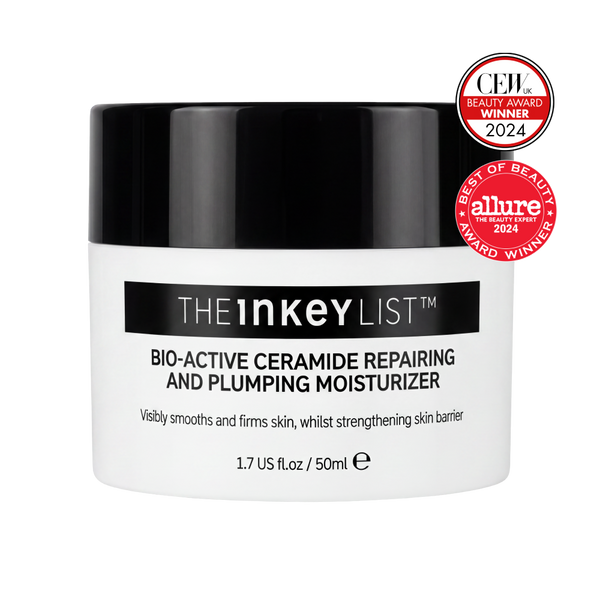
Bio-Active Ceramide Moisturiser, £20
Start here. The Bio-Active Ceramide Moisturiser is the anchor of the range and the product most people should reach for first.
It is the sealing step in the layering order described above. Whatever you have applied underneath, whether that is a hydrating serum, a treatment, or nothing at all, this is the layer that goes over the top and limits moisture escaping. It is an everyday moisturiser rather than an occasional rescue product, and consistency is what makes barrier support work.
It is built around Bio-Active Ceramide NP, which brings the science full circle. NP rebuilds structure. A moisturiser formulated around it is doing structural work on the barrier while it moisturises, rather than only softening the surface. That is the difference between a product that makes skin feel better for an hour and one that helps skin need less help over time.
Who it is for: anyone whose skin feels tight after cleansing, anyone whose barrier is under strain from actives or weather, and anyone who wants a daily moisturiser that earns its place rather than just filling a gap in the routine.
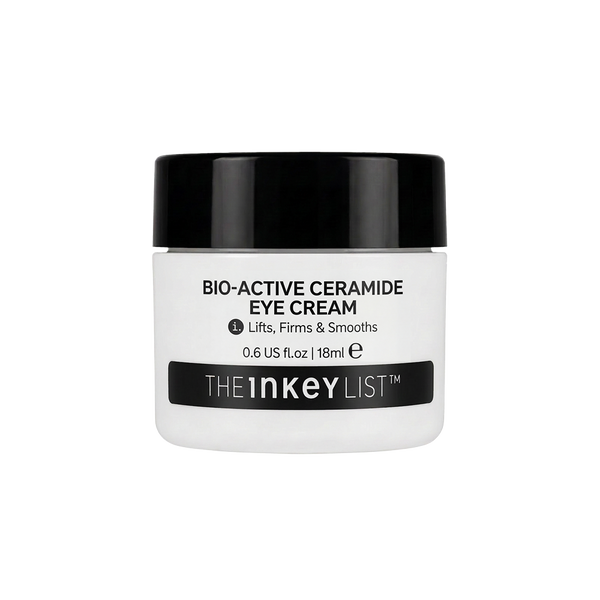
Bio-Active Ceramide Eye Cream, £15, 18ml
The eye area needs its own answer, and this is it- Bio-Active Ceramide Eye Cream
The formula pairs Bio-Active Ceramide NP with a Tetrapeptide Complex. That is the pairing from the section above made literal: ceramides strengthen the barrier, peptides visibly lift and firm. Thin, mobile skin around the eyes benefits from both, because barrier support addresses comfort and moisture retention while the peptide side addresses the look of firmness.
The claims:
- Up to 4x wrinkle reduction¹
- Clinically proven to lift eyelids by 29% in 4 weeks²
- 89% saw fine lines smoothed and blurred instantly³
- Suitable for sensitive eyes. Dermatologist and ophthalmologist approved.
¹ 12-week independent clinical study of 30 people, Ceramide NP 0.2% vs placebo. ² Clinically tested on 32 participants over 28 days. ³ Tested on 32 participants.
That last line matters more than it might appear. Eye products live in the most sensitive real estate on the face, and sensitive-eye suitability alongside dermatologist and ophthalmologist approval is the kind of reassurance that should be standard rather than premium.
Application technique makes a real difference here, and it is the step most people get wrong through simple habit. If you are unsure how much to use or where exactly to place it, how to apply eye cream the right way is a two-minute read that will make the product work harder for you.
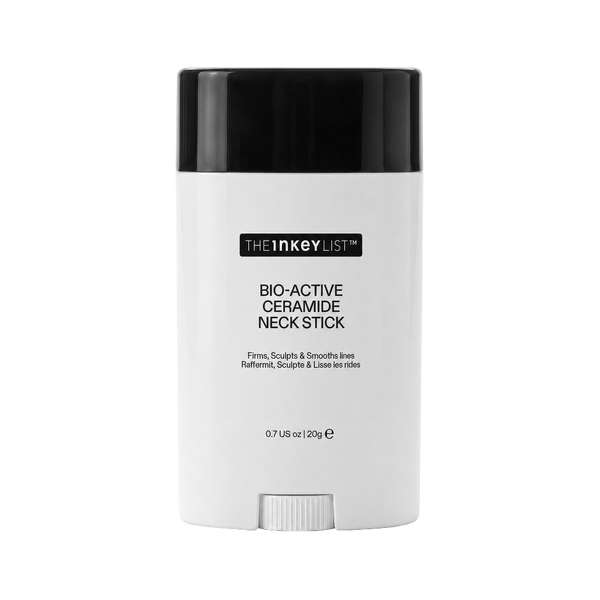
Bio-Active Ceramide Neck Stick, £15
The neck and chest get neglected in most routines, and they show it. The Bio-Active Ceramide Neck Stick is designed to make that area easy to look after rather than another step to remember and skip.
The formula is 0.2% Bio-Active Ceramide NP, 1% Gatuline® In-Tense MB, 2% CO2llageneer®, delivered in a gua sha-inspired stick format. The format is the point as much as the formula. A stick you can sweep upward along the neck and across the chest turns an easily forgotten step into something quick and tactile, and the shape lends itself to the upward, sculpting motion the area responds well to.
The claims:
- Clinically proven to lift, tighten and firm neck and chest in 14 days⁴
- Clinically proven to reduce ‘tech neck’ by 30% in 8 weeks⁴
- Jawline tightness improved by 32% in 56 days⁴
⁴ Clinically tested on 28 participants over 8 weeks.
If the neck is a concern you have been meaning to address, we have covered the causes and the fixes in more depth elsewhere. Fight tech neck deals with the posture-related lines that come from looking down at screens all day, how to get rid of neck lines covers the broader concern, and what causes crepey skin explains the texture and firmness changes that often show up on the neck and chest before anywhere else.
And if you are weighing up whether the Eye Cream or the Neck Stick is worth starting now or later, when should I start using anti-ageing products? is an honest look at timing without the pressure.
Between the three, the routing is straightforward. Barrier strength and daily moisture, take the Moisturiser. Firmness around the eyes, take the Eye Cream. Neck and chest, take the Neck Stick. There is no requirement to own all three, and we would rather you bought the one that matches your actual concern.
Ceramides handle strength and structure. Which leaves one thing they are not designed to do, and that is glow.
Adding Glow, and Building Your Ceramide Routine
A stronger barrier and a brighter complexion are two different outcomes. It is entirely possible to get your barrier into good shape, feel the difference in comfort and hydration, and still look at your skin and think it is looking a bit flat. That is not a failure of your ceramide. It is a job your ceramide was never assigned.
Adding glow with Exosome Glow Serum, £20
Ceramides rebuild. Glow is a separate job.
If your barrier feels stronger but your skin still looks dull, the answer is to add a step rather than swap one out. Layer the Exosome Glow Serum underneath your ceramide moisturiser. Serum first, ceramide moisturiser over the top. That order is not negotiable, because the moisturiser is the sealing layer and sealing layers go last.
What the serum brings to the routine:
- 100% saw more glowing skin, clinically proven*
- Clinic worthy rejuvenated skin in 14 days*
- 6-in-1 skin rejuvenation: clinically proven to visibly improve radiance, hydration, tone, firmness, elasticity, and texture*
- Proven to deliver up to 12-hours of hydration**
- 55% reduction in visible signs of skin stress (redness, puffiness, visible irritation)*
- 63% increase in skin renewal activity in 8 hours*
- Helps support natural collagen production
4-week clinical study of 26 people. Clinical study of 31 people. In-vitro testing of Cica Exosomes showed a 55% reduction in pro-inflammatory markers and a 63% increase in markers associated with skin renewal after 8 hours.
Read that list alongside what you already know about ceramides and the division of labour becomes obvious. The ceramide moisturiser is doing structural, protective work. The glow boosting serum underneath is addressing radiance, tone and the visible signs of stressed skin. Together they cover both halves of what most people actually mean when they say they want better skin.
If exosomes are new to you as an ingredient category, our exosomes page explains what they are and why they have become such a talked-about addition to modern formulas.
Building your ceramide routine, step by step
Layering order is where good products get wasted. Here is the sequence that works, morning and evening:
- Cleanse. Start with clean skin and avoid anything that leaves your face feeling stripped or squeaky. If cleansing leaves skin tight, the cleanser is working against every step that follows.
- Hydrating or treatment serums. This is where hyaluronic acid goes, applied to damp skin. It is also where treatment serums sit, whether that is a glow serum, a targeted active, or a soothing formula.
- Ceramide moisturiser. The sealing step. Everything you applied underneath is held in by this layer, and this is where Bio-Active Ceramide NP does its structural work.
- SPF, every morning. Non-negotiable. No exceptions for cloudy days, desk-based days or winter.
That is the skeleton. Here is how the most common actives fit around it.
Pairing ceramides with retinol. Retinol supports skin’s natural renewal process, and it is also the active most likely to leave a barrier feeling sensitised, especially in the early weeks. Ceramides support skin while you use retinol, which is why pairing the two is a sensible default rather than a clever hack. Apply your retinol first, then your ceramide moisturiser over the top. If you are still building tolerance, using the moisturiser both before and after the retinol is a reasonable way to ease in. Our retinol page covers how to introduce it properly, and what not to mix with retinol covers the combinations worth avoiding while you do.
Pairing ceramides with niacinamide. Straightforward and well tolerated. Niacinamide sits comfortably alongside ceramides in the same routine with no special sequencing required. It is one of the easier additions to make if you want to expand a barrier-focused routine without introducing risk.
Daily SPF. Every barrier-strengthening step you take is undermined by unprotected sun exposure, which makes SPFthe closing step of any morning routine. There is no version of a serious skincare routine that skips it.
If your skin is combination or oily. A rich ceramide moisturiser is not always the right texture for everyone, and there is no virtue in forcing it. Omega Water Cream is the lighter option, giving you moisture and comfort without the weight. Barrier support still matters on oily skin, and often more than people expect, because over-stripping is such a common response to excess oil. Our oily skin collection covers the wider approach.
If your skin runs reactive. Ectoin Hydro-Barrier Serum sits well in the serum step and helps soothe and comfort skin, which makes it a useful addition when your face is in a sensitive phase rather than a stable one. If visible redness is your main concern, the redness collection groups the relevant options.
The broader principle across all of this: build the routine around your barrier rather than around your actives. A strong barrier makes everything else more tolerable, which means you can actually stick with the products that produce results instead of cycling through them during flare-ups.
That covers the routine. Here are the questions that come up most often.
The Bottom Line on Bio-Active Ceramides
The word “ceramide” on a label tells you almost nothing on its own. Structure, type and formulation are what actually determine whether a product does anything for your barrier.
Keep the shorthand: NP rebuilds structure, AP calms reactivity, EOP seals. That single line will get you further through an ingredients list than any front-of-pack claim.
And remember that phytoceramides and bio-active ceramides are not competing categories. Phytoceramides answer where the ingredient came from. Bio-active answers how it is built. INKEY’s ceramides are both, being plant-derived, Vegan Society certified, and structured to match what your skin already makes.
If you want to go deeper on the ingredient itself, our ceramides page is the place to start.
Find the Right Ceramide for Your Skin
Choose by concern rather than by hype. For barrier strength and everyday moisture, the Bio-Active Ceramide Moisturiser is the anchor of the range at £20. For firmness and smoothing around the eyes, the Bio-Active Ceramide Eye Cream covers it at £15. For neck and chest, the Bio-Active Ceramide Neck Stick is £15. Not ready to buy yet? Read the ceramides primer instead and come back when you are. Because at The INKEY List, We Give A Care.
Study References
Bio-Active Ceramide Eye Cream
¹ 12-week independent clinical study of 30 people, Ceramide NP 0.2% vs placebo.
² Clinically tested on 32 participants over 28 days.
³ Tested on 32 participants.
Bio-Active Ceramide Neck Stick
⁴ Clinically tested on 28 participants over 8 weeks.
Exosome Glow Serum
4-week clinical study of 26 people.
Clinical study of 31 people. In-vitro testing of Cica Exosomes showed a 55% reduction in pro-inflammatory markers and a 63% increase in markers associated with skin renewal after 8 hours.
Frequently Asked Questions
Got a question?
Our askINKEY team are a friendly bunch of skincare experts with deep product knowledge and zero judgement. Whether you're an ingredient obsessive or just starting out, we'll make it make sense. No question too big. No question too small. We Give A Care, Every Day.


