



Peptides and Your Eye Area: What They Do and How to Use Them
The skin around your eyes is thinner, drier and more mobile than the rest of your face, and that is exactly why peptides suit it. Here is how to use them.
Author
askINKEY skincare advisor
Published
05 September, 2026
Time to read
8 minutes
Peptides are one of the most talked about ingredients in eye care, and this article explains what they actually do around the eye, which ones are worth knowing about, and how to use them properly. If you want to browse first and read second, our peptide collection and eye treatments are both a click away, and a peptide eye cream sits at the point where those two ranges meet.
Here is what follows. Why the skin around the eye behaves differently to the rest of your face. What peptides are and how they signal. Three specific peptides worth knowing by name. What they can realistically do, and what they cannot. How to pair them with barrier support. How to apply them, and how long to give them. For the full ingredient deep dive, our full guide to peptides covers the science in more depth than we will here.
The central argument is simple. The skin around your eye is thinner and more mobile than the skin on your cheek, which is exactly why a supportive, signal-based ingredient suits it.
Peptides are not a forceful ingredient, and around the eye that is the entire point.
To understand why, start with the skin itself.
Why the Skin Around Your Eyes Is Different
The eye area gets treated as a special case in skincare, and for once the marketing and the anatomy agree. This zone is genuinely built differently, in three ways that matter.
- It is thin. Periorbital skin measures somewhere around 0.5 to 0.6mm in total. Work on the surgical anatomy of the upper eyelid puts upper eyelid skin at roughly 521µm thick with an epidermis of around 49µm. A 2022 systematic review of epidermal thickness sharpens the contrast, measuring upper eyelid epidermis at approximately 48µm against roughly 84µm on the cheek.
- It has fewer oil glands. Sebaceous glands are unevenly distributed across the face, and the eyelid and under-eye area have far fewer of them than the nose, forehead or chin.
- It never stops moving. You blink somewhere in the region of fifteen to twenty times a minute, and that is before you account for smiling, squinting and every other expression.
Upper eyelid epidermis measures around 48µm. Cheek epidermis measures around 84µm. The skin around your eye is roughly half the thickness of the skin a couple of centimetres below it.
The oil gland point deserves more room than it usually gets, because it explains most of the everyday frustration people have with this area. Sebum is not just about shine. It is part of how skin holds onto water, forming a lipid layer that slows evaporation. Fewer oil glands means less of that natural lubrication, which means moisture leaves faster and the barrier reaches the tight, papery, slightly rough stage sooner than it does elsewhere. It is why concealer can look flawless on your cheek and settle into texture under your eye by mid-morning, and why this zone is often the first place to complain when the heating goes on. If that tight, flaky feeling is your main issue, we have written separately about dry, flaky skin under the eyes.
Now put the three together. Thin skin has less margin for error, because there is simply less tissue between an active ingredient and the living layers below. Low-oil skin has a barrier that is already working harder than the rest of your face. Constantly mobile skin folds and unfolds thousands of times a day, which is a large part of why lines tend to become visible here first.
That combination has a clear consequence for ingredient choice. Skin that is thin, dries out easily and moves constantly has a lower tolerance for aggressive actives. Push it hard and you often get irritation rather than results, which then interrupts the routine entirely. Ingredients that support rather than force are a more sensible fit here, and barrier support is not an optional extra alongside them. It is the thing that keeps the routine comfortable enough to continue.
Which brings us to what peptides actually are, and what “support” means in practice.
What Peptides Actually Are and How They Signal
Strip away the marketing and peptides are straightforward.
A peptide is a short chain of amino acids, and amino acids are the building blocks of the proteins that give skin its structure, including collagen and elastin.
Because peptides are fragments of the same material skin already uses, they can act as messengers. The working idea is one of communication rather than force. A peptide applied topically is understood to signal to skin, encouraging it toward behaviour that supports its existing structure, rather than driving a change by removing or resurfacing anything.
That distinction is easier to see when you compare categories, not products. Exfoliating acids work by loosening the bonds between surface cells. Retinoids work by influencing the rate at which skin renews itself. Both are turnover-led, and both are genuinely effective. Peptides work differently, supporting what is already there instead of accelerating its replacement. Neither approach is superior. They do different jobs, and we have unpacked that properly in peptides vs retinol.
This is also why peptides have become such a fixture in peptides skincare routines built around sensitivity and long-term maintenance. The mechanism is inherently low-irritation, which matters everywhere but matters most on skin as thin as the eye area.
If you are sceptical, that is reasonable, and we would rather you read the evidence than take our word for it. Do peptides really work tackles the efficacy question directly, and are peptides safe covers tolerance and who should be cautious. Our complete peptides guide is the deeper read on mechanism.
One caveat worth stating plainly. “Peptide” is a category, not a single ingredient, in the same way “acid” is. Different peptides are studied for different things, so the useful question is never simply whether a product contains peptides. It is which ones.
Which Peptides Matter Around the Eye
Three peptides come up repeatedly in the context of the eye area. Here is what each one is, what it supports, and where you will find it.
Matrixyl 3000
Matrixyl 3000 is a trade-named peptide complex made up of two matrikines, palmitoyl tripeptide-1 and palmitoyl tetrapeptide-7. Matrikines are peptide fragments that skin recognises as signals relating to its own structural matrix, which is the network of collagen and elastin that keeps skin looking firm and springy. If you want the plain-English version of what that matrix actually is, collagen for skin is a good primer.
- What it is: a two-peptide complex, palmitoyl tripeptide-1 plus palmitoyl tetrapeptide-7.
- What it supports: the look of firmness and smoothness, which makes it well matched to under eye fine lines.
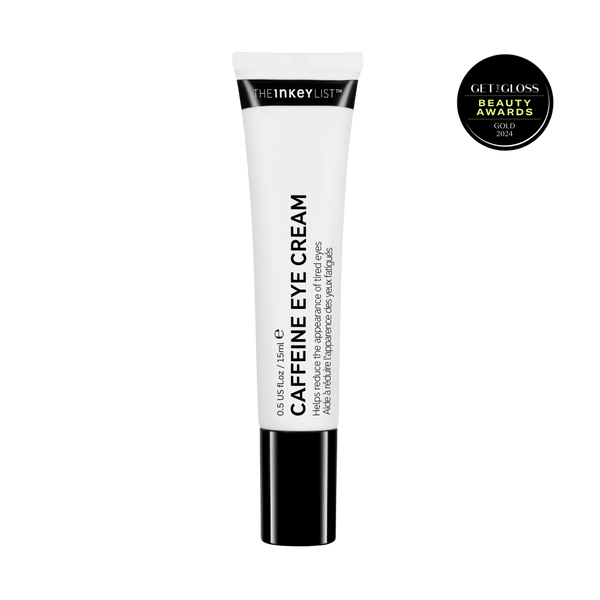
- Where you will find it in our range: our Caffeine Eye Cream (£12), which pairs Matrixyl 3000 with caffeine and Albizia Julibrissin Bark Extract.
That combination is why the Caffeine Eye Cream is our most genuinely peptide-led eye product rather than simply a caffeine one. For the full ingredient story, including how the complex is put together, we have a dedicated read on what is Matrixyl 3000.
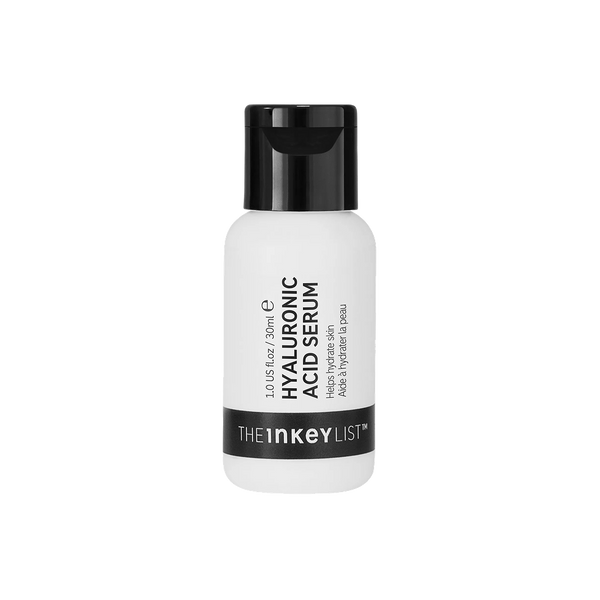
Worth knowing before you buy anything: you may already own a peptide. Matrixyl 3000 is the same complex found in our Hyaluronic Acid Serum (£12, 30ml), so if that is already in your cabinet, you have been using a peptide product without necessarily framing it that way.
Palmitoyl Pentapeptide-4
Also written as Pal-KTTKS, this is one of the most studied peptides in cosmetic science, which is the main reason it belongs in any honest conversation about the category.
- What it is: a five amino acid peptide sequence attached to a palmitic acid chain, which helps it move through the skin’s lipid layers.
- What it supports: the appearance of fine lines and overall skin smoothness.
- Why it matters here: the research behind it is real rather than invented for a label.
A 12-week split-face trial published by Robinson and colleagues in 2005 assessed Pal-KTTKS on photoaged facial skin, comparing treated and untreated sides on the same participants. Split-face design is useful precisely because each person acts as their own control. The point for a reader is not that any single study settles the matter, but that this peptide family has been through genuine clinical assessment.
Acetyl Hexapeptide-8
The one you will most often see referenced in connection with expression lines, and the one most frequently oversold.
- What it is: a six amino acid peptide, sometimes listed as acetyl hexapeptide-3.
- What it supports: the look of expression lines, particularly in areas that move a great deal.
- What we will not claim: anything about muscle activity. Cosmetic products work on the appearance of skin, and that is the honest boundary.
The eye area is the most mobile region on the face, so a peptide studied in relation to expression-related lines has obvious logic here. Keep the expectation at appearance and you will not be disappointed.
Encouragingly, peptide blends have been assessed in this specific zone rather than only on the face generally. A 2023 study in the Journal of Cosmetic Dermatology evaluated a multi-peptide eye serum over 28 days, which is one of the few pieces of peptide research designed around the periorbital area itself. General ingredient science, not a claim about any of our products, but relevant evidence all the same.
Knowing what these peptides do naturally raises the harder question of what they do not.
What Peptides Can and Cannot Realistically Do Around the Eye
Ingredient articles tend to stop at the good part. This is the section that keeps the rest of the article honest.
What peptides can reasonably support:
- The look of smoothness across the under-eye and orbital area.
- The appearance of firmness over consistent, longer-term use.
- Hydration, when the formula also contains humectants and barrier ingredients doing that specific job.
- Comfort on thin skin, because the irritation risk is low compared with turnover-led actives.
What peptides will not do:
- Resolve structural hollowing. Under-eye hollows are largely a matter of facial anatomy, bone structure and fat pad volume, and no topical ingredient changes those. We cover this in under-eye hollows and tear troughs.
- Lighten pigment-led darkness. Peptides are not a brightening ingredient, and if pigmentation is your primary concern, how to get rid of dark circles under the eyes is the more useful read.
- Remove fluid retention. Morning swelling is usually driven by sleep, salt, alcohol or allergy, which is a different mechanism entirely and covered in why are my eyes puffy in the morning.
There is one more thing worth saying plainly. No topical product permanently removes a deep expression line. What a well-formulated peptide product can do is support the appearance of that area over time, with consistent use. If your main interest is lines specifically rather than peptides as an ingredient, how to treat under-eye wrinkles approaches it from that angle.
Peptides are maintenance, not a miracle. That is not a limitation to apologise for, it is what makes them worth using for years rather than weeks.
We would rather frame that as a feature. Quick-fix ingredients tend to come with trade-offs in tolerance, and around the eye those trade-offs are felt sharply. An ingredient you can use twice a day, indefinitely, without your skin objecting, is doing something genuinely valuable over a five-year horizon even if it is undramatic over a five-day one.
Realistic expectations set, the practical question is what a peptide eye cream should sit alongside.
Pairing Peptides With Barrier Support
Start with the logic rather than the products. This zone has fewer oil glands, so it loses moisture more readily and reaches the tight, uncomfortable stage faster than the rest of your face. That matters commercially and practically, because discomfort is the most common reason people quietly abandon an eye routine. And peptides only deliver on consistent use. Barrier support is therefore not a nice-to-have running parallel to your peptide step. It is the condition that makes the peptide step sustainable.
Peptides and Caffeine
Caffeine and peptides are a sensible pairing around the eye because they are aimed at different things. Peptides support the look of firmness and smoothness. Caffeine is best known for helping with the appearance of puffiness, and if that is your primary concern we have covered why your eyes look puffy in the morning properly elsewhere. Our Caffeine Eye Cream (£12) contains both, which is why it works as a single-step morning product rather than something you need to layer.
Peptides and Ceramides
Ceramides are not an add-on ingredient. They are part of the skin’s own barrier structure, the lipids that sit between surface cells and hold the whole arrangement together. Topping them up helps a thin, low-oil zone retain moisture and stay comfortable, which is exactly the problem the eye area has by design.
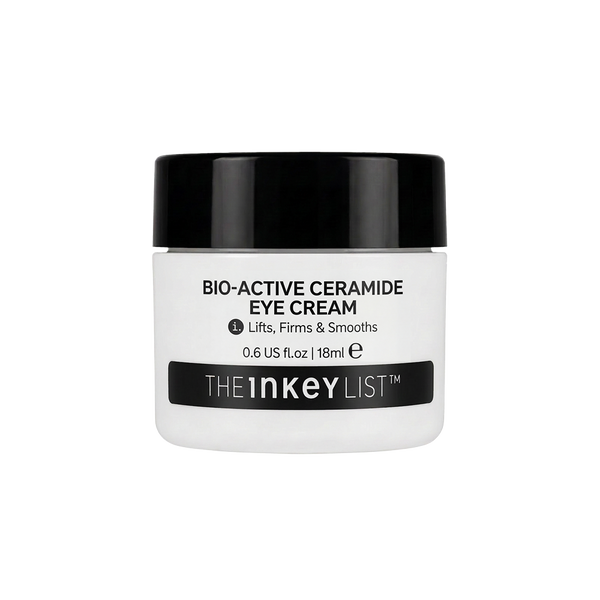
Our Bio-Active Ceramide Eye Cream (£15) is the barrier-led option in our eye range. To be clear about what it is: this is a ceramide product, not a peptide product. Its value in a peptide routine is indirect but genuine. It supports the conditions in which a peptide routine stays comfortable enough to keep going. If you are weighing up whether you need both categories, ceramides and peptides, do you need both answers that question directly. And if you are wondering whether a dedicated eye product is necessary at all, bio-active ceramide eye cream vs moisturiser is an honest look at that.
Taking Peptides Beyond the Eye Area
Your eye area is not sealed off from the rest of your face, and people who like what peptides do around the eye often want them more broadly. Our Peptide Moisturiser (£16) is formulated with acetyl hexapeptide-37 and pentapeptide-48, so it is a genuine peptide step rather than a moisturiser with a peptide-sounding name.
Which One Should You Choose
Genuine steer, not a sales pitch.
- Reach for our Caffeine Eye Cream (£12) if the look of firmness and under eye fine lines is your priority, or if morning puffiness is part of the picture.
- Reach for our Bio-Active Ceramide Eye Cream (£15) if the skin around your eye feels dry, tight or easily irritated, or if previous eye products have not agreed with you.
- Plenty of people use both, one in the morning and one at night. That is a perfectly sensible way to run it, and it is not a hedge.
On layering more generally, the rules are unfussy:
- Thinnest textures first, thickest last.
- Water-based before oil-based.
- Actives before moisturiser.
One note on retinol. Peptides suit daytime use alongside a PM retinoid, which is a common and workable split rather than a compromise, and peptides vs retinol explains how to run the two together.
Knowing what to use together only helps if the application itself is right.
How to Apply Peptide Eye Cream and How Long Results Take
Technique matters more here than almost anywhere else on the face, because thin, mobile skin does not respond well to being pulled around.
- Use less than you think. Roughly a grain of rice per eye is enough. Excess product does not absorb faster, it migrates.
- Apply along the orbital bone. Follow the bone that circles the eye socket rather than going in close to the lash line. Warmth and movement will carry the product inward on their own.
- Use your ring finger. It applies the least pressure of any finger, which is the entire reason for the convention.
- Pat, do not rub. Small tapping motions. Never drag.
- Let it settle before applying anything on top, particularly makeup.
For the full technique breakdown we have how to apply eye cream the right way, which goes further than we need to here.
On timing within the routine, apply after cleansing and any serums, then either before or alongside your moisturiser depending on texture. Peptides are generally well tolerated, so twice-daily use suits most people, and that practicality is part of why they work well in this zone.
A morning routine might look like:
- Cleanse
- Hydrating serum step
- Our Caffeine Eye Cream (£12)
- Moisturiser
- SPF
And in the evening:
- Cleanse
- Treatment step
- Our Bio-Active Ceramide Eye Cream (£15)
- Moisturiser
Now, timelines. Hydration-related smoothness can look better quickly, sometimes within days, because that is water in the skin rather than structural change. Anything relating to the appearance of firmness and fine lines is gradual. The peptide research referenced earlier ran over 28 days and 12 weeks respectively, and a separate clinical evaluation of a topical cream on signs of periorbital ageing similarly assessed this area over a sustained period rather than overnight.
Judge a peptide eye cream over several weeks of consistent use, not several days.
One last practical note, because it comes up constantly: should you keep your caffeine eye cream in the fridge has the answer.
The Bottom Line on Peptides and Your Eye Area
The eye area is thinner, drier and more mobile than the rest of your face, and peptides are a supportive, signal-based ingredient that suits precisely those conditions. Practically, that means looking for Matrixyl 3000 on an ingredient list, pairing your peptide step with barrier support so the routine stays comfortable enough to continue, applying gently along the orbital bone with your ring finger, and judging results over weeks rather than days.
Be clear-eyed about the limits. Peptides are maintenance, not a fix for structural hollowing or pigment-led darkness. Our peptides guide goes deeper on the ingredient, and eye treatments covers the wider range.
Used consistently, peptides are one of the few eye-area ingredients you can keep using indefinitely, and that is the point.
If you want to explore further, our peptide collection and our eye treatments are the places to start. For the look of firmness and under eye fine lines, our Caffeine Eye Cream (£12) is the peptide-led choice. If your eye area feels dry or easily irritated, start with our Bio-Active Ceramide Eye Cream (£15) and build from there.
Frequently Asked Questions
Got a question?
Our askINKEY team are a friendly bunch of skincare experts with deep product knowledge and zero judgement. Whether you're an ingredient obsessive or just starting out, we'll make it make sense. No question too big. No question too small. We Give A Care, Every Day.


