



What Percentage Retinol Should I Use? Why a Higher Number Isn’t a Better Result
A higher number isn't a stronger retinol — here's what actually decides your results, and where to start.
Author
askINKEY skincare advisor
Published
12 September, 2026
Time to read
13 minutes
If you are wondering what percentage retinol you should use, here is the honest answer: you do not need to chase a high number. Start with the lowest effective strength in a formula built to be tolerated, then build slowly. Over-the-counter retinol effectively tops out at around 1%, and going higher tends to buy irritation rather than results. There is also a bigger problem with the number itself. A percentage only means something once you know what it is a percentage of. A pack can legitimately say 3% and contain 0.09% of the actual active.
The short answer: use the lowest effective strength you can apply consistently, in a well-formulated, encapsulated product. Consistency beats intensity every time.
Here is how little the industry seems to trust the number, too. When researchers examined 151 over-the-counter retinol products, only 66 disclosed the retinol percentage at all. Fewer than half. If the figure on the front were the whole story, brands would be telling you far more often than they do.
Within our own range there is an eye cream whose pack says 3% and which contains 0.09% retinol, and a 0.2% serum that is the most powerful formula we make. By the end of this article you will have a strength to start on, a frequency plan that works, and a way of judging a retinol that has nothing to do with the number on the front.
The honest answer depends on three things, and the number on the bottle is only one of them.
The Short Answer: What Percentage Retinol You Should Actually Use
For most people starting out, the right answer is the lowest effective strength you can use consistently, in a formula designed to be tolerated.
Rather than asking which number is biggest, find yourself in one of the three descriptions below.
If you are completely new to retinol, or your skin is sensitive or rosacea-prone
What you want is a gentle, encapsulated, slow-release formula with soothing and barrier support built into it. The encapsulation matters far more than the figure on the front, because it controls how quickly the active actually reaches your skin. A slow, steady release is what allows skin to adapt instead of rebel.
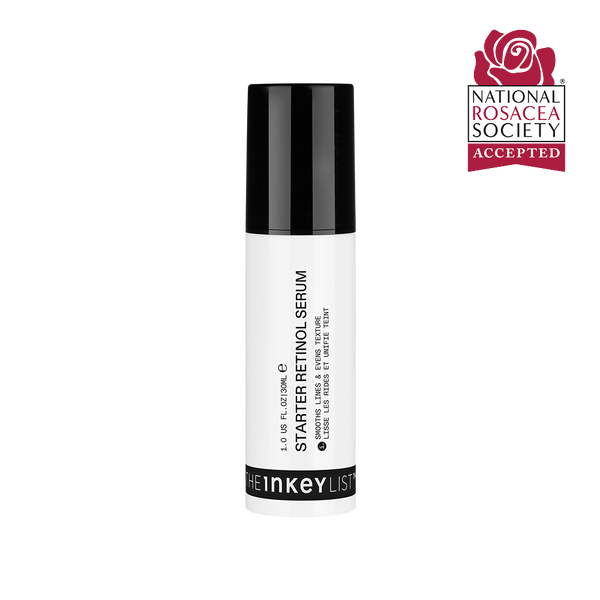
Starter Retinol Serum, £13 for 30ml, is built for exactly this. It is suitable for sensitive and rosacea-prone skin, vegan, fragrance-free, and both dermatologically and clinically tested. It is worth being clear about something: this is not a cautious compromise or a training-wheels product. It smooths fine lines from 7 days (4-week clinical study, 30 participants) and 95% of users experienced zero irritation or redness (4-week in vitro study). If you want more detail on starting out with reactive skin, our guide to retinol and sensitive skin goes deeper.
If you are using retinol comfortably and want to target the eye area
The skin around your eyes is thinner and more delicate than the skin on the rest of your face, which is why it deserves a purpose-built formula rather than a careful dab of whatever serum you already own. Retinol Eye Cream, £13 for 15ml, is formulated for that area specifically, with sodium hyaluronate and shea butter ethyl esters alongside the retinoid.
It is also the single clearest illustration of why percentages mislead people, which we will come back to in a moment.
If you are experienced with retinoids, tolerating nightly use, and ready to step up
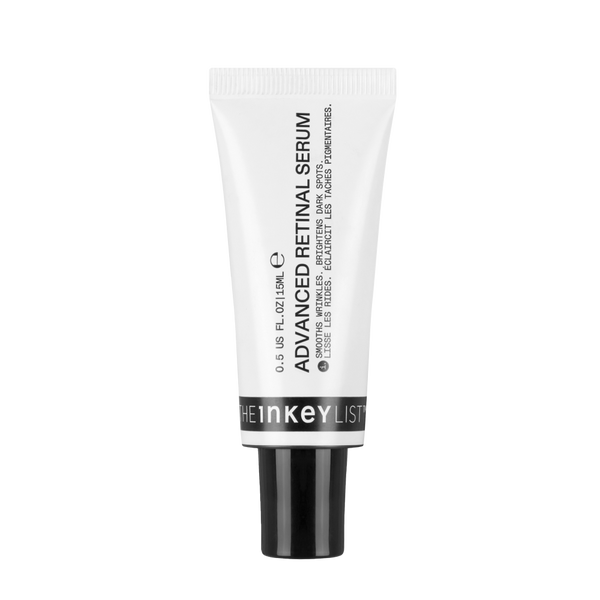
Here you want a higher-strength retinal aimed at deeper wrinkles, firmness and tone. Advanced 0.2% Retinal Serum, £18 for 15ml, works 11x faster than standard retinol (Siegenthaler et al., Biochemical Journal, 1990), and 85% of users saw firmer, more lifted skin in 4 weeks (8-week consumer trial, 105 participants). Notice what stepping up did not involve: a bigger percentage. That distinction is the heart of this article.
Advanced Retinal has not been tested on sensitive skin and has not been tested on rosacea-prone skin. If either of those describes you, stay with Starter Retinol regardless of how experienced you are with retinoids. We would rather say that plainly than sell you the more expensive bottle.
So what is the strongest retinol percentage over the counter? There is no standardised answer, and that is precisely the point. Over-the-counter strengths are not regulated into neat tiers, which is exactly why the number is such a poor shopping signal. In practice, retinol effectively tops out around 1%, because above that efficacy plateaus while irritation keeps climbing. Prescription retinoids are a different category entirely and a conversation for a doctor.
And is 0.3% retinol enough? For most people, yes. There is published evidence that 0.3% performs comparably to 1% on skin-remodelling markers while being significantly better tolerated. We will get into that research properly further down.
Strength is a starting position, not a ranking. Nobody is winning at skincare by using a higher percentage. If you want to see the options together, you can shop all retinol in one place.
That starting point is only ever a starting point, and two products showing the same percentage can behave completely differently.
Why the Percentage on the Bottle Tells You Less Than You Think
Every vitamin A ingredient you can buy has to convert into retinoic acid before your skin can actually use it. That is the only form skin cells respond to. Everything else on an ingredients list is a precursor waiting to be converted, and the number of conversion steps required is what really determines potency.
Retinol needs two conversion steps. Retinal needs one. Prescription retinoic acid needs none, because it arrives ready to work. Fewer steps means faster, more efficient results. Nothing about a percentage on the front of a pack tells you how many steps are involved.
Form beats number. If you want the full breakdown of how these ingredients differ and which suits which skin, our guide to retinol vs retinal walks through the conversion pathway, the tolerability trade-offs and how to choose between them without guessing.
Proof point one: 3% on the pack, 0.09% in the formula
Our Retinol Eye Cream is formulated with 3% Vitalease™, a stabilised slow-release retinoid compound. That 3% equates to 0.09% slow-release retinol.
Read that again, because it is the most useful fact in this article. A pack can legitimately say 3% while containing 0.09% of the actual active. Both figures are entirely true. They are simply measuring different things: one describes the branded compound in the formula, the other describes the retinol within it.
This is not a trick, and it is not unique to us. Describing formulas by their branded complex is standard practice across the industry. But it does make percentage comparisons close to meaningless for a shopper. In that same dataset of 151 over-the-counter products, exactly one eye cream disclosed its retinol percentage, and the figure recorded was 3. Someone comparing eye creams on percentage alone has no way of knowing what that 3 refers to, whether it describes a compound or a raw active, or how the two would compare on skin.
Unless you know what the percentage is a percentage of, the number tells you nothing.
Proof point two: the beginner product and the advanced product
Now look at two products from the same brand, in the same category, on the same shelf.
Starter Retinol Serum is an encapsulated Dual-Retinoid Complex of 1% Granactive Pro+ plus 0.01% Retinal. It is our gentle beginner formula, suitable for sensitive and rosacea-prone skin, with 95% of users experiencing zero irritation or redness (4-week in vitro study).
Advanced 0.2% Retinal Serum is 0.2% retinal. It is the most powerful formula in our range, working 11x faster than standard retinol (Siegenthaler et al., 1990).
Compare the headline figures and 1% looks considerably bigger than 0.2%. In practice, the 0.2% product is the stronger one, by a clear margin. Same brand, same category, numbers pointing in entirely the wrong direction.
There is a deliberate irony worth sitting with here. The beginner formula carries 0.01% retinal, a figure that looks vanishingly small next to a bold 2% label on a shelf. Yet it sits inside one of the better tolerated effective formulas available, alongside 0.5% Amisol Trio for barrier support and 0.2% SymRelief® 100 to calm sensitivity.
We could have put bigger numbers on the front of both bottles. We did not, because they would have been misleading, and because the numbers that would have looked most impressive are the ones that describe our products least accurately.
The form matters more than the figure.
Retinol concentration and retinol strength are not the same thing, and treating them as interchangeable is how people end up with an irritated barrier and a drawer full of abandoned serums. If you want the underlying ingredient science in one place, our complete retinol ingredient guide covers it properly.
Form is only one of the things a percentage fails to tell you. How a formula is built and protected matters just as much.
What Actually Makes a Retinol Work: Stability, Delivery and Formulation
If the number is unreliable, what should you actually be looking at? Four things, none of which appear on the front of the pack.
Stability. Retinol degrades on exposure to light, air and heat. This is not a minor technicality, it is the central engineering problem of retinol formulation. A high percentage that has broken down in the bottle delivers less to your skin than a lower percentage that has been properly protected. The label reflects what went into the formula at manufacture, not what reaches your face eight weeks after opening. Worth knowing too: retinoids are naturally yellow and can deepen in colour over time. Minor colour change is normal and does not mean the product has stopped working.
Packaging. Opaque or dark containers, airless pumps and sealed tubes all protect the active. Clear glass bottles and wide open jars work against it, exposing the formula to light and air every time you use it. This is one of the few quality signals you can genuinely assess before buying, so it is worth paying attention to.
Formula pH. Our published formula pH for the Retinol Eye Cream is 5.0 to 6.0, mildly acidic to near-neutral. That range supports conversion while keeping the formula comfortable on delicate skin. This is formulation context rather than a shopping test, and it is not something you can measure at home.
Delivery and encapsulation. Encapsulation wraps the retinoid inside a protective carrier. That does two jobs at once: it stabilises the active so it does not degrade before it reaches your skin, and it controls how gradually the retinoid is released once it gets there. That controlled release is a large part of why encapsulated retinoids tend to be better tolerated. We use encapsulation across all three of our retinoid formulas. Independent researchers make the same point, noting that encapsulated formulations “offer gradual release for better stability and reduced irritation, while non-encapsulated retinol provides a faster release but may cause more sensitivity”.
Supporting ingredients. Barrier-supporting and hydrating ingredients reduce the disruption retinol inevitably causes. In Starter Retinol Serum that is 0.5% Amisol Trio and 0.2% SymRelief® 100. Advanced Retinal includes SymSitive® 1609. This is formulation doing work that a bigger number simply cannot do.
The evidence: does 0.3% really perform like 1%?
This is where the argument stops being ours and starts being everyone’s. A 2022 paper by Mellody et al. in the International Journal of Cosmetic Science examined 0.3% retinol in two entirely separate pieces of work, and they are worth describing individually rather than blurring together.
The first was a small patch test. Five photoaged volunteers aged 66 to 84 applied product to the forearm under occlusion, with biopsies taken at day 12. On skin-remodelling markers, 0.3% retinol was comparable to 1%. Five people is a small sample and we are not going to pretend otherwise, but the finding is a meaningful signal rather than a marketing line.
The second was a completely separate six-week in-use tolerability study, with 218 participants: 115 using 0.3% and 103 using 1%, escalating gradually to nightly application. Grouping together those who reported no reaction with those who reported mild reactions only, 88.7% of the 0.3% cohort fell into that group, against 62.1% of the 1% cohort. Four participants on 0.3% did not complete the study due to declared tolerance issues, against 23 on 1%.
The authors’ own conclusion is the line worth remembering. Their findings, they write, support “the hypothesis that irritancy is not solely required for retinoid efficacy.”
That is independent researchers, with nothing to sell you, stating that discomfort is not proof that something is working.
A stronger product only wins if you can actually keep using it.
So what percentage of retinol is effective? The genuinely useful definition is this: effective is the strength that reaches your skin in a usable form and that you tolerate well enough to apply consistently for months. A formula that delivers 0.1% reliably for a year outperforms one that delivers 1% for nine days before you give up on it.
Instead of comparing percentages, run through this short checklist:
- What form of vitamin A is it, and how many conversion steps does it need?
- Is it slow-release or encapsulated?
- Is the packaging opaque, airless or otherwise protective?
- What supporting ingredients are in there to protect your barrier?
- Does the brand publish its study sizes and durations, or just the headline figure?
That last one is more revealing than people expect. Pair your retinol with something that supports the barrier, such as our Bio-Active Ceramide Moisturiser at £20, and you have removed most of the reasons people abandon retinol in the first place.
If percentage is a poor guide to quality, the other shortcut shoppers reach for is price.
Does a Higher Price Mean a Better Retinol?
Short answer: no. Price is not a reliable indicator of how much active you are getting, nor of how well a formula performs.
There is research on exactly this. A 2025 research letter by Parikh and Lipoff in the Journal of Cosmetic Dermatologyanalysed 151 unique over-the-counter retinol products sold across nine retailers. The authors found no statistically significant strong correlation between the percentage of retinol in a product and either its retail price or its unit price. Paying more did not reliably get you more retinol.
The secondary finding is arguably more useful to a shopper. Of the 151 products analysed, only 66 disclosed the retinol percentage at all.
If your strategy is to shop by percentage, more often than not the number is not even available to you. You are comparing products on a data point that fewer than half of them publish.
There is a nuance worth reporting honestly, because ignoring it would be the same selective reading this article is arguing against. The researchers did observe a weak negative correlation between the unit price of the retinol itself and the percentage present, meaning cost per unit of retinol tended to fall as the percentage rose. That is an interesting economic observation, not a buying rule, and it says nothing about whether a product will work on your face.
What your money can legitimately buy
Real costs that produce real benefits. Stability testing takes time and laboratory resource. Protective and airless packaging costs more than a simple jar. Encapsulation technology is genuinely expensive to license and formulate with. Supporting actives that improve tolerability add cost per unit. Clinical and consumer testing, with meaningful participant numbers over meaningful durations, is a significant investment. Every one of those things can make a product measurably better, and they are legitimate reasons for a higher price.
What your money often buys instead
Costs that never reach your skin. Celebrity and influencer partnerships. Weighty luxury packaging designed for the bathroom shelf rather than the formula inside it. Prestige positioning. Large advertising campaigns. Retail markups layered on top of all of it. The authors of that analysis point to brand positioning and marketing as likelier drivers of price than formulation.
We are not interested in sneering at expensive skincare. Plenty of luxury-priced formulas are excellent, and good formulation genuinely does cost money. The honest point is narrower and more useful: you cannot read quality off a price tag any more than you can read it off a percentage. Both are shortcuts, and both fail.
There is also a practical dimension that gets overlooked. Cost per use matters more than cost per bottle. A retinol you apply consistently for a year will outperform a prestige one you ration out because you are anxious about finishing it. If the price makes you use less than you should, the expensive product is actively working against the mechanism that produces results in the first place. Consistency is the active ingredient nobody charges for.
That is the thinking behind our own pricing. Starter Retinol Serum is £13, with 90% seeing significant clinical improvement in the appearance of wrinkles in 4 weeks (12-week consumer study, 130 participants). Advanced 0.2% Retinal Serum is £18, visibly reducing deep wrinkles in 1 week (8-week clinical study, 26 participants). Retinol Eye Cream is £13. You can see our retinol range and the wider Anti-Ageing collection to compare.
Your skin cannot read a price tag. It responds to a stable, well-delivered retinoid used consistently.
For an independent view on what retinol does and does not do, the consumer group Which? has a useful overview of what retinol is good for.
The best retinol is the one you can keep using, which makes tolerance the thing that actually determines your results.
How To Build Tolerance Properly
Consistency is the real variable in retinol results, and it is not close. A gentle retinol used three nights a week for six months will comfortably outperform a strong one abandoned after ten days of stinging. Everything below is designed to get you to month six.
- Weeks 1 and 2: two to three nights per week, at night only.
- Weeks 3 and 4: every other night.
- Week 5 onward: nightly, but only if your skin is comfortable. There is no obligation to reach nightly. Plenty of people get excellent results at three or four nights a week indefinitely.
- Eye cream: one to two times per week, building to nightly after roughly four to six weeks.
- If you experience stinging, flaking or tightness: drop back one stage for two weeks, then try again.
How much to use. A pea-sized amount for the entire face. More does not work better, and using too much is the most common beginner mistake by a distance. If you are wondering how much retinol you should use per application, that is genuinely the whole answer.
When and where. Night only, on clean dry skin, straight after cleansing.
When to apply moisturiser. Immediately afterwards. There is no waiting period. The idea that you must sit around for twenty or thirty minutes before moisturising comes from prescription retinoid folklore and does not apply here. If your skin is on the sensitive side, use the moisture sandwich: a thin layer of moisturiser, then your pea-sized amount of retinol, then moisturiser on top. Our Bio-Active Ceramide Moisturiser at £20 works well in both positions. There is more on buffering in our guide to retinol and sensitive skin.
What to expect, and when. You may have noticed that Starter Retinol smooths fine lines from 7 days (4-week clinical study, 30 participants) while most advice says to expect nothing before week four. Both are true, because they describe different things. Surface-level change, such as smoothness and radiance, can appear within the first week or two. Deeper structural change in lines and firmness is collagen-led and takes months. Optimal Starter Retinol results are seen at around 12 weeks. Think of it as the difference between how your skin feels now and how it is being rebuilt over time.
Realistically:
- Days 1 to 14: early surface smoothness, plus possible adjustment dryness.
- Weeks 4 to 8: texture and radiance become more obvious.
- Months 3 to 6: more significant improvement in lines and firmness.
- Beyond 6 months: benefits continue to build with consistent use.
Normal adjustment. Mild dryness, slight flaking and some tightness in the first few weeks are expected as your skin adapts. Uncomfortable, but not a problem.
A sign to stop. Persistent stinging, burning, significant redness, swelling or broken skin are not part of the process. Pause, let your skin settle fully, then reintroduce slowly at a lower frequency.
On purging. Some people experience a short-lived increase in blemishes or breakouts when starting a retinoid, as cell turnover speeds up. It should be temporary and confined to areas where you usually break out. Our guide to what skin purging is explains how to tell it apart from a reaction.
Patch test first. We recommend patch testing any new product before applying it to your whole face.
Daily SPF is non-negotiable. Retinol increases sun sensitivity, so broad-spectrum SPF every morning is part of using retinol properly rather than an optional extra. Dewy Sunscreen SPF 30 sits comfortably under makeup, and the Starter Retinol Protection Duo at £26.60 pairs the two, which makes it the natural starting point for beginners. If you would rather cover face and eyes, the Beginners Retinol Duo is £24.70.
Pregnancy and breastfeeding. We advise not using retinol, retinal or vitamin A products during pregnancy or breastfeeding without consulting your doctor first.
So when people ask what strength retinol they should start with, or whether 0.3 retinol is the right entry point, the frequency plan above matters considerably more than the figure they settle on.
Once your routine is established, the next question is whether to move up a strength, which is not always the right call.
When To Move Up a Strength, What To Pair It With, and Choosing Your INKEY Retinol
When to move up a strength, and when not to
Move up only after you have used your current retinol consistently at your target frequency for at least twelve weeks with no irritation, and only if you have genuinely plateaued.
Do not move up because progress feels slow at week three. Most visible change in tone and fine lines takes eight to twelve weeks minimum, and impatience at week three is the single most common reason people end up irritated. Do not move up during winter, while your barrier is compromised, or while you are already dealing with irritation.
Consider moving across rather than up. Switching from a slow-release complex to a retinal is a step up in potency without any step up in percentage, which loops neatly back to the central point of this article.
And consider staying exactly where you are. If your skin is happy and you are getting results, there is no prize waiting for you at a higher number. Many people never need to move up at all.
One unglamorous detail while we are being honest: retinal is strongly yellow and can leave a temporary tint on some skin tones, with some potential for transfer onto bedding. Let it absorb fully before bed and you will not have a problem.
What to pair retinol with and what to avoid
Pair retinol with hydrating and barrier-supporting ingredients. Avoid layering retinoids with exfoliating acids, or with other retinoids, in the same routine. Keep vitamin C to the morning and retinol to the evening, and introduce only one new active at a time so you can tell what is working.
That is the headline version. The full detail, including the combinations that are genuinely fine despite their reputation, is in our guide to what not to mix with retinol, and there is a dedicated answer on whether you can use vitamin C and retinol together.
Choosing your INKEY retinol
If you are new to retinol, or your skin is sensitive or rosacea-prone, start with Starter Retinol Serum at £13, which smooths fine lines from 7 days (4-week clinical study, 30 participants) and left 95% of users with zero irritation or redness (4-week in vitro study). If you are already comfortable with retinoids and want faster visible results, Advanced 0.2% Retinal Serum at £18 works 11x faster than standard retinol (Siegenthaler et al., 1990), with 85% seeing firmer, more lifted skin in 4 weeks (8-week consumer trial, 105 participants), though it is not suitable for sensitive or rosacea-prone skin. For the eye area, Retinol Eye Cream at £13 delivers 3% Vitalease™, equating to 0.09% slow-release retinol.
Still torn between them? Our guide to which retinol product is right for you walks through it, or the Skincare Quiz will build a personalised routine around your skin rather than around a number.
Which brings us back to where we started. The most powerful serum in our range carries the smallest number on the front, and the eye cream labelled 3% contains 0.09% retinol. The entire argument, proved twice inside one range.
The Takeaway: Start Where Your Skin Is
The percentage on the bottle is one of the least reliable ways to judge a retinol. Three things actually determine your results: the form of vitamin A and how many conversion steps it needs, how well that active is stabilised and delivered to your skin, and whether you can tolerate it well enough to use it consistently for months.
An eye cream labelled 3% that contains 0.09% retinol, and a 0.2% serum that is the most powerful formula in the range, is all the proof anyone needs. Neither shortcut works: not the number on the front, where fewer than half of products even disclose it, and not the number on the price tag, where no strong correlation with retinol content exists.
If you are just beginning, hear this clearly. Starting low is not starting behind.
Start where your skin is, not where the biggest number is. Starter Retinol Serum at £13 is built for retinol beginners, sensitive skin and rosacea-prone skin, while those already comfortable with retinoids can step up to Advanced 0.2% Retinal Serum at £18, which is not suitable for sensitive or rosacea-prone skin. You can also shop the full retinol rangeor take the Skincare Quiz for a personalised recommendation.
Still unsure which strength suits your skin? Our askINKEY advisors will help you work it out. No judgement, no pressure.
Substantiation. Starter Retinol Serum: smooths fine lines from 7 days without irritation, 4-week clinical study on 30 participants. 2x more effective than standard retinol, 4-week in vitro study. 95% experienced zero irritation or redness, 4-week in vitro study. 90% saw significant clinical improvement in the appearance of wrinkles in 4 weeks, 92% said skin felt noticeably smoother, 86% agreed skin tone looked more even, 12-week consumer study of 130 participants. Advanced 0.2% Retinal Serum: visibly reduces deep wrinkles in 1 week, 8-week clinical study of 26 participants. 85% saw firmer, more lifted skin in 4 weeks, 8-week consumer trial of 105 participants. Retinal works 11x faster than standard retinol, G. Siegenthaler et al., Retinol and retinal metabolism, Biochemical Journal, 1990, 268, pp 371-378. Retinol Eye Cream: 3% Vitalease™ Retinol Compound equates to 0.09% slow-release retinol. 0.3% versus 1% retinol: comparable on skin-remodelling markers in a patch test of 5 photoaged volunteers aged 66 to 84, biopsies at day 12; in a separate six-week in-use tolerability study of 218 participants, 115 on 0.3% and 103 on 1%, 88.7% of the 0.3% cohort reported no reactions or mild reactions only against 62.1% of the 1% cohort, with 4 and 23 participants respectively not completing due to tolerance issues. Mellody et al., International Journal of Cosmetic Science, 2022;44(6):625-635. Price and retinol percentage: no strong correlation across 151 over-the-counter products, of which 66 disclosed their retinol percentage. Parikh and Lipoff, Journal of Cosmetic Dermatology, 2025;24(7):e70361. SymRelief® and SymSitive® are registered trademarks of Symrise AG.
Frequently Asked Questions
Got a question?
Our askINKEY team are a friendly bunch of skincare experts with deep product knowledge and zero judgement. Whether you're an ingredient obsessive or just starting out, we'll make it make sense. No question too big. No question too small. We Give A Care, Every Day.


