



Milky Rice Toner: Benefits, How to Use and the Full Routine
Everything you need to know about rice milk toners - what they do, who they suit, and how to slot one into your routine for softer, smoother, better-hydrated skin.
Author
askINKEY skincare advisor
Published
05 February, 2026
Time to read
12 minutes
Toners have changed. The astringent, alcohol-heavy formulas that squeaked across skin and left it tight are largely a thing of the past, replaced by hydrating formats designed to add moisture rather than strip it away. The milky toner is one of the most talked-about of those newer formats, and the rice toner sits right at the centre of the conversation.
This article answers the practical questions. What a milky toner actually is, what a rice toner does for skin, who each one genuinely suits, and how to use one without adding unnecessary complication to a routine that probably has enough steps already.
Two questions come up more than any others. The first is whether a milky toner does anything a serum does not. The second is where the step belongs, exactly, between cleansing and moisturising. Both have straightforward answers, and both are worth getting right before you spend money.
Skincare has become complicated. What most people need is not another product but clarity about the ones they already have, and honesty about what a new one will and will not do.
The sensible place to begin is with the category itself, because “milky toner” describes a texture rather than a single ingredient, and that distinction explains almost everything else.
What Is a Milky Toner? Milky Versus Clear Toners Explained
A milky toner is a toner with an emulsion texture. That is genuinely the whole definition. It contains a small amount of oil or emollient dispersed evenly through water, and that suspension of oil droplets is what scatters light and makes the liquid look opaque and milky rather than clear.
This matters because it is a texture description, not an ingredient claim. “Milky” tells you how a product feels and looks in the palm of your hand. It tells you nothing about what is inside it. Two milky toners sitting side by side on a shelf can have almost nothing in common beyond that shared emulsion format, which is why comparing them by texture alone will only get you so far.
Clear toners work differently. They are typically water-based, built around humectants that attract water, and sometimes acids that exfoliate. They absorb almost instantly and feel extremely light on skin. For a lot of people that lightness is exactly the appeal. For others, and this comes up constantly, a clear toner evaporates so quickly that it feels as though nothing happened at all.
A milky toner carries both water-loving and oil-loving ingredients in the same bottle. Because of that, it tends to feel more cushioned going on, and it leaves skin feeling softer and more comfortable afterwards rather than simply damp for a moment and then dry again.
A milky toner is not a different kind of ingredient. It is a different kind of texture, and that texture is doing a job.
Why the Texture Actually Changes How You Use It
Here is the practical consequence. An emulsion can deliver hydration and a light conditioning feel in a single step, which changes how the step behaves inside a routine.
Some people find a milky toner is enough on its own during warmer months, when a full moisturiser feels like too much and skin still needs something. Others use it as a preparatory layer underneath a richer moisturiser in winter, where the emulsion adds comfort without adding weight. Neither approach is more correct than the other. It depends on your skin, the season, and honestly, what you like the feel of.
That flexibility is the real argument for the format. A clear toner is essentially one thing. A milky toner can be a light finish or a first layer, depending on what you build on top of it.
If you are still working out whether you need a toner at all, it is worth understanding what a toner actually does in a routine before choosing between formats. Getting the category right saves you from buying the wrong texture for the right reason.
Who Milky Toners Suit, and Who Should Look Elsewhere
A milky toner tends to work well for anyone whose skin feels tight after cleansing. That tight, slightly papery sensation is one of the clearest signals that your skin wants comfort added back, and an emulsion texture delivers that quickly.
It also suits dry skin, dehydrated-feeling skin, and anyone who wants noticeable comfort without heaviness. And it particularly suits the group mentioned earlier, the people who have tried clear toners and found them too insubstantial to register.
Now the honest part. If your main goal is exfoliation, or decongesting pores and clearing blackheads, a milky toner is not the right tool for the job. That is not a criticism of the format. It is simply a different function. Toners built around PHA or glycolic acid are the ones formulated to exfoliate, and if that is what you are after, our guide comparing a PHA toner vs glycolic acid toner will point you somewhere far more useful than this format will.
Pointing you away from a product is not a failure of the product. It is the fastest route to you getting the result you actually wanted.
Milky Toner Is Not the Same Thing as Cleansing Milk
This confusion is common enough to be worth clearing up directly, because the two products share a word and nothing else.
A cleansing milk is a cleanser. It is a rinse-off or wipe-off step, designed to lift away makeup, sunscreen, oil and the general debris of a day, and it is not meant to stay on your face. A milk toner is a leave-on hydrating step, applied after cleansing, and it stays put.
If you use one in place of the other, one of two things happens. Either you leave a cleanser sitting on your skin all day, or you rinse away a hydrating step you paid for. Both are avoidable with thirty seconds of label reading.
The simplest test is where the product sits in the instructions. Anything that says “rinse” or “remove” is cleansing. Anything that says “follow with” is a leave-on step. If you want to see how different formats compare in practice, you can browse the full toner range and read the directions on each.
Texture explains how a milky toner feels. It does not explain what is inside it, and that brings us to the ingredient most closely associated with this format.
What Is a Rice Toner? Rice Water and Rice Ferment for Skin
A rice toner is a toner built around rice-derived ingredients. In practice that usually means rice water, rice extract, or rice ferment filtrate, though the label covers a broad and varied field.
That breadth is worth flagging before anything else. “Rice toner” is a category description rather than a formula standard. Two products carrying the name can differ enormously in concentration, in supporting ingredients, and in texture. One might be a clear, water-light liquid. Another might be a cushioned emulsion. Results are not interchangeable between them, and assuming otherwise is how people end up disappointed by a category rather than by a specific product.
Rice Water for Skin: Where the Tradition Comes From
Rice water is the starchy, cloudy liquid left behind after rice is soaked or rinsed. It has been used as a skin and hair conditioning rinse for a very long time, particularly across East Asia, where the practice is embedded in generations of everyday routine rather than invented by a marketing department.
That heritage is a large part of why searches for a korean rice toner are so consistently popular. The format did not appear from nowhere. It arrived in Western routines through Korean and Japanese skincare traditions, where hydrating, layerable, comfort-focused textures have long been standard rather than novel.
It is worth treating that lineage with accuracy rather than mystique. Rice water is not a secret. It is a simple, traditional skin-conditioning ingredient that modern formulation has refined, stabilised and made consistent from bottle to bottle. The refinement is the modern contribution. The idea is much older.
Understanding Rice Ferment Filtrate
Fermentation is the step that turns rice into something a formulator can work with reliably.
The process breaks rice down into smaller components. That is the plain-language version, and it is the main reason ferments appear so frequently in this category rather than raw rice extract. Fermented ingredients tend to be easier to incorporate into a stable formula and easier to keep consistent across batches.
On a label, the form you will actually see is Saccharomyces/Oryza Sativa ferment filtrate. Worth committing to memory if you are the kind of person who reads INCI lists, and we would encourage you to be. Ingredient transparency only helps you if you can recognise what you are looking at, and the marketing name on the front of a bottle rarely matches the technical name on the back.
Being Honest About What Rice Can and Cannot Do
This is where a lot of content about rice toners overreaches, so let us be direct.
Rice-derived ingredients are used in skincare for conditioning, for softening, and for supporting a smoother-looking finish. That is a genuine and worthwhile job. It is also the extent of it.
Rice does not lighten skin. It does not whiten skin. It will not fade pigmentation, and it will not repair your skin barrier on its own. You will find claims like these attached to rice ingredients across the internet, often stacked with impressive-looking references, and they go considerably further than the ingredient warrants.
We would rather tell you what rice actually does and have you trust the rest of what we say. Overstating one ingredient devalues every other claim on the page.
The practical framing is this. A rice toner is a hydrating and conditioning step. It is not an active treatment step. It belongs in the same mental category as the things that make your skin feel comfortable and look well-conditioned, not the same category as your retinol or your acid.
That distinction is especially useful for people who suspect their skin is dehydrated rather than dry. Dehydration is a water problem, not an oil problem, and it responds well to hydrating steps of exactly this kind. If you are not sure which you are dealing with, how to tell if your skin is dehydrated walks through the signs, and our dehydrated skincollection gathers the formats that tend to help.
Having covered rice toners as a category, it is worth looking at what a specific, carefully built formula actually contains.
Inside INKEY’s Nourishing Rice Milk Hydrating Toner
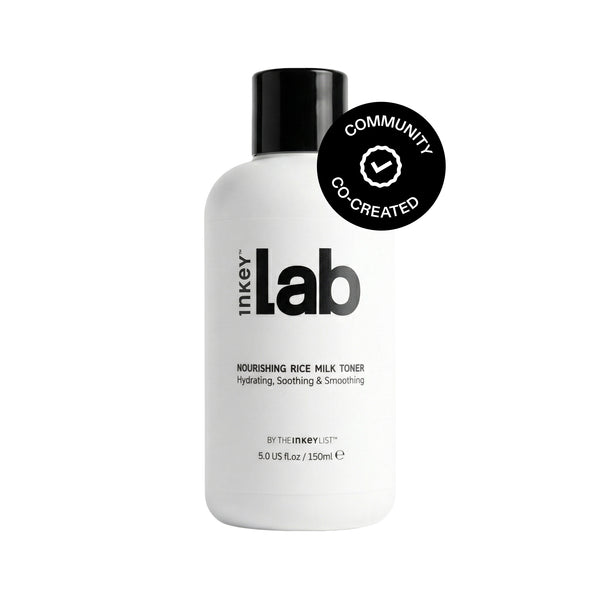
Our Nourishing Rice Milk Hydrating Toner is a 100ml milky toner, and it exists because our community asked for it. It was co-created with the INKEY Lab community, which means the format, the texture and the finish were shaped by people telling us what they actually wanted from a hydrating step rather than by us guessing.
That process is worth mentioning for a reason beyond nice sentiment. A product built from stated preferences tends to solve real complaints. In this case the complaint was consistent and specific: hydrating toners that either felt like water and vanished, or felt heavy and sat on the skin. The brief was comfort without weight.
The Named Actives, in Plain English
The formula contains two named complexes: RiFirm™ and ETERWELL™ YOUTH.
RiFirm™ is a rice-derived complex, and it is the reason this sits in the rice toner category rather than simply being a milky toner with rice somewhere in the ingredient list. Its role in the formula is to support a smoother, more comfortable and better-hydrated-looking complexion.
ETERWELL™ YOUTH works alongside it, contributing to that same overall finish of conditioned, comfortable-looking skin.
Note the language there, because it is deliberate. These are cosmetic ingredients doing cosmetic work. They condition the surface of your skin and improve how it looks and feels. They are not pharmaceuticals, and we are not going to describe them as though they were.
Two Hero Botanicals
Rice Ferment Filtrate (Saccharomyces/Oryza Sativa) is the fermented rice ingredient discussed in the previous section, included here in its stabilised, formulation-ready form. It contributes to the conditioning, softening finish that defines the rice toner category.
Alpine Willowherb (Epilobium Fleischeri) is a botanical extract that grows in high alpine conditions. In this formula it supports the soothing, comfortable feel of the finished product, which is one of the qualities reviewers mention most often.
The Glycerin Point, Which You Can Verify Yourself
Here is the part of the formula story we are most confident about, because you do not have to take our word for any of it.
The INCI list opens: Aqua, Vitis Vinifera (Grape) Seed Oil, Glycerin, Butylene Glycol.
Ingredient lists are ordered by concentration. Glycerin sitting in third position, ahead of most of the formula, means the humectant story here is real and checkable on the label itself rather than something asserted in marketing copy.
A humectant draws water into the upper layers of skin and holds it there. That is the mechanism, and it is one of the best-understood in all of skincare. Glycerin is not new, it is not exciting, and it is not going to trend on social media. It is simply one of the most reliable hydrating ingredients available, which is precisely why it appears so high in a formula built to hydrate.
If you want the fuller picture, what does glycerin do for your skin covers the ingredient properly, and how glycerin compares to hyaluronic acid is genuinely useful if you are deciding between humectants or wondering whether you need both. Our hyaluronic acid range is there if that comparison sends you in the other direction.
Notice also the second ingredient, Vitis Vinifera (Grape) Seed Oil. That is the emollient component creating the emulsion, and it is the technical reason this toner is milky rather than clear. Everything discussed in the first section about oil dispersed through water is happening right there in position two.
The Specifications Worth Knowing
The pH is 5 to 5.5, which sits comfortably within skin’s own preferred range. A formula in that range is unlikely to leave skin feeling stripped or uncomfortable in the way a high-pH product can.
The formula is vegan. It is also safe to use in pregnancy and whilst breastfeeding, which removes a question that otherwise requires an awkward amount of research on the part of the reader.
The texture is lightweight and silky. It is non-sticky, and it absorbs without leaving residue behind.
What People Actually Say About It
The toner is rated 4.7 out of 5 from 37 reviews. That is a small review base and we are not going to present it as anything larger, but the themes within it are consistent enough to be worth reporting.
Reviewers most often describe the toner as soothing and calming. The milky texture is repeatedly noted as absorbing easily rather than sitting on the surface, and several people highlight how well it layers underneath serums and makeup.
That last point about layering matters more than it might sound. A hydrating step that pills under makeup or interferes with what goes on top of it becomes a step people quietly abandon. The feedback suggests this one behaves itself in a full routine.
There is one more thing reviewers mention, and we will come to it honestly rather than leaving it out.
Now, from what is in the bottle to what it is actually designed to do, and just as importantly, what it is not.
Hydration, Smoothing and Skin Barrier Support - Not Exfoliation
This toner is designed to hydrate, smooth and soothe. Those three jobs are the whole remit.
It is not an exfoliating toner. It does not contain acids for that purpose, and it should not be chosen by anyone shopping for exfoliation.
We want to be unambiguous about that, because vagueness on this point is how people end up with a product that was never going to do what they bought it for. If exfoliation is your goal, toners formulated with PHA or glycolic acid are the correct category, and you can compare hydrating and exfoliating formats across our full toner range to see the difference in how each is built.
A single product that claims to do everything is usually a product doing several things poorly. Hydration and exfoliation are separate functions requiring separate formulation, and treating them as one is not a shortcut.
What “Supporting Your Skin Barrier” Honestly Means
Barrier language is used loosely across the industry, so it is worth defining what we mean by it and, more importantly, what we do not.
Your skin barrier is its outer defence. It holds water in and keeps irritants out, and when it is working well you generally do not think about it at all. When it is compromised, skin tends to feel tight, reactive, uncomfortable and harder to soothe than usual.
Here is the honest framing for this product. A well-hydrated skin surface sitting at a comfortable pH is an easier environment for your barrier than skin that feels tight and stripped. This toner contributes to that environment. That is support and comfort.
It is not repair. This toner does not repair, rebuild or restore your skin barrier, and we are not going to attach a timeframe to a benefit we have not measured. Anyone promising barrier repair on a stopwatch is selling you certainty they do not have.
If barrier concerns are what brought you here, our damaged skin barrier collection is the more relevant starting point, and ceramides are the natural next concept to understand, since they are structural components of the barrier itself rather than surface conditioners.
Why the Finish Feels Cushioned
The mechanism is not complicated and it connects directly to the formula.
Glycerin high in the ingredient list draws and holds water in the upper layers of skin. The light emollient base, that grape seed oil in position two, gives the formula its emulsion texture and its softening finish. Together they are why this rice milk toner feels cushioned rather than tight, and why skin still feels comfortable some time after application rather than only in the moment.
That is the entire explanation. No proprietary mystery, no percentages we cannot substantiate.
The Tackiness Question, Answered Plainly
A small number of users find the finish slightly tacky at first. We would rather say that here than have you discover it yourself and wonder why nobody mentioned it.
If you experience it, there are three practical fixes and they usually resolve it between them. Use less than you think you need, because a hydrating toner does not require saturation. Apply to slightly damp skin rather than fully dry skin, which helps it spread and absorb more readily. And give it a moment to settle before moving to your next step rather than layering immediately on top.
Most people who report initial tackiness find it disappears once they adjust the amount. It is a technique adjustment rather than a formulation flaw.
With expectations set correctly, the practical question is where this step actually sits in a routine.
How to Use a Rice Milk Toner: Morning and Evening Routines
The basics first, because they cover most of what you need.
Use it twice daily, morning and evening, after cleansing. Apply with clean hands or a cotton pad. The cotton pad is entirely optional, and hands work perfectly well whilst wasting noticeably less product, since a pad absorbs a fair amount of what you pour onto it. It can be applied after your preferred hydrator, or in place of it, depending on how much your skin wants on any given day.
Your Morning Routine, Step by Step
Step one. Cleanse with a gentle cleanser. Our Hydrating Cream to Milk Cleanser is a comfortable choice for a morning wash, particularly if your skin feels tight after cleansing with anything stronger.
Step two. Apply the Nourishing Rice Milk Hydrating Toner. To be completely clear, this step is a toner, not a cleanser. Cleanse first, then tone. Smooth it over the face with your hands or a pad and give it a moment to settle.
Step three. Apply a serum, if you use one. This step is optional and depends entirely on what you are targeting.
Step four. Moisturise. The Bio-Active Ceramide Moisturiser pairs well here, and it is a sensible partner for a hydrating toner because it addresses the barrier side of things whilst the toner handles surface hydration.
Step five. SPF, every single morning, without exception. Our Dewy Sunscreen SPF 30 sits comfortably over a milky toner without disruption. If you want to understand the numbers properly before choosing one, what is SPF explains what the rating actually measures.
Your Evening Routine, Step by Step
Step one. Cleanse. Double cleanse if you have worn makeup or SPF during the day, which in practice means most days. A first cleanse removes the products, a second cleanses the skin underneath.
Step two. Apply the Nourishing Rice Milk Hydrating Toner, exactly as in the morning.
Step three. Apply your treatment or serum, if that is part of your routine. This is where a retinol or a targeted serum belongs.
For a step that supports a glowing, well-hydrated appearance, the Exosome Hydro-Glow Complex is designed to be applied after the toner. It helps skin look smoother and more radiant, and it layers neatly on top of the hydration the toner has already delivered.
Step four. Moisturise to seal everything in. The Bio-Active Ceramide Moisturiser works as well at night as it does in the morning, and evening is when many people prefer something a little more substantial.
If you are assembling a routine from nothing, building a full routine is a more thorough starting point than working step by step from a single product page.
Layering With Actives
This is the question we are asked most, so here is the direct answer.
This toner can be used in the same routine as AHAs, BHAs, retinols or vitamin C. It is a hydrating step, not a competing active, so it does not fight with the things it sits alongside.
The ordering principle is simple. Cleanse, tone, then actives, then moisturiser. Hydrating steps sit comfortably underneath actives and, for many people, make those actives more tolerable by ensuring skin is not already tight and uncomfortable before a stronger ingredient goes on.
If your skin is feeling sensitised, spacing your actives out across the week is a reasonable and well-established approach. You do not need to use everything every night, and a rest night is not a wasted night. Hydrating steps like this one can continue daily whilst the actives rotate around them.
For readers who want to explore other options at either end of the routine, our hydrators and moisturisers collections lay out the alternatives.
Having covered how to use it, the more personal question is whether it is the right choice for your skin at all.
Is a Milky Toner Right for Your Skin Type? An Honest Assessment
Some products suit some people. Any brand telling you a single formula suits everybody is making a marketing statement rather than a factual one.
Who Tends to Get On Well With It
Dry skin, generally yes. The emulsion texture delivers both water and a light conditioning element, which is usually what dry skin is short of.
Dehydrated-feeling skin, also yes, and the high glycerin position is the reason. Dehydration responds to humectants, and this formula leads with one.
Skin that feels tight after cleansing is perhaps the clearest signal of all. That tightness is a request for comfort, and a milky toner answers it directly.
It also suits anyone who wants a hydrating step that layers well under makeup, which reviewers consistently confirm, and anyone who has tried clear toners and found them too lightweight to notice.
Combination and Oily Skin
Worth being balanced here rather than dismissive.
A milky toner can absolutely work for combination and oily skin, particularly during colder months when even oily skin can feel tight, and particularly on the drier areas of a combination face. Texture preference is personal and seasonal, and plenty of people who describe their skin as oily in July want something more cushioned in January.
The formula is lightweight and absorbs without residue, which makes it more wearable on oilier skin than the word “milky” might suggest. If in doubt, use less and apply it only where your skin feels tight.
The Honest Position on Sensitive Skin
We are not going to tell you this product is suitable for all skin types including sensitive skin, because that is not a claim we can stand behind.
This product has not been tested specifically on sensitive skin. That is the accurate statement, and it is different from saying it will cause a problem. It means we do not have the specific testing that would justify a sensitive-skin claim, so we are not making one.
We always advise patch testing before using any new product. Apply a small amount to a discreet area, such as the inner forearm or just behind the ear. Leave it alone. Check the area over the following day for any redness, itching or irritation before applying anything to your face. If your skin is reactive generally, it is worth doing this with every new product regardless of what the packaging promises.
A claim we cannot stand behind is not worth making. Ingredient transparency has to include the gaps, or it is just selective advertising with a friendlier tone.
What Is Verified, and What to Expect
Two reassurances that are fully confirmed: the formula is vegan, and it is safe to use in pregnancy and whilst breastfeeding.
On results, here is a realistic timeline. Hydration is felt quickly. Comfort and softness are immediate or close to it, because that is how humectants and emollients behave on the skin surface.
Smoother-looking, better-conditioned skin is the longer game. It builds with consistent daily use over weeks, not overnight. Nobody should promise you a transformation by morning, and a product that genuinely hydrates does not need to.
If your skin runs particularly dry, pairing the toner with a ceramide-based moisturiser is the logical combination, and bio-active ceramides compared with regular ceramides explains why the distinction is worth understanding. Our hydrators collection covers the wider options if you want to build out the hydrating side of your routine.
A handful of specific questions come up repeatedly, so here they are, answered directly.
Where a Milky Rice Toner Fits in Your Routine
The throughline is straightforward. A milky toner is defined by its texture, an emulsion of oil dispersed through water that feels cushioned rather than watery. A rice toner is defined by its ingredients, most often rice water, rice extract or rice ferment filtrate. Our Nourishing Rice Milk Hydrating Toner is both, and it is built to hydrate, smooth and soothe rather than to exfoliate.
Everything else follows from that. It sits after cleansing, morning and evening. It layers happily with actives. It suits dry and dehydrated-feeling skin especially well, and it works for combination and oily skin depending on the season and how much you use.
One honest note to repeat, because it matters more than any benefit listed above: this product has not been tested specifically on sensitive skin, so patch test before you commit to it.
You do not need more skincare. You need clarity you can trust. Clear guidance, proven ingredients, real results, and a straight answer when the straight answer is less flattering than the alternative.
If you want to check the detail yourself, the full ingredient list and every review sit on the Nourishing Rice Milk Hydrating Toner page. Still weighing up formats? Compare hydrating and exfoliating options across all toners, or if you are starting from scratch, The Complete Skincare Guide will walk you through building a routine properly. Because at INKEY, we give a care.
Frequently Asked Questions
Got a question?
Our askINKEY team are a friendly bunch of skincare experts with deep product knowledge and zero judgement. Whether you're an ingredient obsessive or just starting out, we'll make it make sense. No question too big. No question too small. We Give A Care, Every Day.


