



Polyglutamic Acid vs Hyaluronic Acid: Which Is Better?
Polyglutamic acid and hyaluronic acid both hydrate, but in completely different ways. Here is what each one does, and why using both together works best.
Author
askINKEY skincare advisor
Published
21 August, 2026
Time to read
5 minutes
The polyglutamic acid vs hyaluronic acid question usually gets asked in one of two ways: is polyglutamic acid better, or should one replace the other? The honest answer is neither. Both are humectants, which means they attract water and hold onto it, but they do that job at different depths in your skin. Hyaluronic acid draws moisture into the deeper layers. Polyglutamic acid holds moisture at the surface and helps stop it escaping.
So they are not competitors. They are a pairing, and using both gives you more than using either one on its own.
Below, we explain what each ingredient actually does, why the “acid” in both names is misleading, how they differ in practice, the right order to layer them, what else they work well with, and the answers to the questions people ask most.
What Is Polyglutamic Acid? (And Why It Is Not an Exfoliating Acid)
Most people arrive at this comparison already knowing hyaluronic acid. Polyglutamic acid is the unfamiliar half, so let us start there.
Polyglutamic acid, usually shortened to PGA, is a humectant. A humectant is an ingredient that attracts water and holds onto it, keeping it where your skin can benefit from it rather than letting it evaporate away. That is the entire job description. Glycerin is a humectant. Hyaluronic acid is a humectant. Polyglutamic acid belongs to the same family.
Structurally, PGA is made up of chains of glutamic acid, which is an amino acid, and it is produced through fermentation. That is as deep into the chemistry as anyone needs to go to use it well.
The “acid” in polyglutamic acid is misleading
Here is the correction that matters most, because it is the single biggest misconception about this ingredient.
Polyglutamic acid has “acid” in the name, but it does not exfoliate.
PGA is not in the same family as AHAs, BHAs or PHAs. Those acids work by loosening the bonds that hold dead cells to the surface of your skin, encouraging them to shed. Polyglutamic acid does nothing of the sort. In the scientific literature it is consistently classified as a humectant and a film former rather than an exfoliating agent, and research on poly gamma glutamic acid as a biopolymer describes it in exactly those terms. There is no evidence of it acting as an exfoliant.
Why does this matter practically? Because a lot of people have avoided PGA on the assumption that it would be strong, potentially sensitising, or something they would need to build up tolerance to slowly. If that has been your hesitation, you can set it aside. It is a hydrating ingredient, not an active in the way retinol or glycolic acid are actives.
One more thing worth planting now, because it explains everything in the comparison section. Polyglutamic acid is a very large molecule. Considerably larger than most forms of hyaluronic acid. Hold onto that, because size is what determines where an ingredient ends up in your skin.
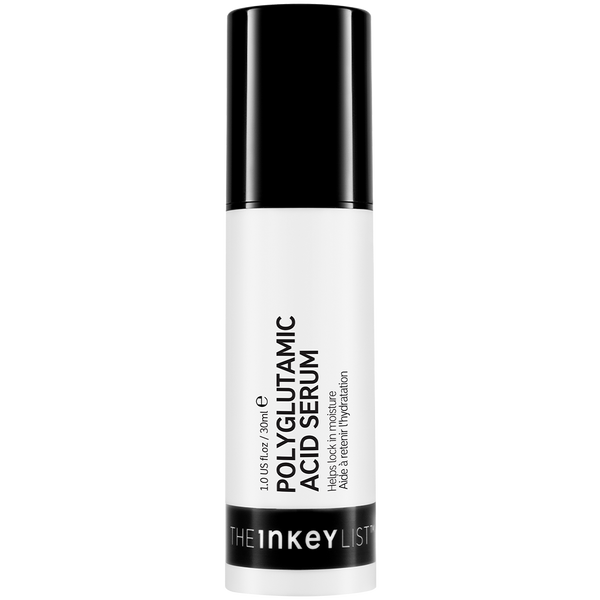
If you want to try it, our Polyglutamic Acid Serum is £15.00. That is the practical detail out of the way, and we will come back to how it fits into a routine later on.
Now for the ingredient you probably already own.
What Hyaluronic Acid Actually Does for Your Skin
There is a temptation, in any article structured as a comparison, to set up one ingredient as the outdated option that the newer one improves on. That would be inaccurate here, so we are not doing it.
Hyaluronic acid is a humectant, like PGA, and it occurs naturally in your skin already. It is not foreign, it is not aggressive, and despite the name it does not exfoliate either. The same misunderstanding applies to both ingredients, and it is wrong in both cases.
Molecular weight is the part most articles skip
This is the detail that actually determines whether a hyaluronic acid serum does much for you.
Hyaluronic acid is not a single fixed thing. It comes in a range of molecular weights, and those weights behave differently once applied. Smaller molecules travel further into the upper layers of skin. Larger ones stay nearer the surface. A review of hyaluronic acid in topical applications found that lower molecular weight hyaluronic acid penetrates meaningfully further than heavier forms, which is why the weight used in a formula changes the result you get.
The practical consequence is straightforward. A serum built on a single molecular weight delivers hydration to one level. A serum using several weights spreads that hydration across multiple levels at once, which is a more complete result from the same application.
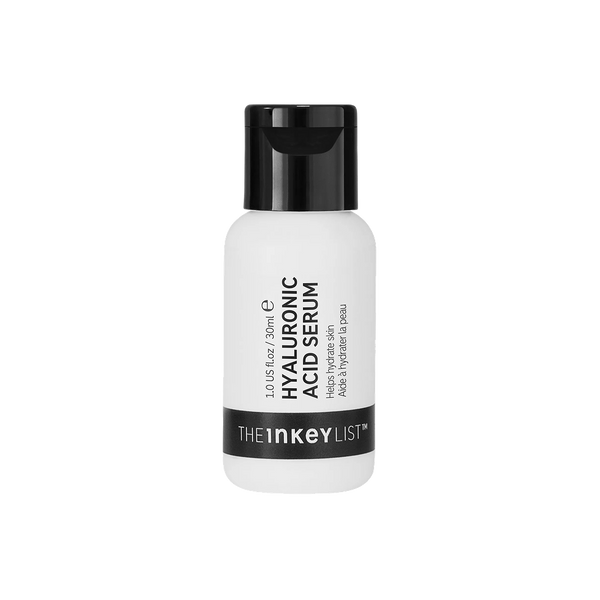
That is the approach behind our Hyaluronic Acid Serum, £12.00, which uses 2% pure hyaluronic acid at three molecular weights so hydration is not concentrated in a single spot. It also includes Matrixyl 3000, a peptide that helps plump, firm and smooth the look of skin. If peptides are a new term, they are short chains of amino acids used in skincare to support the look of firmness and texture.
Apply it to damp skin
Humectants work with the water that is available to them. Apply hyaluronic acid to skin that is still slightly damp after cleansing and you are giving it something to draw on immediately. This is a small technique change with a noticeable difference, and it applies equally to polyglutamic acid.
If hyaluronic acid has “stopped working” for you
This comes up constantly, and the diagnosis is usually wrong.
If your skin feels beautifully hydrated for an hour after applying hyaluronic acid and tight again by mid-afternoon, the ingredient has not failed. What has probably happened is that moisture was drawn in successfully and then nothing held it there. Hydration that is not sealed will leave. That is not an argument for abandoning hyaluronic acid, it is an argument for what you put on top of it.
Which brings us to the actual answer you came here for.
Polyglutamic Acid vs Hyaluronic Acid: The Real Difference
The polyglutamic acid vs hyaluronic acid comparison resolves cleanly once you stop thinking about strength and start thinking about depth.
Hyaluronic acid works deeper, drawing moisture into the skin. Polyglutamic acid works at the surface, holding moisture there and helping to reduce how much escapes. Two different jobs, at two different levels.
How polyglutamic acid works
Remember that PGA is a large molecule. Large molecules do not travel far. Instead of sinking in, polyglutamic acid largely stays on and near the surface, where it forms a light, breathable film across the skin.
That film is the point. Water is constantly leaving your skin through the surface, a process that speeds up in dry air, in heated rooms and in cold weather. A humectant film sitting at the surface helps slow that loss down, so the moisture already present stays put for longer. Research on polyglutamic acid film formation and moisture retention supports this surface-level mechanism, describing its film-forming behaviour as central to how it performs in cosmetic formulas.
How hyaluronic acid works
Hyaluronic acid, particularly at smaller molecular weights, behaves differently because it can travel further. Rather than sitting on top, it hydrates within the upper layers of skin, binding water where your skin can use it. That is a genuinely different action from forming a surface film, and it is not one polyglutamic acid can replicate.
Why the difference matters
Here is the simplest way to hold it in your head. Hyaluronic acid fills the reservoir. Polyglutamic acid puts a lid on it.
Now apply that to a real complaint. If your skin feels hydrated immediately after a serum and tight a few hours later, you are likely drawing water in without holding onto it. That is a sealing problem, not a hydration problem, and adding a stronger hydrating serum will not fix it. You need something working at the surface.
The reverse is also true. Surface film alone, with nothing hydrating underneath, is a lid on an empty reservoir.
So, is polyglutamic acid better than hyaluronic acid? No. And when people search for what is better than hyaluronic acid, the honest answer is that nothing straightforwardly replaces it, because no other humectant does precisely what it does. Any article declaring a clear winner between these two is oversimplifying. One is not an upgrade of the other, and swapping is a lateral move at best.
Which raises the obvious follow-up question.
Why Using Both Together Works Better Than Choosing One
If one ingredient draws moisture in and the other holds it at the surface, the logic writes itself. Each covers the other’s gap.
Used together, hyaluronic acid does the work of pulling water into the upper layers, and polyglutamic acid reduces how quickly it leaves again. Neither is redundant, because neither is doing the other’s job.
What to realistically expect
Let us be specific and modest about this, because hydration is often oversold.
You should expect skin that stays comfortable for longer through the day rather than tightening a few hours after your routine. You should expect it to look plumper and smoother, since well-hydrated skin reflects light more evenly and fine lines look softer when skin is not depleted. And you will likely notice makeup sitting better, because foundation clinging to dry patches is very often a hydration issue rather than a foundation issue.
What you should not expect is transformation. These are hydrating ingredients. They are not going to resurface your skin or change your pigmentation.
Who notices the biggest difference
Anyone with dehydrated skin is the clearest case. Dehydration is a lack of water rather than a lack of oil, and it is a condition rather than a skin type, which means anyone can experience it. Oily skin included. If your skin is producing plenty of oil and still feels tight, dehydration is the likely explanation.
Oily and combination skin types tend to do well here specifically because neither ingredient is an oil. Both are lightweight, and this pairing offers a route to proper hydration without the heaviness that puts oilier skin off moisturising properly in the first place.
Dry skin will benefit too, with one caveat worth stating plainly. Dry skin lacks oil, and humectants do not supply oil. Serums alone will not be enough, and a moisturiser on top is not optional.
Environment matters more than people assume. Air conditioning, central heating, long flights and cold outdoor air all increase how quickly water leaves the skin surface. If you spend your days moving between climate-controlled rooms, surface sealing is doing more work than you realise.
Anyone using actives will also feel the benefit. If retinol or exfoliating acids are part of your routine, supporting hydration alongside them tends to make the whole routine more comfortable to stick with.
And the honest counterpoint: if your skin is already comfortable, never tight, and hydrated by mid-afternoon, this pairing is maintenance rather than a fix. It is worth knowing which of those two situations you are in.
It is also worth knowing that humectants are a whole family rather than two rival ingredients. Glycerin is a humectant you almost certainly already use, often sitting quietly in the ingredient list of a cleanser or moisturiser you have owned for years.
The pairing itself is our Polyglutamic Acid Serum at £15.00 and our Hyaluronic Acid Serum at £12.00. Those are the polyglutamic acid benefits and hyaluronic acid benefits working together rather than in competition.
Knowing the pairing works is one thing. Applying it in the right order is what makes it work.
How to Layer Polyglutamic Acid and Hyaluronic Acid in Your Routine
The governing principle for layering anything is thinnest to thickest. Lightest, most watery textures go first, richest textures last, so each layer can absorb properly instead of being blocked by something heavier sitting above it. If your full routine order is unclear, our guide on how to build your skincare routine covers the whole sequence.
For this specific pairing, the order runs like this. Cleanse, then apply hyaluronic acid while your skin is still slightly damp. Follow with polyglutamic acid, which is the heavier of the two and belongs on top. Then apply your moisturiser to seal everything in. In the morning, finish with sunscreen as your final step.
The damp skin point deserves proper explanation rather than being treated as a throwaway tip. Humectants work with whatever water is available to them. Applying them to bone-dry skin in a dry room gives them less to draw on. Applying to slightly damp skin, then sealing with a moisturiser, gets more out of both ingredients for exactly the same effort.
Both can be used morning and evening. Neither requires building up tolerance, and there is no adjustment period to work through.
Pairing with niacinamide
Niacinamide sits comfortably alongside both. It works on oil control, visible redness and the look of pores, while the humectants handle hydration, so there is no overlap and no conflict. Our Niacinamide Serum is £12.00.
Pairing with vitamin C
Also fine together. Vitamin C targets dullness and uneven tone, and hydration supports comfort alongside it, which matters because vitamin C can feel like a lot on skin that is already depleted. Our 15% Vitamin C + EGF Serum is £16.00.
Pairing with retinol
This is one of the genuinely useful combinations. Hydration helps keep skin comfortable while using retinol, which is often the difference between staying consistent and giving up. The wider rules on what retinol should and should not sit next to are covered properly in our guide on what not to mix with retinol.
Pairing with ceramides
This is the sealing step, and it completes the structure. Ceramides are lipids that form part of your skin’s own barrier. A ceramide moisturiser is what locks the hydration layers underneath it in place, which is precisely what is missing when hydration seems to disappear by mid-afternoon. Our Bio-Active Ceramide Moisturiser is £20.00.
Hydration and sealing solve moisture. Some readers are chasing something else.
Want More Than Hydration? Adding Glow to Your Routine
Hydration makes skin look plumper and smoother. It does not, on its own, address radiance, tone, texture and firmness. If those are your goals, you need a step that does more than hold water.
That is where exosomes come in as an ingredient area worth understanding before you buy anything. Our Exosome Glow Serum, £20.00, is a glow boosting step that also hydrates, which means it sits naturally alongside the pairing described above rather than replacing it.
The clinical results are as follows. 100% saw more glowing skin, clinically proven. It is proven to deliver up to 12-hours of hydration**. It offers 6-in-1 skin rejuvenation: clinically proven to visibly improve radiance, hydration, tone, firmness, elasticity, and texture. And it delivers clinic worthy rejuvenated skin in 14 days*.
This is an add-on step rather than a replacement for hydration. If your only concern is tightness and dryness, the two-serum pairing already covers it.
*4-week clinical study of 26 people
**Clinical study of 31 people
The Verdict on Polyglutamic Acid vs Hyaluronic Acid
Polyglutamic acid is not better than hyaluronic acid, and hyaluronic acid is not better than polyglutamic acid. The polyglutamic acid vs hyaluronic acid debate only makes sense as a comparison if you assume they are doing the same job, and they are not.
Hyaluronic acid draws moisture into the deeper layers. Polyglutamic acid holds it at the surface. A moisturiser seals both in. Remove any one of those three and the other two work harder for a smaller result.
The useful conclusion is not that you need more products. It is that you need the right ones working in the right order, which is a very different thing.
If you want to build the pairing into your routine, start with the Hyaluronic Acid Serum at £12.00 and the Polyglutamic Acid Serum at £15.00. If you would rather work out where they fit before buying anything, our guide on how to build your skincare routine walks through the full order from cleanse to seal.
Frequently Asked Questions
Got a question?
Our askINKEY team are a friendly bunch of skincare experts with deep product knowledge and zero judgement. Whether you're an ingredient obsessive or just starting out, we'll make it make sense. No question too big. No question too small. We Give A Care, Every Day.


