



Meet the Retinol & PHA Treatment Stick
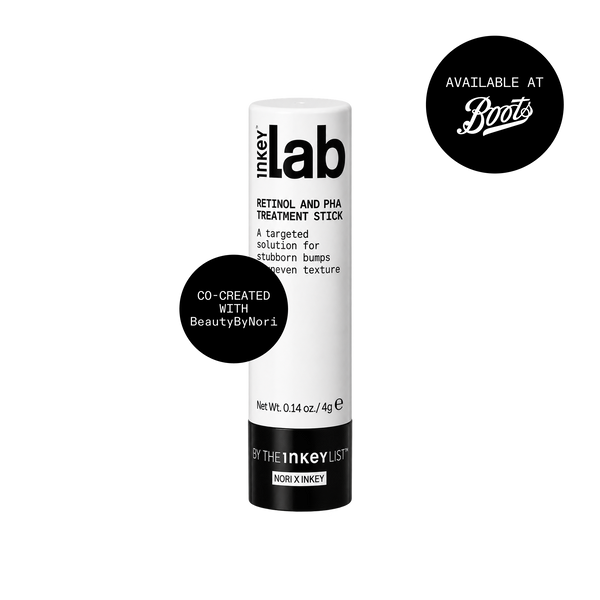
Introducing the Retinol & PHA Treatment Stick, our new INKEY Lab exclusive designed to target small, hard bumps and uneven texture around the eyes and cheeks.
Author
askINKEY skincare advisor
Published
14 October, 2026
Time to read
8 minutes
The Retinol & PHA Treatment Stick is a targeted, PM-only treatment designed to smooth small, hard bumps and stubborn uneven texture around the eye contour and cheeks.
This blog introduces our newest INKEY Lab exclusive: the Retinol & PHA Treatment Stick (£11.00). It’s a product we’re genuinely excited about, not because it reinvents skincare, but because it solves a very specific, very common problem that general serums tend to overlook.
We co-created this one with pharmacist and content creator Nori Moteirek, known to most of you as BeautyByNori. If you’re dealing with small, hard bumps (the kind often associated with milia) or persistent rough patches that cluster around the eyes and cheeks, this is the product we built with exactly that in mind.
In terms of what’s actually inside: a considered 0.3% Retinol paired with 2.5% PHA, delivered in a precise stick format rather than a dropper serum. We’ll explain why that combination and that format matter in a moment. For now, the headline is this: it’s a PM-only product, it’s designed to be built up slowly, and it is not an overnight fix. We’d rather be straight with you about that than oversell it.
This is also the first piece in a short series we’re publishing on this exact concern area. We won’t go deep on the full science of milia here, that’s coming in future posts, but we wanted to introduce the product properly first. If you’re new to the ingredients themselves, our Retinol and PHA pages cover the full detail. This piece lives within our INKEY Lab, our space for more targeted, exploratory formats, and you can read more about the thinking behind the collaboration on our BeautyByNori partnership page.
With the basics out of the way, it’s worth explaining why we felt this product needed to exist in the first place, because that context will make the rest of this guide click into place.
Why We Created the Retinol & PHA Treatment Stick
Most retinol products on the market are built to do one job: treat the whole face. That’s useful for general ageing concerns and overall texture, but it creates a gap for a very specific type of problem. Small, hard bumps, often clustered tightly around the eye contour and across the cheeks, and the kind of stubborn, rough texture that doesn’t really respond to a standard moisturiser or exfoliant, tend to need something more targeted than “apply a pea-sized amount all over.”
The issue is that most retinol serums are formulated to spread. That’s by design, they’re meant to cover the whole face evenly, which is exactly what you want for a general anti-ageing or texture-smoothing step. But it’s not what you want when the area that needs attention is a few square centimetres around the eye, where skin is thinner, more reactive, and sits close to the eyes themselves. Using a full-strength, full-face serum in that specific zone can be more product than the area needs, and in some cases, more risk than it’s worth.
That’s the gap we built this stick to fill.
Precision matters near the eye. A stick format means you can apply exactly where you need it and nowhere else, which is a different proposition entirely from a dropper serum spreading across the whole face.
A stick allows for controlled, deliberate application. You can trace it along the orbital bone with precision, something that’s genuinely difficult to do with a liquid serum and a fingertip. That control is the whole point. It’s not a gimmick, it’s a direct response to the fact that this particular concern lives in a delicate, specific location that deserves a delicate, specific delivery method.
We didn’t build this one alone, either. Nori Moteirek, known as BeautyByNori, is a pharmacist and content creator who has spent years helping her audience understand what’s actually happening in their skin, not just what to buy. That clinical background matters here. This isn’t a product dreamed up around a trend, it’s one shaped by someone whose day job involves understanding how actives behave on skin, which lines up neatly with how we like to formulate: start with the science, not the marketing angle. You can read more about how that collaboration came together on our BeautyByNori partnership page.
This is also why the product lives within INKEY Lab rather than our core range. INKEY Lab is where we test more exploratory formats and formulations, the ones that are a little more niche, a little more targeted, and don’t necessarily need to suit every single person’s routine. A treatment stick aimed specifically at small, hard bumps and uneven texture around the eyes and cheeks is a good example of exactly that kind of product. It’s not meant to replace your everyday retinol serum. It’s meant to sit alongside it, solving a problem that a full-face product isn’t designed to solve.
So let’s be precise about the actual claim here, because we’d rather underpromise than oversell. This product is designed to visibly smooth the appearance of small, hard bumps and stubborn uneven texture with consistent use over time. It is not designed to “cure,” “remove,” or “eliminate” anything overnight, and we’d be doing you a disservice if we implied otherwise. Skin takes time to respond to active ingredients, and this is a product you build into your routine gradually, not one you expect miracles from after a single use.
If you’re already shopping for texture concerns more broadly, our Improve Texture collection is worth a browse, this stick is a natural addition to that category, just with a much more targeted use case.
Now that you understand the reasoning behind the product, it’s worth unpacking what’s actually inside the formula and why these two particular actives were chosen to work together.
Inside the Formula: 0.3% Retinol + 2.5% PHA
Two actives do the heavy lifting here, and they were chosen deliberately to complement each other rather than compete.
Retinol’s role
Retinol is one of the most well-studied ingredients in skincare, and its core job is supporting cell turnover, helping skin shed old surface cells more efficiently so that smoother, more even-looking skin can come through. Over consistent use, this is what contributes to a visibly smoother texture and a more refined appearance where small, hard bumps tend to gather.
The concentration here, 0.3%, is worth pausing on. This isn’t a full-face serum strength, and it isn’t meant to be. It’s a considered, targeted dose designed specifically for a spot-treatment format used on smaller, more delicate areas. A higher percentage might make sense in a product designed to treat your entire face, but that’s not what this stick is for. The dose is matched to the job, not maximised for the sake of a bigger number on the packaging. If you want the fuller picture on how retinol works, how it converts in skin, and how different formats and strengths compare, our dedicated retinol page covers that in depth, we won’t repeat all of it here.
PHA’s role
PHA, or polyhydroxy acid, is the gentler cousin of AHAs and BHAs. It exfoliates in a similar way, by helping to loosen the bonds between dead skin cells on the surface, but it does so with larger molecules that penetrate more slowly and gently. That matters enormously in a product that’s going to be used near the eye contour, an area where a stronger, faster-acting acid could easily tip over into irritation.
Pairing PHA with retinol in the same formula is not a casual decision. Retinol alone can occasionally feel drying or tight for some people as skin adjusts, and PHA’s gentler exfoliation and hydrating properties help support a more comfortable experience alongside it, without adding the kind of intensity you’d get from combining retinol with a stronger acid like glycolic or salicylic. If you want to understand PHA on its own terms, our PHA pillar page goes into the full detail on how it compares to other exfoliating acids.
Together, retinol and PHA were paired specifically with this use case in mind: small, hard bumps and uneven, rough texture that cluster in areas where you need targeted cell turnover support without overwhelming sensitive skin nearby.
Beyond the actives themselves, the sensory experience matters too. This is a lightweight, easy-glide balm texture, not a heavy, greasy cream. It sinks in without leaving residue, which is a deliberate choice given this is a product people will often be applying close to their eyes, sometimes as part of a routine that also involves makeup the next morning. Nobody wants a product that sits on the skin’s surface for hours.
If texture and uneven skin tone are concerns you’re already working on more broadly, our guide on how to improve skin texture is a useful companion read, it covers the wider picture beyond just this one product.
Understanding the formula is one thing, but knowing exactly how to use it safely, especially so close to the eye area, is where the real value of this guide comes in.
How to Use the Retinol & PHA Treatment Stick Safely
This is the section we’d ask you to read most carefully, because using a targeted retinol product near the eye area correctly matters more than with almost any other step in your routine.
First, the headline rule: this is a PM-only product. Retinol can increase skin’s sensitivity to light, so this stick should only be used as part of your evening routine, never during the day.
Here’s how to introduce it properly:
- Cleanse first. Start with clean, dry skin as your base, as you would before any active step.
- Apply along the orbital bone only, if you’re using it for the eye area. Trace the stick gently along the bony ridge beneath and around the eye, avoiding the eyelids, lash line, and the immediate eye area itself. Precision is the whole point of the stick format, use it.
- Use on cheeks for uneven texture if that’s your primary concern, this isn’t exclusively an eye product. Apply to the specific areas where texture feels rough or bumpy.
- Start at 1 to 2 nights per week. Give your skin time to build tolerance before increasing frequency, exactly how we recommend introducing any retinol product.
- Follow with SPF the next morning. Retinol increases sun sensitivity, so a broad-spectrum SPF the following day isn’t optional, it’s essential. You can find general SPF guidance on our SPF page if you want a refresher on how to choose and apply it.
A few important notes on who shouldn’t use this product. It’s not suitable for sensitive skin, because it contains retinol, which can be too intense for reactive or compromised skin barriers. It’s also not for use during pregnancy or breastfeeding, consistent with general guidance around retinoid use.
One more rule worth repeating clearly: don’t combine this with other retinoids or exfoliating acids in the same routine. Using multiple actives from the same family at once is one of the most common causes of over-exfoliation, and it defeats the purpose of choosing a gentler, more considered formula in the first place. If you want the full picture on which ingredients don’t play well together, our guide on what not to mix with retinol breaks it down properly.
Because this is a new, targeted retinol product being introduced to a particularly delicate area, we’d also recommend a patch test before your first full application, especially if you’re prone to sensitivity anywhere on your face. Our guide on why you need to do a patch test explains exactly how to do this properly, it only takes a couple of extra days and it’s worth the peace of mind.
If you’re newer to retinol in general, and this feels like a lot to take in at once, our beginner’s guide on how to start retinol without irritating your skin is a good place to build your foundational understanding before adding a more targeted product like this one into the mix.
None of this is meant to sound alarming, it’s simply about being completely clear so you get the best possible results with the least amount of unnecessary trial and error. Used correctly and consistently, this is a genuinely low-drama addition to a PM routine.
With the safety fundamentals covered, let’s talk about how this product actually slots into the rest of your routine, because it’s designed to be additive, not disruptive.
Building It Into Your Routine
This stick is a spot-treatment step, which means it comes after your core routine, not instead of it. Think of it as an addition layered on top of your existing cleanse, treat, moisturise routine, rather than a replacement for your serum or moisturiser.
Because retinol and PHA, even at considered, targeted doses, can occasionally leave skin feeling a touch more sensitive while it adjusts, we’d recommend following up with a barrier-supporting moisturiser afterward. Our Bio-Active Ceramide Moisturiser (£20.00) is designed to help support comfort while your skin builds tolerance, replenishing the barrier so you’re not left feeling tight or dry the next morning.
For the eye area specifically, there’s a natural AM pairing worth mentioning too. Our Caffeine Eye Cream (£12.00) works well as a complementary morning step, helping with depuffing and brightness around the eyes, without overlapping actives with the Treatment Stick you’ve used the night before. Together, that’s a fuller eye-area story: targeted treatment overnight, brightening support the next morning, without doubling up on anything that might overwhelm the skin.
A simple way to think about the rhythm:
- PM: Cleanse, apply the Retinol & PHA Treatment Stick along the orbital bone and/or cheeks (1 to 2 nights per week to start), follow with your usual moisturiser or our Bio-Active Ceramide Moisturiser for extra barrier support.
- AM: Cleanse, apply Caffeine Eye Cream if you’re building out the eye-area routine, finish with a broad-spectrum SPF.
It’s worth saying plainly: you don’t need to buy all of these products to see results from the Treatment Stick on its own. These are additive suggestions for anyone building a fuller routine around this concern, not a requirement. The building-tolerance-slowly principle doesn’t just apply to this one stick, either, it applies to your whole routine whenever you’re introducing new actives. Real, lasting results come from consistency over weeks and months, not from stacking as many products as possible in week one.
If you skipped the beginner’s retinol guide earlier and want to revisit it in the context of your full routine, retinol for beginners is worth bookmarking.
Bringing It All Together
To recap simply: the Retinol & PHA Treatment Stick is a targeted, PM-only product combining 0.3% Retinol and 2.5% PHA, built specifically to address small, hard bumps and stubborn uneven texture around the eye contour and cheeks. It’s not an overnight fix, and we won’t pretend otherwise, this is a gradual, build-tolerance product designed for consistent, long-term use.
It’s an INKEY Lab exclusive, co-created with pharmacist and content creator BeautyByNori, which means it’s grounded in real formulation thinking rather than a passing trend. And this is just the beginning of our deeper dive into this topic. Over the coming weeks, we’ll be publishing more on milia itself, the difference between milia and milk spots, and a closer look at what retinol can and can’t realistically do for this concern.
If what you’ve read here sounds like it addresses something you’ve been dealing with, now’s a good time to take the next step.
Ready to Try It?
Shop the Retinol & PHA Treatment Stick and start building it into your PM routine at your own pace. Not ready to commit just yet? Browse the rest of our INKEY Lab exclusives to see what else we’re exploring.
Frequently Asked Questions
Got a question?
Our askINKEY team are a friendly bunch of skincare experts with deep product knowledge and zero judgement. Whether you're an ingredient obsessive or just starting out, we'll make it make sense. No question too big. No question too small. We Give A Care, Every Day.


