



SPF 30 vs SPF 50: Which Should You Actually Use?
The gap between SPF 30 and SPF 50 is just 1%. How much you actually apply matters far more than the number on the bottle.
Author
askINKEY skincare advisor
Published
28 May, 2026
Time to read
14 minutes
SPF 30 filters approximately 97% of UVB. SPF 50 filters approximately 98%. That single percentage point is the entire SPF 30 vs SPF 50 debate, and it is a much smaller gap than the packaging, the marketing and the price difference tend to suggest.
Here is the part that matters more. The difference between SPF 30 and 50 on paper is almost irrelevant next to the difference between applying enough product and applying a thin, rushed layer. How protected your skin actually is on a given Tuesday morning has very little to do with the number printed on the bottle and almost everything to do with how much of that bottle ends up on your face.
This article covers the maths behind both numbers, why under-application quietly undoes even the highest factor, when SPF 50 genuinely earns its place, whether you can still tan while wearing it, and what sensible SPF looks like across a full UK year. It is the focused, practical companion to our complete SPF guide, which is where to go for the wider science of how sunscreen works.
One thing to establish before the numbers: this is not a summer-only decision. UVA is present all year in the UK, it passes straight through cloud and window glass, and it is the wavelength most associated with photoageing. The SPF question is a January question as much as a July one.
What SPF 30 and SPF 50 Actually Block
SPF is not a percentage, which is the root of most of the confusion. The number is a measure of how much longer protected skin takes to show signs of burning compared with unprotected skin, under standardised laboratory conditions. Because it is a ratio rather than a share, SPF 50 instinctively reads as “nearly twice as strong as SPF 30”. It is not.
Translated into the version that is actually useful, the figures look like this. For every 100 UVB rays reaching your skin, SPF 30 lets roughly three through and SPF 50 lets roughly two through. One ray in a hundred is the whole difference.
Laying the full range out shows why the curve flattens so quickly.
SPF 15 blocks approximately 93% of UVB. Seven in every 100 UVB rays reach the skin.
SPF 30 blocks approximately 97% of UVB. Three in every 100 reach the skin. The step up from SPF 15 to SPF 30 delivers 4% additional blocking, which is a meaningful jump.
SPF 50 blocks approximately 98% of UVB. Two in every 100 reach the skin. The step up from SPF 30 to SPF 50 delivers only 1% additional blocking.
SPF 50+ is a regulated designation in the UK and EU, indicating 98% or more, with minimal incremental gain over SPF 50.
The pattern is diminishing returns, and the earliest gains are by far the largest. Moving from no protection to SPF 15 is transformative. Moving from SPF 15 to SPF 30 is a genuine upgrade. Moving from SPF 30 to SPF 50 is a refinement. That is why SPF 30 is the widely recommended everyday baseline in NHS sunscreen and sun safety advice rather than the highest available number being pushed as standard.
There is a bigger clarification hiding behind all of this. SPF measures UVB only. It tells you nothing whatsoever about UVA, the longer-wavelength radiation that penetrates more deeply and is associated with photoageing, fine lines and what UVA does to skin over time in the form of uneven pigmentation. A sky-high SPF number with poor UVA coverage is a half-finished product.
UVA protection does not come from choosing a higher factor. It comes from broad-spectrum formulation. In the UK and EU, the shorthand to look for is the UVA circle logo on the packaging, the small UVA letters inside a printed circle, which indicates the product meets the regulatory standard for UVA protection relative to its SPF. If you want the full mechanism behind filters, absorption and reflection, the science of how sunscreen works goes deeper than this comparison needs to.
One last detail, because it sets up everything that follows. Those SPF ratings are achieved in testing at an application rate of 2mg per square centimetre of skin. That is a generous, precisely measured, laboratory-standard amount. It is also the exact point where the label and real life part company.
How Much SPF You Actually Need to Apply
Almost nobody applies 2mg per square centimetre. Most people apply somewhere between a quarter and half of that in everyday use, which is not a criticism of anyone’s discipline. It is simply what happens when you are applying sunscreen quickly, over moisturiser, with one eye on the clock and a coffee going cold in the kitchen.
The consequence is the single most important thing in this article. Under-application does not reduce protection proportionally, it reduces it sharply. Applying half the recommended amount of SPF 50 does not leave you with SPF 25. It leaves you with something considerably lower than that. The same collapse applies to SPF 30, and it is why the number on the bottle is such a poor predictor of how protected you really are.
Which leads to the conclusion the whole piece hangs on.
A correctly applied SPF 30 outperforms a poorly applied SPF 50 every time.
So how much is enough? Roughly two finger-lengths of product, or about a quarter of a teaspoon, for face and neck. The finger method is the easier one to actually use: squeeze the sunscreen in a line along the full length of your index finger, then again along your middle finger. That is your face and neck sorted, without needing to measure anything.
It will look like more product than you are used to. That feeling is the problem, not the amount.
Technique matters nearly as much as quantity. Press and pat the product into skin in sections rather than vigorously rubbing it in, because rubbing displaces product across the surface and leaves patchy, uneven coverage exactly where you think you have covered. Work deliberately through the zones people routinely miss: the hairline, the sides of the nose, the ears, the area under the eyes, the jawline and the neck. If you wear your hair off your face, add the tops of the ears to that list.
Placement in the routine is straightforward. SPF is the final step of your morning skincare, applied after moisturiser and never underneath it. Give it two to three minutes to settle before makeup goes anywhere near it, which prevents pilling and stops you disturbing the layer you just built. If you want the finer detail on that handover between skincare and makeup, prepping skin before makeup covers it properly.
This “amount matters” principle is not unique to sunscreen either. Under-dosing quietly undermines serums, moisturisers and treatments in exactly the same way, and how much skincare you should actually be using is worth a read if your whole routine has been running on a pea-sized amount of everything.
Reapplication deserves a mention, briefly. No SPF lasts all day, regardless of factor, and topping up matters on long or high-exposure days. For the practicalities, including the awkward question of how to do it over a full face of makeup, how to reapply sunscreen over makeup without ruining it has the method.
Generous, even coverage and sensible topping up are the same two habits emphasised in Cancer Research UK sun safety guidance. Neither of them requires you to spend more money on a higher number. Both of them require you to use more of what you already own.
Once the amount is sorted, the next question people ask is almost always about tanning.
Can You Actually Tan With SPF 50?
Yes, you can still tan while wearing SPF 50. No hedging on that one.
Here is why. SPF 50 blocks approximately 98% of UVB, which means roughly 2% still reaches the skin, and in most skin types that residual exposure is enough to trigger a melanin response over time. On top of that, SPF numbers measure UVB only, and UVA also stimulates melanin, contributing to both the immediate darkening you might notice after a few hours outside and the slower, delayed tanning that develops over following days. Since no sunscreen blocks 100% of UV, and since almost nobody applies the full laboratory amount anyway, tanning can and does happen under high-factor SPF.
It is worth being clear about what a tan actually is, without any moralising attached. Melanin production is the skin’s protective response to UV exposure. It is the skin reacting to radiation, which is also how Cancer Research UK on sun safety and tanning frames it. That is a biological fact rather than a judgement about how you like to look in August.
The honest balance is this: a correctly applied SPF 50 dramatically slows and reduces tanning compared with unprotected skin. The response is far slower, far less intense, and far less likely to tip into burning. You are not choosing between a tan and no tan. You are choosing between a gradual, controlled response and an unmanaged one.
There is a longer-term point that gets less airtime. UVA-driven changes such as fine lines, loss of firmness and uneven pigmentation accumulate whether or not a visible tan ever develops. You do not need to go brown for photoageing to be happening. This is precisely why broad-spectrum coverage matters more than chasing a higher SPF number, and why the UVA circle logo is the more useful thing to check on a bottle.
If you want colour without the UV exposure, self-tanning remains the straightforward alternative.
And if you are prone to dark spots, melasma or uneven tone, this section is really about you. Tanning and pigmentation are the same mechanism expressing itself in different ways, so consistent daily SPF is the single most effective preventative step available. Does sunscreen really help with hyperpigmentation unpacks that relationship in detail, and what causes dark spots explains the triggers behind them.
Tanning is one of several areas where common assumptions about SPF do not survive contact with the evidence, so the rest are worth tackling directly.
SPF Myths, Debunked
The most damaging misconception in sun care is that a higher SPF number automatically equals better protection. It sounds harmless. In practice it encourages people to apply a thinner layer, skip the top-up, stay out longer, and end up less protected than someone using a well-applied SPF 30. Confidence in the number replaces care in the application.
Myth: a higher SPF lets you stay in the sun longer before reapplying
SPF measures the intensity of protection, not its duration. Every sunscreen degrades with UV exposure, sweat, swimming, towel drying and ordinary physical contact with your own hands, phone and clothing. A factor 50 does not buy you extra hours. The reapplication rule applies regardless of the number on the bottle.
Myth: a high SPF number means full UV protection
SPF covers UVB only. A high number paired with weak UVA coverage still leaves skin open to photoageing and pigmentation. Broad-spectrum protection and the UVA circle logo are the genuine non-negotiables, not the size of the SPF figure.
Myth: the SPF in my foundation is enough
Most foundations sit below SPF 30, and even the ones that do not are almost never applied in anything close to the quantity used in SPF testing. Nobody applies a quarter teaspoon of foundation, and nobody reapplies it every couple of hours. Treat SPF in makeup as a welcome supplement, never as a replacement for a standalone sunscreen underneath it.
Myth: you only need SPF when it is sunny
This is the most UK-relevant myth of the lot. UVA passes through cloud cover and through window glass, and it is present year-round. A flat grey Manchester morning in February is still delivering UVA to your face, and so is the window seat you work next to all day. Visible brightness and warmth are poor proxies for UV exposure, which is why “it is not sunny” is not a reason to skip the final step of your routine.
Myth: darker skin tones do not need SPF
Higher melanin levels offer some natural protection, but that is not the same as immunity. Pigmentation concerns, uneven tone and photoageing all still occur, and in deeper skin tones post-inflammatory marks can be more persistent and harder to fade. Everyone needs daily SPF.
Myth: sunscreen causes breakouts
Some formulas will congest some skins, which is a texture and formulation issue rather than an argument against wearing SPF. Heavy, occlusive or highly fragranced textures are the usual culprits. Lightweight, non-comedogenic, oil-free options exist precisely for this reason, and the best sunscreen for oily and blemish-prone skin narrows the field. Skipping SPF is by far the worse trade, because UV exposure makes post-breakout marks darker and slower to fade.
The other question that tends to follow all of this is which filter type to choose, and mineral vs chemical sunscreen: which is right for your skin answers it without the usual noise. If you have enjoyed dismantling assumptions, the skincare tips that do more harm than good extends the exercise well beyond sunscreen.
Strip the myths away and one reframe remains: the best SPF is the one you apply correctly, in the right amount, every single day. The cloudy-day myth in particular points straight at what SPF looks like across a full UK year.
Wearing SPF All Year Round in the UK
The UK has a genuinely seasonal UV pattern, and it does influence which strength makes sense at different points in the year. What it does not change is the recommendation to wear SPF daily. The habit stays constant; the intensity flexes.
Winter, November to February. The UV index across most of the UK sits around 0 to 2 and UVB is low. UVA, however, remains present, still passes through cloud and window glass, and continues driving the cumulative photoageing that builds quietly over decades rather than announcing itself in a single afternoon. SPF 30 as the final step of your morning routine remains entirely appropriate.
Spring, March to April. The UV index climbs into the 2 to 4 range, and this is where people are most reliably caught out. The air still feels cold, the coats are still on, and UV is rising meaningfully while nothing about the weather signals it.
Summer, May to August. Southern England regularly records a UV index around 6 to 8. During peak hours of roughly 11am to 3pm, SPF 50 becomes the more sensible choice for extended time outdoors. Scotland, the north of England and Wales run slightly lower, but still reach levels worth respecting on clear days.
Autumn, September to October. The UV index falls back towards 2 to 3, and SPF 30 is sufficient for everyday use again.
There is a second reason winter deserves attention, and it has nothing to do with UV intensity. UK winter skin is frequently more barrier-compromised than summer skin, thanks to cold air, wind exposure and the relentless dryness of central heating. A compromised barrier is more vulnerable to environmental stress rather than less, so the daily SPF habit arguably matters more in January than people assume. If your skin is tight, flaky or stinging when products go on, what a damaged skin barrier looks like will help you identify what is happening before you layer anything else on top.
Texture preferences shift in winter too. A formula that felt perfect in July can feel insufficient in February, and sunscreen for dry skin covers the more comfortable options. For the wider picture of how everything else in your routine should adapt, your complete seasonal skincare routine guide takes the seasonal thinking beyond sunscreen, and should you wear SPF in winter: your year-round SPF guide tackles the winter question head on.
General UK sun-safety advice, including NHS guidance on sun safety and the recommendations of recognised bodies such as the British Association of Dermatologists, consistently frames daily protection as a year-round habit rather than a seasonal one.
So when does SPF 50 genuinely earn its place? A short, practical list: extended outdoor activity such as hiking, gardening, running or spectating; higher altitude, including skiing; very fair skin that burns easily; photosensitising medication, which includes some antibiotics, retinoids and acne treatments; recently treated or post-procedure skin; and travel to higher-UV destinations. Outside those circumstances, a well-applied SPF 30 is doing the job.
Knowing when to wear it is only half the battle. The other half is choosing a formula you will genuinely reach for at 7am.
Choosing an SPF You Will Actually Wear
Compliance is the single biggest factor in real-world sun protection. A brilliant sunscreen you find unpleasant is worse than a good sunscreen you enjoy applying, because the second one actually makes it onto your face. With that in mind, here is what to look for:
- Broad-spectrum UVA and UVB protection, indicated by the UVA circle logo on UK and EU packaging
- SPF 30 as your daily minimum, stepping up to 50 for the higher-exposure situations listed above
- Fragrance-free if your skin is reactive or easily irritated
- Non-comedogenic and oil-free if you are oily or blemish-prone
- Dermatologically tested, so you know it has been assessed on real skin
- A texture you genuinely like, because this is the factor that determines whether you use it
If your skin runs sensitive or reactive, fragrance-free is the most useful filter to apply, and patch testing before full-face use is always worth the two minutes. What sensitive skin actually is is a good starting point if you are not sure whether that describes you, what causes redness covers the reactive side specifically, and how to patch test skincare explains the method properly. For formula recommendations, sunscreen for sensitive skin narrows things down.
Oily and blemish-prone skin needs the opposite priority: lightweight, oil-free, non-comedogenic textures that sit under makeup without sliding. If you have written off SPF because it broke you out, the formula was the problem, not the category. What oily skin is explains why certain textures behave the way they do on your skin, and sensitive skin and breakouts covers the tricky overlap if you are both reactive and congestion-prone. Worth remembering too: daily SPF is central to stopping post-breakout marks from darkening, which marks left behind after a breakout explains in more detail.
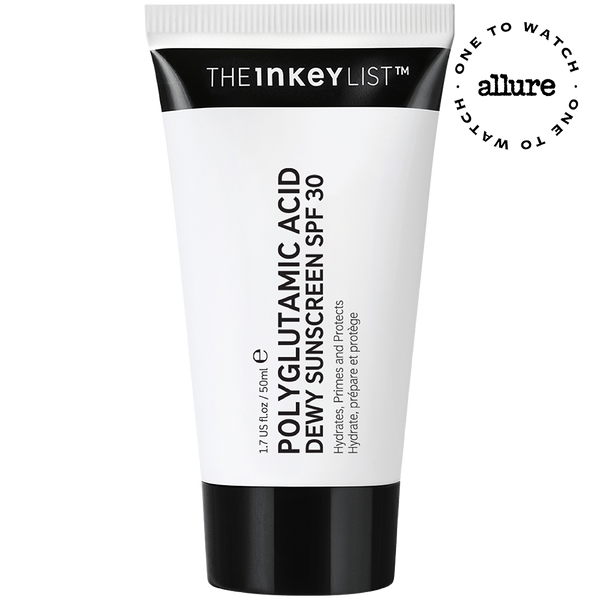
Our Dewy Sunscreen SPF 30 (£15.00, 50ml) was built around exactly this compliance problem. It is broad-spectrum, fragrance-free and non-comedogenic, with an 8% hydration trio of Polyglutamic Acid, Glycerin and Squalane, so it hydrates while it protects rather than sitting on top of skin like a chore. In an independent consumer trial of 66 people over two weeks, 97% said it looked invisible on their skin tone and 90% said skin felt primed for makeup. In practice that makes it an SPF doubling as a glowing, primed base.
The hydration side is doing real work here. Glycerin is a well-established humectant that draws water into the upper layers of skin, while Polyglutamic Acid delivers the dewy, cushioned finish. If you are curious how that ingredient compares with the one everyone knows, Polyglutamic Acid vs Hyaluronic Acid is the explainer.
Where SPF Fits in Your Morning Routine
- Cleanse to remove overnight oil and residue
- Serum, applied to clean skin so it absorbs properly
- Moisturiser, to hydrate and support the barrier
- SPF last, always over moisturiser and never underneath it
- Wait two to three minutes before makeup so the layer can set
Top up through the day on long or high-exposure days, using the reapplication guide linked earlier.
The serum step is where antioxidants belong. Our 15% Vitamin C + EGF Serum (£16.00) is a strong morning choice underneath sunscreen. Vitamin C is an antioxidant, and antioxidants help neutralise the free radicals generated by UV exposure, which means the two steps are addressing different parts of the same problem. SPF limits how much UV reaches skin; the antioxidant helps with the consequences of what gets through. What Vitamin C does for skin covers the wider benefits, and why you always need both Vitamin C and SPF explains the pairing properly.
Wearing SPF well all day only pays off if you also take it off properly at night.
How to Remove SPF Properly at the End of the Day
UV filters are engineered to cling. They are designed to survive heat, sweat, humidity and a full day of daylight without sliding off your face, which is exactly what you want from them at 9am and exactly why a quick splash of water will not shift them at 10pm.
Leaving them on has consequences. Residual filters mixed with sebum, sweat and airborne pollution sitting on skin overnight is a reliable recipe for congestion and dullness, and that leftover layer physically interferes with how well your evening serums and treatments absorb. You can use an excellent retinoid or acid and get a fraction of the benefit simply because it never properly reached skin.
The method is a double cleanse. Start with an oil or balm cleanser to melt and emulsify the SPF layer, worked into dry skin with dry hands, then follow with a water-based second cleanse to clear the remaining residue. Give it at least 60 seconds rather than a rushed ten, and pay attention to the jawline, hairline, sides of the nose and neck, which is precisely where SPF accumulates and precisely where most people stop cleansing.
Our Oat Cleansing Balm 150ml (£15.00) handles the first step, melting makeup, SPF and daily impurities in around 30 seconds. It contains 1% Colloidal Oatmeal to help visibly reduce redness and soothe dryness, plus 5% Oat Kernel Oilto help lift impurities while supporting the skin’s moisture, so removal does not come at the cost of comfort. It suits all skin types, including sensitive. If you used the previous version, what changed in the new Oat Cleansing Balm explains the reformulation that took Oat Kernel Oil up to 5%.
For the full technique, how to remove sunscreen properly and why double cleansing matters goes further than this section has room for, and the complete guide to double cleansing covers the method across every skin type.
There is a direct morning payoff too. Properly cleansed skin means tomorrow’s SPF applies evenly, sits smoothly and performs the way it is supposed to, which is a large part of how to get glowing skin in the first place. Application and removal are not two separate habits. They are two halves of the same one.
Conclusion: The Bottom Line on SPF 30 vs SPF 50
SPF 30 is effective. It blocks approximately 97% of UVB and stands as the evidence-based everyday baseline for the vast majority of daily situations in the UK, across every season.
SPF 50 is not a gimmick, and it genuinely earns its place in specific circumstances: long stretches outdoors, altitude, very fair skin that burns easily, photosensitising medication, recently treated skin and travel to higher-UV destinations. In those situations, reach for it without hesitation.
Outside them, the number is the least interesting part of the decision. What actually determines your protection is whether you apply enough, whether you apply it evenly, whether you wear it on the grey days as well as the bright ones, and whether you take it off properly at night. A correctly applied SPF 30 beats an under-applied SPF 50 every time.
Daily SPF is one of the most evidence-backed long-term investments you can make in your skin. It is also one of the few that only works as a habit, which means the sunscreen that fits effortlessly into your morning will always outperform the one that impresses on paper.
Make SPF the Easiest Step in Your Routine
Our Dewy Sunscreen SPF 30 (£15.00) is broad-spectrum, fragrance-free and lightweight, with a dewy finish that works as a primed base rather than a barrier between you and your makeup. That matters, because a formula you enjoy wearing is a formula you will apply properly, in the right amount, every day.
Pair it with Oat Cleansing Balm 150ml (£15.00), with 5% Oat Kernel Oil, to take it all off cleanly at night.
Want the full science behind filters, ratings and formulation? Explore our complete SPF guide. Not sure where to start with your routine? Take our free skincare quiz and we will build you a personalised one.
Further reading: mineral vs chemical sunscreen, should you wear SPF in winter, sunscreen for dry skin and why you always need both Vitamin C and SPF.
Frequently Asked Questions
Got a question?
Our askINKEY team are a friendly bunch of skincare experts with deep product knowledge and zero judgement. Whether you're an ingredient obsessive or just starting out, we'll make it make sense. No question too big. No question too small. We Give A Care, Every Day.


