



Does Niacinamide Help With Acne? The Science-Backed Answer
Niacinamide calms inflammation, reduces excess oil, supports your skin barrier and fades post-blemish marks. Here is the evidence, and how to use it properly.
Author
askINKEY skincare advisor
Published
17 May, 2026
Time to read
15 minutes
Yes. Niacinamide genuinely helps with blemishes and breakouts, and the evidence behind it is peer-reviewed rather than promotional. That distinction matters, because plenty of skincare ingredients arrive with confident marketing and very little published research standing behind them. Niacinamide is not one of them.
Niacinamide is a form of vitamin B3, and it is one of the most heavily researched ingredients in all of skincare. So when people ask does niacinamide help with acne, the honest answer is not a hedge. It does, and researchers understand reasonably well why.
This article covers the whole picture: how niacinamide works at a mechanism level, what the clinical evidence actually shows, what it does for excess oil and congested pores, what it realistically will not do, which ingredients it pairs well with, and how to build it into a routine you can follow tomorrow morning. Prices are included throughout, because knowing what something costs is part of knowing whether it is right for you.
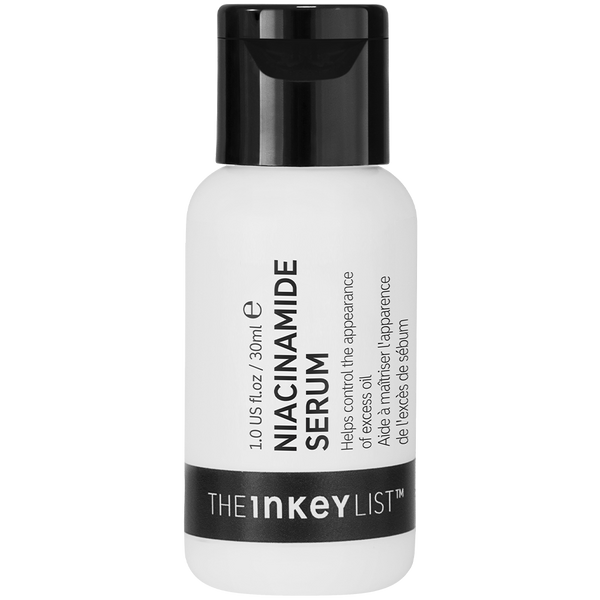
The hero product for most people is the 10% Niacinamide Serum at £12. If you want the broader ingredient picture, there is our full niacinamide ingredient guide, and if you want the wider view of the concern itself, INKEY’s complete acne guide covers it.
The reason niacinamide performs so well comes down to a single structural advantage: it does not tackle one driver of breakouts. It tackles several at once.
What Niacinamide Actually Does for Blemish-Prone Skin
Most blemish ingredients are specialists. Benzoyl peroxide targets bacteria. Salicylic acid clears congestion inside the pore. Retinoids accelerate cell turnover. Each does its one job well, and each leaves the other drivers of a breakout untouched.
Niacinamide is unusual because it works on four separate drivers simultaneously. That is the whole reason it punches above its weight against narrower, more aggressive ingredients, and it is why it has become a fixture in routines for blemish-prone skin rather than a short-term fix.
Breakouts are what researchers call a multifactorial condition. Excess oil, blocked pores, bacterial activity and inflammation all feed into each other in a loop, and interrupting only one point in that loop tends to produce partial results. If you want the clinical background on the condition itself, we have written about what acne vulgaris actually isin detail. For now, here is what niacinamide does about it.
It calms the inflammatory response that makes spots red and sore
When a blemish forms, your skin does not sit passively. It launches an inflammatory cascade, sending out signalling molecules called cytokines that recruit immune activity to the site. The main players have names worth knowing only because they show up in the research: TNF-alpha, IL-1, IL-6 and IL-8.
Those cytokines are the reason a spot is not just a blocked pore but a red, swollen, tender one. They are the difference between congestion you can barely see and a blemish you can feel every time your face moves.
A 2024 peer-reviewed study published in Antioxidants confirms that niacinamide inhibits the production of these pro-inflammatory cytokines. It does this through NF-kB-mediated transcription control, which in plain English means it acts on the switch that tells skin cells to start producing inflammatory signals in the first place. The same research shows niacinamide suppresses COX-2, another enzyme involved in the inflammatory process.
Translated properly: niacinamide turns down the volume on the reaction that makes a spot look and feel angry.
There is a practical consequence to this that most people get exactly backwards. Because niacinamide’s calming action is most valuable during an active flare-up, it is the last thing you should remove from your routine when your skin is breaking out. The instinct to strip everything back to bare basics at the first sign of a bad skin week means removing the one thing actively working on the inflammation. We will come back to this, because it is the single most common mistake in blemish routines.
It supports your skin’s own defences against Cutibacterium acnes
Cutibacterium acnes is the bacterium associated with blemishes. It lives on everyone’s skin quite happily, and it is not an invader to be eliminated. Problems arise when the conditions inside a blocked, oil-rich pore let it proliferate beyond its normal level.
Niacinamide’s approach here is genuinely different from most blemish ingredients. It does not kill bacteria directly. Instead, it encourages your skin’s own antimicrobial peptides, the naturally occurring defence molecules your skin already produces, and supports healthy neutrophil activity as part of the normal immune response.
The practical upside is significant. Because niacinamide is not acting as an antimicrobial agent, there are no antibiotic resistance concerns attached to using it every day, indefinitely. That is not a claim many blemish-fighting ingredients can make, and it is a large part of why niacinamide suits long-term daily use rather than short courses.
It reduces oil at the source, not on the surface
This is where niacinamide separates itself from the mattifying products most oily-skinned people have cycled through.
Research shows that topical niacinamide at 2 to 5% reduces sebum production at the sebaceous gland itself, acting via the HCA2 receptor pathway. The sebaceous gland is the small structure attached to each hair follicle that manufactures your skin’s oil.
Read that distinction carefully, because it is the whole point. Blotting papers, clay masks and mattifying powders remove or absorb oil that has already been produced and has already reached your skin’s surface. They are managing an output. Niacinamide reduces the output.
That is why the effect holds through the day rather than fading an hour after you apply it. You are not competing with your skin’s oil production on a rolling basis. You are moderating it.
It builds the skin barrier up rather than stripping it down
The fourth mechanism is the one people overlook, and arguably the one that makes the other three sustainable.
Niacinamide activates serine palmitoyl transferase, the enzyme responsible for ceramide synthesis. Ceramides are the lipid molecules that sit between your skin cells and hold the outer layer together, functioning something like mortar between bricks. More ceramides means a better epidermal permeability barrier, which means skin that holds onto water and keeps irritants out more effectively.
This matters enormously for blemish-prone skin, because the conventional approach to breakouts has historically been to strip. Strong cleansers, aggressive actives, alcohol-heavy toners. That approach damages the barrier, and a damaged barrier produces more sensitivity, more redness and, frequently, more oil as the skin overcompensates. If your routine has left your skin tight, stinging or reactive, supporting a healthy skin barrier is the reset worth understanding.
Niacinamide is non-comedogenic and builds the barrier rather than degrading it. That is precisely why it suits sensitive and reactive skin types who cannot tolerate harsher blemish ingredients, and why it can sit in a routine permanently without the tolerance issues that force people off stronger actives.
Four mechanisms, one ingredient, applied once or twice a day. If you want the practical side of that, how and when to use niacinamide covers application in more depth than we will get into here.
Mechanism is one thing. What the evidence shows when this is actually tested on skin is another.
Is Niacinamide Good for Acne? What the Evidence Shows
Yes, and the strength of the evidence is the reason we can say so plainly.
The most striking result comes from research cited by Acne Support UK, the patient information resource run by the British Association of Dermatologists. Studies referenced there found that 4% topical niacinamide produced comparable anti-inflammatory activity in blemish-prone skin to 1% topical clindamycin, a prescription antibiotic.
Studies cited by Acne Support UK found 4% topical niacinamide produced anti-inflammatory activity in blemish-prone skin comparable to 1% topical clindamycin, a prescription antibiotic.
That deserves careful framing rather than a victory lap. It does not mean niacinamide replaces prescription medicine, that every case responds the same way, or that anyone should abandon a plan agreed with their GP. Individual results vary, and severe or cystic breakouts frequently need clinical input that no over-the-counter serum can provide.
What it does mean is that an ingredient you can buy without a prescription, for the price of a couple of coffees, has held its own against a prescription option in published research. That is worth sitting with.
The accessibility angle here genuinely matters. Prescription routes involve GP appointments, waiting lists, prescription charges where applicable, and for some people a level of friction that means they simply never start. The 10% Niacinamide Serum costs £12 and requires nothing more than deciding to try it. When an ingredient with real published evidence behind it is also the accessible option, more people get to benefit from it. That is not a marketing line, it is just how access works.
What to realistically expect, week by week
Skincare timelines get wildly misrepresented, so here is an honest sequence. These are typical patterns rather than guarantees, and skin varies.
- Weeks one to two. Reduced shine and noticeably better oil control through the day. This is the first thing most people register, and it is the sebum regulation beginning to take effect.
- Weeks four to six. Fewer new blemishes forming, and the ones that do appear calming down faster than they used to. The inflammatory mechanism is doing its work here.
- Weeks six to eight. Visible pore refinement and smoother overall texture as congestion reduces and the barrier strengthens.
- Weeks eight to twelve. Post-blemish marks beginning to fade. This is always the slowest change, because pigment clears gradually.
The pattern to notice is that the benefits are cumulative and the deeper ones arrive last. Abandoning niacinamide at week two because your skin has not transformed means quitting before three of the four mechanisms have had time to demonstrate anything. If impatience is the issue, how long skincare actually takes to work sets expectations across ingredient types more broadly.
Now the honest limitation. Niacinamide is a daily regulator, not an overnight spot fix. It shifts the conditions in your skin that allow breakouts to form, and that is a slower, quieter kind of progress than a targeted overnight product promises. It is also more durable.
And if your breakouts are persistent, painful, cystic or leaving marks that distress you, seeing a GP or a dermatologist is the right call. No serum, ours included, is a substitute for clinical advice when skin needs it.
With the general case established, let us deal with the concern most readers actually arrive with.
Niacinamide for Oily Skin: Controlling Shine and Refining Pores
Excess oil is usually the first thing people want addressed, and it is also the most logical place to start, because oil is upstream of almost everything else.
Here is the sequence. Your sebaceous glands produce sebum. That sebum mixes with dead skin cells shed inside the follicle. That mixture forms a plug. The plug becomes a blackhead when it meets air and oxidises, or a closed comedone when it does not, and if bacteria proliferate inside it and inflammation kicks in, it becomes the red, raised blemish you actually notice.
More oil means more raw material for that process. Reduce the oil and you reduce the substrate the whole cascade depends on. If you want to understand the underlying picture, what oily skin actually is covers the causes properly, and why is my skin so oily gets into the specific triggers.
This is where niacinamide’s mechanism becomes practically important rather than academically interesting. Reducing production at the gland means you are not fighting a rolling battle at the surface. The oil is not arriving to be blotted, because less of it is being made. Which is why people using niacinamide consistently describe the effect as their skin simply being less oily, rather than as a product that keeps shine at bay for a few hours.
The honest answer on pore size
Pores do not shrink. Not from serums, not from cold water, not from anything you apply topically.
Pore size is largely determined by genetics and by structural changes in the skin over time. Any product promising to shrink pores is either being loose with language or being untruthful.
What actually changes is how visible they are. A pore stretched by a plug of oxidised sebum and dead skin looks considerably larger and darker than the same pore when it is clear. Reduce the oil, reduce the congestion, and the pore becomes visibly less noticeable even though its physical dimensions have not changed at all.
That is a real, visible, worthwhile result. It is just not the same claim, and we would rather tell you which one you are getting. For congestion specifically, blackheads is the pillar worth reading.
The moisturiser mistake
If you have oily skin, you have probably at some point decided that moisturiser was the enemy. It is an intuitive conclusion and a completely counterproductive one.
Strip the skin and you compromise the barrier. Compromise the barrier and your skin loses water more readily, registers the deficit, and frequently responds by producing more oil to compensate. The tight, squeaky feeling after a harsh cleanse is not cleanliness. It is barrier disruption, and your skin will answer it.
Oily skin needs hydration. What it does not need is a heavy, occlusive cream that sits on the surface and adds congestion. The distinction is formulation, not whether you moisturise at all, and the best moisturiser for oily skin goes through what to look for.
The Omega Water Cream at £14 is built for exactly this problem. It is oil-free and water-based, so it hydrates without adding grease. It contains 5% niacinamide, which means it contributes to the oil regulation and calming benefits alongside your serum rather than just sitting on top of them. It also carries a 0.2% ceramide complex rich in omegas 3, 6 and 9 to support the barrier, plus 3% betaine for hydration.
In a consumer study, 100% of participants said their skin felt deeply hydrated after 14 days, and 95% agreed their skin tone looked more even after 28 days. Worth being precise about what that is: a consumer study reflecting how people rated their own skin, not a clinical study. Both are useful, they measure different things, and conflating them is not something we are prepared to do.
When 10% is not quite enough
For most people, 10% niacinamide is the right strength. It supports all four mechanisms well and is comfortably tolerated.
For persistently very oily skin, particularly if shine returns within a couple of hours regardless of what you do, the 20% Niacinamide Serum at £16 is the step-up. Note the slug there, it is not the intuitive one.
Be clear on what “step-up” means. It means stronger, not better. Higher percentages do not automatically produce better results, and for a lot of people they simply increase the likelihood of flushing or irritation without improving the outcome. Start at 10%. Move to 20% if 10% has been consistent for a couple of months and oil is still your dominant, unresolved concern.
If you would rather browse by concern than by product, shop the full excess oil range collects the relevant options in one place.
We have spent a while on what niacinamide does well. It is only fair to be equally direct about what it does not do.
What Niacinamide Will Not Do: Marks, Purging and Breakouts
Can niacinamide cause breakouts?
No. Niacinamide is non-comedogenic and works by calming inflammation, so it cannot reasonably cause the reaction it reduces. If new blemishes have appeared since you started using it, something else in your routine is almost certainly responsible. We have unpacked the likely culprits properly in Can Niacinamide Cause Acne? Side Effects Explained.
Does niacinamide cause purging?
No. Purging happens when an ingredient accelerates skin cell turnover and pushes existing congestion to the surface faster, which applies to retinoids and exfoliating acids, not niacinamide. The 2024 study confirmed niacinamide has no effect on keratinocyte proliferation, so the mechanism for purging simply is not present. If you are trying to work out whether what you are experiencing is a purge or a reaction, What Is Skin Purging? Your Complete Guide will tell you.
Does niacinamide help with acne scars?
This depends entirely on what you are actually looking at, and the two things get conflated constantly.
True structural scars, meaning rolling, boxcar and ice-pick, are physical changes to the deeper layer of skin where tissue has been lost or tethered. No topical product can restructure them, and anything claiming otherwise is overselling. Those need clinical procedures, and types of acne scars will help you identify which you have.
Post-inflammatory hyperpigmentation is a different thing entirely. These are the flat brown or dark marks left behind after a blemish clears, and niacinamide does help with them by interrupting the transfer of pigment to surface skin cells. Expect gradual fading over roughly eight to twelve weeks of consistent daily use. The flat red or pink version is post-inflammatory erythema, covered in post-inflammatory erythema and red marks.
Daily SPF is non-negotiable here, because UV exposure darkens and prolongs every single mark you are trying to fade. For the full picture, see acne scars and post-blemish marks, the pillar on post-inflammatory hyperpigmentation, and our guide on how to treat post-inflammatory hyperpigmentation.
Saying clearly what an ingredient cannot do is not a weakness in the argument. It is what makes the rest of it credible. Which brings us to what niacinamide works best alongside.
What to Pair With Niacinamide for Blemish-Prone Skin
Niacinamide is unusually cooperative. It is stable, well tolerated, and it plays nicely with almost everything, which makes it one of the easiest actives to build a routine around. Here is how it combines with the ingredients you are most likely to be considering.
Niacinamide and salicylic acid
The framing of “niacinamide vs salicylic acid for acne” is the wrong question, because these two are not competing for the same job.
Salicylic acid is oil-soluble. That property is the whole reason it works: it travels into the pore itself rather than staying on the surface, and it dissolves the mixture of dead skin cells and sebum causing the blockage. It clears congestion that already exists. If blackheads are your main concern, Salicylic Acid for Blackheads is the specific read, and salicylic acid explained covers the ingredient in full.
Niacinamide works upstream. It reduces how much oil is produced and calms the inflammatory response, so there is less material forming blockages in the first place and less redness when one does.
Clear the congestion, reduce the conditions that create it. That is a complete strategy, and neither half achieves it alone.
The layering is simple. Cleanse with the Salicylic Acid Cleanser at £14, which delivers the acid where it is useful and rinses it away, then apply the 10% Niacinamide Serum to clean skin. We have written this pairing up in full in Salicylic Acid and Niacinamide: The Best Duo for Oily, Blemish-Prone Skin.
If you are dealing with all three stages at once, meaning excess oil, active blemishes and the marks left behind, the 360° Skin Clearing Serum at £16 is formulated to address the full sequence in a single step.
Niacinamide and retinol
Retinol accelerates cell turnover and refines texture, and it is genuinely excellent at both. It also commonly brings dryness, flaking and sensitivity, particularly in the first few weeks, and that side effect is the reason most people who start retinol stop retinol.
Niacinamide’s barrier support makes it a sensible buffer. Apply niacinamide first, let it absorb for a minute, then apply retinol on top. The barrier is better supported, tolerance improves, and you are more likely to still be using the retinol in two months.
Retinol is PM only, without exception. If you are new to it, what retinol is and how it works is the place to start, Can You Use Niacinamide With Retinol? covers the combination specifically, and What Not to Mix With Retinol will keep you out of trouble.
Niacinamide and azelaic acid
A quietly excellent pairing, and underrated. Both ingredients are gentle, both are well tolerated, and both are useful where redness and blemishes show up together, which is extremely common in adult skin.
There is no need to alternate days or separate them into different parts of your routine. They can be used together. Azelaic acid explained covers the ingredient, and Azelaic Acid and Niacinamide: Can You Use Them Together?answers the combination question directly.
Niacinamide and glycolic acid
These work together with sensible spacing rather than being applied simultaneously. The details are in Niacinamide and Glycolic Acid: Can You Use Them Together?.
If you are comparing brightening ingredients
Readers weighing up which glow-focused ingredient to prioritise often want a straight comparison rather than a single recommendation. Vitamin C vs Niacinamide vs Exosomes: which glow ingredient does your skin need sets them side by side.
Niacinamide is not only for oily skin
Worth stating plainly, because the association with oil control is so strong that dry-skinned readers often assume niacinamide is not for them. Dry and dehydrated skin benefits too, largely through the barrier and ceramide mechanism. Is Niacinamide Good For Dry Skin? makes the case.
The rule that underpins all of the above
Pairing actives without supporting the barrier is the most common reason routines stop working.
People stack salicylic acid, retinol and an exfoliant, get good results for three weeks, then find their skin turning red, tight and reactive. The actives were not wrong. The missing piece was the barrier support that lets skin tolerate them. Niacinamide is doing double duty in any routine like this, contributing its own benefits while making everything else more sustainable.
Which ingredients to combine is one half of the practical picture. Strength, timing and specific circumstances are the other.
Percentages, Timing and Specific Situations
What percentage of niacinamide should you use?
Clinical research supports roughly 2 to 10% for blemish-relevant benefits. At 10%, all four mechanisms are well supported, which is why it is the standard recommendation and the strength most people should choose.
Higher is not automatically better. This is one of the most persistent misunderstandings in skincare, and it costs people money and comfort. Very high percentages can cause flushing, tingling or irritation in sensitive skin without delivering proportionally better results. The 20% Niacinamide Serum at £16 exists as a step-up for persistently oily skin, not as a general upgrade for everyone who wants faster progress.
Should you use niacinamide in the morning or at night?
Both work, and this is genuinely a preference rather than a rule.
Niacinamide is stable, it does not increase sun sensitivity, and it layers well under other products. Morning application suits oil control, because you get the sebum-regulating benefit across the hours when you are actually out in the world. Evening application suits anyone using retinol, since niacinamide functions as the buffer underneath it.
Twice daily is fine for most people and is what we would suggest as a default. If your skin is sensitive or reactive, start with evenings only and build to twice daily after a week or two once you know how you tolerate it.
Does niacinamide help with hormonal breakouts?
Honestly: niacinamide does not change your hormones. Nothing you apply topically does.
What it does is address the downstream consequences. Hormonal fluctuations drive increased sebum production and heightened inflammation, and those are precisely the two things niacinamide moderates. The result for many people is that hormonal breakouts are less severe and shorter-lived, appearing on a calmer, less oily baseline than they otherwise would.
That is a meaningful improvement, and it is not the same as prevention. Hormonal Acne: What Causes It and How to Manage It goes into the fuller picture.
What about fungal acne?
Fungal acne is not true acne at all, which is why it frustrates so many people. It is an overgrowth of yeast within the hair follicles, and it typically presents as small, uniform, itchy bumps clustered together rather than the varied mix of blackheads, whiteheads and inflamed spots you get with blemishes.
Because the cause is different, standard blemish products often do nothing for it. Niacinamide is unlikely to make fungal acne worse and may help calm surrounding irritation, but it will not resolve it on its own. This needs a different approach, set out in What Is Fungal Acne? Symptoms, Causes and How to Treat It.
Is niacinamide safe during pregnancy and breastfeeding?
Niacinamide is generally considered suitable during pregnancy and breastfeeding. This matters a great deal, because several of the most common and effective blemish actives are not, and people frequently find their routine gutted overnight.
Always check with your midwife or GP, who know your circumstances. For the wider picture of what stays and what goes, Your Guide To Pregnancy-Safe Skincare covers it.
Can you use niacinamide on active, inflamed spots?
Yes, and this is exactly when it earns its place. The calming mechanism is most useful when there is active inflammation to calm.
For individual raised spots, Hydrocolloid Invisible Pimple Patches at £9 for a pack of 22 are worth having. They draw out fluid, protect the spot from being picked, and can be worn overnight or under makeup during the day.
To repeat the point that matters most: do not stop using niacinamide when you break out. Removing the calming ingredient at the exact moment inflammation peaks is the wrong move, and it is the one people make most often.
Everything above is only useful if it turns into something you can actually do. Here is the routine.
Your Niacinamide Routine for Blemish-Prone Skin
Morning routine for oily and blemish-prone skin
- Cleanse with the Salicylic Acid Cleanser at £14. This clears the oil that accumulated overnight and decongests pores before anything else goes on.
- Apply the 10% Niacinamide Serum at £12. A pea-sized amount across face and neck is plenty.
- Moisturise with the Omega Water Cream at £14. Oil-free, non-comedogenic, and it adds another 5% niacinamide to the day.
- Protect with the Dewy Sunscreen SPF 30 at £15.
That last step is not optional, and it is worth making the case properly rather than treating it as a footnote. UV exposure darkens post-blemish marks and prolongs how long they take to fade. If you are using niacinamide to fade pigmentation and skipping SPF, you are actively undoing the work every time you leave the house. SPF 30 or higher, every day, is what makes the fading mechanism worth anything. Why SPF matters explains the reasoning, and if you are worried a sunscreen will leave you greasy or congested, the best sunscreen for oily and blemish-prone skinaddresses that specifically.
Evening routine with retinol
- Cleanse.
- Apply the 10% Niacinamide Serum and allow it to absorb for a minute.
- Apply retinol. PM only.
- Finish with the Omega Water Cream to seal everything in and support the barrier overnight.
Evening routine without retinol
- Cleanse.
- 10% Niacinamide Serum.
- Omega Water Cream.
Three steps. This is the version for beginners, for sensitive skin, and for anyone resetting after a period of irritation. Simple routines followed consistently beat elaborate routines followed sporadically, every time.
Application tips that genuinely matter
- A pea-sized amount is enough. Using more does not work faster and may cause temporary flushing. Serums are formulated at a concentration that works in small quantities.
- Do not mix serums in your palm. Combining products before application changes how each one behaves and how it penetrates. Apply separately and let each absorb.
- Damp or dry skin both work. Niacinamide is not fussy about this.
- Sensitive skin should start slowly. Evenings only for the first week or two, then build to twice daily once you know how your skin responds.
The mistakes worth avoiding
- Stopping niacinamide the moment a breakout appears. The most counterproductive move available to you, and the most common. Inflammation is precisely what it addresses.
- Expecting results in days rather than weeks. Oil control shifts early. Everything else takes six to twelve weeks. Judging at day ten tells you almost nothing.
- Changing three things at once. If you introduce a new cleanser, a new serum and a new moisturiser in the same week and your skin reacts, you have no way of knowing which one caused it. Introduce one product at a time and give it a fortnight.
What it actually costs
A complete blemish-focused routine can start from £12 with the serum alone. Good skincare should not require a significant financial decision, and evidence-backed ingredients should not be priced as luxuries.
If you would rather browse than follow a prescribed routine, shop blemishes and breakouts has the full range. And if you are not sure where your skin sits or which products suit it, Breakout Analyser Pro will give you a personalised analysis rather than a guess.
A few specific questions come up often enough to deserve direct answers.
The Bottom Line: Niacinamide Works, With Realistic Expectations
Niacinamide does four things for blemish-prone skin, and it does them at the same time. It calms the inflammatory response that makes spots red and painful. It supports your skin’s own defences against the bacteria involved in breakouts. It reduces oil production at the sebaceous gland rather than mopping it up at the surface. And it strengthens the skin barrier through ceramide synthesis, which is what makes everything else sustainable rather than a short-lived improvement.
It is equally worth being clear about the limits. It does not cause breakouts. It does not cause purging, because the mechanism for purging is not present. It fades post-blemish marks gradually over eight to twelve weeks, and it does not restructure true scarring, which needs clinical input.
The variable that decides your outcome is consistency. Oil control arrives early. Everything else builds across eight to twelve weeks of daily use, and the people who see the best results are simply the ones who kept going through the unremarkable middle stretch.
A complete routine is not complicated: the 10% Niacinamide Serum at £12 as the core, the Salicylic Acid Cleanser at £14 to clear congestion, and the Omega Water Cream at £14 to hydrate and support the barrier. Add daily SPF and you have covered every mechanism discussed in this article.
Clear guidance, ingredients with real evidence behind them, and honest expectations about what they will and will not do. That is the whole proposition, and niacinamide happens to be one of the ingredients that makes the case for itself.
Where to start
Start with the 10% Niacinamide Serum at £12. It is the right strength for most people and the single most useful addition to a blemish-prone routine.
Not sure what your skin needs? Breakout Analyser Pro gives you a personalised analysis of breakout-prone skin, or the Skincare Quiz will build you a routine in two minutes.
Prefer to browse? Shop blemishes and breakouts or build your own routine.
Frequently Asked Questions
Got a question?
Our askINKEY team are a friendly bunch of skincare experts with deep product knowledge and zero judgement. Whether you're an ingredient obsessive or just starting out, we'll make it make sense. No question too big. No question too small. We Give A Care, Every Day.


