



Glycolic Acid for Scalp: What It Does and Who It Suits
What glycolic acid actually does on your scalp, how to use it safely, and when flaking needs your GP instead.
Author
askINKEY skincare advisor
Published
05 August, 2026
Time to read
11 minutes
Glycolic acid for scalp use is an alpha hydroxy acid applied before you shampoo to loosen the bonds between dead skin cells, clearing product build-up, dead skin and excess oil from the surface of your scalp. It is the same ingredient many people already know from facial exfoliation, reformulated at a different concentration, in a different format and at a different pH for an entirely different part of the body.
This article covers what glycolic acid does once it reaches your scalp, why build-up accumulates there, the signs that tell you exfoliation would help, its honest limits, how it compares with salicylic acid specifically on the scalp, the step by step method, how often to use it, who it suits and the questions people ask most often.
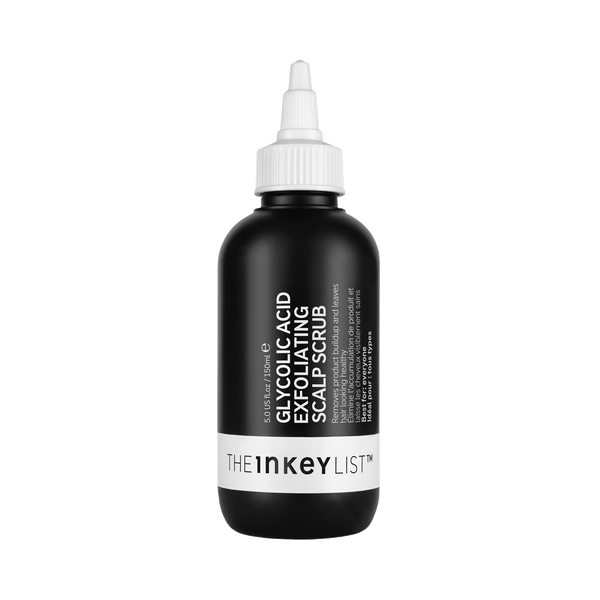
The reference product throughout is our Glycolic Acid Exfoliating Scalp Scrub (£14 for 150ml), a pre-shampoo treatment built around 7% Glycolic Acid. It sits within our wider range of scalp treatments, and if you would rather have a routine built for you than assemble one yourself, our Hair and Scalp Quiz takes around two minutes.
One point to establish immediately, because a great many pages on this subject blur it: a glycolic acid scalp scrub is a build-up and oil product. It is not a dandruff treatment. This article explains precisely where that line sits and what to do if you find yourself on the other side of it.
Here is what you will find below:
- What glycolic acid does on the scalp, and what each active in our formula is for
- Why product build-up, sebum and dead skin gather at the roots
- How to tell whether your scalp needs exfoliating right now
- The honest limits, including dandruff and seborrhoeic dermatitis
- Glycolic acid versus salicylic acid, scalp only
- The full application method, including contact time
- Frequency, suitability and what results to realistically expect
- A simple weekly scalp routine
- Direct answers to the most common questions
Begin with the mechanism, because everything else follows from it.
What Glycolic Acid Actually Does on Your Scalp
Your scalp is skin. That sounds obvious written down, but it is the single most useful reframe in this article, because most people treat the scalp as an accessory to hair rather than as skin in its own right. It sheds on a cycle. It produces sebum. It hosts a microbiome. It responds to congestion, over-cleansing, hard water and residue exactly as facial skin does. The difference is that facial skin is visible, gets cleansed twice daily and receives a considered routine, whilst the scalp sits beneath hair, gets shampooed and forgotten.
Glycolic acid is an alpha hydroxy acid originally derived from sugar cane, and it has the smallest molecular size of the AHA family. Small molecules move efficiently, which is why glycolic acid is the AHA most often chosen when the goal is meaningful surface exfoliation rather than a gentle polish.
The mechanism is straightforward once the marketing language is stripped away. Dead skin cells on the surface do not simply drop off. They are held in place by bonds, and when skin is congested those bonds hold on for longer than they should. Glycolic acid reduces the cohesion between those dead surface cells so they release and lift away rather than staying put. Cleveland Clinic’s explainer on glycolic acid describes this same action of loosening the bonds holding dead cells to the skin’s surface, which is the entire basis of its use as an exfoliant.
On the face, that shows up as smoother texture and more even tone. On the scalp it shows up differently. Dead skin cells on the scalp cannot shed cleanly into the air. They are caught in a dense forest of hair fibres, they mix with sebum, and they combine with whatever you sprayed, creamed or oiled onto your roots that week. The result is a compacted layer at the root that shampoo alone does not always dissolve.
What that means in practice
- Clearer follicles. Build-up gathers around the follicle opening. Clearing it helps keep hair follicles clean.
- Less residue at the roots. The film you can sometimes feel when you run a fingertip along your parting.
- Roots that feel lifted. Not coated or conditioned, but genuinely lighter, because there is less material weighing them down.
- A more balanced surface environment. A scalp that is neither stripped nor congested is a better environment for hair to grow from.
Now the formula itself. We publish percentages on every product page for a reason, and the same logic applies here. Each active in our Glycolic Acid Exfoliating Scalp Scrub earns its place.
- 7% Glycolic Acid. The chemical exfoliant. It loosens dead skin cells, product build-up and the compacted layer sitting at the root. Seven percent is a considered concentration for a rinse-off scalp treatment used once or twice weekly rather than a leave-on daily product.
- 2.5% SymControl Scalp. A sebum regulator derived from a Mediterranean microalgae. This is the part most people overlook. Exfoliating away oil is one thing. Reducing sebum overproduction at source addresses why the scalp became greasy so quickly in the first place.
- 2% Castor Beads. Physical exfoliation working alongside the acid rather than instead of it. They are made from hydrogenated castor oil and are 100% biodegradable, which matters when the rinse water goes straight down the drain.
- 0.5% BioEcolia. A prebiotic that helps balance and maintain the scalp microbiome. Exfoliation is by definition a disruptive act, so supporting the microbial balance of the surface you have just cleared is not an optional extra.
The formula sits at pH 4.0 to 5.0, close to skin’s own naturally acidic range. It is free from fragrance, alcohol, silicone, sulphates and gluten, it is certified by The Vegan Society and it is Leaping Bunny approved.
So is glycolic acid good for hair?
This is where precision matters, and where a great deal of content becomes loose. The honest answer to “what does glycolic acid do for hair” is that it does not really do anything to your hair. It works on the scalp, not on the hair fibre. It is not conditioning your strands, repairing damage or smoothing the cuticle.
What happens is downstream. A scalp that is not carrying a compacted layer of oil, dead skin and styling residue produces roots that feel cleaner and look less dull, and hair that moves more freely because it is not weighed down at the base. That is a real and noticeable difference, and it is worth having. But it comes from clearing the scalp, not from the acid treating the hair.
The same discipline applies to growth. A clean scalp helps keep hair follicles clean and supports a balanced scalp microbiome, which supports the environment healthy hair grows from. We will say that glycolic acid helps boost healthy hair growth in that sense. We will not tell you it will make your hair thicker or denser, or bring hair back, because a scalp scrub does not do that.
If you want the fuller background on the ingredient itself, including how it behaves on facial skin, the wider glycolic acid range and our breakdown of the 5 benefits of glycolic acid cover that ground properly. This article stays on the scalp.
Understanding what glycolic acid clears raises the obvious next question. Where did it all come from?
Why Scalp Build-Up Happens in the First Place
Build-up is not a hygiene failure. It is the predictable result of three continuous processes meeting a modern hair routine, and nobody is doing anything wrong by having it.
The first contributor is sebum. Your scalp has a high density of sebaceous glands and produces oil continuously. That oil is functional. It conditions hair, maintains the acid mantle and forms part of the scalp’s natural barrier. But sebum production varies enormously between people, and some scalps simply produce more than the hair above can absorb or distribute. Excess sebum becomes the adhesive that everything else sticks to.
The second contributor is normal cell turnover. Your scalp sheds dead skin cells on the same cycle as the rest of your skin. On your arm those cells brush away against clothing. On your scalp they are trapped in hair with nowhere to go, mixing with the sebum already present and forming the compacted layer exfoliation is designed to lift.
The third is product residue, and this is the contributor that has changed most in the last decade. Consider what a typical week now involves at the root:
- Dry shampoo, which works by design by depositing absorbent material and staying put
- Texturising sprays and root-lift powders, formulated for grip rather than easy removal
- Leave-in conditioners and bond treatments applied generously and not always kept to the mid-lengths
- Hair oils and scalp oils, some of which are genuinely difficult to rinse fully
- Gels, mousses, creams and styling pastes
- Heat protectants applied before every blow dry or straightening session
None of these are bad products. Most are doing exactly what they were formulated to do. The point is simply that many were never designed to rinse out completely, and used frequently without periodic deep cleansing, deposits compound rather than reset.
Then there are the environmental and lifestyle factors layered on top:
- Hard water, which leaves mineral deposits on hair and scalp and makes shampoo lather and rinse less effectively
- Sweat from exercise, which mixes with sebum and product and dries in place
- Hats, helmets and headwear, which trap heat and moisture against the scalp and can increase oil production
- Longer gaps between washes, whether by choice, by protective styling or by schedule
This is also why the sebum regulator in our formula matters. Exfoliating a scalp that is overproducing oil clears the current layer but does nothing about tomorrow’s. Pairing exfoliation with SymControl Scalp addresses both the accumulation and one of the drivers behind it, which is a more complete answer than exfoliation alone.
Why shampoo alone sometimes falls short
Shampoo is very good at what it is built for. Surfactants lift surface oil and loose debris from hair fibres and rinse them away, which is the correct job for cleaning hair.
Dissolving compacted dead skin cells that are chemically bonded to one another and physically bound up with weeks of styling residue is a different task altogether. It is closer to what an exfoliant does on facial skin than to what a cleanser does. Washing your face daily with a good cleanser is correct, and it still does not replace periodic exfoliation. The scalp works the same way.
That is the gap a glycolic acid scalp treatment fills. It does not replace your shampoo. It is the step before it, once or twice a week, that gives your shampoo a clean surface to work on.
There is a great deal more to say about scalp care generally, but we have covered that properly elsewhere rather than repeating it here. Our Scalp Health 101 guide covers the fundamentals, and 5 straightforward tips for a healthy scalp and hair covers the everyday habits that sit alongside exfoliation.
Knowing why build-up happens is useful. Knowing whether it is happening to you is more useful, so here is how to tell.
The Signs Your Scalp Needs Exfoliating (And the Signs It Does Not)
Self-assessment is genuinely difficult with scalps, because you cannot easily see the surface you are trying to evaluate. So work from what you can feel and from how your hair behaves rather than from what you can see in the mirror.
Signs a scalp exfoliating scrub may help
- Roots that feel flat or weighed down soon after washing. You have washed, dried and styled, and by the following morning the volume at the root has collapsed in a way that does not match how much product you used.
- A film you can feel at the root. Run a fingertip firmly along your parting on clean, dry hair. If it feels slightly tacky, textured or coated rather than clean, that is residue.
- Hair that greases faster than it used to. A shift in your own baseline tells you far more than any absolute standard. If you used to manage three days comfortably and now struggle past one, something has changed at the surface.
- Dull-looking roots. Light reflects off a clean scalp differently from how it reflects off a coated one. Dullness concentrated at the root rather than through the lengths is a build-up signal.
- A congested-feeling scalp. Heavy, occupied, mildly itchy in a general way rather than in a persistent, localised way.
- Heavy dry shampoo or styling product use. If dry shampoo is a several-times-a-week habit, or you regularly use root powders, waxes, gels or texturising sprays, you are depositing more than a standard wash removes.
- Long stretches between washes. Protective styling, a busy schedule or a deliberate low-wash routine all mean more accumulation between resets.
If several of those describe you, our Glycolic Acid Exfoliating Scalp Scrub is designed for exactly that situation.
Signs it is not the answer right now
This list matters just as much, and we would far rather you closed this page without buying anything than used an exfoliating acid on a scalp that should not receive one.
- A sore, broken, raw or bleeding scalp. Do not apply exfoliating acids to broken skin. This appears on our product page and it is not a formality.
- Sunburn on the scalp. Along your parting or anywhere thinning has exposed skin, wait until it has fully recovered.
- A scalp already irritated by another treatment. Chemical processing, a recent colour service, a strong medicated product or a reaction to something new all mean waiting.
- Persistent red, itchy patches with recurring flaking. This is the important one, and it has its own section next.
- A scalp already reacting to over-exfoliation. Tightness, stinging, a raw feeling or noticeably heightened sensitivity all mean scaling back rather than pushing on.
Loose flakes are not the same as persistent flaking
This distinction is the difference between a product that will help you and one that will not, so it is worth being precise about.
Loose flakes appearing alongside general dryness, tightness and visible product residue, without redness and without persistent itching, are frequently just accumulated dead skin and residue. Exfoliation addresses that directly.
Persistent flaking that recurs on a cycle, comes with visible redness, comes with genuine itching rather than mild awareness, and returns reliably no matter how thoroughly you wash, is a different situation entirely. That pattern points towards a condition rather than build-up, and no scrub is going to resolve it.
Over-exfoliation is real
More is not better. An over-exfoliated scalp feels tight, stings when product is applied, becomes reactive to things that never troubled it before, and can paradoxically produce more oil as it compensates. If any of that appears, stop, allow the scalp to recover fully, then restart at a lower frequency.
Whatever your situation, patch test before your first full application, keep the product to the scalp only, avoid the eyes and do not apply to broken or irritated skin. If you are genuinely unsure whether exfoliation is your answer, our Hair and Scalp Quiz will point you towards the right category rather than leaving you to guess.
That second list leads directly into the part of this article we consider most important.
What Glycolic Acid Will Not Do: The Honest Limits
Most pages ranking for glycolic acid and the scalp will imply, suggest or state outright that it treats dandruff. We are not going to do that, because it is not accurate.
Glycolic acid alone is not an established treatment for dandruff or seborrhoeic dermatitis. A glycolic acid scalp scrub is for product build-up, excess oil, dead skin cells and flat-feeling roots.
That sentence is the one to take from this article. Everything else is detail around it.
Why glycolic acid is not a dandruff treatment
Dandruff and seborrhoeic dermatitis are not caused by insufficient exfoliation. They are commonly linked to Malassezia, a yeast that lives naturally on human skin and which, in some people, triggers an inflammatory response in areas rich in sebaceous glands. The scalp is the most sebaceous-gland-dense region of the body, which is why it is the most common site.
That is why the recognised treatments target the yeast and the inflammation rather than the flakes themselves. The American Academy of Dermatology’s guidance on seborrheic dermatitis treatment sets out the standard approaches, which centre on medicated actives including antifungals such as ketoconazole, along with salicylic acid, selenium sulphide, zinc pyrithione and coal tar, used in specific ways over specific timeframes. Glycolic acid does not appear as a recognised first-line treatment for the condition.
The logic is simple. Exfoliating away visible flakes removes what is on the surface. It does not address what is producing them. If a condition is generating flaking, the flaking returns, because the driver is still there.
An international expert consensus on managing scalp seborrhoeic dermatitis sets out the same principle, describing a management pathway built on appropriate medicated actives and ongoing maintenance rather than surface removal alone.
So does glycolic acid help with dandruff at all?
Here is the measured answer. If you have flaking and you also have significant product build-up sitting over it, a glycolic acid scalp treatment will clear that build-up, and your scalp will feel and look cleaner as a result. Some of what you were seeing may well have been residue rather than the condition.
But it is not treating the condition underneath. If a condition is driving the flaking, it will return, and continuing to exfoliate an inflamed scalp in the hope that it eventually settles is not a good plan. It is more likely to aggravate matters.
For fairness and accuracy, hydroxy acids as a broad family are not absent from this research area. A randomised study comparing a lipohydroxy acid shampoo with an antifungal shampoo examined how a hydroxy acid formulation performed against a recognised antifungal in this context, and research on a hydroxy acid based scalp scrub regimenhas looked at scrub-format regimens more generally. That work is interesting context for the category. It is not evidence for our specific formula, and we are not going to present it as though it were.
Scalp psoriasis
Do not apply exfoliating acids to psoriatic plaques or to broken skin without professional guidance. Scalp psoriasis involves accelerated cell turnover and an inflammatory process, plaques are frequently fragile, and mechanical or chemical exfoliation applied without medical direction can make matters considerably worse. This is a conversation to have with your GP, who can advise on what is appropriate for your specific presentation or refer you onwards.
When to speak to a professional
If your flaking is persistent, if your scalp itches in a way that distracts you, if there is visible redness, if patches recur in the same places, or if the problem returns reliably no matter what you do, that is worth raising with your GP.
We are not saying that to move the problem off our desk. We are saying it because a correctly diagnosed condition treated with the right active resolves far faster than months of experimenting with cosmetic products that were never designed for it. Getting you to the right answer matters more to us than getting you to buy a scrub.
If flaking and itchiness are your main issue
For scalps where flaking and an itchy feeling dominate rather than oiliness and residue, our Salicylic Acid Exfoliating Scalp Treatment (£15) is the better-suited product in our range. Salicylic acid is oil-soluble, works into the follicle rather than only across the surface, and our treatment is specifically formulated as a pre-wash step for flaky, itchy-feeling scalps.
That is not an upsell. It is pointing you at the right shelf.
Since we have now named both acids, it is worth comparing them properly.
Glycolic Acid vs Salicylic Acid for the Scalp: How to Choose
These two products are the most common decision point in our scalp range, and the difference between them comes down to one property of chemistry with very real practical consequences.
We have compared these ingredients for facial skin in detail in glycolic acid vs salicylic acid: which is right for your skin. This section is strictly about the scalp, because the scalp changes the calculation.
Glycolic acid on the scalp
- Water-soluble, so it works across the scalp surface rather than deep into the follicle.
- Best for build-up, meaning the compacted mix of dead skin, sebum and styling residue sitting on the surface.
- Best for excess oil, particularly in our formula, which pairs the acid with a sebum regulator.
- Best for dull, flat roots that feel weighed down soon after washing.
- Best for heavy product users, especially frequent dry shampoo, root powder and texturising spray.
- Includes physical exfoliation. Our scrub contains 2% biodegradable castor beads, so you get immediate mechanical exfoliation alongside the chemical action.
- £14 for 150ml.
Salicylic acid on the scalp
- Oil-soluble, which means it can work into the follicle itself rather than only across the top.
- Formulated in our range for flaky and itchy-feeling scalps, which is a different primary complaint.
- Suited to scalps where flaking is the visible issue rather than greasiness or residue.
- No physical exfoliant. It is a treatment rather than a scrub, so there are no beads.
- £15 for 150ml.
Which should you choose?
We will give you an actual recommendation rather than a hedge.
If your main complaint is residue, oiliness, roots that go flat quickly and a scalp that feels congested, choose the glycolic scrub. That is precisely the problem it was built for.
If your main complaint is flaking and an itchy feeling, choose the salicylic treatment. Oil-soluble action into the follicle is the more relevant mechanism for you.
If you genuinely have both, start with whichever troubles you more, use it consistently for four weeks, then reassess rather than trying to solve everything at once.
Can you use both?
Yes, but alternate them rather than layering them. That is our official product guidance and the reasoning is straightforward. Both products are exfoliating actives. Applying them in the same session, or on consecutive wash days, meaningfully increases the risk of over-exfoliating a part of the body that is easy to over-treat precisely because you cannot see it clearly.
A workable pattern is one product on one wash day and the other on the next wash day the following week, keeping total exfoliation to once or twice weekly overall rather than once or twice weekly each.
You can see how both sit within the full range over in scalp treatments, alongside our Glycolic Acid Exfoliating Scalp Scrub and our Salicylic Acid Exfoliating Scalp Treatment.
Product chosen, here is exactly how to use it.
How to Use Glycolic Acid on Your Scalp, Step by Step
This is a pre-shampoo treatment. It goes on before you wash rather than after, and you do not need to shampoo first to prepare the scalp. Here is the complete method for our Glycolic Acid Exfoliating Scalp Scrub (£14).
- Start on dry or damp hair, before shampooing. Either works. Dry gives slightly better control over placement, damp spreads a little more easily. Do not wash first.
- Shake the bottle well. Two reasons. The castor beads settle towards the bottom between uses, so shaking redistributes them and means you actually get the physical exfoliation you paid for. Shaking also helps keep the nozzle clear, and a clogged nozzle is the single most common application frustration people report.
- Section your hair. Part it and work in rows across the head, moving the parting roughly an inch each time. The nozzle is designed to reach the scalp itself, and sectioning is what makes that possible rather than depositing product across your lengths where it does nothing.
- Apply enough to cover the full scalp, then massage in with your fingertips. Fingertips, not fingernails. Nails scratch and irritate the very surface you are trying to treat. Use small circular movements and cover the whole scalp, including the back of the head and the nape, which almost everyone under-treats.
- Leave on for 10 minutes. Ten minutes is the instruction. Not twenty, not an hour, and never overnight. Longer contact does not deliver a better result, it simply raises the chance of irritation.
- Rinse thoroughly, then shampoo and condition as usual. Rinse under running water with fingertips moving continuously through the roots. Keep going for longer than feels necessary. Then shampoo and condition exactly as you normally would.
If you have thick, curly or coily hair
Worth flagging honestly, because it is the most common practical complaint: castor beads can be harder to rinse from thick, densely curly or coily hair. Dense hair traps them, and they do not simply fall out under the shower.
Three things fix this almost entirely:
- Work in smaller sections during application. More sections, less product per section, better scalp contact and fewer beads sitting on the hair rather than the scalp.
- Allow genuine extra rinsing time. Double what you would allow for straight hair, and keep fingertips moving through the roots throughout rather than letting water do the work.
- Rinse in sections too. Lift and separate as you go, working the water in at the root rather than over the top of the hair.
Doing this properly the first time is the difference between a great result and an irritating one, which is exactly why we would rather tell you upfront than let you discover it in the shower. For broader specialist guidance, the British Association of Dermatologists leaflet on caring for Afro-textured hair is an excellent independent resource.
Aftercare
- No SPF needed afterwards. Some AHA products carry sun sensitivity guidance, but this is a rinse-off scalp treatment and no additional SPF step is required.
- Style as normal. Once your hair is clean and dry, everything else in your routine proceeds as usual.
- Patch test before your first full use. Standard practice with any new active, and particularly worthwhile if your scalp runs sensitive.
For context on how acids are regulated and used at different concentrations and pH levels, the US FDA’s guidance on alpha hydroxy acids is a useful internationally recognised reference. If you are wondering how this step fits alongside your other actives, what products should I not layer together covers the general principles.
The short version
How long to leave glycolic acid on your scalp: 10 minutes. How often: once or twice a week. When: before shampooing, on dry or damp hair.
That covers a single session. The rhythm over weeks is where results actually come from.
How Often to Use It, Who It Suits, and What to Expect
Frequency and timing
Once or twice a week, always as a pre-shampoo step. Not daily, and not as a replacement for shampoo.
Start at once a week. Build to twice weekly only if your scalp stays comfortable after several sessions, and only if your build-up genuinely warrants it. Heavy dry shampoo users and people whose oiliness returns quickly usually settle at twice. Those with drier scalps or lighter product use are often better at once, or even once every ten days.
Keep contact time at 10 minutes regardless of frequency. Extending contact time is the most common way people over-treat, and it delivers nothing extra. Independent guidance on alpha hydroxy acids consistently supports introducing them gradually and building up, rather than starting at maximum frequency and reducing after a reaction.
Can you use a glycolic acid face toner on your scalp?
We are asked this constantly, and the answer is no, not really, for three reasons that have nothing to do with brand loyalty.
Format. A thin liquid toner does not stay where you put it on a scalp. Gravity takes it, hair wicks it, and it runs off towards your hairline, forehead, ears and eyes rather than sitting on the skin that needs it. A scrub with a targeted nozzle delivers product to the scalp itself and keeps it there for the full contact time.
Control. A face formula is designed for facial skin, at a facial concentration and pH, usually as a leave-on step. Our scalp scrub is designed as a 10 minute rinse-off treatment, paired with a sebum regulator for a part of the body with far higher sebaceous gland density, and with a prebiotic supporting a microbiome that differs from the face. Those are different problems requiring different formulation decisions.
Safety. Runoff near the eyes is a genuine issue rather than a theoretical one. Anything liquid applied above the eyeline will eventually travel, and an acid in the eye is a bad afternoon.
Our Glycolic Acid Toner (£13) is formulated for the face and belongs on the face. The scalp scrub is formulated for the scalp. Same headline ingredient, different jobs, different formats. The same logic explains why our Glycolic Acid Exfoliating Body Stick (£15) exists as a third format again, because body skin is a distinct situation of its own.
Coloured, textured, sensitive and thinning hair
Coloured hair. Safe for coloured hair. Because it is a pre-shampoo treatment that is rinsed out and followed by your usual shampoo and conditioner, it is not left sitting on the hair fibre. If you have had a colour service very recently and your scalp still feels sensitised, wait until that has settled before your first use.
Textured hair. Our consumer study included participants across hair types 1A to 4C, so this was tested across the full range rather than on a single texture. The practical advice for coily and densely curly hair is as above: section thoroughly, apply in smaller sections and allow genuinely extra rinsing time with fingertips working through the roots. The British Association of Dermatologists leaflet on caring for Afro-textured hair is well worth reading alongside this. Applied and rinsed properly, textured hair does very well with this step, because dense hair and protective styling are precisely the conditions under which build-up accumulates.
Sensitive scalps. Suitable. The formula is fragrance-free and alcohol-free, both common triggers on reactive skin, and it sits at a skin-friendly pH of 4.0 to 5.0. Patch test first, start at once weekly and keep to 10 minutes.
Pregnancy and breastfeeding. Safe to use.
Thinning hair. A clean scalp with clear follicles supports the environment hair grows from, but this scrub is not a hair loss treatment and we will not present it as one. If you are worried about shedding or thinning, speak to your GP, and read how to prevent hair loss and thinning hair for the fuller picture.
What results to expect and when
We ran a consumer study with 52 participants spanning hair types 1A to 4C. Here is what it found.
- Immediately after use: 88% agreed their scalp felt cleaner.*
- Immediately after use: 81% agreed their hair felt and looked healthier.*
- After 4 weeks of consistent use: 92% agreed their hair felt healthier.*
\Based on a consumer study of 52 participants with hair types 1A to 4C.*
The pattern in that data is worth reading properly. The immediate effect is a cleaner-feeling scalp, which makes sense, since you have just removed a layer of accumulated material. The four week figure concerns how hair feels overall, which is the downstream result of maintaining a clear scalp across multiple wash cycles rather than one dramatic session.
Which brings us to the honest expectation. This is a maintenance step, not a one-off fix. Your scalp will produce sebum again tomorrow and shed cells again next week, and if you use dry shampoo you will deposit more product again on Thursday. Build-up returns because the processes creating it never stop. That is not a flaw in the product, it is simply what skin does.
Treat it as you would facial exfoliation. You would not exfoliate once and expect permanent results. You would build it into a rhythm.
For readers who want an overnight step to pair with this, our Caffeine Stimulating Scalp Treatment (£15) is designed for exactly that, which leads neatly into how the whole thing fits together.
Building a Simple Scalp Routine That Works
A scalp routine does not need to be elaborate to work. Two steps, positioned correctly in your week, is genuinely enough for most people.
The structure is easy to remember: exfoliating treatment before you wash, caffeine overnight on a clean dry scalp.
Wash day
- Apply our Glycolic Acid Exfoliating Scalp Scrub to a dry or damp scalp, sectioning as you go.
- Massage in with fingertips and leave for 10 minutes.
- Rinse thoroughly, working fingertips through the roots.
- Shampoo and condition as normal.
Once or twice weekly, depending on how quickly build-up returns for you.
The alternative wash day
If flaking and an itchy feeling dominate rather than oiliness and residue, swap in our Salicylic Acid Exfoliating Scalp Treatment on that wash day instead. Alternate the two rather than stacking them, and keep total exfoliation to once or twice a week across both products combined.
Overnight, on non-wash days
Our Caffeine Stimulating Scalp Treatment (£15) contains 1% Caffeine and 1% Redensyl. It is applied to a clean, dry scalp at night, left in overnight and not rinsed out. It works best on a scalp that has already been cleared, which is precisely why the exfoliation step comes first in the week.
A workable weekly rhythm
- Wash day one: glycolic scrub, 10 minutes, rinse, shampoo, condition.
- Two or three evenings across the week: caffeine treatment overnight on a clean, dry scalp.
- Wash day two, if you exfoliate twice: glycolic scrub again, or the salicylic treatment if flaking is the bigger issue that week.
- Everything else: your normal shampoo, conditioner and styling routine, unchanged.
That is the entire routine. Nothing needs adding to your morning, and the exfoliation step happens during 10 minutes you were going to spend getting ready anyway.
Who this routine suits
All of the products above are suitable for sensitive scalps, safe for coloured hair, and safe to use during pregnancy and breastfeeding. Between them they cover the full range of hair types tested in our consumer study, 1A through 4C.
What to expect from it
A cleaner-feeling scalp immediately, with four weeks as the meaningful checkpoint for how your hair feels overall. In our study, 92% agreed their hair felt healthier after four weeks of consistent use.*
\Based on a consumer study of 52 participants with hair types 1A to 4C.*
The word doing the work in that sentence is consistent. Consistency beats intensity every time. Twice a week done properly, at 10 minutes, with a thorough rinse, will outperform one aggressive session followed by three weeks of nothing. Scalp care rewards rhythm.
You can see the full range together in scalp treatments, or if you would rather not assemble it yourself, our Hair and Scalp Quiz will build a routine around your specific scalp and hair type.
That covers the routine. Here are the questions people still ask.
The Bottom Line on Glycolic Acid for Scalp Care
Glycolic acid on the scalp does one thing well and does it reliably: it loosens the bonds holding dead skin cells in place, clearing product build-up, dead skin and excess oil before you shampoo, so roots feel lighter, cleaner and less weighed down. In our formula it is paired with a sebum regulator, biodegradable physical exfoliants and a microbiome prebiotic, because clearing the surface and supporting it afterwards are two halves of the same job.
The boundary is worth repeating once. This is a build-up and oil product rather than a dandruff treatment, and if your flaking is persistent, itchy, red or recurring, your GP will get you to the right answer far faster than any scrub will.
The method is simple enough to remember without writing it down: 10 minutes, once or twice a week, before you shampoo.
That is our position on it. Clear guidance, proven ingredients, real results, and no claims we cannot stand behind.
Find the Right Scalp Routine for You
If you would like a routine built around your specific scalp and hair type rather than choosing yourself, take our Hair and Scalp Quiz and you will have a personalised recommendation in around two minutes. If you would rather browse and decide for yourself, you can shop scalp treatments across the full range.
Our Glycolic Acid Exfoliating Scalp Scrub is £14 for 150ml.
Frequently Asked Questions
Got a question?
Our askINKEY team are a friendly bunch of skincare experts with deep product knowledge and zero judgement. Whether you're an ingredient obsessive or just starting out, we'll make it make sense. No question too big. No question too small. We Give A Care, Every Day.


