



When To Use a Pimple Patch in Your Routine
Discover exactly when to use a pimple patch - where it sits in your routine, before or after serum and moisturiser, how long to leave it on, and when overnight beats daytime.
Author
askINKEY skincare advisor
Published
20 October, 2026
Time to read
12 minutes
A pimple patch is one of the simplest tools in skincare, but the question people ask most is not what it does - it is whento use it. This guide answers exactly that. You will learn when to use a pimple patch, where it sits in your AM and PM routine, whether it goes before or after serum and moisturiser, how long to leave it on, and when overnight wear beats daytime wear. No fluff, no fear, just the timing that makes a patch actually work.
Here is the context that matters most: a patch only does its job when it sits on clean, dry skin and when the spot is at the right stage. The sticker needs a bare surface to grip, and it needs something to draw out. That means timing is as important as the patch itself. Get the sequence right and the patch quietly does the work while you sleep. Get it wrong - sealed under a layer of serum, say - and it slides off by morning.
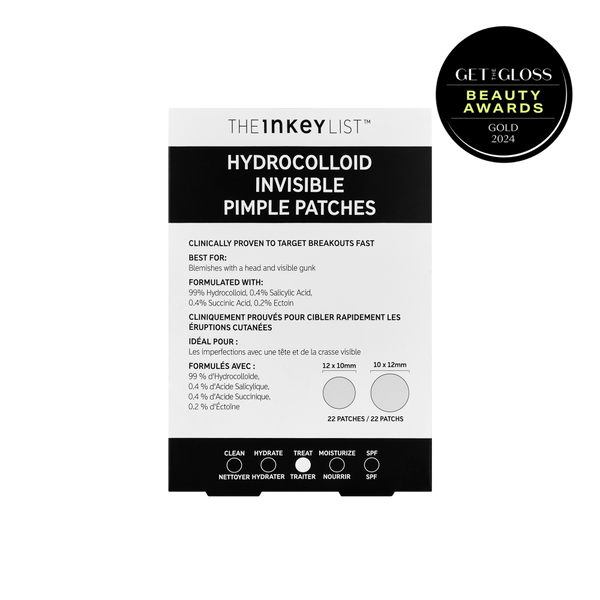
The hero of this routine is our Hydrocolloid Invisible Pimple Patches (£9.00, Pack of 22), designed to sit flat and nearly undetectable over a blemish. Step one, before any patch, is always clean skin, which is where our Salicylic Acid Cleanser (£14.00) earns its place. If you want the one-line answer before the full breakdown, it is coming up next.
The Short Answer: When To Use a Pimple Patch
If you only read one section, read this one. Use a pimple patch after cleansing, on clean and dry skin, placed directly over a spot that has come to a head - one with visible fluid or a whitehead. That is the whole rule in a sentence. Everything else in this guide is detail that helps you apply it well.
Overnight wear usually gives the deepest result. The reasoning is simple: the patch gets the longest uninterrupted stretch to draw out fluid while you sleep, and you are not tempted to touch, prod or pick at the spot in the mirror every hour. A patch left undisturbed for eight hours simply has more time to work than one you keep peeking under at your desk.
The practical trick is to apply the patch as close to a bare-skin step as possible so it can stick and work. Think of the patch as the thing you build around, not the thing you bury under. Treat and hydrate the rest of your face, leave the one spot bare, and the patch does the rest.
Here is the whole thing in four quick points, so you can screenshot it and move on:
- When: after cleansing, as close to bare skin as possible.
- Where: directly over the spot, pressed flat so the edges seal.
- How long: at least 4 hours, ideally overnight.
- What stage: a spot that has come to a head, with a visible whitehead or fluid.
That is the answer to when to apply a pimple patch and when to put on a pimple patch in one tidy block. We are deliberately not re-explaining the science of hydrocolloid here - if you want the mechanism behind why these little stickers pull fluid out of a blemish, our full breakdown of how hydrocolloid patches work covers it properly. For now, the rest of this guide breaks down exactly where the patch sits in your routine order.
Where a Pimple Patch Fits in Your Routine Order (Before or After Serum and Moisturiser)
This is the question that sends most people to search in the first place: does a pimple patch go before or after serum and moisturiser? The honest answer has two halves, and once you understand the golden rule, both halves make instant sense.
The golden rule is this: a patch needs clean, dry, bare skin under it to stick and absorb. Hydrocolloid is an adhesive dressing. Oils, serums and creams sitting underneath it do two bad things at once. First, they stop the patch adhering, so it lifts at the edges or slides off entirely. Second, they create a barrier that stops the patch doing its job, because it cannot draw fluid through a layer of moisturiser. As dermatologist Amy Kassouf explained to Cleveland Clinic, “the adhesive on the patches won’t stick as well to wet skin,” which is why thoroughly drying the area is a non-negotiable step.
So here is the direct answer to the before-or-after question. You use a pimple patch after cleansing, but you apply it to the bare spot, then apply your serums and moisturiser around it, not over it. The patch comes after the cleanse and before you seal everything else in - but geographically, it lives on its own little island of bare skin that the rest of your products flow around.
That sounds fiddly written down. In practice it takes seconds. Here is how to use a pimple patch alongside the rest of your routine without any drama:
- Cleanse and pat dry as normal.
- Look at the spot you want to patch and mentally mark it as a “no-product zone.”
- Treat and hydrate the rest of your face exactly as you usually would, keeping product off that one spot.
- Press the patch onto the bare spot.
- Carry on with your routine everywhere else.
If you use a leave-on treatment or serum anywhere near the blemish, let it fully dry first before placing the patch, so the skin under the patch stays dry. A tacky, half-absorbed active under the adhesive will undermine the seal just as much as a cream will.
This is where our targeted treatments fit neatly into the picture. Our 360 Skin Clearing Serum (£16.00) is the kind of leave-on step you apply to the surrounding skin and the wider breakout-prone area - the “treat around the patch” move. Let it dry, then patch the one spot that has come to a head. For hydration, our lightweight Omega Water Cream (£14.00) is the moisturiser you smooth around the patch rather than sealing underneath it. It keeps the rest of your skin comfortable without flooding the one area the patch is trying to work on.
To answer the “pimple patch before or after moisturiser” query as plainly as possible: after, and around the patch, never sealed underneath it. The patch always wants to be the last thing touching that specific spot. With the principle settled, the easiest way to make it second nature is to see it inside a full routine - so let’s walk through a morning first.
Your AM and PM Routines With a Pimple Patch
Rules are easier to follow when you can see the whole sequence laid out. Below are two copy-and-keep routines - one for the morning and one for the evening - that put a pimple patch exactly where it belongs. The same clean-and-dry principle runs through both, because that is what makes the patch stick and work.
AM routine with a pimple patch
- Cleanse with our Salicylic Acid Cleanser (£14.00) to start on genuinely clean skin.
- Pat your skin dry. Dry really does mean dry - a damp surface is the number one reason patches lift.
- Apply any serum and a lightweight moisturiser like our Omega Water Cream (£14.00) around the spot you are treating, leaving that one area bare.
- Place the patch on the bare spot and press the edges flat.
- Finish with Dewy Sunscreen SPF 30 applied around the patch, not over it, so the patch stays exposed and able to work.
A daytime patch is discreet enough to wear out and about - ours are virtually invisible, so most people will never notice it. If you are wondering about wearing one beneath foundation, we cover that fully in our guide on whether you can wear pimple patches under makeup, so we will not repeat the layering detail here.
PM routine with a pimple patch
- Double cleanse if you have been wearing makeup or SPF during the day - one cleanse to remove, one to actually clean.
- Pat your skin completely dry.
- Treat and hydrate the skin around the spot, keeping product off the blemish itself. Let any actives dry before the next step.
- Place the patch last, directly over the spot, and press it down.
- Leave it on overnight.
Notice what the evening routine does: it saves the patch for the very end, so nothing goes on top of it, and it hands the patch the longest possible window to work while you sleep. That is the setup that gives you the deepest result.
A quick note that applies to both routines: the clean-and-dry rule is not a suggestion, it is the whole game. If you take one habit from this section, make it pat dry before you patch. A ten-second extra pat with a clean towel is the difference between a patch that stays put for eight hours and one you find stuck to your pillow.
If you keep both routines somewhere you can glance at them - a note on your phone, a card by the mirror - the sequence becomes automatic within a week. One question still comes up more than any other once people have the routine down: should you wear a patch during the day or overnight? Let’s settle that next.
Overnight vs Daytime: When Each One Works Best
Overnight or daytime is not a trick question, and there is no single correct answer - it depends on what you want the patch to do. The good news is that the decision rule is short, and you can even do both if you like.
Overnight is usually best for the deepest result. While you sleep, the patch gets its longest uninterrupted stretch to draw out fluid, and - just as importantly - you are not awake to touch the spot. No mirror checks, no absent-minded prodding, no picking. An overnight pimple patch is working hardest precisely because you are doing nothing at all. Cleveland Clinic notes that many patches are “made to be worn overnight while you sleep,” which lines up with what most people find in practice: the morning reveal is where patches earn their reputation.
Daytime works well when protection and discretion matter more than maximum drawing power. If your real problem is that you cannot stop touching a spot, a daytime patch is a physical barrier between your fingers and the blemish. It keeps the area covered, stops makeup clinging to a raised spot, and buys you a calmer skin day. Because our patches are virtually invisible, they sit comfortably through a full day of meetings, errands or a night out without announcing themselves.
So here is the simple decision rule, no overthinking required:
- Choose overnight for maximum drawing-out power and uninterrupted working time.
- Choose daytime for protection from picking and quiet, invisible coverage.
- Do both by swapping to a fresh patch when you move from night to day, or day to night.
Overnight is when the patch works hardest. Daytime is when it protects you from yourself. Both are valid - just not with the same patch.
One rule holds whatever time of day you wear it: replace a saturated patch whenever it turns white or cloudy. That colour change is the visible sign the patch has absorbed as much as it can hold, and a saturated patch is no longer pulling anything out. Day or night, cloudy means swap. Peeling off a patch that has turned opaque and replacing it with a fresh clear one is often the single most effective thing you can do to keep a spot moving in the right direction. If you want the science behind that drawing-out effect, our explainer on how hydrocolloid patches work goes deeper.
Which brings us neatly to the question people search for more than any other in this whole topic: exactly how long should a patch stay on your skin?
How Long To Leave a Pimple Patch On (and Which Spots To Patch)
This is the big one. “How long to leave a pimple patch on” is the single most-searched timing question, so let’s lead with the number: leave a patch on for at least 4 hours, and overnight is ideal. Our Hydrocolloid Invisible Pimple Patches are clinically proven to visibly reduce breakouts in 4 hours, so four hours is not a token minimum - it is a genuine working window. Overnight simply gives the patch more of what it already does well.
The second number to remember is zero - as in, zero reasons to leave a white patch on. Swap for a fresh patch the moment the current one turns white or cloudy. That colour change means it has absorbed as much fluid as it can, and leaving a saturated patch in place does nothing but take up space. A fresh patch resets the clock. This is also how patches back up their core promise: as WebMD explains, hydrocolloid patches work by absorbing fluid and oil from the blemish, which is exactly what that cloudy appearance is showing you in real time.
You can keep patching across several days until a spot settles. There is no hard limit on how many times you re-patch the same blemish - the only conditions are the same two that apply to the very first patch: always on clean, dry skin, and always with a fresh patch each time. Think of it as a daily reset rather than a one-and-done.
How long to leave a pimple patch on, summed up
- Minimum: 4 hours of continuous wear.
- Ideal: overnight, for the longest uninterrupted stretch.
- Swap trigger: whenever the patch turns white or cloudy.
- Repeat: fresh patch, clean dry skin, as many days as it takes to settle.
Just as important as how long is which spots actually benefit. Patches are not a universal fix, and knowing where they shine saves you a lot of disappointment.
Patches work best on a spot that has come to a head - one with visible fluid or a whitehead sitting at the surface. That is the stage where there is something for the hydrocolloid to draw out and a surface for it to protect. Medical News Today describes how hydrocolloid dressings create a moist environment that supports healing at the surface, which is precisely the kind of lesion a pimple patch is built for.
Where patches are less useful is on deep, closed bumps sitting under the skin with nothing at the surface. There is no fluid at the top for the patch to absorb and no open area to protect, so the sticker has little to work with. The dedicated hero link makes this easy to action: reach for our Hydrocolloid Invisible Pimple Patches (£9.00) when a spot has surfaced, and set your expectations lower for bumps that are still buried deep.
Blackheads are their own specific question - common enough that we gave them their own home. Rather than half-answering it here, point yourself to our full guide on whether pimple patches work on blackheads. With timing and spot selection sorted, let’s pull everything into one routine you can actually remember.
Building a Simple Routine Around Your Patch: The Bottom Line
If this whole guide collapsed into a single mental model, it would be four words: cleanse, treat, hydrate, patch. That is the frame. Everything else is detail that hangs off it.
Here is the full frame restated in plain terms. Cleanse so the patch has clean skin to grip. Treat the breakout-prone area with your actives, letting them dry. Hydrate the surrounding skin, keeping product off the one spot. Patch that bare spot last, so nothing sits on top of it. The patch always goes over clean, dry, bare skin, and everything else goes around it.
The timing rules are just as short, and worth committing to memory:
- Leave a patch on for at least 4 hours - overnight is ideal.
- Swap it for a fresh one when it turns white.
- Patch spots that have come to a head, not deep closed bumps.
- Fresh patch, clean dry skin, every single time.
One honest line on what patches can and cannot do, because good guidance never oversells. Patches are genuinely great at two jobs: helping along surface spots that have come to a head, and protecting your skin from your own fingers so a blemish can settle in peace. They are not a fix for deep bumps under the skin, and they are not a substitute for a consistent overall routine. Knowing the limits is what makes them so reliable at the thing they are good at.
That balance - clear guidance, proven ingredients, real results - is the whole point. A patch is a small, honest tool, and used with the right timing it quietly outperforms its price. Start with clean skin, keep our Hydrocolloid Invisible Pimple Patches within reach, and let the four-step frame do the rest.
Ready To Patch at the Right Time
Timing is the quiet secret behind a pimple patch that actually works. Start with clean skin, patch the bare spot once it has come to a head, give it at least 4 hours - overnight if you can - and swap when it turns white. Do that and you are already ahead of most people reaching for a patch in a panic. Keep our Hydrocolloid Invisible Pimple Patches (£9.00, Pack of 22) on hand so the right moment never catches you without one.
If you want to go deeper, the rest of our pimple patch cluster has you covered: the science of how hydrocolloid patches work, the truth about whether pimple patches work on blackheads, and the full lowdown on wearing them when you can wear pimple patches under makeup. Clear guidance, proven ingredients, real results - that is the promise, and the right timing is where it starts.
Frequently Asked Questions
Got a question?
Our askINKEY team are a friendly bunch of skincare experts with deep product knowledge and zero judgement. Whether you're an ingredient obsessive or just starting out, we'll make it make sense. No question too big. No question too small. We Give A Care, Every Day.


