



How Do Hydrocolloid Patches Work?
How do hydrocolloid patches work? We explain the science simply - how they draw out fluid, why they turn white, which spots they suit, and how to use them.
Author
askINKEY skincare advisor
Published
20 October, 2026
Time to read
12 minutes
This article explains, in plain language, how do hydrocolloid patches work and what do hydrocolloid patches actually do once they are on your skin. We will cover what hydrocolloid is, how a patch behaves on a spot, why the patch turns white, which breakouts it suits and which it does not, how to use one properly, and where a patch fits into a wider routine. If you already know the theory and just want the product, you can skip ahead to our Hydrocolloid Invisible Pimple Patches, or start your routine a step earlier with our Salicylic Acid Cleanser as the prep step before a patch goes on.
The good news is that there is no mystery here, and nothing about hydrocolloid requires a chemistry degree to follow. We will explain the science simply, because clarity you can trust is the whole point. The best place to start is not with the patch at all, but with the material it is made from.
What is hydrocolloid?
Hydrocolloid is a gel-forming material that absorbs moisture and creates a sealed, slightly moist environment underneath itself. That is genuinely the whole definition. When you strip away the branding and the clever packaging, a hydrocolloid patch is a small, flexible dressing made from a substance designed to soak up fluid and lock it away inside a gel, whilst keeping the area beneath it protected from the outside world.
If that sounds more like a plaster than a beauty product, that is because the technology started life in medicine. Hydrocolloid dressings have been used in wound care for decades, applied to blisters, minor wounds and pressure sores, precisely because they manage fluid and support a controlled healing environment. The spot patch you press onto a whitehead borrows this exact same technology and shrinks it down to blemish size. According to a narrative review of hydrocolloid dressings in wound care, these materials have a long, well-documented history in clinical settings, which is part of why they translate so well to skincare. The idea was not invented to sell patches. It was adapted from something that already worked.
Not every patch is hydrocolloid, and not every hydrocolloid patch is equal
Here is a point worth holding onto, because it answers a question people ask constantly: are pimple patches hydrocolloid? The honest answer is that some are and some are not. Hydrocolloid is one specific type of patch material, not a catch-all term for every sticker you can put on a spot. There are microneedle patches that deliver ingredients into the skin, there are drying patches soaked in actives, and there are simple adhesive covers. Hydrocolloid is its own distinct category, defined by that fluid-absorbing, gel-forming behaviour.
Even within hydrocolloid patches, the quality varies more than most people realise. The amount of hydrocolloid in a patch matters, because it directly affects how much fluid the patch can draw in and how reliably it seals. Many patches on the market contain only around 60 to 80 percent hydrocolloid, with the rest made up of other materials. That difference is not just a number on a label. A higher hydrocolloid content generally means stronger absorption and a more dependable barrier, which is exactly why we will come back to this later when we look at what sets our own formula apart.
For now, the takeaway is simple. Hydrocolloid is a proven, medical-origin material that absorbs fluid and seals a small area. Now that you know what the material is, let us look at what it actually does once it is sitting on a spot.
How do hydrocolloid patches work on a spot?
So how does a hydrocolloid patch work in practice, and how do hydrocolloid pimple patches earn the shelf space they have taken over in so many bathroom cabinets? The mechanism is best understood as three separate jobs happening at once: drawing out fluid, protecting the spot, and giving you a visible sign that it is working. As the Cleveland Clinic explainer on how pimple patches work sets out, the core actions are absorbing fluid, covering the blemish and reducing the temptation to pick. We will take each of those in turn, because understanding them separately is what helps you use a patch at the right moment.
A hydrocolloid patch is not doing one clever thing. It is quietly doing three at once.
Drawing out fluid and impurities
The first and most famous job is absorption. When a spot has come to a head, meaning there is visible fluid or a white tip at the surface, the hydrocolloid gets to work. It draws that excess fluid and the impurities within it up and into the gel, where they are trapped. This is the satisfying bit that has fuelled a thousand close-up videos, and it is the number one reason people reach for a patch in the first place.
So, do hydrocolloid patches pull out fluid? Yes, they genuinely do, but with one important caveat that is easy to miss. There has to be fluid at or near the surface for the patch to draw anything out. Hydrocolloid cannot reach down into the skin and extract something that is not already close to the top. It works on what it can touch. This is precisely why patches perform best on spots that have already surfaced and come to a head, and why they do far less for a bump that is still forming deep below the surface.
Think of it less like a magnet pulling from the depths and more like a sponge resting on a damp surface. It absorbs what is available to absorb. That honesty matters, because it sets a realistic expectation, and realistic expectations are what stop people feeling let down by a product that is actually doing its job. With the absorption covered, the second job is one people often undervalue: protection.
Creating a protective seal that stops touching and picking
The moment a patch goes on, it forms a physical seal over the spot. That seal shields the blemish from bacteria, dirt, friction from your pillow, oil from your hair and the dozens of surfaces your face brushes against during the day. In a world where we touch our faces far more often than we think, a simple barrier does a surprising amount of quiet work.
The behavioural benefit is arguably even more valuable than the physical one. A patch stops you touching, picking and squeezing. This is not a small thing. Picking is one of the most common reasons a spot ends up leaving a mark long after the spot itself has gone, because the damage you do with your fingers reaches deeper than the original blemish ever did. A patch physically gets between your fingernails and your skin, and it makes picking almost impossible. For anyone who knows they are a picker, that alone is reason enough to keep a pack within reach.
On top of all this, the sealed, slightly moist environment the patch creates is the kind of setting skin tends to prefer for calm, undisturbed recovery. It is protected, it is left alone, and it is not being irritated. That combination is what supports faster, calmer healing. One question we hear constantly is about the white blister that appears, so let us clear that up next.
Why does the patch turn white?
If you have ever peeled off a patch and found a cloudy white circle where it sat, you have witnessed the single most reassuring sign that a patch is doing its job. So why do hydrocolloid patches turn white? The white, swollen area is simply the hydrocolloid gel reacting with the fluid it has absorbed. As the gel takes on moisture, it turns opaque and raised. That is all it is. It is normal, it is expected, and it is visible proof the absorption mechanism is working.
There is a persistent myth worth busting here. The white patch is not pus being dramatically “pulled from deep in the skin”. Nothing is being yanked up from below. What you are seeing is surface fluid gelling into the material, exactly as the hydrocolloid is designed to do. It is a chemical reaction between the dressing and the moisture it has drawn in, not an excavation.
It is also worth saying the reverse. If you remove a patch and there is little or no white at all, that does not mean the patch has failed. A small spot, a dry spot, or a spot that had not fully come to a head simply may not produce much fluid to absorb. In that case the patch has still been quietly protecting the area and keeping your fingers away, which is valuable on its own. No white does not equal no benefit. Now that the science is clear, let us look at what makes our own patch different.
What makes our Hydrocolloid Invisible Pimple Patches different?
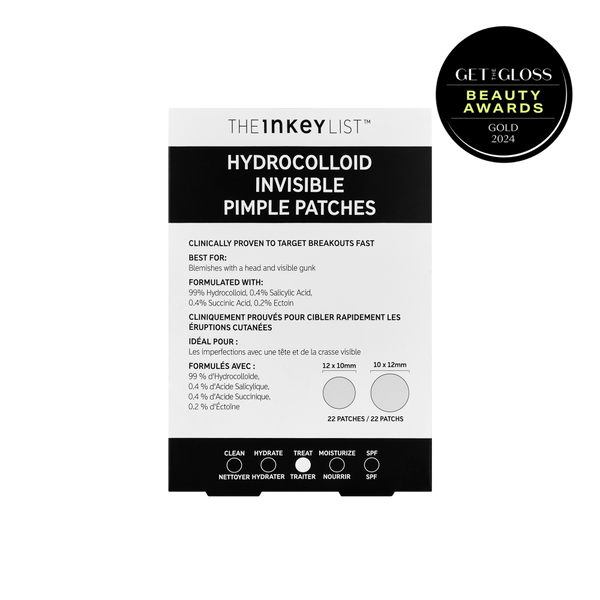
Having explained how the material works in general, it is fair to ask what separates a well-made patch from an average one. With our Hydrocolloid Invisible Pimple Patches (£9), the answer comes down to the formula, because the formula is where a patch either delivers or disappoints.
The foundation is 99% hydrocolloid. That high percentage is deliberate, and it circles back to the point we made earlier about patches that contain only 60 to 80 percent. A near-pure hydrocolloid base means stronger, more reliable absorption and a more dependable protective seal. It is the difference between a patch that holds fast and works, and one that lifts at the edges or barely registers the fluid it is sitting on.
Around that base sit three targeted ingredients, each chosen for a specific job rather than for the length of the ingredient list:
- 0.4% salicylic acid gently exfoliates and helps unclog the pore, working on the blockage beneath the blemish.
- 0.4% succinic acid helps reduce the appearance of redness and excess oil, calming how the surrounding skin looks.
- 0.2% ectoin locks in hydration and helps soothe blemish-prone skin, so the area is cared for rather than stripped.
This is not a case of stacking actives for the sake of a crowded label. Each ingredient addresses a different part of what you can see and feel in a spot, and they are formulated at gentle percentages designed to sit under an occlusive patch for hours at a time.
The results are backed by testing rather than hope. In a clinical study of 20 people, the patches were clinically proven to visibly reduce breakouts in 4 hours and to reduce the appearance of redness in 8 hours. That is a meaningful, measurable timeframe, and we are careful to describe it exactly as the study found it rather than reaching for bigger claims.
Then there is the detail that genuinely changes how you can use them. These patches are virtually invisible on all skin tones and ultra-thin, which means they are not confined to overnight duty. You can wear them discreetly during the day, under makeup, out in the world, rather than only hiding under one in the dark. For anyone who has ever avoided a patch because it announced itself across the room, that is a quiet game-changer.
Practically, they are £9.00 for a pack of 22, in two sizes, 10mm and 12mm, so you can match the patch to the spot instead of covering a small blemish with something twice its size. They are suitable for sensitive skin, vegan, non-comedogenic, and friendly to use during pregnancy and whilst breastfeeding. Strong formula, honest claims, easy to live with. The obvious next question is which spots this actually suits, and that is where honesty matters most.
Which spots do hydrocolloid patches work on?
A patch is a brilliant tool for the right job and the wrong tool for others, and knowing the difference saves you money and frustration. Hydrocolloid patches work best on raised, surface spots with a visible head or fluid. Whiteheads and spots that have come to a head are exactly what the technology was built for, because there is fluid at the surface for the gel to draw in. If a spot is domed, shiny and ready, a patch is your friend.
The limits are just as important to understand. Take blackheads. Do hydrocolloid patches work on blackheads? Honestly, no, not really. A blackhead sits inside the pore, a plug of oil and dead skin oxidised dark at the surface, and crucially there is no fluid for a patch to absorb. Pressing a hydrocolloid patch over a blackhead gives the gel nothing to work with. For blackheads and general congestion you want something that can get inside the pore, which is where a cleanser or a BHA step earns its place. Our Salicylic Acid Cleanser works at the cleansing stage to keep pores clear, and our Beta Hydroxy Acid (BHA) Serum is a more targeted option for stubborn blackheads and congestion, because BHAs are oil-soluble and can reach down into the pore where a patch simply cannot.
The same honest logic applies to cysts. Do pimple patches work on cysts? Not meaningfully. Deep, under-the-skin bumps and cysts have nothing at the surface to absorb, so a patch has little to act on. It may offer a small amount of protection and stop you prodding at a tender area, but it will not resolve the bump itself. Painful cystic spots are worth taking seriously, and for those it is sensible to speak to your GP. If you want to understand why these deeper breakouts happen in the first place, our guide to cystic acne, what it is, what causes it, and how to treat it goes into far more detail than a patch ever could.
And then there is the person whose breakouts are not one isolated spot but a recurring, all-over pattern. A patch is a spot fix, not a full-face strategy, so dotting individual patches across widespread breakouts is neither practical nor the point. For recurring breakouts at every stage, a leave-on serum designed for full-face use is the smarter route. Our 360 Skin Clearing Serum is built for exactly that, targeting breakouts across the whole face rather than one spot at a time.
The honest summary is this: reach for a patch when you have a surface spot with a head, and reach for something else when you do not. Once you know when a patch is the right call, the next thing to get right is how you use it.
How to use hydrocolloid patches
Knowing how to use hydrocolloid patches properly is the difference between one that stays put all night and one that slides off onto your pillow by midnight. The method is simple, but a couple of the steps are non-negotiable. Here is the full sequence:
- Cleanse the skin to remove makeup, oil and the day’s grime.
- Dry the skin fully. This step matters more than any other, so do not rush it.
- Apply the patch directly over the spot, choosing the size that best matches the blemish.
- Press to seal, holding gently for a few seconds so the adhesive grips.
- Leave it on for at least 4 hours, or overnight for the best result.
- Remove it gently, peeling from one edge rather than ripping.
- Reapply a fresh one if the spot is still active and you want to keep going.
The reason clean, dry skin is so important is purely practical. Hydrocolloid will not adhere properly to skin that is damp, oily or coated in product. If the patch cannot grip, it cannot form the seal that makes it work, and it will simply fall off. Getting this one step right solves the vast majority of complaints about patches not sticking.
That principle also determines where a patch sits in your routine. A patch goes on bare, clean, dry skin before your serums and moisturiser, not after. Active treatments and creams create a slippery layer that stops the patch adhering, so if you apply your full routine first and then try to add a patch, you are setting it up to fail. The patch goes on first, directly onto the spot, and the rest of your routine works around it on the surrounding skin.
Wearing one under makeup is entirely possible thanks to how thin and invisible these patches are. The trick is order and technique. Apply the patch first, let it settle, then pat your foundation or concealer gently over the top. Pat, do not rub, because rubbing can catch the edge and lift it. Done this way, a well-placed patch disappears under a light layer of coverage.
One last practical note: use the right size for the spot. The 10mm patch suits smaller blemishes, the 12mm covers larger ones, and matching the two means the patch does its job without taking up more of your face than it needs to. You can find both sizes in our Hydrocolloid Invisible Pimple Patches, and if you need to prep first, our Salicylic Acid Cleanseris the cleanse step to start with. With the how-to covered, it helps to zoom out and see where a patch fits in the bigger picture.
Hydrocolloid patches in your wider routine
As useful as a patch is, it is worth being clear-eyed about what it can and cannot do over time. A patch is a spot fix. It is the thing you reach for when a specific blemish has surfaced and you want to protect it, calm it and stop yourself picking at it. What a patch is not is a full breakout strategy. Lasting, clearer-looking skin does not come from patches alone. It comes from a consistent routine that addresses the conditions breakouts thrive in, day after day.
A balanced routine tends to follow a simple logic. You cleanse to keep pores clear and remove the oil, dirt and makeup that contribute to congestion. You treat with targeted actives suited to your skin, whether that is a BHA for congestion or a soothing active for redness. You hydrate and support the barrier with a moisturiser, because skin that is looked after is better placed to cope than skin that is stripped and irritated. A patch then slots in on top of all this as the spot-specific tool, for the moments when a particular blemish needs attention.
Reassuringly, patches are gentle enough to sit alongside the rest of your routine without drama. They are suitable for sensitive skin, so they are not a harsh add-on that upsets everything else you are doing. They simply do their one job while your core routine does the heavier lifting underneath.
If you want to go deeper on the parts of a routine a patch cannot cover, a few places are worth your time. For oil control and visibly reducing the look of blemishes between flare-ups, our 10% Niacinamide Serum is a dependable everyday step. If your breakouts have arrived or stuck around later than you expected, our guide to adult acne, why it happens after 25 and what to do about it explains the drivers behind grown-up breakouts. And if you are weighing up which active to build a routine around, our explainer on benzoyl peroxide versus salicylic acid and which is better for acnehelps you make an informed choice rather than a guess.
The short version
Hydrocolloid patches work by doing three things at once: the gel absorbs fluid from a spot that has come to a head, the patch seals and protects the area from bacteria and your own fingers, and the white circle you see afterwards is simply the gel showing it has absorbed that fluid. That really is the entire mechanism.
Patches are at their best on surface spots with a visible head. They are not the tool for blackheads, where a cleanser or BHA serum belongs, and they do little for deep cysts, where a full routine and, if needed, a GP make more sense. Used in the right moment, on clean dry skin, a patch is one of the simplest and most satisfying tools in skincare. That is the INKEY promise in a sentence: clear guidance, proven ingredients, and claims we can actually stand behind.
Keep our Hydrocolloid Invisible Pimple Patches (£9) on hand so you are ready the next time a surface spot appears, and if you want to understand what is really driving your breakouts rather than just treating them one at a time, our Breakout Analyser Pro tool can point you towards the right routine for your skin. Because knowing what your skin actually needs is always the first step, and we give a care about getting it right.
Frequently Asked Questions
Got a question?
Our askINKEY team are a friendly bunch of skincare experts with deep product knowledge and zero judgement. Whether you're an ingredient obsessive or just starting out, we'll make it make sense. No question too big. No question too small. We Give A Care, Every Day.


