



NAD+ and Exosomes: How the Two Work Together
NAD+ and exosomes are two different cell-science ideas, not rivals. Here is what each one does and how they fit together in modern skincare.
Author
askINKEY skincare advisor
Published
19 October, 2026
Time to read
10 minutes
NAD+ and exosomes are two of the most talked-about ideas in modern skincare science, and they are also two of the most misunderstood. In the simplest terms, NAD+ is a coenzyme linked to energy inside skin cells, while exosomes are tiny messengers that carry signals between cells. One is about what happens inside a cell. The other is about what travels between them. They are not the same thing, and they are not in competition - they describe two different layers of the same picture.
This article exists to clear that up. We are going to take each idea on its own, explain it in plain English, and then show you how the two fit side by side in the way skin is understood today. Along the way we will be honest about scope: this is an educational piece when it comes to NAD+, because we do not sell a standalone NAD+ product. The product that actually lives inside this cellular-science story - and the one we will point you to - is our Exosome Glow Serum.
In one line: NAD+ is the energy idea inside skin cells, and exosomes are the messenger idea between them.
If you want the full primers, you can always read what are exosomes and NAD+ explained on their own pages. This piece is not a re-run of those - it is the bridge between them. We will keep the definitions short here precisely because they are covered in depth elsewhere, and we would rather spend the time on the thing people actually get confused about: how these two concepts relate. So let us start by taking each idea on its own, one at a time, before we show you how they connect.
What NAD+ Actually Is (The Energy Idea), In Plain English
Let us begin with the half of the story that feels the most abstract, because once it clicks, everything else gets easier. NAD+ stands for nicotinamide adenine dinucleotide, which is a mouthful, so forget the full name. What matters is this: NAD+ is a coenzyme found inside your cells, and it is closely tied to how those cells make and use energy. That is the whole concept in a sentence. It is a helper molecule that cells rely on when they are doing the everyday work of being a cell.
Now, why does that matter for skin? Here is where we need to be careful and clear at the same time. When people talk about NAD+ for skin, they are usually reaching for a cosmetic idea rather than a medical one. Skin that looks tired, fatigued, and a little flat is often described as skin that looks low on energy. Skin that looks fresh, bright, and awake is described as skin that looks energised. NAD+ gets pulled into that conversation because it is the molecule most associated with cellular energy in the first place. So the cosmetic takeaway - the only takeaway we are making here - is about the look of healthy, energised skin, not about anything happening biologically that we could or would promise.
Think of NAD+ as the idea of energy inside a skin cell, not a product on your shelf.
That line is worth sitting with, because it captures exactly how we treat NAD+ at The INKEY List. We talk about it as science, as a concept that helps explain how skin is understood - not as a bottle you can buy from us. There is no standalone NAD+ product in our range, and we are not going to imply there is. This is biology we find genuinely interesting and worth explaining clearly, and it is also a topic where honesty matters, because the gap between “a molecule involved in cellular energy” and “a finished product that does X to your face” is a wide one, and we are not going to pretend it is narrow.
The reason NAD+ became a skincare talking point at all is that the wider science around it is real and well-studied. Researchers have spent years looking at how NAD+ relates to the way cells function and how that changes over time, including in the context of skin and ageing. If you want to see where some of that interest comes from, a peer-reviewed review on NAD+, skin and ageing gives a sense of the academic foundation. We link to it not to make a claim about any product, but to show that the energy-and-skin concept is grounded in genuine research rather than invented for marketing.
To keep this section honest and short, here is the shape of the idea, laid out plainly:
- What it is: a coenzyme inside cells, tied to how cells make and use energy.
- The skin angle: the cosmetic language of tired-looking versus energised-looking, radiant skin.
- The honest caveat: it is a biology concept here, not a product claim, and not something we bottle and sell.
That last point is the one we will keep coming back to, because it is central to how this whole article works. We are happy to explain NAD+ well. We are not going to turn it into a sales pitch. If you want the deeper dive, NAD+ explained is the full primer, and we have also written around the edges of the topic in pieces like is NAD a peptide and what are NAD levels, so you can go as deep as you like without us re-treading all of it here.
The key thing to carry forward is that NAD+ sits inside the cell. It is an internal story. And that framing becomes really useful the moment we turn to the second idea, because exosomes work on an entirely different level. Having covered energy inside the cell, let us move to the other half of the story: messages between cells.
What Exosomes Do (The Communication Idea), Without the Jargon
If NAD+ is about what happens inside a single cell, exosomes are about what happens in the space between them. Here is the short version, and we are deliberately keeping it short because we go deep on this elsewhere: exosomes are tiny messengers that help carry signals between skin cells. That is the concept. They are part of how cells “talk” to one another, passing along information in a way that keeps the wider system coordinated. When people ask what are exosomes for skin, that messenger role is the heart of the answer.
The reason this communication idea has captured so much attention is that it reframes how we think about skin entirely. Instead of imagining skin as a passive surface you treat from the outside, the exosome conversation treats it as a network of cells constantly exchanging messages. That is also why how do exosomes work is such a common search - the mechanism is genuinely different from the ingredients most people grew up with. The science behind cell-to-cell communication is well established in the literature, and if you want to see the academic grounding for the “messengers between cells” framing, a peer-reviewed review on exosomes in cell-to-cell communication is a solid place to start.
Now for the part that is specific to us, using only the facts we can stand behind. The exosomes in our formula are plant-derived from cica (Centella Asiatica), a botanical long associated with calm, comfortable-looking skin. There are 3 million cica-derived exosomes per bottle, and each one is remarkably small - around 300 times smaller than a pore. Those three facts are worth holding onto, because they are concrete, verifiable, and they give you a real sense of the scale and the source rather than a vague gesture at “advanced technology.”
Here are those sourcing facts in one quick, scannable list:
- Source: plant-derived from cica (Centella Asiatica)
- Quantity: 3 million cica-derived exosomes per bottle
- Scale: each around 300 times smaller than a pore
In cosmetic terms, the benefit language around exosomes is about skin that looks calmer, fresher, and more radiant. That is the vocabulary we use, and we use it carefully. We are describing the look of skin, the appearance of a healthier complexion, not making promises about what is happening beneath the surface. The goal of this section is not persuasion - it is clarity. We want you to walk away with a clean mental model: exosomes are the between-cells messengers, NAD+ is the inside-the-cell energy helper.
We will say it plainly: the full definition of exosomes lives elsewhere, and we would rather point you there than rewrite it. For the complete picture, what are exosomes is the pillar, and if you specifically want the delivery-system detail - how something that tiny is used in a serum - exosomes explained covers that ground. Here, we only need enough of the definition to make the comparison work.
And that comparison is exactly where the real value of this article sits. Because now that both ideas are defined - energy inside the cell, messages between cells - we can finally address the confusion that sends so many people searching in the first place. Let us tackle it head on.
NAD+ vs Exosomes: Different Jobs, Not Rivals
This is the section this article uniquely owns, so let us be direct. A lot of people assume NAD+ and exosomes are the same thing, or that they are two competing actives you have to choose between. Both assumptions are wrong, and the fix is surprisingly simple once you see it. The two ideas are not even playing the same game. One is about energy inside a cell. The other is about communication between cells. They describe different things at different levels of the same cellular picture.
Here is the distinction in the cleanest form we can give it, written as two lines rather than a table, because a table would overcomplicate something that is genuinely this simple:
NAD+ is about energy inside the cell.
Exosomes are about messages between cells.
That is it. That single contrast resolves almost all of the confusion. If you remember nothing else from this article, remember those two sentences, because everything else follows from them. We have deliberately chosen to write it this way instead of lining the two up in a comparison grid. A grid invites you to score them against each other, pick a winner, and treat them as rivals. But rivalry is exactly the wrong frame, and the layout should reflect that.
So why do people mix them up in the first place? There are a few understandable reasons. The first is timing. Both NAD+ and exosomes surfaced in the skincare conversation at roughly the same moment, as part of a broader wave of interest in cell communication skincare and cellular science more generally. When two unfamiliar terms arrive together, the brain tends to file them in the same drawer. The second reason is vocabulary. Both get linked to the same desirable outcomes - glowy, healthy-looking, youthful-looking skin. When two ideas lead to the same adjectives, it is easy to assume they must be doing the same job. And the third reason is simply that both sound technical and scientific, which can make them blur together for anyone who is not deep in the detail.
But sounding similar is not the same as being similar. Consider a loose analogy. Think of a single office. The electricity powering each computer is one thing - that is the energy inside each workstation, the NAD+ idea. The emails flying between desks are something else entirely - that is the communication between workstations, the exosome idea. Nobody would ask whether you should “pick electricity or email” for your office. You would not frame them as competitors, because they are not solving the same problem. They operate on different levels, and the office needs the concept of both to make sense. NAD+ and exosomes relate to skin in much the same way.
This is why the “which one is better” question quietly falls apart under inspection. It assumes a shared category - two actives, one shelf, one winner - that does not actually exist here. You cannot sensibly rank energy-inside-a-cell against messages-between-cells any more than you can rank a battery against a conversation. They are different kinds of thing. Understanding that is more useful than any ranking could ever be, because it changes the question you ask. Instead of “which should I choose,” the better question becomes “how do these two ideas fit together in how skin is understood today.”
One more honesty note, because it belongs right here at the point of comparison. On the NAD+ side, everything we have said stays strictly conceptual. We are not implying that The INKEY List delivers NAD+ in a product, and we are not quietly folding a science concept into a sales message. If you want to revisit either pillar at this exact moment of comparison, what are exosomes and NAD+ explained are both one click away. With the difference now clear, let us do the more interesting thing and show how these two ideas actually live together in one modern skincare conversation.
How the Two Ideas Fit Together in Modern Skincare Science
Having spent all that effort separating NAD+ and exosomes, it might feel counterintuitive to bring them back together. But the separation was the point - you can only see how two things complement each other once you are clear that they are different. So here is the single picture. Energy inside cells and communication between cells are two layers of the same story about how skin is understood today. One layer looks inward, at how a cell powers its own everyday work. The other layer looks outward, at how cells coordinate with their neighbours. Good-looking, healthy-looking skin gets talked about in terms of both, which is precisely why NAD+ and exosomes keep turning up in the same conversations.
This is a genuine shift in how skincare is explained, not a marketing invention. For a long time, the language of skincare was mostly about surfaces and symptoms: this cream for dryness, that serum for dullness. The newer language is more about systems. Modern formulas are increasingly described through a cellular lens - what is happening at the level of the cell and between cells - and that lens naturally has room for both an energy idea and a communication idea. When a topic is framed cellularly, exosomes and cellular energy end up sitting next to each other almost automatically, because they are the two most obvious layers to talk about. They are not competing for the same slot. They are filling two different slots in a single explanation.
It is worth being reassuring here, because this kind of talk can make people anxious that they are falling behind, that there is yet another thing they are supposed to buy. That is not the message, and it is important to us that it does not land that way. The arrival of this cellular vocabulary does not mean you need more products. It means the science is being explained more clearly, with more honesty about what is happening and at what level. Clearer explanations are a good thing for you, not a prompt to add five more steps to your routine. This is very much part of our We Give A Carephilosophy - the belief that clarity you can trust is itself a benefit, and that you deserve to understand what you are using rather than just being sold to.
There is a stress angle worth mentioning briefly too, because it is part of why the “calm, healthy-looking skin” idea matters within this cellular picture. The way skin looks when it is under pressure is a real part of the modern conversation, and if you want the context for that, what is skin stress covers it. We mention it only lightly, as background - the point is that when you understand skin as a system of cells with energy and communication, the idea of calm, settled, radiant-looking skin becomes easier to talk about coherently rather than as a vague promise.
So where does that leave us practically? With a clean, two-part model that you can carry into any skincare conversation and use to cut through the noise:
- Layer one - energy inside cells: the NAD+ idea, about how cells power their everyday work. Conceptual, science-led, and not something we sell.
- Layer two - communication between cells: the exosome idea, about how cells pass signals to one another. The layer our product actually lives in.
Two layers, one picture - that is the whole relationship between NAD+ and exosomes.
Our role in all of this is simply to make the science simple and honest, and to be upfront about which part of it we actually put in a bottle. NAD+ we explain. Exosomes we also explain - and, unlike NAD+, exosomes are also where we have an actual product to offer. So let us move from the concept to the one product in our range that fits this cellular-science conversation, and let us do it honestly, with claims we can stand behind.
Where Our Exosome Glow Serum Fits In
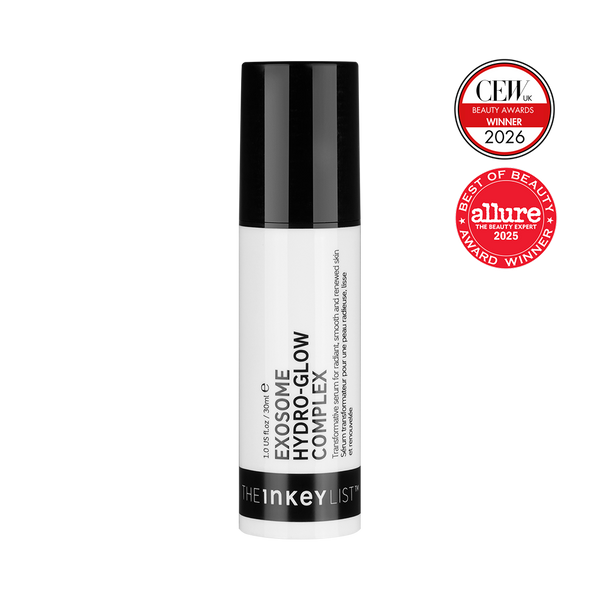
Up to now, this has been almost entirely educational, and deliberately so. But there is one product that sits right inside this cellular-science story, and it would be strange not to tell you about it. Because NAD+ is conceptual - a science idea we explain rather than a product we sell - the thing that actually lives in this conversation is our Exosome Glow Serum (£20), a 30ml serum built around cica-derived exosomes. It is the practical counterpart to all the theory above: the communication layer, in a bottle you can actually use.
Let us talk about what it is formulated around, using the same facts from earlier so you are not taking anything new on faith. The exosomes are plant-derived cica exosomes, and each one is around 300 times smaller than a pore. That is the sourcing story, kept consistent with everything we have already said. Now, for what it is clinically shown to do, we are going to use only our approved, tested claims, with footnote markers so you can see exactly what each claim rests on. Here they are, laid out to be easy to scan - and to be clear, this is a list of claims, not a comparison against anything else:
- 6-in-1 skin rejuvenation, clinically proven to visibly improve radiance, hydration, tone, firmness, elasticity and texture.*
- 100% saw more glowing skin, clinically proven.*
- Clinic worthy rejuvenated skin in 14 days.*
- Up to 12 hours of hydration.**
- Helps support natural collagen production.
Notice the language in that first claim: visibly improve. That word is doing honest work. We are describing the look and appearance of skin - the visible outcomes people experienced in testing - rather than making promises about biological processes we would not claim. That is a line we hold to carefully. The serum is about the appearance of more radiant, more even, firmer-looking skin, and the claims above are the clinically tested version of exactly that.
There is one more set of numbers you may have seen associated with cica exosomes, and it is important we frame them precisely. In in-vitro laboratory testing of Cica Exosomes, there was a 55% reduction in pro-inflammatory markers and a 63% increase in markers associated with skin renewal after 8 hours.* Those figures come from laboratory testing of the exosomes themselves - not from a study on people’s faces, and not a measure of on-skin results. We keep that distinction sharp on purpose. In-vitro laboratory findings and on-skin outcomes are two different categories of evidence, and blurring them would be exactly the kind of overpromising we are trying to help you avoid. So: the 55% and 63% figures are in-vitro laboratory testing of Cica Exosomes, full stop.
That is also why we are keeping this section short and singular. One product, one honest price, one clear place in the story. We are not going to repeat the pitch five different ways, because that would undercut the whole point of an educational article. The Exosome Glow Serum is simply the natural home for everything the communication layer describes, and £20 for 30ml is the whole commercial ask.
For completeness and honesty, here are the footnotes behind the claims above:
*4-week clinical study of 26 people.
**Clinical study of 31 people.
***In-vitro testing of Cica Exosomes showed a 55% reduction in pro-inflammatory markers and a 63% increase in markers associated with skin renewal after 8 hours.
The Bottom Line on NAD+ and Exosomes
Here is everything above, compressed. NAD+ is the energy idea inside cells. Exosomes are the messenger idea betweencells. They are not the same thing, and they are not rivals - they sit side by side as two layers of one cellular-science picture, and understanding that is far more useful than trying to crown a winner. That is the whole takeaway, and it is genuinely as simple as it sounds once the two ideas are pulled apart.
On the honesty front, nothing has changed from where we started. We explain the NAD+ science because it is interesting and because clarity is worth something, but we do not sell a standalone NAD+ product. The product that fits this story is our Exosome Glow Serum - the communication layer, in a 30ml bottle, backed by the clinically tested claims and the clearly-labelled in-vitro laboratory findings we set out above. Clear guidance, proven ingredients, real results: that is the standard we hold ourselves to, and it is why we would rather teach you the difference between two ideas than sell you on confusion between them.
Because at The INKEY List, We Give A Care.
Keep Exploring
If the communication layer is the part that interests you, take a closer look at our Exosome Glow Serum and see exactly what it is built around. And if you want the full science behind either idea, the two pillar pages are the place to go: read the exosomes pillar for the complete messenger story, or the NAD+ pillar for the full energy-inside-the-cell concept. No pressure, no hard sell - just the clearest explanation we can give you, and a product that sits honestly inside it.
Frequently Asked Questions
Got a question?
Our askINKEY team are a friendly bunch of skincare experts with deep product knowledge and zero judgement. Whether you're an ingredient obsessive or just starting out, we'll make it make sense. No question too big. No question too small. We Give A Care, Every Day.


