



How to Reapply Sunscreen Over Makeup Without Ruining It
The simple, makeup-safe way to top up your SPF mid-day, with no smudging, no patchiness and no starting your face again.
Author
askINKEY skincare advisor
Published
28 May, 2026
Time to read
16 minutes
It is one o’clock. You did your base this morning, you were careful about it, and the SPF you applied underneath has been quietly wearing down since breakfast. You know you should top it up. You also know that squeezing more sunscreen onto a finished face feels like undoing an hour of work with one swipe of your fingers.
Here is the honest answer. You can absolutely reapply sunscreen over makeup. It just needs a different technique to the one you use in the morning. The morning method is rub, spread and blend. The midday method is press and roll. That single change is the difference between a smooth top-up and a streaky, patchy mess.
This article covers why a second application genuinely matters even when your face is already made up, why the SPF in your foundation is not doing the job you think it is, the step-by-step damp sponge method that makeup artists use, where mists and SPF powder honestly fit in, how to choose a sunscreen that layers well in the first place, and how to take the whole lot off properly at night.
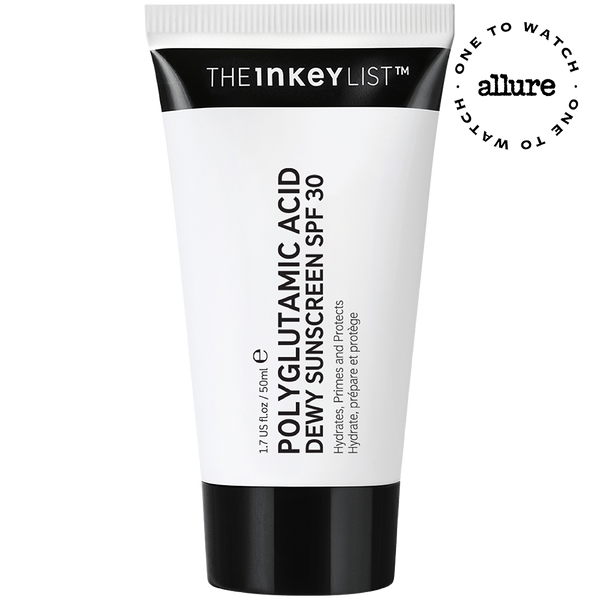
Throughout, we will reference our Dewy Sunscreen SPF 30, a lightweight broad-spectrum formula designed to sit comfortably under makeup in the morning and over it at midday.
Let’s start with the question that stops most people before they begin: if you applied SPF this morning, why do you need to do it again at all?
Why Your SPF Still Needs a Top-Up, Even Over Makeup
Sunscreen is not a coat of armour that stays where you put it. It is a thin, fragile film of active ingredients sitting on the surface of your skin, and from the moment you apply it, that film begins to degrade. Understanding how and why makes the midday effort feel a lot less like a chore and a lot more like the obvious thing to do.
How UV filters break down across the day
There are two broad families of UV filter, and they fail in slightly different ways.
Chemical filters work by absorbing ultraviolet radiation and converting it into a very small amount of heat, which then dissipates from the skin. That is an elegant mechanism, but it has a built-in limitation. The filter is consumed by the very thing it is protecting you from. Every photon it absorbs uses up a little more of its capacity. This is called photodegradation, and it means a chemical filter is a finite resource that depletes across a day of exposure.
Mineral filters, principally zinc oxide and titanium dioxide, behave differently. They are considerably more photostable, meaning they do not break down under UV in the same way. But photostability is only half the story, because a mineral filter still has to physically remain on your face to work. And that is where everything falls apart.
If you want to go deeper on the differences between the two, our guide to mineral vs chemical sunscreen breaks down which suits which skin type, and it is worth reading before you buy your next bottle. Filter type also affects how a product behaves when layered on top of makeup, which becomes relevant later in this article.
The coverage data is more sobering than most people expect
We do not have to guess at how quickly sunscreen protection declines in the real world, because it has been measured directly. Research published in the Journal of the American Academy of Dermatology assessed facial sunscreen coverage during outdoor exposure and found that coverage declined by a mean of 18.31% within the first two hours alone. By the end of an eight-hour working day, that figure had reached 31.63%.
Read that again, because the implication is significant. Roughly a third of your coverage is gone by home time, and that is before you factor in anything unusual. No swimming. No sport. No heatwave. Just an ordinary day.
Physical removal is the bigger culprit
Photodegradation gets the attention, but the more mundane mechanism is simply that sunscreen gets rubbed, wiped and absorbed off your face.
Consider what actually happens to your face between nine and one. You rest your chin on your hand during a long meeting. You eat lunch, which takes product off the area around your mouth. You hold your phone against your cheek. You scratch your nose. You rub your eye. You put on and take off sunglasses. You get warm on the walk back from the sandwich shop and blot your forehead.
Then there is sebum. Across the day, your skin produces oil that gradually dilutes and disperses the film of sunscreen sitting on top of it. If you have oily skin or combination skin, this is the mechanism that costs you coverage fastest, and it is why the shine that appears on your T-zone by lunchtime is also a signal that your protection has thinned in exactly that area.
None of this is a failure on your part. It is simply what happens to a thin layer of product on a living, moving, oil-producing surface.
The short version on frequency
Broadly, the American Academy of Dermatology advises reapplying every two hours when you are outdoors, and sooner after swimming, sweating heavily or towel drying. That is the rule of thumb worth committing to memory. For the full picture, including how this shifts by season, setting and skin type, head to our complete SPF guide, which covers the timing question properly. We will leave it there and get back to the technique.
Why consistency matters most for skin tone
If your primary skin concern is uneven tone, this section matters more to you than to anyone else.
UV exposure is one of the main drivers of uneven melanin production. It darkens existing marks, it can trigger new ones, and it is particularly effective at deepening the marks left behind after a blemish has healed. If you are working on hyperpigmentation, an inconsistent SPF habit quietly undermines every other step in your routine. You can use the most thoughtfully formulated brightening ingredients available, and then spend three unprotected hours by a window every afternoon actively working against them.
This is not a reason to panic. It is a reason to treat the midday top-up as part of the same project as everything else on your shelf. Our article on whether sunscreen really helps with hyperpigmentation goes into the relationship in more detail.
One more thing worth settling before we move on. People often assume the answer to declining coverage is simply a higher number, so they buy SPF 50 and reapply less. Strength and frequency are separate variables, and a higher SPF that you apply once is still a thinning layer by mid-afternoon. If you want to resolve which number suits you, read SPF 30 vs SPF 50: which should you actually use? rather than trying to solve it with maths at the bathroom mirror.
So the case for reapplying is settled. Which brings us to the reason most people still do not do it.
Why Makeup Makes Reapplying Sunscreen Awkward
Let’s be straight about this, because pretending otherwise helps nobody. Putting a cream or lotion on top of foundation, concealer, blusher and setting powder is a genuine technical problem. It is not a small inconvenience that can be waved away with “just pop some more on”. There is a real reason people avoid it, and the reason is that doing it badly looks worse than not doing it at all.
Three specific things go wrong.
Dragging. Your fingertips have grip. When you move them across your face, they do not glide over your base, they take it with them. The foundation shifts sideways, pools in one spot and leaves a bare patch somewhere else. This is most visible over the cheeks, where the base is usually thinnest and most carefully blended, and around the nose, where there is already a tendency towards patchiness.
Pilling. This is when your layers roll up into small grey or white flakes that sit on the surface and flick off when you touch them. It usually happens for one of two reasons. Either the products are not playing nicely together in terms of texture and formulation, or, far more commonly, the layer underneath had not fully set before the next one went on. Pilling looks like a product problem and is usually a patience problem. If it is a recurring frustration, our guide on how to prevent pilling when applying your skincare routine covers the fix.
Breaking the finish. You have spent time building a particular look. A dewy sunscreen dropped onto a carefully set matte base will dissolve the powder and turn the whole thing damp. A heavier, more occlusive SPF over an already luminous base will tip it from glowing into greasy. The protection might be fine, but the face in the mirror is not the one you left the house with.
Here is the mechanism in one sentence: grip is what moves makeup, so anything that presses rather than rubs will deposit product without shifting what is underneath.
That is the whole principle. It is not complicated, and once you understand it, every technique in this article becomes obvious rather than fiddly. You are not trying to blend the sunscreen in. You are trying to lay it down on top.
It is worth saying plainly that if you have been skipping your top-up because you did not want to wreck your face, that was a perfectly rational decision based on the information available to you. This is a technique problem with a straightforward answer. It is not a discipline problem, and it is certainly not a personal failing.
Before we get to the method, there is one shortcut almost everyone reaches for first, and it deserves a direct answer.
Does the SPF in My Foundation Count?
No. Not as your reapplication.
This is not a criticism of SPF-containing makeup, and it is not about formula quality. It is about quantity, and the numbers are genuinely surprising.
Every SPF figure printed on every product, sunscreen and foundation alike, is measured under laboratory conditions at a standardised application density of 2mg per square centimetre of skin. That number is only valid at that quantity. Apply less, and you do not get a proportionally smaller amount of protection, you get a disproportionately smaller amount, because the relationship between thickness and protection is not linear.
Now look at what people actually apply. Studies on how much sunscreen people actually use have consistently found real-world application densities of roughly 0.39 to 0.79mg per square centimetre. A more recent survey of facial application thickness put the figure at around 0.85mg per square centimetre. Broader research on real-world SPF application quantities reinforces the finding that most people apply somewhere between a quarter and a half of the tested amount.
And crucially, those figures are for dedicated sunscreen. For a product people are deliberately applying for sun protection. Foundation is applied for coverage and finish, in a considerably thinner layer, and blended down further still.
Think about it practically. To reach the SPF printed on a foundation label, you would need to wear a quantity of foundation that would be visibly, uncomfortably heavy. It would look like stage makeup. Nobody applies foundation that way, and nobody should have to.
So where does that leave SPF in makeup? It is a genuine bonus sitting on top of a proper sunscreen layer. It adds a little something, particularly in the areas where your sunscreen application was thinnest. It is not a replacement for a dedicated SPF, and it is not a reapplication method. Wear it happily, just do not count on it.
With the shortcut off the table, here is the method that actually works.
How to Reapply Sunscreen Over Makeup: The Damp Sponge Method
Press and roll. Never sweep or drag. Everything below is an application of that single rule.
There is a second principle that matters almost as much, and it is the one most people get wrong: apply enough. A thin, cautious scrape of product gives you a thin, cautious scrape of protection. The volume for a top-up is the same as the volume you used this morning. That is roughly three quarters of a teaspoon for the face and neck, or around three finger-lengths of product. Quantity guidance is covered in more detail in our complete SPF guide if you want to calibrate properly.
Now the method.
- Dampen a clean cosmetic sponge with water, then squeeze it out firmly. Damp, not wet. A soaking sponge will absorb your sunscreen rather than depositing it onto your skin.
- Dispense your sunscreen onto the back of a clean hand, not directly onto the sponge. This lets you control exactly how much you pick up and keeps the process hygienic.
- Load a small amount onto the flat side of the sponge. Build up over several passes rather than attempting the whole face in one go.
- Start at the forehead. Press the sponge flat against the skin, then roll it gently from one edge to the other. Lift, reload, move along. Never sweep sideways.
- Work in sections: forehead, then cheeks, then nose, then chin, then jaw and neck. Finishing one zone before moving to the next stops you double-covering one area and missing another entirely.
- Use the pointed tip of the sponge for the sides of the nose, around the nostrils and along the hairline. These are the most consistently under-covered areas on the entire face.
- Go back over the whole face for a second pass. This is how you get close to an adequate quantity, and it is the step almost everyone skips.
- Let it settle for two to three minutes before touching your face, misting, or applying any further makeup.
Troubleshooting as you go
- The product is dragging. Your sponge is too dry. Add a little water and squeeze it out again.
- Your base is lifting. You are sweeping rather than pressing. Slow down and lift the sponge fully between placements.
- It is pilling. The layer underneath had not set. Give each layer its settling time.
- The finish is too dewy. Press a clean, dry section of the sponge over the shiny areas to lift the excess. Do not add powder on top, which will only create texture.
- You have run out of patience. Prioritise the high-exposure zones: forehead, nose, cheekbones and the tops of the ears.
Why this works
Three things are happening at once. The moisture in the sponge buffers the product as it lands, softening the impact so it does not sit in a concentrated blob. The pressing motion deposits product rather than displacing what is underneath. And the sponge absorbs a small amount of excess, so the layer that remains on your skin sits evenly rather than pooling in fine lines and around the nose.
This is not a workaround invented for sunscreen. It is exactly the logic a makeup artist uses whenever they need to apply anything over a finished base, which is why it works so reliably.
Our Dewy Sunscreen SPF 30 suits this method particularly well because of its lightweight texture, which means it does not need heavy working-in to disappear. The press and roll approach is the technique we recommend for it on the product page.
The wearability data supports that. In an independent consumer trial of 66 participants over two weeks, 97% said the formula looked invisible on their skin tone, and 90% said their skin felt primed for makeup. That second figure is the relevant one here, because a sunscreen that sits well under makeup is generally a sunscreen that sits well over it too.
Of course, a sponge is not always to hand, and there are days when the two-minute settling time is two minutes you do not have. So let’s look at the alternatives honestly.
Other Ways to Top Up SPF Over Makeup: Mists and Powders
There are two formats people reach for when the sponge is not practical, and both are surrounded by a fair amount of confusion. Here is what each one actually does.
Hydrating mists and SPF mists: what each one actually does
This is the single most commonly confused point in this entire topic, so let’s draw the line clearly.
A hydrating mist is not sun protection. An SPF mist contains UV filters and is.
They can look almost identical on a shelf and in a handbag. They do completely different jobs.
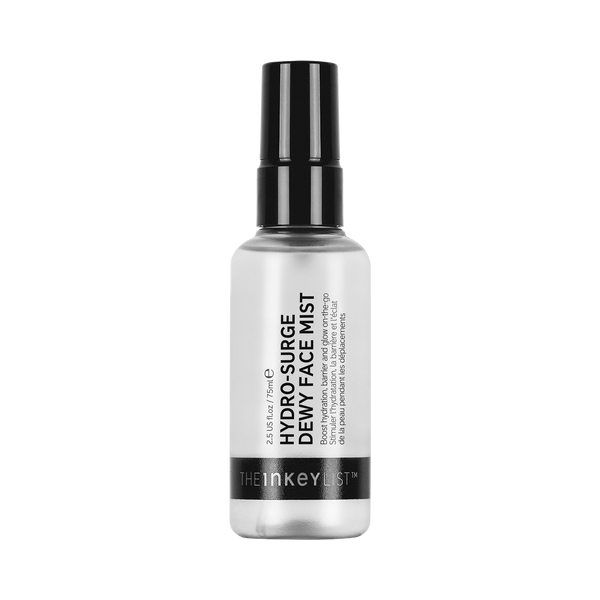
Our HydroSurge Dewy Face Mist is a hydrating mist. It contains no UV filters, and it cannot be used as a reapplication method. What it is genuinely excellent at is being the finishing step after your SPF top-up, refreshing the skin and reviving the look of makeup that has had a long morning.
The formula is built around 3% Aquaxyl to help strengthen the skin’s moisture barrier and reduce water loss, 3% Hydroviton for immediate hydration, and 2% Earth Marine Water for a natural, healthy-looking finish. It is fragrance-free and alcohol-free, and in a two-week consumer trial of 103 people it was clinically proven not to disturb makeup.
That barrier point matters more than it sounds. Skin loses water continuously through the surface in a process called transepidermal water loss, and it accelerates in air conditioning, on heating-heavy commutes and in dry indoor offices. Supporting the barrier means less of that water escapes, which is why a hydrating mist feels restorative rather than just wet. If your skin regularly feels tight and looks dull by mid-afternoon, you may be dealing with dehydrated skin rather than dry skin, and if it feels reactive and easily irritated alongside that, it is worth reading about a damaged skin barriertoo. For more on the format generally, see can you use face mist over makeup?
On SPF mists specifically, the honest position is that they are convenient and they are easy to get wrong. The protection depends entirely on how generously and evenly you apply, and it is remarkably easy to under-apply a spray because you cannot see the layer you are building. If you use one:
- Hold it roughly 20 to 25cm from your face.
- Keep your eyes closed and hold your breath briefly.
- Work systematically across the whole face rather than spritzing vaguely in front of you.
- Let it dry naturally rather than rubbing it in, which defeats the point of choosing a no-touch format.
- Apply more than feels necessary. Whatever you think is enough, it probably is not.
SPF powder: how it works and where it genuinely fits
Brush-on SPF powders have become genuinely popular, and it is easy to see why. They are usually mineral-based, using zinc oxide or titanium dioxide suspended in a loose powder, most often dispensed through a built-in brush in a twist-top barrel.
The appeal over makeup is obvious. There is no wet product landing on a finished base, so there is no risk of dragging. They take down shine while they are at it, which means the top-up doubles as a blot. They are compact and mess-free enough to keep in a bag. And they are genuinely useful on the areas that other formats struggle with: the hairline, the scalp parting and the tops of the ears, all of which are burned far more often than people expect.
Now the caveat, and this is where the real value of this section sits.
Powders are very easy to under-apply against the 2mg per square centimetre standard used to measure SPF in the first place. Research on application density found that at 1.33mg per square centimetre, protection fell to roughly 63% of what the same product delivered at the full 2mg. Consumer-use estimates for powder products put typical real-world application at around 0.65mg per square centimetre, which is a long way below even that reduced figure.
Regulators have noticed. In its review of sunscreen formats, the FDA has noted that evidence is not yet adequate to establish that powder sunscreens perform equivalently to traditional formats.
The clinical consensus follows the same line. Dermatologists broadly position powder SPF as a touch-up rather than as a replacement for your main sunscreen.
A powder is a top-up, not a foundation of protection. It works best layered over a sunscreen you have already applied properly.
Our own position, stated plainly: we do not make an SPF powder. We are not recommending one, and we are not selling you one. But we would rather tell you how the format actually behaves than pretend it does not exist.
So here is the practical view. If a powder is the only thing that will realistically get you to top up at all, then a powder used generously is unquestionably better than no top-up. Use far more than feels natural, go over the same area several times, and treat it as a supplement to a morning application rather than the whole of your protection. If you can manage a cream or lotion with a damp sponge, that remains the more reliable route.
Ranked by how dependably each format delivers real protection over makeup:
- Cream or lotion with a damp sponge. The most reliable by a clear margin. You can see the layer, control the quantity and reach every area.
- Stick. Good for targeted zones like the nose, ears and hairline. Harder to cover a whole face evenly, and it can drag if you press too firmly.
- Mist. Convenient and quick, but easy to under-apply and difficult to judge coverage.
- Powder. The most makeup-friendly option available, and the hardest of all to apply in sufficient quantity.
Every one of these methods works better when the sunscreen underneath was chosen to layer well in the first place.
Choosing a Sunscreen That Layers Well Under and Over Makeup
Half the battle with reapplication is won at the point of purchase. A sunscreen that behaves under makeup in the morning will almost always behave over it at midday, and a sunscreen that fights your base at eight will fight it at one.
Here is what to look for.
A lightweight texture that spreads without heavy rubbing. If a formula needs to be worked into the skin with real pressure to disappear, it is going to move your makeup. Lightweight textures deposit easily and settle fast.
A finish that matches the base you actually wear. This is the one people overlook. A very dewy sunscreen under a dewy foundation is a lovely thing at nine in the morning and reads as straightforward shine by lunchtime. Match the finish to your base, not to whatever looks best in the first ten minutes.
A formula that absorbs rather than sitting wet on the surface. Products that remain tacky are the ones that pill when something goes on top of them.
Broad-spectrum protection covering UVA and UVB. UVB is the burning wavelength. UVA penetrates more deeply and is the one most associated with long-term visible changes. You want both covered, every time.
Fragrance-free, if your skin is easily upset. Fragrance is one of the more common sources of irritation, and an SPF is a product you wear every single day across your whole face.
The settling time nobody allows for
Most pilling is a pacing problem rather than a product problem. Skincare, then sunscreen, then makeup, applied in rapid succession with no pause, is a recipe for little grey rolls of product.
Give each layer sixty seconds. Brush your teeth in between. Make the coffee. It is genuinely that simple, and it resolves the majority of layering complaints. Our guide to prepping skin before makeup covers the sequencing in more detail.
Hydration makes the top-up feel better, not just work better
If a sunscreen contains humectants, the midday application adds comfort as well as protection. That matters enormously for how likely you are to keep doing it, because a top-up that leaves your skin feeling plump and comfortable is one you will repeat, and a top-up that feels like a chalky film is one you will start skipping.
Our Dewy Sunscreen SPF 30 contains 8% of INKEY’s Hydration Trio: Polyglutamic Acid, Glycerin and Squalane. Glycerin in particular is one of the most well-established humectants available, drawing water into the upper layers of the skin and holding it there, which is exactly what you want from something you are layering over a base that has been sitting on your face for four hours.
If dryness is your main concern, our guide to sunscreen for dry skin covers what to prioritise in a formula.
On suitability, the formula is designed for all skin types including sensitive skin, and it is fragrance-free, non-comedogenic and dermatologically tested. One important honest note: it is not water resistant. If you swim or sweat heavily, reapply straight afterwards rather than assuming it has held.
What goes underneath it in the morning
Antioxidants in the morning with SPF layered on top is the standard, well-established pairing, and the two do different jobs. Antioxidants help address the free radical damage that gets through, while sunscreen reduces how much gets through in the first place. Neither replaces the other. Our article on vitamin C and SPF: why you always need bothexplains how to sequence them without pilling.
A day of morning SPF, makeup and one or two top-ups adds up to a substantial amount of product. All of it has to come off.
Taking It All Off at the End of the Day
This is where a lot of otherwise excellent routines quietly fall apart.
Water alone does not shift UV filters. Neither does a quick splash with a gel or foam cleanser, not over a full day of layered sunscreen, foundation, powder and a couple of top-ups. Most people finish their evening cleanse genuinely believing their face is clean, and a swipe of a cotton pad would tell them otherwise.
The reason comes down to basic chemistry. Like dissolves like. Sunscreen filters, makeup and your own sebum are largely oil-soluble, and water-based cleansers are not well equipped to break them down. An oil or balm first cleanse dissolves them properly, and a second, water-based cleanse then washes everything away and leaves the skin genuinely clean rather than approximately clean.
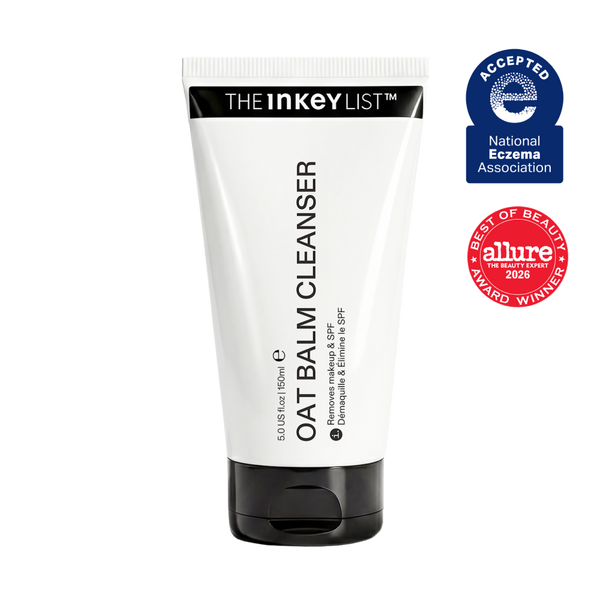
Our Oat Cleansing Balm is built for exactly this job. It melts makeup and SPF in 30 seconds, and it is formulated with 1% Colloidal Oatmeal to help visibly reduce redness and soothe, alongside 3% Oat Kernel Oil to help lift impurities while supporting the skin’s moisture. It is suitable for all skin types, including dry and easily irritated skin.
How to use it properly:
- Apply to dry skin. Wet skin dilutes the balm and stops it breaking down product effectively.
- Massage for a full 30 to 60 seconds. Most people stop at ten.
- Pay particular attention to the hairline, the jaw and the sides of the nose, which is where sunscreen collects and where residue is most often left behind.
- Add a little water and emulsify until the balm turns milky.
- Rinse thoroughly, then follow with your second cleanse.
For a fuller walkthrough, read how to remove sunscreen properly: why double cleansing matters.
Here is the point that ties this whole article together. Thorough removal is what makes consistent reapplication sustainable. Skin that is never properly cleansed starts to feel congested, blackheads become more visible around the nose, and the first thing anyone blames is the sunscreen. It is almost never the sunscreen. It is the cleanse. Get the evening right and the daytime habit stops feeling like a trade-off.
Let’s pull everything into a quick-reference close.
Common Mistakes, the Routine and Your Questions Answered
Common mistakes when reapplying sunscreen over makeup
- Rubbing instead of pressing. This is what ruins the base, every single time. Press and roll.
- Under-applying. A token layer delivers a token amount of protection. Match your morning quantity.
- Relying on the SPF in foundation or powder as the whole top-up rather than as a bonus.
- Missing the ears, neck, hairline and sides of the nose. These are the areas that get skipped most consistently.
- Skipping the top-up on cloudy days or when working indoors beside a sunny window. UVA passes through cloud and glass.
- Using a hydrating mist and believing it is sun protection. It is not, unless it contains UV filters.
- Applying over damp or sweaty skin. Let the skin dry first, or the product will not sit evenly.
- Using sunscreen past its date. Check the period after opening symbol on the packaging, and see our guide to skincare expiry dates, shelf life and storage.
Shop the routine
- Protect: our Dewy Sunscreen SPF 30, broad-spectrum UVA and UVB protection in a lightweight texture that works under makeup in the morning and over it at midday.
- Refresh: our HydroSurge Dewy Face Mist, clinically proven not to disturb makeup, the finishing step after your top-up.
-
Remove: our Oat Cleansing Balm, melting makeup and SPF in 30 seconds.
Conclusion
The reason most people skip the midday top-up is technique, not motivation. Once you know how to lay product down instead of rubbing it in, the whole thing stops being a problem.
Of the three routes available to you, a cream or lotion applied with a damp sponge is the most reliable and the one worth learning properly. A mist is convenient as long as you apply far more generously than feels natural. A powder is the kindest to your makeup and the easiest of all to under-apply, so treat it as a supplement rather than a solution.
If you remember nothing else, remember this: press and roll, never sweep and drag, and use enough.
Reapplying sunscreen over makeup takes under five minutes, needs no touch-up products afterwards, and leaves your base exactly where you put it this morning. For the complete picture on sun protection, from filter types to seasonal adjustments, head to our complete SPF guide.
Ready to Build a Top-Up Habit That Sticks?
Start with the formula that makes it easy. Dewy Sunscreen SPF 30 is a lightweight, broad-spectrum SPF built to work under your makeup in the morning and over it at midday, with 8% of our Hydration Trio to keep skin comfortable all day.
Not sure where to begin? Take our skincare quiz for a routine built around your skin and your concerns. Or message the askINKEY team, who will answer any question, big or small, with no pressure to buy anything at all.
Because at The INKEY List, We Give A Care.
Frequently Asked Questions
Got a question?
Our askINKEY team are a friendly bunch of skincare experts with deep product knowledge and zero judgement. Whether you're an ingredient obsessive or just starting out, we'll make it make sense. No question too big. No question too small. We Give A Care, Every Day.


