
Sunscreen for Dry Skin: How to Find an SPF That Hydrates
SPF is the single most important daily skincare step for every skin type - dry skin included. That is not up for debate. What is worth discussing is why so many people with dry skin find sunscreen uncomfortable, tightening, or downright drying - and what to do about it.
The problem is not sunscreen. The problem is the wrong sunscreen. The majority of SPF formulas on the market are designed with oily or combination skin in mind: lightweight water-gels, high-alcohol bases, fast-absorbing textures that are engineered to disappear without a trace. On dry skin, these formulas can strip the lipid barrier, draw moisture out of the skin, and leave a tight, chalky, or dull finish that makes you want to skip the step entirely. That is precisely the worst outcome.
Dry skin needs an SPF that does two things simultaneously: protect against UV damage and actively support the skin’s moisture levels. Those two goals are not in conflict - they just require the right formulation.
This guide covers everything you need to know to find and use a sunscreen that actually works for dry skin. You will learn which hydrating ingredients to look for on the label, which formulation types to avoid, how to layer your moisturiser and SPF correctly, and how to build a complete AM routine that protects and nourishes from cleanse to finish. For a full grounding in how SPF works, our complete SPF guide is the place to start. If you already know your skin is dry, you can browse the dry skin collection and the SPF collection to explore product options.
In this guide:
- Why dry skin has specific sunscreen needs
- The hydrating ingredients to look for in an SPF
- What to avoid in sunscreen if you have dry skin
- How to layer moisturiser and SPF correctly
- A complete AM routine for dry skin
- FAQs - your most common questions answered
Why Dry Skin Responds Differently to Standard SPF Formulas
Understanding why dry skin struggles with certain sunscreens starts with understanding what dry skin actually is - and what it is not.
Dry skin is a skin type, not a temporary condition. It is characterised by reduced natural oil production - specifically, the skin produces less sebum than other skin types. Sebum is not just the thing that makes skin shiny; it is a critical component of the skin’s lipid barrier, the outermost protective layer that keeps moisture in and environmental aggressors out. When sebum levels are lower than they should be, that barrier is compromised. Moisture escapes more easily through a process called transepidermal water loss (TEWL), which leads to the classic dry skin experience: tightness, flaking, rough texture, and a tendency toward redness or sensitivity.
It is worth distinguishing dry skin from dehydrated skin, because these two concerns are often confused. Dry skin lacks oil. Dehydrated skin lacks water. You can have both at the same time - and if you do, both will affect how your SPF feels and performs. Dehydrated skin often feels tight despite being oily, whereas dry skin feels tight because the lipid barrier itself is under-resourced. Knowing which concern (or both) applies to you shapes the kind of SPF and routine support you need.
Here is where UV exposure enters the equation, and why the relationship between dry skin and sunscreen matters far more than most people realise. UVA and UVB rays do not just cause tanning or burning. Over time, cumulative UV exposure actively degrades the skin barrier. It increases TEWL, disrupts the skin’s lipid structure, and accelerates the breakdown of collagen and elastin - all of which are already more vulnerable in dry skin. In other words, skipping SPF to avoid the discomfort of a drying formula is genuinely counterproductive: the UV exposure you allow in causes the very barrier damage that makes dry skin worse.
The NHS recommends daily broad-spectrum SPF use regardless of skin type or season - and that recommendation applies equally to dry skin. The goal is simply to find a formula that delivers that protection without the side effects.
So why do so many standard sunscreens cause problems for dry skin? Most SPF formulas are optimised for wearability on oily or combination skin. They use lightweight gel textures or water-gel bases that set with a matte or near-matte finish, fast-drying alcohol carriers that help the formula absorb quickly without greasiness, and silicone-heavy textures that create a smooth, pore-filling effect on the skin’s surface. Each of these characteristics serves oily skin well. On dry skin, they are a different story. High-alcohol formulas draw moisture out of the skin. Gel textures provide no lipid or emollient support. Silicones without accompanying humectants can create a surface film without doing anything meaningful for the skin beneath it.
The difference between a sunscreen that suits dry skin and one that does not often comes down entirely to the non-filter ingredients - the supporting cast of humectants, emollients, and barrier-active ingredients that surround the UV filters in the formula. A well-designed SPF for dry skin should function as a protective step and a hydrating step in one. It should sit comfortably on the skin, contribute to moisture levels throughout the day, and support rather than compromise the lipid barrier.
That is the benchmark to hold any SPF to when you have dry skin. It is a higher bar than most products clear - but knowing what to look for makes it far easier to find what works.
The next step is knowing exactly which ingredients on the label signal that a formula will meet those needs.
Hydrating Ingredients to Look for in Sunscreen for Dry Skin
Reading a skincare ingredient list can feel like decoding a different language. But for dry skin, there are a handful of key ingredients that immediately signal whether a sunscreen formula will work for you - or work against you. These are the ones worth learning, because they appear across products and will help you make faster, more confident choices at the shelf or online.
Think of this as your positive checklist. When you find one or more of these ingredients in an SPF formula alongside its UV filters, you are looking at a product that has been designed to hydrate as well as protect.
Polyglutamic Acid (PGA)
Polyglutamic Acid is one of the most powerful humectants in modern skincare - and one of the most underappreciated. A humectant is an ingredient that attracts and binds water to the skin, drawing it both from the environment and from deeper skin layers toward the surface. PGA does this exceptionally well: it is capable of holding up to four times more moisture than Hyaluronic Acid, making it a standout performer for dry skin. In an SPF formula, PGA helps prevent the formula from feeling tight or drying, and contributes to the kind of dewy, plumped finish that dry skin responds well to. It is not an ingredient you will find in many sunscreens, which is part of what makes it such a meaningful inclusion when it does appear.
Glycerin
Glycerin is one of the most widely studied and consistently proven humectants in skincare. It works by drawing water from the environment and from deeper skin layers to the skin’s surface, helping to maintain moisture balance throughout the day. It is non-comedogenic, compatible with all UV filter types, and extremely well tolerated - making it the ideal humectant inclusion for a broad-spectrum SPF. Its presence in a sunscreen formula is one of the clearest signals that the product has been formulated with skin health (not just UV protection) in mind.
Squalane
Where humectants attract water, emollients work differently: they fill in the microscopic gaps in the skin’s surface, softening and smoothing texture and reducing moisture loss. Squalane is a plant-derived emollient that mimics the skin’s own natural lipids - which is precisely why dry skin responds to it so well. The skin recognises it, absorbs it readily, and benefits from its barrier-softening properties without the heaviness or pore-blocking potential of heavier oils. In an SPF, squalane helps the formula sit comfortably on dry skin, provides a smooth application experience, and actively supports the lipid barrier that dry skin needs help maintaining.
Hyaluronic Acid
Hyaluronic Acid is the best-known hydrating ingredient in skincare, and for good reason. As a surface humectant, it provides immediate visible plumping and a reduction in the tightness that dry skin frequently experiences. It is lightweight enough to be completely compatible with SPF formulations, and its inclusion helps create a more comfortable, less dragging application experience. It works particularly well when applied before SPF in a dedicated serum step - more on that in the layering section. In a sunscreen itself, it offers that first layer of instant hydration that makes the product feel like a genuine skin treatment rather than a functional barrier product.
Ceramides
Ceramides are lipid molecules that form a significant part of the skin’s natural barrier structure. They work differently from humectants and emollients - their primary role is to reinforce and restore the barrier itself, reducing TEWL and improving the skin’s ability to retain moisture over time. For very dry or compromised skin, ceramides in an SPF formula are a meaningful bonus. They are not as commonly included as glycerin or hyaluronic acid, but their presence - particularly alongside other humectants - signals a genuinely barrier-conscious formula.
The critical point about all five of these ingredients is that they transform a sunscreen from a single-function product into a multi-tasking step. Rather than completing your AM routine and then applying a product that simply sits on top of your skin as a physical barrier, you are applying a formula that actively contributes to your skin’s hydration levels throughout the day. For dry skin, that distinction is significant.
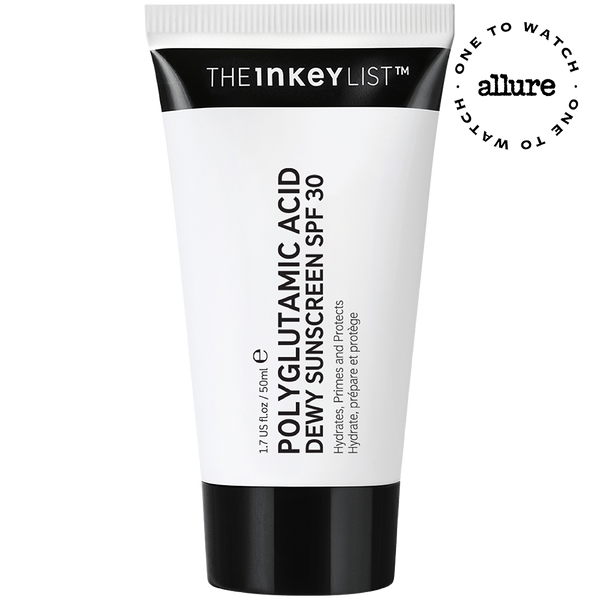
When shopping, a broad-spectrum SPF at minimum SPF 30 that contains at least one or two of these ingredients - ideally PGA, Glycerin, and Squalane in combination - will perform fundamentally differently on dry skin than a standard lightweight formula. Our Dewy Sunscreen SPF 30 (£15) was formulated specifically around this principle, with an 8% combined hydration trio of Polyglutamic Acid, Glycerin, and Squalane working alongside its broad-spectrum UV filters. For a broader understanding of SPF filter types and protection ratings, our complete SPF guidecovers the science in full.
Knowing what to look for is only half the equation - understanding what to avoid in a sunscreen is equally important for dry skin.
What to Avoid in Sunscreen If You Have Dry Skin
Ingredient literacy - the ability to read an INCI (International Nomenclature of Cosmetic Ingredients) list and understand what it contains - is the most powerful tool a dry skin shopper has. The front of a product can claim almost anything. The ingredient list tells you the truth.
There are several formulation types and specific ingredients that consistently cause problems for dry skin. Learning to recognise them takes about five minutes, and it will save you from buying products that make your skin feel worse rather than better.
High concentrations of drying alcohols
Alcohol in skincare is a broad category, and the distinction matters enormously. Drying alcohols - ethanol, SD alcohol, denatured alcohol - are used in SPF formulas to make them feel lighter, dry down faster, and absorb more quickly. On oily skin, this is often a desirable property. On dry skin, it is actively damaging: these alcohols strip the skin’s natural lipids and increase TEWL, leaving dry skin more exposed and more parched after every application.
The important clarification here is that not all alcohols are the same. Fatty alcohols - cetearyl alcohol, cetyl alcohol, stearyl alcohol - are emollients, not drying agents. They are perfectly appropriate for dry skin and are frequently found in moisturising creams and lotions. The ones to watch for on the label are the single-name alcohols: ethanol, alcohol denat., or SD alcohol listed high in the ingredient order.
Gel and water-gel textures designed for oily skin
If a sunscreen is marketed as ultra-light, oil-free, pore-minimising, or mattifying, it is almost certainly not designed for dry skin. These textures are engineered to minimise any sensory richness - which means they typically contain no emollient support and rely on alcohol or silicones to achieve their fast-drying, weightless feel. On dry skin, they feel tight immediately after application and can leave the skin looking dull by midday. Cream or lotion textures are a far better match.
Fragrance and parfum
Fragrance is one of the most common causes of skin sensitivity and irritation across all skin types - but it is particularly problematic for dry skin, where the compromised barrier offers less protection against reactive ingredients. Fragrance has no functional skincare benefit: it makes a product smell pleasant, and nothing else. Look for fragrance-free explicitly on the label - and note that unscented is not the same thing, as some unscented products still contain masking fragrances.
Silicone-heavy formulas without humectants
Silicones - dimethicone and its variants - are not inherently problematic for dry skin. They create a smooth, even texture and can help a formula spread easily. The issue arises when silicones are the primary non-filter ingredient in a formula without accompanying humectants or emollients. In that case, you get a cosmetically pleasing application experience and a smooth finish, but no meaningful moisture support. Some dry skin types find these formulas leave skin feeling increasingly tight as the day progresses. The solution is not to avoid silicones - it is to check that they appear alongside glycerin, PGA, or squalane in the formula.
High-alcohol spray SPFs
Alcohol-based aerosol or spray sunscreens are predominantly designed for body or sports use, where fast application over large areas is the priority. The alcohol levels in these formulas are almost always incompatible with dry facial skin. If you use a spray SPF on your face, look for a water-based, alcohol-free formulation specifically designed for facial use - and avoid applying body-use spray SPFs to the face regardless of the SPF rating.
As a quick reference, here is what to watch out for and what to look for instead:
- Ethanol / SD Alcohol (high concentration) - strips lipids and increases moisture loss. Look for fatty alcohols such as cetearyl or cetyl alcohol, which are emollients, not drying agents.
- Gel and water-gel textures (oil-free, mattifying) - designed for oily skin and drying on dry skin. Look for cream or lotion textures with humectants.
- Fragrance / Parfum - irritates compromised dry skin barriers with no skincare benefit. Look for explicitly fragrance-free formulations.
- Silicones without humectants - surface smoothing only, with no real moisture contribution. Look for silicones paired alongside glycerin, PGA, or HA.
- High-alcohol spray SPFs - highly dehydrating on contact. Look for cream-based SPFs with moisturising actives instead.
The British Association of Dermatologists provides clear guidance on sunscreen formulation and safety - a useful reference point when you want credible, clinical context for ingredient decisions. And if fragrance sensitivity or barrier compromise is a concern alongside dryness, our guide to sunscreen for sensitive skin covers overlapping considerations that may also be relevant for you.
Our Dewy Sunscreen SPF 30 (£15) avoids all of the red-flag formulation types listed above: it is fragrance-free, non-comedogenic, and uses a lightweight cream texture with its 8% hydration trio rather than a gel base or high-alcohol carrier.
With a clear picture of what to look for and what to avoid, the next step is understanding exactly how to layer your moisturiser and SPF for maximum benefit on dry skin.
How to Layer Moisturiser and SPF Correctly for Dry Skin
One of the most common mistakes in AM skincare - not just for dry skin, but across all skin types - is applying SPF in the wrong order. This single error can compromise both the protection you get from your sunscreen and the hydration you get from the rest of your routine. Getting the order right is non-negotiable.
The golden rule: SPF is always the final step.
Moisturiser goes before SPF. Always. Applying SPF first and moisturiser on top does two things, both of them bad: it dilutes the UV filters in the sunscreen (reducing the actual protection you receive), and it prevents the hydrating actives in your SPF from sitting at the skin’s surface where they can contribute to moisture levels throughout the day. SPF applied over a hydrated base also feels more comfortable, spreads more evenly, and is far less likely to create that patchy, uneven finish that dry skin is prone to.
Here is the complete layering sequence for dry skin at a glance:
- Hydrating serum (HA or PGA) applied to slightly damp skin - saturates the skin with moisture before any occlusive layers are applied.
- Barrier serum (optional, for very dry or compromised skin) - ceramides and Ectoin reinforce and protect the barrier before moisturiser seals everything in.
- Moisturiser - locks in serums and adds the lipid and emollient nourishment dry skin needs.
- SPF as the final AM step - broad-spectrum UV protection applied on top of fully hydrated skin.
Here is each step explained in full.
Step 1 - Hydrating serum (applied to slightly damp skin)
The most effective way to apply a humectant serum - whether that is the Hyaluronic Acid Serum (£9) or the Polyglutamic Acid Serum (£15) - is onto skin that still has a small amount of water on its surface. This is not soaking wet: a light mist of water or applying the serum within 30 seconds of patting your face dry is enough. Humectants work by attracting water; the presence of water on the skin surface dramatically improves their ability to bind moisture into the skin rather than drawing it from deeper layers.
Allow this serum to absorb for around 30-60 seconds before moving on.
Step 2 - Barrier serum (optional, particularly for very dry or compromised skin)
For skin that is chronically dry, frequently reactive, or showing signs of barrier damage - persistent redness, stinging when products are applied, visible flaking that does not respond to basic moisturisation - adding a barrier-focused serum between your hydrating serum and moisturiser provides meaningful extra support. The Ectoin Hydro-Barrier Serum(£15) combines Ectoin with ceramides to reinforce barrier integrity and reduce TEWL before the rest of your routine builds on top.
Step 3 - Moisturiser
Moisturiser does two things that serums alone cannot: it seals in the hydration delivered by the previous serum step, and it provides the lipid and emollient support that dry skin needs. For a dry skin type, a ceramide-rich moisturiser is ideal. The Bio-Active Ceramide Moisturiser (£19) delivers both occlusive and emollient action, creating the hydrated, smoothed surface that makes the SPF step comfortable and effective.
Allow your moisturiser to absorb for 30-60 seconds before applying SPF.
Step 4 - SPF (the final AM step, without exception)
Apply your SPF as a distinct final step - not mixed with foundation, not layered under a moisturiser. For dry skin, press and pat the formula into the skin rather than rubbing. This technique is gentler, reduces the friction that can disturb underlying layers, and results in more even coverage. After applying SPF, wait 2-3 minutes before applying makeup: this brief window allows the SPF to settle and ensures your foundation does not disrupt the UV filter layer. Our Dewy Sunscreen SPF 30 (£15) is designed specifically for this final step - its cream texture sits easily on top of a moisturised base without pilling or balling.
Reapplication tip for dry skin
Reapplying SPF over makeup is one of the more practical challenges of daily SPF use. For dry skin, the best approach is a slightly damp beauty blender - dab (do not press hard or rub) SPF on top of your makeup. This ensures coverage without disturbing your base, and the dampness prevents the SPF from sitting heavily on top of dry skin. For more detailed guidance on SPF quantities and reapplication methods, the SPF guide goes into full detail.
A note on SPF as moisturiser
Some people ask whether a hydrating SPF can replace their moisturiser entirely. For dry skin specifically, the answer is usually no - at least not without a serum underneath. Even a well-formulated SPF with humectant and emollient ingredients is primarily a UV protection product. The quantities of hydrating actives, while meaningful, are not typically at the same concentration as a dedicated moisturiser. Using both - moisturiser as the sealing step, SPF as the protective final layer - gives dry skin the best of both functions.
Now that layering is clear, let us put this all together into a complete AM routine for dry skin, from cleanse to SPF.
Your Complete AM Routine for Dry Skin With SPF as the Final Step
A good routine for dry skin in the morning is not about using more products. It is about using the right products in the right order - each step building on the last to create the hydrated, protected canvas that dry skin needs to look and feel its best throughout the day.
Here is the complete AM routine for dry skin, step by step:
- AM Cleanse - Gentle, non-stripping cleanser
- Hydrating Serum - Humectant serum applied to damp skin
- Barrier Serum (optional) - Ceramide and Ectoin support for very dry or compromised skin
- Eye Treatment (optional) - Targeted hydration for the eye area
- Moisturiser - Lipid and emollient support
- SPF - the final step - Broad-spectrum UV protection
Step 1 - Gentle AM Cleanse
Morning cleansing for dry skin should be brief and gentle. Overnight, skin does not accumulate the same level of product, oil, and environmental debris as during the day - so a heavy-duty cleanse at this stage is unnecessary and can strip the skin’s overnight recovery work. A single, gentle cleanse is all that is needed. The Oat Cleansing Balm (£15) is ideal for dry skin in the morning: it melts quickly into skin, removes residue without stripping, and leaves a comfortable, non-tight finish.
The key thing to avoid: foaming cleansers with sulphates strip the skin’s lipid barrier aggressively. They are popular because they create a satisfying lather, but they actively worsen dryness. Keep morning cleansing gentle and quick.
INKEY Tip: Double cleansing is a PM technique, not an AM one. In the morning, one gentle cleanse is sufficient.
Step 2 - Hydrating Serum on Damp Skin
Apply your humectant serum immediately after patting (not rubbing) your skin with a towel - leaving a small amount of moisture on the surface. This amplifies the serum’s hydrating effect considerably. The Hyaluronic Acid Serum (£9) works at the skin’s surface to deliver immediate plumping. The Polyglutamic Acid Serum (£15) provides deeper, longer-lasting moisture binding. Both are effective; using one is sufficient.
Step 3 - Barrier Serum (Optional)
For dry skin that is reactive, easily irritated, or showing signs of barrier compromise, the Ectoin Hydro-Barrier Serum(£15) adds a targeted layer of barrier support between your hydrating serum and moisturiser. It is not an essential step for every dry skin routine - but for very dry or sensitive skin, it can be the difference between a routine that calms the skin and one that still feels insufficient.
Step 4 - Eye Treatment (Optional)
The eye area is often the first place dry skin shows its most visible symptoms - fine lines, texture, a creased or crepey appearance. A targeted eye product at this stage addresses the specific thinness and sensitivity of the skin around the eyes before the moisturiser and SPF steps seal everything in.
Step 5 - Moisturiser
This is a non-negotiable step for dry skin. The Bio-Active Ceramide Moisturiser (£19) provides lipid and emollient nourishment through ceramide-rich ingredients that reinforce the barrier and lock in the serums applied in the previous steps. Apply to the full face and neck, allow 30-60 seconds to absorb, then move on to SPF.
INKEY Tip: Do not skip moisturiser in favour of a hydrating SPF alone. Even the most moisturising SPF formula is not a substitute for a dedicated moisturising step - especially for dry skin.
Step 6 - SPF (Always the Final Step)
Our Dewy Sunscreen SPF 30 (£15) completes the routine. Applied to a fully hydrated, moisturised base, it delivers broad-spectrum UVA and UVB protection alongside its 8% PGA, Glycerin, and Squalane hydration trio. It is clinically proven to deliver instant hydration - which means your SPF step is contributing meaningfully to your skin’s overall moisture levels throughout the day, not just sitting on top as a passive barrier.
SPF is a year-round step. If you are not already wearing it every day regardless of season or weather, the guide to SPF all year round covers why UVA protection matters even in winter. You can also build your routine using the bundle builder to get everything in one go and save in the process.
A note on SPF removal at the end of the day
The final step of any day that involves SPF is proper SPF removal. This is not optional: SPF that is not fully removed contributes to product build-up and can exacerbate congestion and sensitivity. At the end of the day, use the Oat Cleansing Balm (£15) as the first cleanse step - it melts makeup and SPF thoroughly in around 30 seconds and is specifically suitable for dry and sensitive skin. Follow with a water-based second cleanser to clear the remaining residue. The Oat Cleansing Balm can also be used as a 10-minute mask for dry skin - leave it on before removing for an extra layer of nourishment, particularly restorative after a day of UV exposure.
With the full routine mapped out, the final section addresses the most common questions people ask about finding and using the best sunscreen for dry skin.
Your Questions About Sunscreen for Dry Skin, Answered
What is the best sunscreen for dry skin?
The best sunscreen for dry skin is a broad-spectrum SPF 30 or higher formulated with humectant and emollient ingredients such as Polyglutamic Acid, Glycerin, Squalane, or Hyaluronic Acid. Look for cream or lotion textures rather than gels, and avoid high-alcohol formulas. Our Dewy Sunscreen SPF 30 (£15) was formulated specifically for dry skin needs, with an 8% hydration trio of Polyglutamic Acid, Glycerin, and Squalane working alongside its broad-spectrum UV filters.
Can sunscreen make dry skin worse?
Yes - the wrong sunscreen can worsen dryness significantly. Lightweight gel formulas, high-alcohol bases, and sunscreens designed for oily or mattifying results often strip or actively dehydrate dry skin on contact. The solution is not to stop wearing SPF - it is to switch to a formula with hydrating ingredients and a cream or lotion texture. The sunscreen is not the problem; the formulation is.
Should I use moisturiser before or after sunscreen?
Moisturiser always goes before sunscreen. SPF is the final step in your AM routine without exception. Applying moisturiser first creates a hydrated, nourished base; your SPF then sits on top as the protective final layer. Applying SPF before moisturiser dilutes the UV filters and reduces the effectiveness of your sun protection - as well as preventing both products from performing their functions properly.
Is SPF 30 enough for dry skin?
SPF 30 blocks approximately 97% of UVB rays and is the minimum dermatologist-recommended level for daily protection. For the purposes of everyday use - commuting, office windows, brief outdoor exposure - SPF 30 with the right hydrating formulation is highly effective for dry skin. For extended time outdoors or high UV environments, SPF 50 provides additional protection. That said, formula quality matters as much as SPF number: a well-formulated SPF 30 with hydrating actives will serve dry skin better than a poorly formulated SPF 50 that causes discomfort. For more on SPF ratings, see our complete SPF guide.
What ingredients should I look for in sunscreen for dry skin?
The most impactful hydrating ingredients to look for are Polyglutamic Acid (PGA), Glycerin, Squalane, and Hyaluronic Acid. PGA and Glycerin are humectants that attract and bind moisture to the skin surface. Squalane is an emollient that mimics the skin’s natural lipids and strengthens the barrier. Hyaluronic Acid delivers immediate surface plumping. Ceramides are a valuable bonus for very dry or compromised skin. Finding one or more of these ingredients alongside a broad-spectrum UV filter in a cream-texture formula is the clearest signal that a sunscreen will work for, rather than against, dry skin.
Is mineral or chemical sunscreen better for dry skin?
Either can work for dry skin - what matters far more than the filter type is the overall formulation. A well-formulated chemical sunscreen with humectant and emollient ingredients can be highly effective and comfortable for dry skin. Mineral formulas tend to have thicker textures that some dry skin types find easier to layer, but they can also leave a white cast if not formulated carefully. The most important credentials to look for regardless of filter type are: fragrance-free, dermatologically tested, and a hydrating ingredient list. If you have oily or combination skin rather than dry skin, sunscreen for oily and blemish-prone skin covers what to look for in that context.
Can I use sunscreen under makeup with dry skin?
Yes - and a well-chosen hydrating SPF actually makes a better makeup base than many dedicated primers for dry skin. A dewy or satin-finish SPF with humectant ingredients creates a plumped, smooth surface that foundation adheres to well. Apply SPF as the final skincare step, allow 2-3 minutes for it to absorb and settle, then apply makeup. Avoid matte-finish SPFs for this purpose - they are designed to reduce shine, which means they actively work against the natural-looking hydration that dry skin needs.
How do I reapply sunscreen over makeup without disturbing dry skin?
Use a slightly damp beauty blender and gently dab SPF on top of your makeup rather than rubbing or pressing hard. This distributes coverage without disturbing the base beneath. Apply in small amounts, building coverage gradually, and allow each application to set before adding more. This technique works particularly well for dry skin because the moisture in the blender prevents the SPF from sitting heavily or feeling tacky on top of already-dry skin.
Which sunscreen is best for dry, sensitive skin?
Look for a sunscreen that is fragrance-free, paraben-free, dermatologically tested, and non-comedogenic, with hydrating actives such as Glycerin, Squalane, and Hyaluronic Acid. High-alcohol formulas and anything with added fragrance or synthetic dyes should be avoided - both are among the most common causes of sensitivity reactions on a compromised dry skin barrier. Our Dewy Sunscreen SPF 30 (£15) meets all of these criteria and is suitable for sensitive skin as well as dry skin. For more on the overlap between these two skin concerns, the guide to sunscreen for sensitive skin is worth reading alongside this one.
Do I need to wear SPF in winter if I have dry skin?
Yes - without exception. UVA rays are present year-round, are not blocked by cloud cover, and penetrate glass windows. Daily UV exposure in winter months is cumulative: the damage it causes to the skin barrier builds over time even when you cannot see or feel it happening. For dry skin in particular, this matters enormously - because cumulative UV exposure degrades the very barrier structures that dry skin already struggles to maintain. Wearing SPF every day in winter protects the barrier from UV-driven damage and helps prevent the worsening of dryness that UV exposure causes over time. Cancer Research UK provides clear guidance on year-round UV risk and sun safety.
Dry Skin and Sunscreen: The Final Word
Dry skin and sunscreen have never been incompatible. They became associated with conflict because most sunscreens were not designed with dry skin in mind - and the experience of using the wrong formula convinced too many people that SPF and dryness simply do not coexist comfortably. They do. The formula is what changes everything.
With the ingredient knowledge to shop effectively - looking for Polyglutamic Acid, Glycerin, Squalane, and Hyaluronic Acid; identifying and avoiding high-alcohol formulas, gel textures, and fragranced SPFs - finding the best sunscreen for dry skin becomes a much simpler task. And with the right layering sequence in place - hydrating serum on damp skin, barrier support, moisturiser, then SPF as the final step - every product in the routine gets to do its job properly.
What is worth holding onto is this: daily SPF use is the single most impactful step for protecting skin from UV-driven barrier damage. For dry skin, that damage is not just an aesthetic concern - it actively worsens the underlying condition. Consistent protection, paired with a formula that actively supports hydration, is both the preventative measure and the treatment. Our Dewy Sunscreen SPF 30 (£15) was built for exactly this purpose - broad-spectrum protection with an 8% hydration trio that works with dry skin, not against it.
Shop the Routine
Ready to try a sunscreen your dry skin will actually thank you for?
Shop the Dewy Sunscreen SPF 30 - £15
Build your complete dry skin AM routine and save up to 20%.
Build Your Routine
Not sure where to start? Take our 2-minute Skincare Quiz and we will build a personalised routine for your skin type.
Take the Skincare Quiz
Want to go deeper on SPF? Read more from our sun protection guides: