



Succinic Acid for Skin: What It Does and How to Use It
Not an AHA, not an exfoliant. Here is what succinic acid actually does for blemish prone skin, and how to use it.
Author
askINKEY skincare advisor
Published
23 August, 2026
Time to read
10 minutes
Succinic acid is a skincare ingredient that helps calm the look of individual blemishes, balance excess oil and limit the bacteria linked to breakouts. Despite the name, it is not an exfoliating acid, and it works very differently to the acids most people already know.
Acids can be confusing, so here is what this page covers: what succinic acid actually is, what it does for skin, whether it counts as an AHA, how it compares to salicylic acid, what the viral red succinic acid products actually are, how it works alongside a pimple patch, and exactly how to fit it into your routine. Plus eleven of the questions we get asked most often.
What is Succinic Acid?
Succinic acid is a naturally occurring substance found in plants and in animal tissue. In skincare, it is typically derived from amber or from sugar cane. It has been studied for its anti-inflammatory, antimicrobial and antioxidant properties, which is a useful combination when you are dealing with a blemish, because a blemish involves inflammation, bacteria and oil all at once.
One of the more genuinely interesting things about succinic acid is its molecular size. It is a very small molecule, smaller than many of the actives you will find in a targeted product. Small molecule size matters because it influences how easily an ingredient can get where it needs to go rather than sitting on the surface. It is part of why succinic acid works well in a targeted format that you press onto one spot, rather than spreading across the whole face.
Is succinic acid an AHA?
No. Succinic acid is not an AHA, and it is not a BHA either. It is a dicarboxylic acid, which means it works differently to exfoliating acids. It does not slough off dead skin cells. Instead it helps calm the look of redness, reduce excess oil and limit the bacteria linked to breakouts, which is why it suits blemish prone skin without the sting of an exfoliant.
To be completely clear on the follow-up question: succinic acid is not an exfoliant. If you are specifically looking for an acid that exfoliates, that is a different category of ingredient with a different job.
That covers what succinic acid is not. Here is what it actually does.
What are the Benefits of Succinic Acid?
Succinic acid earns its place in a routine through three properties working together, rather than through one dramatic effect.
It helps calm the look of redness. Its anti-inflammatory properties mean it is well suited to the angry, inflamed-looking stage of a blemish, when the surrounding skin looks irritated and sore.
It helps limit blemish causing bacteria. Its antimicrobial properties target one of the underlying contributors to breakouts, rather than only addressing how a spot looks.
It offers antioxidant support. Antioxidants help defend skin against environmental stressors. If antioxidant protection is your priority, our 15% Vitamin C and EGF Serum is formulated specifically for that job.
It is also hydrating and soothing rather than stripping, which is not something you can say about every blemish-targeting ingredient. Many actives in this space leave skin tight and flaky. Succinic acid does not work by drying skin out. For an added hydration layer underneath, our Hyaluronic Acid Serum is a straightforward pairing.
Is succinic acid good for sensitive skin?
Generally, it tends to be better tolerated than acids that work by resurfacing the skin. Because succinic acid is not an exfoliant, it is not removing layers of dead skin cells, and that is usually where the stinging, tightness and sensitivity associated with acids comes from.
That said, better tolerated is not the same as guaranteed. Skin is individual. Patch test first, introduce it slowly, and if your skin feels uncomfortable, reduce how often you use it.
Does succinic acid help with marks left behind by spots?
Here is the honest answer. Succinic acid works on the blemish itself and the inflammation around it. It is not a pigmentation ingredient and we would not claim it fades marks that are already there.
What it can do is help address a spot at the point where marks are most likely to be created. A blemish that calms down sooner, and that you have not picked at, is less likely to leave something behind. Prevention is the realistic angle here, not correction. If existing marks are your main concern, our blemish scars collection is the more relevant starting point.
This is also the single strongest argument for keeping a pimple patch in the house, and we will come back to that properly further down.
Which naturally raises the question of how succinic acid compares to the blemish acid almost everyone has already tried.
Succinic Acid vs Salicylic Acid: What’s the Difference?
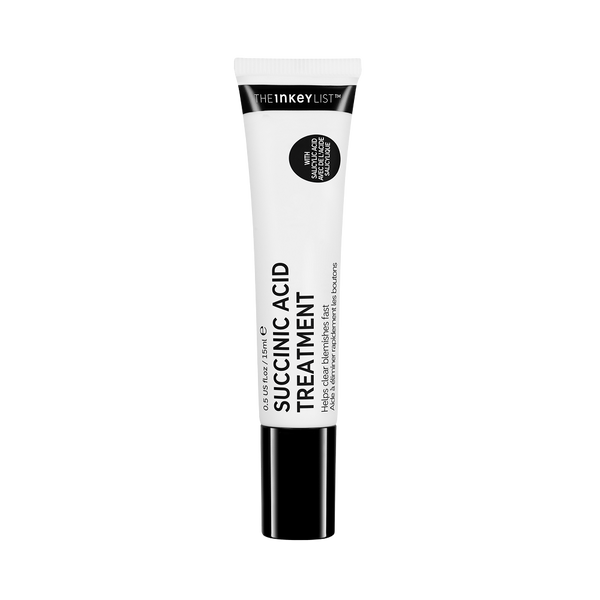
Succinic acid and salicylic acid do different jobs. Salicylic acid is a BHA that gets inside the pore and clears out the oil and debris blocking it. Succinic acid works on the surface and around the blemish, calming the look of redness and limiting blemish causing bacteria. You do not have to choose between them. INKEY’s Succinic Acid Treatmentcontains both, at 2% succinic acid and 1% salicylic acid, alongside 2% sulfur.
That combination is a deliberate formulation decision rather than a case of stacking actives for the sake of it. Each one handles a different part of what is actually happening in a blemish:
- Sulfur absorbs excess oil. Oil is the starting condition for congestion. Sulfur helps mop it up.
- Salicylic acid unclogs. As a BHA, it is oil-soluble, so it can get down inside the pore and clear the blockage.
- Succinic acid calms. It works on the inflammation and the bacteria around the blemish, which is the part you can see in the mirror.
Oil, blockage, inflammation. Three contributors, three ingredients, one formula.
The two acids, side by side
Succinic acid is a dicarboxylic acid, so it is neither an AHA nor a BHA. It works by calming the look of redness, limiting blemish causing bacteria and helping balance oil, rather than by exfoliating. It suits the angry, inflamed-looking individual blemish, the kind you notice in the mirror and want to settle down. In our formula it sits in a non-drying, green-tinted cream that you press onto one spot, AM and PM, up to three times a day.
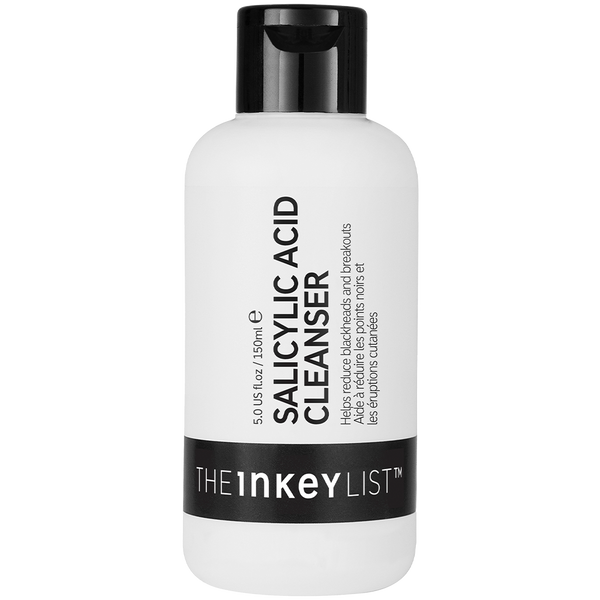
Salicylic acid is a beta hydroxy acid. It is oil-soluble, which means it can get down inside the pore and exfoliate there, clearing out the oil and debris causing the blockage. It suits congestion, blackheads and generally oily areas rather than one isolated blemish, and it is usually encountered either in a cleanse step or in a leave-on product. In our formula it is blended into the same treatment at 1%.
In short: salicylic acid works on the blockage, succinic acid works on the inflammation around it, and the reason both are in one tube is that a blemish is rarely just one of those things.
A question we get a lot is whether succinic acid and salicylic acid are safe to use together. In this formula, yes, because they are already formulated together and tested that way. Blending percentages is not something to improvise at home, which is precisely why they were combined at 2% and 1% rather than left for you to layer.
Succinic acid is the acid people are only now getting to know, which brings us to the version currently filling everyone’s feeds.
What is “Red Succinic Acid”?
Red succinic acid is not a different type of succinic acid. It is a marketing name used by a range of viral K-beauty products, where succinic acid is combined with other ingredients in a red-tinted formula. The succinic acid itself is the same ingredient. The colour comes from the formulation, not from a different or stronger version of the acid.
This is worth understanding beyond this one trend, because colour is a formulation choice, not a potency signal. Our own Succinic Acid Treatment is green, and that green comes from a chlorophyll-derived plant pigment. It tells you nothing about how strong the formula is. The percentages on the packaging do that.
None of this makes red-tinted formulas better or worse. It just means the colour is not the thing to judge them on.
Now for the part you actually came for.
How to Use Succinic Acid in Your Skincare Routine
Succinic Acid Treatment is designed for targeted use, not all-over application. Use it AM and PM, up to three times a day, on individual blemishes as they appear.
Pat it directly onto the spot with clean fingers. Do not rub it in across surrounding skin. Leave it around five minutes to dry down and it sits comfortably under makeup without pilling or flaking, which is what makes it wearable during the day rather than only overnight.
The formula is naturally green, from a chlorophyll-derived plant pigment. That is the ingredient showing, not a tint added for effect.
Where it goes in your routine:
- Cleanse. Start on clean, dry skin.
- Hydrate. Apply Hyaluronic Acid Serum across the face.
- Apply Succinic Acid Treatment. Press Succinic Acid Treatment onto individual spots only.
- Moisturise. Follow with your eye cream and moisturiser.
- SPF. Finish your morning routine with Dewy Sunscreen SPF 30.
Succinic Acid Treatment is £13 for 15ml.
Should you use a pimple patch as well?
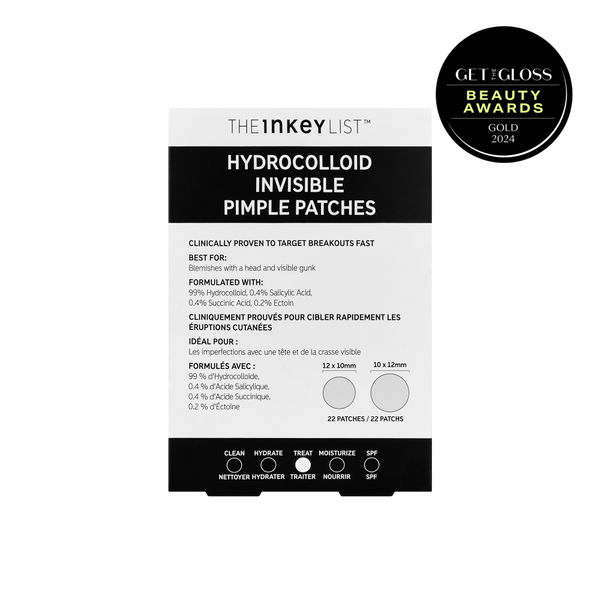
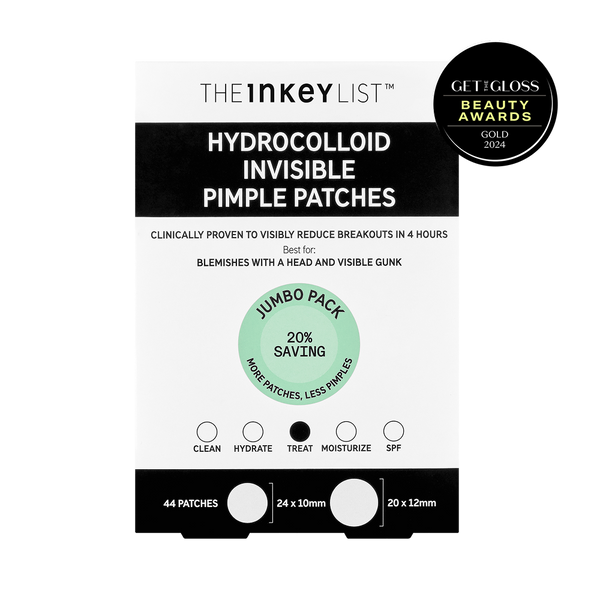
Yes, and we would genuinely encourage it. A pimple patch is one of the most useful and most underrated things you can keep in a bathroom cabinet if you have blemish prone skin, and it does something no leave-on product can. Ours are Hydrocolloid Invisible Pimple Patches, £9.00 for a pack of 22, in two sizes so you can match the patch to the spot rather than wearing something twice the size of the thing you are covering.
A hydrocolloid patch works in two ways at once. The hydrocolloid material draws fluid out of a blemish that has already come to a head, and the patch itself forms a physical barrier over the top. That barrier is the part people undervalue. It keeps the area clean, it stops makeup, hair, phone screens and pillowcases from sitting on an open or irritated spot, and, most usefully of all, it makes picking almost impossible.
That last point matters more than any ingredient in this article. Picking is one of the most common reasons a blemish leaves a mark behind long after the blemish itself has gone. A patch physically gets between your fingers and your face. We noted earlier that prevention is the realistic angle when it comes to marks, and covering a spot rather than picking it is the most effective preventative step most people can actually take.
Here is the part most people do not realise: our patches contain succinic acid too. Alongside the 99% hydrocolloid base, each patch carries 0.4% succinic acid, 0.4% salicylic acid and 0.2% ectoin, a hydrating ingredient that helps soothe blemish prone skin.
So this is the same ingredient you have been reading about, delivered a completely different way. The cream gives you a higher concentration you can apply anywhere, any time, several times a day. The patch gives you a lower concentration held against one spot, under an occlusive seal, for hours at a stretch while you sleep. Different format, different moment, same acid.
When to reach for a patch rather than the treatment. Patches are at their best on a blemish that has already surfaced and come to a head, and overnight, when you are asleep and not touching your face. Leave one on for at least four hours, or right through the night. They are also excellent on a day when you know you will be tempted to pick.
When to reach for the treatment rather than a patch. Succinic Acid Treatment is the better option on a blemish that is still under the surface, where there is nothing for a patch to draw out, and on the inflamed, red, sore stage where you want to calm the look of the area. It also disappears under makeup, which a patch does not.
Can you use both? Yes, but not stacked in the same moment, and this is the part most people get wrong. A hydrocolloid patch needs clean, dry, completely product-free skin to stick properly. Apply a patch over a freshly applied cream and two things happen: the patch will not adhere, and it will slide off within the hour taking your treatment with it.
Use them in sequence instead:
- Apply a Hydrocolloid Invisible Pimple Patch overnight on a spot that has come to a head, on clean dry skin with nothing underneath it.
- Remove it in the morning, cleanse, and let skin dry fully.
- Apply Succinic Acid Treatment to the area during the day, where it will sit invisibly under makeup.
Or simply run them on alternate nights. Neither approach demands anything complicated. The rule to remember is only that the patch goes on bare skin, always.
If you are building a wider routine rather than reaching for one product, our blemishes and breakouts collection groups everything relevant in one place. And if you are not sure what your skin is actually dealing with, Breakout Analyser is a useful next step.
Below are the questions we get asked most.
The Short Version
Succinic acid is not an exfoliating acid, and it was never meant to be one. It works on individual blemishes by calming the look of redness, helping balance excess oil and limiting blemish causing bacteria. And it works alongside salicylic acid rather than instead of it, which is exactly why both sit in the same formula.
Pair it with a pimple patch and you have covered both halves of the problem. The treatment calms the look of the blemish and goes on under makeup during the day. The patch covers the spot overnight and keeps your fingers away from it, which is the single most useful thing you can do to stop a blemish leaving a mark behind. Patch on bare skin, treatment during the day, and you rarely need anything more complicated.
Ready to try it? Succinic Acid Treatment is £13 for 15ml, and our Hydrocolloid Invisible Pimple Patches are £9.00 for a pack of 22. Not sure if either is right for your skin? Ask askINKEY and we will point you in the right direction.
Frequently Asked Questions
Got a question?
Our askINKEY team are a friendly bunch of skincare experts with deep product knowledge and zero judgement. Whether you're an ingredient obsessive or just starting out, we'll make it make sense. No question too big. No question too small. We Give A Care, Every Day.


